
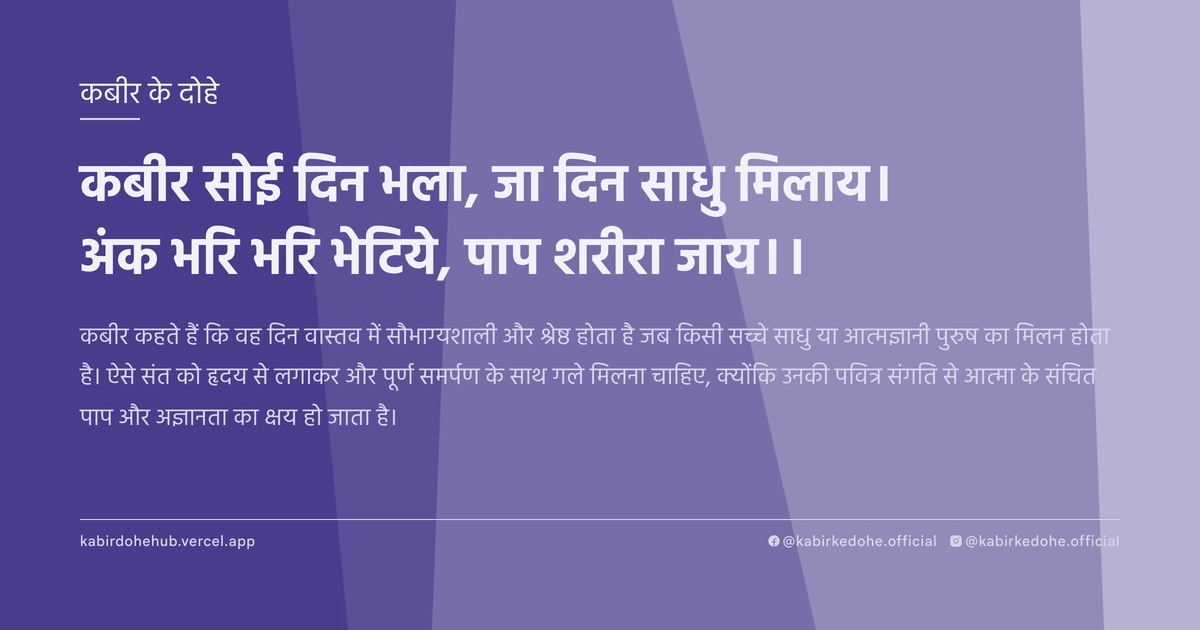
कबीर सोई दिन भला, जा दिन साधु मिलाय।
अंक भरि भरि भेटिये, पाप शरीरा जाय।।
Kabir soi din bhala, ja din sadhu milay. Ank bhari bhari bhetiye, paap sharira jaaye.
इस पृष्ठ पर इस कबीर दोहे का अर्थ (meaning), हिंदी व्याख्या और अंग्रेज़ी अनुवाद, दार्शनिक विश्लेषण और व्यावहारिक जीवन सीख दी गई है। यह दोहा सत्संग (Satsang) विषय से जुड़ा है — Kabir doha meaning and explanation in Hindi and English.
अर्थ (Meaning):
कबीर कहते हैं कि वह दिन वास्तव में सौभाग्यशाली और श्रेष्ठ होता है जब किसी सच्चे साधु या आत्मज्ञानी पुरुष का मिलन होता है। ऐसे संत को हृदय से लगाकर और पूर्ण समर्पण के साथ गले मिलना चाहिए, क्योंकि उनकी पवित्र संगति से आत्मा के संचित पाप और अज्ञानता का क्षय हो जाता है।
Kabir asserts that the truly auspicious day is the one when one encounters a genuine Sadhu or an enlightened soul. He urges the seeker to embrace such a saint with open arms and total devotion, for the mere presence and association with a realized being dissolve the accumulated sins and spiritual impurities of the physical existence.
व्याख्या (Interpretation):
शाब्दिक अर्थ में यह दोहा एक संत के दर्शन की खुशी को दर्शाता है, परंतु इसका गहरा आध्यात्मिक अर्थ 'साधु' को एक बाहरी व्यक्ति के बजाय 'शुद्ध चेतना' के रूप में देखने में है। यहाँ 'साधु' वह है जिसने अपनी इंद्रियों को जीत लिया है और ब्रह्म में लीन है। 'अंक भरि भरि' का अर्थ केवल शारीरिक आलिंगन नहीं, बल्कि अहंकार का पूर्ण विसर्जन और समर्पण है। यह निर्गुण भक्ति का मार्ग है जहाँ बाहरी कर्मकांडों के बजाय आंतरिक शुद्धि पर बल दिया गया है। जब एक अज्ञानी व्यक्ति एक आत्मज्ञानी के संपर्क में आता है, तो माया का पर्दा फटने लगता है। यह मिलन वास्तव में आत्मा का परमात्मा से मिलन का पूर्वाभास है। इस प्रकार, पापों का जाना वास्तव में अज्ञान (Avidya) का विनाश है, जिससे द्वैत समाप्त होता है और अद्वैत की अनुभूति होती है।
Literally, this couplet celebrates the joy of meeting a saint, but its deeper metaphysical meaning views the 'Sadhu' not as a mere person, but as the embodiment of Pure Consciousness. The Sadhu represents one who has transcended the ego and merged with the Formless (Nirgun). 'Embracing them fully' symbolizes the total surrender of the ego and the merging of the individual will into the divine will. In the context of Nirgun Bhakti, this is not about ritualistic worship but about the transmission of grace (Shaktipat) through association. The 'removal of sins' is a metaphor for the dissolution of Maya (illusion) and the erasure of the false identity. It highlights the paradox that while the path to liberation is internal, the catalyst is often an external mirror—the Guru—who reflects the seeker's own inherent divinity. Thus, the meeting is the collapse of the duality between the seeker and the sought.
दार्शनिक विश्लेषण (Philosophical Analysis):
कबीर का यह दोहा उस युग की प्रतिक्रिया है जहाँ धर्म केवल बाहरी आडंबरों, जातिगत श्रेष्ठता और कठोर कर्मकांडों में सिमट गया था। कबीर ने 'साधु' की परिभाषा को बदल दिया; उनके लिए साधु वह नहीं था जिसने गेरुआ वस्त्र पहने हों, बल्कि वह था जिसका आचरण सत्य हो। यह दृष्टिकोण सूफी मत के 'पीर' और अद्वैत वेदांत के 'गुरु' के सिद्धांत से मेल खाता है, जहाँ गुरु केवल एक मार्गदर्शक नहीं, बल्कि वह द्वार है जिससे होकर साधक शून्य में प्रवेश करता है।
यहाँ 'पाप' शब्द का प्रयोग नैतिक अपराधों के लिए नहीं, बल्कि उस 'अविद्या' के लिए किया गया है जो आत्मा को शरीर के साथ जोड़ देती है। जब हम किसी आत्मज्ञानी के संपर्क में आते हैं, तो उनकी ऊर्जा हमारे भीतर के सोए हुए बोध को जगाती है। यह मनोवैज्ञानिक रूपांतरण की प्रक्रिया है जहाँ बाहरी प्रभाव आंतरिक परिवर्तन का कारण बनता है। कबीर यहाँ यह स्पष्ट करते हैं कि ज्ञान पुस्तकों से नहीं, बल्कि जीवित अनुभव (Living Experience) से प्राप्त होता है।
यह दोहा जाति और वर्ग के भेदभाव को पूरी तरह नकारता है। एक साधु की संगत किसी भी सामाजिक स्थिति वाले व्यक्ति के लिए उपलब्ध है, बशर्ते उसमें समर्पण का भाव हो। यह सामाजिक समरसता का एक शक्तिशाली उपकरण है, जो यह सिखाता है कि आध्यात्मिक श्रेष्ठता जन्म से नहीं, बल्कि बोध से आती है।
सूफीवाद के 'फना' (अहंकार का विनाश) की अवधारणा यहाँ स्पष्ट है। जब साधक साधु को 'अंक भरि' (गले लगाकर) मिलता है, तो वह वास्तव में अपने छोटे 'मैं' को उस विराट 'मैं' में विलीन कर रहा होता है। यह मिलन द्वैतवाद (Duality) का अंत है।
अंततः, कबीर यह संदेश देते हैं कि मनुष्य का सबसे बड़ा दुर्भाग्य अज्ञानता है और सबसे बड़ा सौभाग्य एक ऐसे मार्गदर्शक का मिलना है जो उसे इस भ्रमजाल से बाहर निकाल सके। यह केवल एक सामाजिक मिलन नहीं, बल्कि एक आध्यात्मिक विस्फोट है जो साधक के जीवन की दिशा बदल देता है।
This Doha emerges from an era where religion had devolved into hollow rituals, caste hierarchies, and rigid dogma. Kabir redefines the 'Sadhu' not by the saffron robes they wear, but by the purity of their realization. This aligns with the Sufi concept of the 'Pir' and the Advaita Vedanta principle of the 'Guru'—the bridge between the finite self and the infinite Brahman. The Guru is not merely a teacher but a living portal to the Void.
The term 'Paap' (sin) here is not used in a moralistic or judicial sense, but as 'Avidya' (spiritual ignorance). Sin is the identification of the eternal Atman with the transient body. The association with a realized soul triggers a psychological and spiritual shift, where the vibration of the enlightened being awakens the dormant consciousness within the seeker. Kabir emphasizes that true knowledge is not found in scriptures (Shastras) but in the 'Living Word' and lived experience.
Furthermore, this teaching is a radical rejection of caste and social stratification. The grace of a Sadhu is accessible to all, regardless of birth, provided there is genuine surrender. This promotes a democratic spirituality where the only currency is sincerity, not social status. It challenges the monopoly of the priestly class over salvation.
There is a strong resonance with the Sufi concept of 'Fana' (annihilation of the ego). The act of 'embracing' the saint is a metaphor for the dissolution of the separate self into the Universal Self. It is the moment the drop realizes it is the ocean. The physical embrace is the outward sign of an inward merging.
Ultimately, Kabir posits that the greatest human tragedy is to live and die in ignorance, and the greatest blessing is the encounter with a mirror—the Guru—who reflects the seeker's own forgotten divinity. It is a call to move from the ritualistic periphery to the experiential center of existence.
मूल संदेश (Core Message):
- बाहरी आडंबरों को छोड़कर जीवित अनुभव की खोज करें।
- अहंकार का विसर्जन ही वास्तविक आध्यात्मिक उपलब्धि है।
- सच्चा गुरु वह है जो आपको आपके अपने स्वरूप से मिला दे।
- संगति का प्रभाव आत्मा के गहरे स्तरों को शुद्ध करता है।
- द्वैत का अंत ही दुखों का अंत है।
- Seek living experience over hollow ritualistic performances.
- The annihilation of the ego is the only true spiritual achievement.
- A true Guru is a mirror reflecting your own inherent divinity.
- Right association purifies the deepest layers of the soul.
- The end of duality is the end of all human suffering.
व्यावहारिक उदाहरण (Practical Example):
वाराणसी के एक पुराने घाट पर माधव नाम का एक वृद्ध नाविक रहता था। माधव का जीवन केवल नाव चलाने और लोगों को पार उतारने में बीता था, लेकिन उसका मन हमेशा एक गहरी बेचैनी से भरा रहता था। वह रोज हजारों लोगों को देखता, लेकिन उसे लगता कि वह सबके बीच रहकर भी अकेला है। वह धर्म के नाम पर होने वाले शोर-शराबे से दूर रहता था, क्योंकि उसे लगता था कि असली शांति कहीं और है।
एक दिन, एक साधारण से दिखने वाले संन्यासी उसकी नाव पर सवार हुए। उस संन्यासी के चेहरे पर एक ऐसी शांति थी जिसे माधव ने पहले कभी नहीं देखा था। संन्यासी ने कोई उपदेश नहीं दिया, बस चुपचाप गंगा की लहरों को देखते रहे। माधव ने उनसे पूछा, "महाराज, मैं जीवन भर लोगों को पार उतारता रहा, पर खुद इस बेचैनी के पार नहीं जा सका। क्या यह पाप है?"
संन्यासी मुस्कुराए और बोले, "पाप वह नहीं जो तुमने किया, बल्कि वह है जो तुम खुद को मान बैठे हो। तुम नाविक नहीं हो, तुम वह अनंत सागर हो जिसमें यह नाव तैर रही है।"
यह बात माधव के हृदय में बिजली की तरह कौंधी। उसने पहली बार महसूस किया कि उसकी सारी समस्याएँ उसकी अपनी पहचान (Identity) से जुड़ी थीं। उसने संन्यासी के चरणों में गिरकर उन्हें गले लगा लिया। वह आलिंगन केवल शारीरिक नहीं था, बल्कि माधव के भीतर के 'नाविक' के अहंकार का अंत था।
उस क्षण माधव को महसूस हुआ कि वह और वह संन्यासी अलग नहीं हैं। उसकी वर्षों की मानसिक घुटन, क्रोध और अधूरापन एक पल में गायब हो गया। उसे समझ आया कि जिसे वह 'पाप' समझ रहा था, वह केवल अज्ञानता का एक पर्दा था।
अगले कुछ दिनों तक माधव ने उस संन्यासी की सेवा की। उसने सीखा कि मौन में कितनी शक्ति होती है। उसने देखा कि संन्यासी हर व्यक्ति को एक समान दृष्टि से देखते थे, चाहे वह राजा हो या भिखारी।
माधव का व्यवहार पूरी तरह बदल गया। अब वह केवल पैसे के लिए नाव नहीं चलाता था, बल्कि हर यात्री में उस परमात्मा की झलक खोजने लगा। उसकी नाव अब केवल भौतिक पारुत्त का साधन नहीं, बल्कि करुणा का केंद्र बन गई।
गाँव के लोग हैरान थे कि जो माधव हमेशा चिड़चिड़ा रहता था, वह अब शांत और आनंदित कैसे हो गया। माधव ने उन्हें बताया कि उसे वह 'दिन' मिल गया था जिसका वह इंतजार कर रहा था।
उस एक मुलाकात ने माधव को बाहरी दुनिया की तलाश से हटाकर आंतरिक शांति की ओर मोड़ दिया। उसने जान लिया कि जब अहंकार मिटता है, तो केवल प्रेम शेष रहता है।
On an ancient ghat in Varanasi lived an elderly boatman named Madhav. Madhav had spent his entire life ferrying people across the river, yet his heart was plagued by a persistent, nameless restlessness. He watched thousands of pilgrims pass by daily, but felt an isolating void, sensing that the loud rituals of religion were merely noise masking a deeper silence.
One afternoon, a simple-looking monk boarded his boat. The monk possessed a radiance of peace that Madhav had never encountered. The monk did not preach; he simply gazed at the flowing Ganges in profound silence. Overwhelmed, Madhav asked, "Maharaj, I have spent my life helping others cross the river, but I cannot cross the river of my own unrest. Is this my sin?"
The monk smiled gently and replied, "Sin is not what you have done, but what you believe yourself to be. You are not the boatman; you are the infinite ocean in which this boat floats."
These words struck Madhav like a bolt of lightning. For the first time, he realized that his suffering was rooted in his narrow identification with his social role and his ego. In a surge of emotion, Madhav threw himself at the monk's feet and embraced him tightly. This embrace was not merely physical; it was the collapse of the 'boatman' identity.
In that moment of surrender, Madhav felt the boundary between himself and the monk dissolve. The years of accumulated frustration, anger, and a sense of inadequacy vanished instantly. He understood that what he had termed 'sin' was actually just the veil of ignorance (Maya).
For the next few days, Madhav served the monk, learning the power of silence and the art of witnessing. He observed how the monk viewed every human being with the same equanimity, whether they were a wealthy merchant or a starving beggar.
Madhav's demeanor underwent a total transformation. He no longer rowed the boat merely for coins; he began to see every passenger as a manifestation of the Divine. His boat ceased to be a mere commercial vessel and became a sanctuary of compassion.
The villagers were astonished. The once irritable and brooding Madhav was now a beacon of joy and serenity. When asked about the change, Madhav simply said he had finally found the 'day' he had been waiting for.
That single encounter shifted Madhav's gaze from the external horizon to the internal landscape. He realized that when the ego is annihilated, only unconditional love remains.
अभ्यास मार्गदर्शन (Practice Guidance):
- प्रतिदिन 20 मिनट मौन साधना करें, जहाँ आप किसी बाहरी व्यक्ति या आंतरिक गुरु की उपस्थिति को महसूस करें।
- स्व-अन्वेषण जर्नल: लिखें कि आपकी कौन सी 'पहचान' (जैसे पद, जाति, रिश्ता) आपको दूसरों से अलग करती है और उसे मानसिक रूप से विसर्जित करने का प्रयास करें।
- व्यवहारिक परिवर्तन: दिन में कम से कम एक बार किसी ऐसे व्यक्ति की निस्वार्थ सेवा करें जिसे समाज 'निम्न' मानता है, यह महसूस करते हुए कि वह भी वही ब्रह्म है।
- डायग्नोस्टिक चेकलिस्ट: क्या आप अभी भी दूसरों में दोष ढूंढ रहे हैं? क्या आप अपनी उपलब्धियों पर गर्व करते हैं? यदि हाँ, तो आप अभी भी 'अंक भरि' समर्पण से दूर हैं।
- Practice 20 minutes of daily silent meditation, focusing on the presence of an inner Guru or a higher consciousness within yourself.
- Self-Inquiry Journaling: List the identities (status, caste, role) that make you feel separate from others, and consciously practice dissolving them in your thoughts.
- Behavioral Shift: Perform a selfless act of service for someone marginalized by society, consciously recognizing the shared divinity (Brahman) between you both.
- Diagnostic Checklist: Are you still judging others? Do you feel a sense of superiority based on your knowledge? If yes, you are still operating from the ego and have not yet achieved true surrender.
चिंतन प्रश्न (Reflection Questions):
- क्या मैं वास्तव में एक गुरु की तलाश में हूँ, या मैं केवल अपनी मान्यताओं की पुष्टि करने वाला व्यक्ति चाहता हूँ?
- मेरे जीवन में 'पाप' का अर्थ क्या है—नैतिक गलती या स्वयं से अलगाव?
- यदि मेरी सारी सामाजिक पहचान छीन ली जाए, तो मेरे भीतर क्या बचेगा?
- मैं दूसरों को गले लगाने (स्वीकार करने) में कितना सक्षम हूँ, बिना किसी निर्णय के?
- क्या मेरा 'अहंकार' मुझे वास्तव में किसी आत्मज्ञानी के सामने झुकने से रोकता है?
- Am I truly seeking a Guru, or am I merely looking for someone to validate my existing biases?
- What does 'sin' mean in my life—a moral failing or a state of separation from the Self?
- If all my social identities were stripped away, what would remain of 'me'?
- How capable am I of embracing another human being without a shred of judgment?
- Does my ego prevent me from truly bowing before a realized soul, even when I recognize their wisdom?