
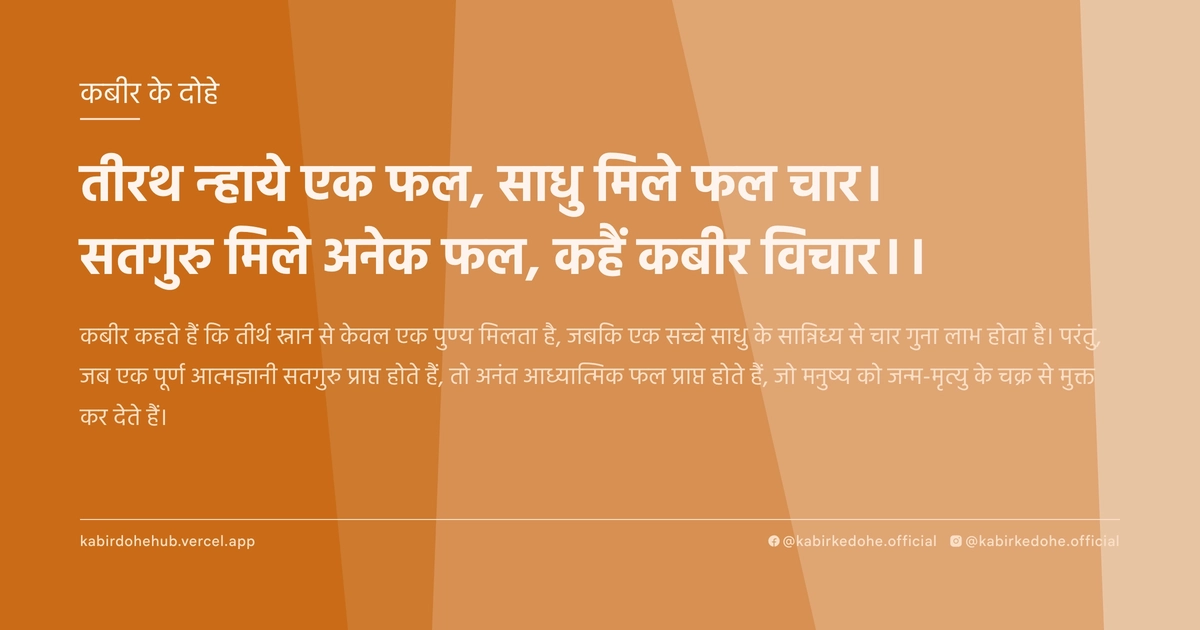
तीरथ न्हाये एक फल, साधु मिले फल चार।
सतगुरु मिले अनेक फल, कहैं कबीर विचार।।
Teerath nhaye ek phal, sadhu mile phal chaar. Satguru mile anek phal, kahein kabir vichaar.
इस पृष्ठ पर इस कबीर दोहे का अर्थ (meaning), हिंदी व्याख्या और अंग्रेज़ी अनुवाद, दार्शनिक विश्लेषण और व्यावहारिक जीवन सीख दी गई है। यह दोहा गुरु महत्व (The Guru's Importance) विषय से जुड़ा है — Kabir doha meaning and explanation in Hindi and English.
अर्थ (Meaning):
कबीर कहते हैं कि तीर्थ स्नान से केवल एक पुण्य मिलता है, जबकि एक सच्चे साधु के सान्निध्य से चार गुना लाभ होता है। परंतु, जब एक पूर्ण आत्मज्ञानी सतगुरु प्राप्त होते हैं, तो अनंत आध्यात्मिक फल प्राप्त होते हैं, जो मनुष्य को जन्म-मृत्यु के चक्र से मुक्त कर देते हैं।
Kabir explains that bathing at a pilgrimage site yields a single fruit of merit, while meeting a realized saint brings fourfold benefits. However, encountering a True Guru (Satguru) bestows infinite spiritual fruits, liberating the seeker from the endless cycle of birth and death through ultimate wisdom.
व्याख्या (Interpretation):
इस दोहे का शाब्दिक अर्थ बाहरी कर्मकांडों की तुलना आंतरिक ज्ञान से करना है। तीर्थ स्नान एक शारीरिक और मानसिक शुद्धि का प्रतीक है, जो क्षणिक शांति देता है। साधु का सान्निध्य मानसिक दिशा प्रदान करता है। लेकिन 'सतगुरु' यहाँ केवल एक व्यक्ति नहीं, बल्कि उस जागृत चेतना का प्रतीक हैं जो माया के पर्दे को हटाकर आत्मा और ब्रह्म की एकता (अद्वैत) का साक्षात्कार कराते हैं। यह निर्गुण भक्ति का सार है, जहाँ ईश्वर किसी मूर्ति या स्थान में नहीं, बल्कि स्वयं के भीतर स्थित है। सतगुरु वह कुंजी हैं जो अहंकार के ताले को खोलकर साधक को शून्य में विलीन कर देते हैं।
The literal meaning compares external rituals with internal realization. Pilgrimage represents physical and mental cleansing, offering fleeting peace. A saint provides mental direction. However, the 'Satguru' here is not merely a person but a symbol of awakened consciousness that removes the veil of Maya, revealing the non-duality of Atman and Brahman. This is the essence of Nirgun Bhakti, where the Divine resides not in idols or locations, but within the self. The Satguru is the key that unlocks the prison of ego, allowing the seeker to dissolve into the Infinite Void.
दार्शनिक विश्लेषण (Philosophical Analysis):
कबीर का यह विचार तत्कालीन समाज में व्याप्त अंधविश्वास और कर्मकांडीय धर्म के विरुद्ध एक सशक्त प्रहार है। उन्होंने देखा कि लोग मोक्ष की खोज में भौगोलिक स्थानों (तीर्थों) की यात्रा करते हैं, जबकि मोक्ष का मार्ग आंतरिक रूपांतरण से होकर गुजरता है। यह दृष्टिकोण अद्वैत वेदांत के उस सिद्धांत से मेल खाता है जहाँ 'अहं ब्रह्मास्मि' (मैं ही ब्रह्म हूँ) की अनुभूति ही अंतिम सत्य है।
सूफी मत के 'पीर' या 'मुर्शिद' की अवधारणा के समान, कबीर सतगुरु को अनिवार्य मानते हैं क्योंकि बिना मार्गदर्शक के अहंकार स्वयं को सत्य मान बैठता है। यहाँ 'फल' शब्द का प्रयोग भौतिक लाभ के लिए नहीं, बल्कि चेतना के स्तरों के उत्थान के लिए किया गया है। तीर्थ स्नान केवल 'पुण्य' देता है, जो कि एक सीमित अवधारणा है।
कबीर जाति और धर्म की सीमाओं को तोड़कर एक ऐसे सत्य की बात करते हैं जो सार्वभौमिक है। उनके लिए ritualism (कर्मकांड) एक मानसिक बंधन है जो मनुष्य को बाहरी दिखावे में उलझाए रखता है और उसे अपनी अंतरात्मा से दूर करता है।
मनोवैज्ञानिक स्तर पर, यह दोहा 'बाहरी समर्थन' (External Validation) से 'आंतरिक बोध' (Internal Realization) की ओर संक्रमण है। जब व्यक्ति यह समझ जाता है कि पवित्रता जल में नहीं, बल्कि विचार और आचरण में है, तब उसका अहंकार नष्ट होने लगता है।
अंततः, यह विश्लेषण स्पष्ट करता है कि कबीर के लिए ज्ञान का उच्चतम स्तर वह है जहाँ गुरु और शिष्य के बीच का द्वैत समाप्त हो जाए और केवल शुद्ध चेतना शेष रहे। यह शून्य की अवस्था ही वह 'अनेक फल' है जिसकी वे चर्चा कर रहे हैं।
Kabir's insight is a powerful critique of the superstitions and ritualistic religion prevalent in his era. He observed people traveling to geographical locations (pilgrimages) in search of salvation, whereas the path to liberation lies through internal transformation. This aligns with the Advaita Vedanta principle of 'Aham Brahmasmi' (I am Brahman), where the realization of oneness is the ultimate truth.
Similar to the Sufi concept of the 'Pir' or 'Murshid', Kabir views the Satguru as essential because, without a guide, the ego mistakenly perceives itself as the Truth. The term 'fruit' (phal) here does not refer to material gain but to the elevation of levels of consciousness. Pilgrimage offers only 'merit' (punya), which is a limited, transactional concept.
Kabir transcends the boundaries of caste and creed to speak of a universal truth. For him, ritualism is a mental shackle that entangles a person in external appearances, distancing them from their inner soul.
On a psychological level, this doha represents a transition from 'External Validation' to 'Internal Realization.' When an individual understands that purity resides not in water but in thought and conduct, the ego begins to dissolve.
Ultimately, this analysis clarifies that for Kabir, the highest state of knowledge is where the duality between the Guru and the disciple vanishes, leaving only pure consciousness. This state of 'Shunya' (Void) is the 'infinite fruit' he discusses.
मूल संदेश (Core Message):
- बाहरी कर्मकांड केवल मन को शांत करते हैं, मुक्त नहीं।
- सच्चा ज्ञान वह है जो अहंकार की परतों को नष्ट कर दे।
- गुरु वह नहीं जो रास्ता दिखाए, बल्कि वह है जो स्वयं रास्ता बन जाए।
- पवित्रता जल में नहीं, बल्कि विचार की शुद्धता में है।
- अद्वैत की अनुभूति ही जीवन का सर्वोच्च फल है।
- External rituals only calm the mind; they do not liberate it.
- True knowledge is that which annihilates the layers of ego.
- The Guru is not one who shows the path, but one who becomes the path.
- Purity resides not in water, but in the clarity of thought.
- The realization of non-duality is the supreme fruit of life.
व्यावहारिक उदाहरण (Practical Example):
वाराणसी के घाटों पर रहने वाली एक वृद्ध विधवा, जानकी, का जीवन केवल गंगा स्नान और माला जपने तक सीमित था। वह मानती थी कि यदि वह प्रतिदिन ब्रह्म मुहूर्त में स्नान करेगी और कठिन व्रत रखेगी, तो उसे मोक्ष मिल जाएगा। उसका पूरा अस्तित्व बाहरी नियमों और सामाजिक दबावों के इर्द-गिर्द घूमता था।
एक दिन उसकी मुलाकात एक फकीर से हुई, जो घाट की सीढ़ियों पर चुपचाप बैठा था। जानकी ने उससे पूछा कि मोक्ष के लिए कौन सा तीर्थ सबसे श्रेष्ठ है। फकीर ने मुस्कुराते हुए कहा, 'माँ, तू जिस जल में शरीर धो रही है, वह केवल त्वचा साफ करता है। जिस दिन तू अपने भीतर के क्रोध और मोह के मैल को धोएगी, तू उसी क्षण मोक्ष पा लेगी।'
जानकी को पहले यह बात अजीब लगी। उसने तर्क दिया कि शास्त्रों में तीर्थों की महिमा बताई गई है। फकीर ने उसे एक चुनौती दी: 'अगले सात दिनों तक स्नान करो, लेकिन स्नान के बाद यह देखो कि क्या तुम्हारा मन दूसरों के प्रति वैसा ही दयालु है जैसा तुम चाहती हो कि ईश्वर तुम्हारे प्रति हो।'
जानकी ने ऐसा ही किया। उसने महसूस किया कि वह स्नान तो कर रही थी, लेकिन उसके मन में अन्य विधवाओं के प्रति ईर्ष्या और समाज के प्रति कड़वाहट भरी थी। वह बाहरी पवित्रता का ढोंग कर रही थी, जबकि भीतर वह अशांत थी।
धीरे-धीरे उसे समझ आया कि फकीर की बातें उसे उस 'सतगुरु' की ओर ले जा रही थीं जो उसके भीतर ही सोया हुआ था। उसने बाहरी अनुष्ठानों को पूरी तरह छोड़ा नहीं, लेकिन अब उसका उद्देश्य बदल गया था।
उसने अपने जीवन का शेष समय उन अनाथ बच्चों की सेवा में लगा दिया जो घाटों पर भटकते थे। उसने पाया कि एक भूखे बच्चे को रोटी खिलाने से मिलने वाली शांति, सौ बार गंगा स्नान से अधिक थी।
यह 'कबीर ट्विस्ट' था—जब बाहरी तीर्थ का मोह समाप्त हुआ, तब आंतरिक तीर्थ का द्वार खुला। जानकी का अहंकार, जो 'पवित्रता' के दावे पर टिका था, टूट गया।
अंत में, जानकी ने महसूस किया कि वह फकीर केवल एक व्यक्ति नहीं था, बल्कि वह माध्यम था जिसने उसे स्वयं के वास्तविक स्वरूप से मिलवाया। वह अब मोक्ष की तलाश में नहीं थी, क्योंकि वह स्वयं मोक्षमय हो चुकी थी।
Janaki, an elderly widow living on the ghats of Varanasi, spent her life confined to bathing in the Ganges and chanting beads. She believed that by bathing during the Brahma Muhurta and observing rigorous fasts, she would attain salvation. Her entire existence revolved around external rules and social pressures.
One day, she encountered a wandering fakir sitting silently on the steps of the ghat. Janaki asked him which pilgrimage was the most superior for attaining moksha. The fakir smiled and said, 'Mother, the water you use to wash your body only cleanses the skin. The day you wash away the filth of anger and attachment within, you will attain liberation in that very moment.'
Janaki initially found this strange. She argued that the scriptures praised the glory of pilgrimages. The fakir gave her a challenge: 'Bathe for the next seven days, but after each bath, observe whether your heart is as compassionate toward others as you wish God to be toward you.'
Janaki did exactly that. She realized that while she was bathing, her heart was filled with jealousy toward other widows and bitterness toward society. She was pretending to be externally pure while remaining internally turbulent.
Gradually, she understood that the fakir's words were leading her toward that 'Satguru' who lay dormant within her. She did not completely abandon external rituals, but her purpose had changed.
She spent the remainder of her life serving orphaned children who wandered the ghats. She found that the peace gained from feeding a hungry child was greater than a hundred baths in the Ganges.
This was the 'Kabir Twist'—when the obsession with external pilgrimage ended, the door to the internal pilgrimage opened. Janaki's ego, which rested on the claim of 'purity,' collapsed.
In the end, Janaki realized the fakir was not just a person, but the medium that introduced her to her true self. She was no longer searching for salvation, for she had become salvation itself.
अभ्यास मार्गदर्शन (Practice Guidance):
- दैनिक आत्म-निरीक्षण: प्रतिदिन 15 मिनट मौन बैठें और यह विश्लेषण करें कि आपका व्यवहार 'दिखावे' (Ritual) से प्रेरित है या 'करुणा' (Compassion) से।
- साक्षी भाव का अभ्यास: जब भी आप किसी धार्मिक या आध्यात्मिक कार्य को करें, तो स्वयं को एक तीसरे व्यक्ति की तरह देखें और पूछें—'क्या यह क्रिया मेरे अहंकार को बढ़ा रही है या घटा रही है?'
- सेवा का संकल्प: सप्ताह में एक बार ऐसा कार्य करें जिससे किसी का वास्तविक लाभ हो, बिना किसी को बताए कि आपने वह कार्य किया है (गुप्त दान/सेवा)।
- डायग्नोस्टिक चेकलिस्ट: यदि आप अभी भी मानते हैं कि कोई विशेष स्थान या वस्तु आपको पवित्र बना सकती है, तो आप अभी भी 'तीर्थ' के स्तर पर हैं। यदि आप मानते हैं कि केवल ज्ञान ही मुक्ति का मार्ग है, तो आप 'साधु' के स्तर पर हैं। यदि आप स्वयं को और दूसरे को एक ही चेतना का हिस्सा मानते हैं, तो आप 'सतगुरु' के मार्ग पर हैं।
- Daily Self-Inquiry: Sit in silence for 15 minutes daily and analyze whether your behavior is driven by 'Appearance' (Ritual) or 'Compassion'.
- Practice of Witness Consciousness: Whenever you perform a religious or spiritual act, observe yourself as a third party and ask—'Is this action inflating my ego or diminishing it?'
- Vow of Service: Once a week, perform an act that genuinely benefits someone else, without letting anyone know that you were the one who did it (anonymous service).
- Diagnostic Checklist: If you still believe a specific place or object can make you holy, you are at the 'Pilgrimage' level. If you believe only knowledge is the path to liberation, you are at the 'Saint' level. If you perceive yourself and others as part of the same consciousness, you are on the path of the 'Satguru'.
चिंतन प्रश्न (Reflection Questions):
- मेरे जीवन में 'तीर्थ' क्या है? वह कौन सी बाहरी आदतें हैं जिन्हें मैं अपनी आध्यात्मिक प्रगति मान बैठा हूँ?
- क्या मैं वास्तव में सत्य की खोज कर रहा हूँ, या मैं केवल एक 'आध्यात्मिक पहचान' (Spiritual Identity) विकसित करना चाहता हूँ?
- मेरे भीतर का वह कौन सा 'मैल' है जिसे कोई भी बाहरी जल नहीं धो सकता?
- यदि मेरे पास कोई धार्मिक उपाधि या पहचान न हो, तो क्या मेरी करुणा और प्रेम अभी भी शेष रहेंगे?
- मैं अपने जीवन में 'सतगुरु' को एक व्यक्ति के रूप में खोज रहा हूँ या एक जागृत अवस्था के रूप में?
- What is the 'pilgrimage' in my life? Which external habits have I mistaken for spiritual progress?
- Am I truly seeking the Truth, or am I merely trying to construct a 'Spiritual Identity'?
- What is that 'filth' within me that no external water can ever wash away?
- If I had no religious titles or identities, would my compassion and love still remain?
- Am I searching for the 'Satguru' as a person, or as a state of awakened consciousness?