
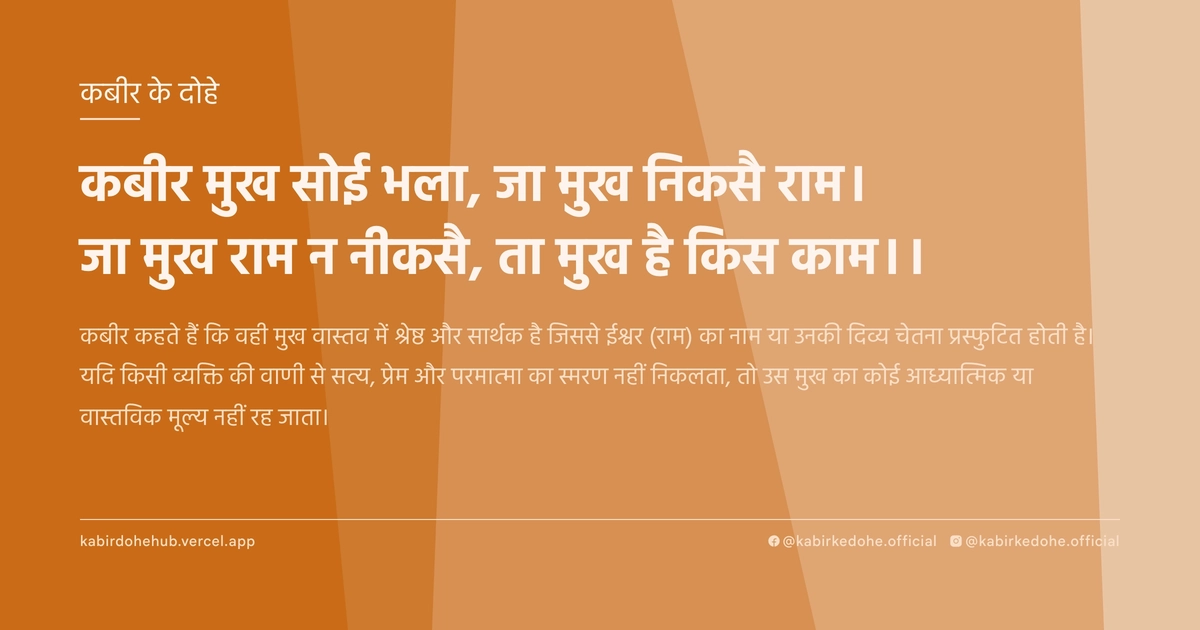
कबीर मुख सोई भला, जा मुख निकसै राम।
जा मुख राम न नीकसै, ता मुख है किस काम।।
Kabir mukh soi bhala, ja mukh niksai Ram. Ja mukh Ram na niksai, ta mukh hai kis kaam.
इस पृष्ठ पर इस कबीर दोहे का अर्थ (meaning), हिंदी व्याख्या और अंग्रेज़ी अनुवाद, दार्शनिक विश्लेषण और व्यावहारिक जीवन सीख दी गई है। यह दोहा भक्ति (Bhakti) विषय से जुड़ा है — Kabir doha meaning and explanation in Hindi and English.
अर्थ (Meaning):
कबीर कहते हैं कि वही मुख वास्तव में श्रेष्ठ और सार्थक है जिससे ईश्वर (राम) का नाम या उनकी दिव्य चेतना प्रस्फुटित होती है। यदि किसी व्यक्ति की वाणी से सत्य, प्रेम और परमात्मा का स्मरण नहीं निकलता, तो उस मुख का कोई आध्यात्मिक या वास्तविक मूल्य नहीं रह जाता।
Kabir asserts that the only mouth truly worthy of praise is the one from which the name of the Divine (Ram) or the essence of Truth emanates. If a person's speech does not reflect the presence of the Divine or the vibration of universal love, then that mouth serves no higher spiritual purpose.
व्याख्या (Interpretation):
शाब्दिक रूप से, यह दोहा राम नाम के जप पर जोर देता है, लेकिन आध्यात्मिक स्तर पर 'राम' यहाँ किसी व्यक्ति विशेष नहीं, बल्कि उस सर्वव्यापी चेतना (Nirgun Brahman) का प्रतीक है जो कण-कण में व्याप्त है। जब कबीर 'मुख' की बात करते हैं, तो वे केवल शारीरिक अंगों की नहीं, बल्कि मनुष्य की अभिव्यक्ति और उसके अहंकार के द्वार की बात कर रहे हैं। यह दोहा माया के प्रभाव को हटाने का आह्वान है, जहाँ मनुष्य शब्दों के जाल में उलझा रहता है। यहाँ विरोधाभास यह है कि सबसे शक्तिशाली अभिव्यक्ति वह है जो स्वयं को मिटाकर परमात्मा को प्रकट करती है। जब वाणी से 'राम' निकलता है, तो वह केवल शब्द नहीं, बल्कि आत्मा का परमात्मा के साथ अद्वैत मिलन का प्रमाण होता है। अंततः, यह संदेश देता है कि बाहरी सौंदर्य या वाकपटुता व्यर्थ है यदि हृदय में ईश्वरीय प्रेम का वास न हो।
Literally, this couplet emphasizes the chanting of 'Ram', but on a deeper spiritual plane, 'Ram' does not refer to a mythological figure but to the all-pervading consciousness (Nirgun Brahman) present in every atom. When Kabir speaks of the 'mouth', he is not merely referring to the physical organ, but to the portal of human expression and the gateway of the ego. This is a call to pierce through the veil of Maya, where humans are often trapped in the labyrinth of meaningless words. The central paradox lies in the fact that the most powerful expression is one that annihilates the 'I' to reveal the 'Divine'. When 'Ram' emanates from the mouth, it is not a mere phonetic sound, but a testament to the non-duality (Advaita) of the Atman and Brahman. Ultimately, it suggests that external beauty or rhetorical eloquence is futile if the heart does not vibrate with divine love.
दार्शनिक विश्लेषण (Philosophical Analysis):
कबीर का यह दोहा उस युग की उपज है जहाँ धर्म केवल कर्मकांडों और बाहरी दिखावे तक सीमित हो गया था। उन्होंने देखा कि लोग कठिन उपवास रखते थे और तीर्थयात्राएँ करते थे, लेकिन उनके शब्दों में करुणा और सत्य का अभाव था। कबीर ने इस पाखंड का खंडन करते हुए 'नाम स्मरण' को सबसे सरल और प्रभावी मार्ग बताया। यह दृष्टिकोण सूफी मत के 'ज़िक्र' (Zikr) और अद्वैत वेदांत के 'सोऽहम्' (Soham) के समान है, जहाँ साधक अपनी व्यक्तिगत पहचान को मिटाकर सार्वभौमिक सत्य में विलीन हो जाता है।
दार्शनिक रूप से, कबीर यहाँ वाणी की शुद्धि को आत्मा की शुद्धि से जोड़ रहे हैं। उनके लिए, 'राम' का नाम लेना केवल एक धार्मिक क्रिया नहीं, बल्कि एक मनोवैज्ञानिक रूपांतरण है। जब कोई व्यक्ति निरंतर उस निराकार सत्ता का स्मरण करता है, तो उसका अहंकार (Ahamkara) धीरे-धीरे नष्ट होने लगता है। यह प्रक्रिया व्यक्ति को जाति, धर्म और सामाजिक श्रेणियों के संकीर्ण बंधनों से मुक्त करती है, क्योंकि परमात्मा किसी विशेष भाषा या लिपि का मोहताज नहीं है।
यहाँ 'मुख' का उपयोग एक रूपक के रूप में किया गया है। यह वह स्थान है जहाँ से विचार पदार्थ बनते हैं। यदि विचार दूषित हैं, तो वाणी विषैली होगी। यदि विचार परमात्मा में लीन हैं, तो वाणी अमृत बन जाएगी। कबीर यह स्पष्ट करते हैं कि ज्ञान केवल पुस्तकों में नहीं, बल्कि उस जीवंत अनुभव में है जो वाणी के माध्यम से प्रेम और शांति के रूप में प्रकट होता है।
यह दोहा इस बात पर प्रहार करता है कि कैसे मनुष्य अपनी बौद्धिक श्रेष्ठता का उपयोग दूसरों को नीचा दिखाने के लिए करता है। कबीर के अनुसार, वह विद्वान व्यर्थ है जिसकी वाणी में विनम्रता और ईश्वर के प्रति समर्पण नहीं है। यह 'निर्गुण भक्ति' का सार है—जहाँ ईश्वर मंदिर या मस्जिद में नहीं, बल्कि साधक की शुद्ध वाणी और पवित्र हृदय में निवास करता है।
अंततः, यह विश्लेषण हमें यह समझने में मदद करता है कि कबीर का 'राम' वास्तव में वह आंतरिक प्रकाश है जो अज्ञान के अंधेरे को मिटाता है। जब यह प्रकाश वाणी के माध्यम से बाहर आता है, तो वह सुनने वाले और बोलने वाले दोनों के बीच के भेद को समाप्त कर देता है, जिससे एक सामूहिक आध्यात्मिक चेतना का उदय होता है।
This couplet is a product of an era where religion had become confined to rigid rituals and external displays of piety. Kabir observed people performing grueling fasts and long pilgrimages, yet their speech remained devoid of compassion and truth. By rejecting this hypocrisy, Kabir proposed 'Naam Simran' (remembrance of the Name) as the simplest and most potent path to liberation. This approach mirrors the Sufi practice of 'Zikr' and the Advaita Vedanta concept of 'Soham', where the seeker dissolves their individual identity into the universal truth.
Philosophically, Kabir links the purification of speech to the purification of the soul. For him, chanting the name of 'Ram' is not a mere religious act but a psychological transformation. As one consistently remembers the formless entity, the ego (Ahamkara) gradually erodes. This process liberates the individual from the narrow confines of caste, creed, and social hierarchies, as the Divine is not bound by any specific language or script.
The 'mouth' here serves as a metaphor. It is the threshold where thoughts materialize into form. If thoughts are corrupted, speech becomes toxic; if thoughts are immersed in the Divine, speech becomes nectar. Kabir clarifies that true knowledge does not reside in scriptures but in the lived experience that manifests as love and peace through one's words.
This verse strikes at the heart of intellectual arrogance, where humans use their erudition to belittle others. According to Kabir, a scholar is useless if their speech lacks humility and surrender to the Divine. This is the essence of 'Nirgun Bhakti'—where God resides not in temples or mosques, but in the pure speech and sacred heart of the practitioner.
Ultimately, this analysis reveals that Kabir's 'Ram' is actually the inner light that dispels the darkness of ignorance. When this light emanates through speech, it collapses the duality between the speaker and the listener, giving rise to a collective spiritual consciousness.
मूल संदेश (Core Message):
- बाहरी पूजा व्यर्थ है यदि वाणी में प्रेम नहीं है।
- अहंकार शब्दों के माध्यम से प्रकट होता है, विनम्रता के माध्यम से मिटता है।
- सच्चा मंत्र वह है जो व्यवहार में करुणा बनकर उतरे।
- ईश्वर किसी मंदिर में नहीं, बल्कि शुद्ध संवाद में बसते हैं।
- वाणी की शुद्धि ही आत्मा की वास्तविक शुद्धि का द्वार है।
- External rituals are futile if speech lacks love.
- Ego manifests through words; it dissolves through humility.
- The true mantra is that which descends as compassion in behavior.
- The Divine resides not in temples, but in pure communication.
- Purification of speech is the gateway to the purification of the soul.
व्यावहारिक उदाहरण (Practical Example):
वाराणसी के एक पुराने घाट पर माधव नाम का एक वृद्ध बुनकर रहता था। माधव अपनी कला में निपुण था, लेकिन उसका स्वभाव अत्यंत क्रोधी और कठोर था। वह अपनी श्रेष्ठता के अहंकार में डूबा रहता और अक्सर अपने पड़ोसियों और सहायकों को कड़वे शब्दों से अपमानित करता था। वह खुद को एक बड़ा भक्त मानता था क्योंकि वह घंटों मंदिर में बैठता था, लेकिन उसके घर और कार्यस्थल पर केवल कलह और तिरस्कार का वातावरण रहता था।
एक दिन, माधव की मुलाकात एक घुमंतू साधु से हुई जो घाट की सीढ़ियों पर चुपचाप बैठे थे। माधव ने अपनी कला का बखान करते हुए साधु से पूछा कि क्या उसकी भक्ति उसे मोक्ष दिलाएगी। साधु ने माधव की ओर देखा और शांति से कहा, 'तुम्हारी उंगलियां तो सुंदर वस्त्र बुन रही हैं, लेकिन तुम्हारी जीभ केवल कांटे बो रही है। जिस मुख से अपशब्द निकलते हैं, क्या वहां राम का वास हो सकता है?'
यह बात माधव के हृदय में किसी तीर की तरह चुभी। उसने महसूस किया कि वह मंदिर में तो राम को खोज रहा था, लेकिन अपनी वाणी से उन लोगों को चोट पहुँचा रहा था जो वास्तव में राम के ही रूप थे। उसे समझ आया कि उसकी पूजा केवल एक बाहरी दिखावा थी, जबकि उसका आंतरिक जीवन द्वेष से भरा था।
अगले कुछ महीनों तक, माधव ने एक कठिन संकल्प लिया। उसने तय किया कि वह तब तक नहीं बोलेगा जब तक उसके शब्द किसी के चेहरे पर मुस्कान न लाएं या किसी के दुख को कम न करें। शुरुआत में यह बहुत कठिन था; उसका पुराना क्रोध बार-बार उभरता, लेकिन वह तुरंत मौन हो जाता और मन ही मन 'राम' का स्मरण करता।
धीरे-धीरे, उसके व्यवहार में परिवर्तन आने लगा। उसने अपने सहायकों से सम्मानपूर्वक बात करना शुरू किया और अपनी गलतियों के लिए उनसे क्षमा मांगी। उसके शब्दों में अब कठोरता की जगह करुणा और मिठास थी। लोग जो पहले उससे डरते थे या उससे नफरत करते थे, अब उसकी ओर खिंचे चले आने लगे।
माधव ने पाया कि जैसे-जैसे उसकी वाणी शुद्ध हुई, उसके मन की अशांति समाप्त होने लगी। उसे अब मंदिर में घंटों बैठने की आवश्यकता महसूस नहीं होती थी, क्योंकि उसे हर इंसान की मुस्कान में और हर मददगार शब्द में वही 'राम' दिखने लगे थे।
एक दिन, एक युवा बुनकर उसके पास आया और पूछा, 'बाबा, आपकी कला इतनी अद्भुत कैसे हो गई?' माधव ने मुस्कुराते हुए उत्तर दिया, 'बेटा, जब मैंने अपने मुख से कड़वाहट निकाली, तब जाकर मेरे हाथों में ईश्वर का वास हुआ।'
माधव का जीवन अब एक जीवित प्रार्थना बन गया था। उसने सीखा कि सच्ची भक्ति माला फेरने में नहीं, बल्कि अपनी वाणी को प्रेम का माध्यम बनाने में है। उसकी कार्यशाला अब केवल वस्त्रों का केंद्र नहीं, बल्कि शांति और सद्भाव का एक छोटा सा मंदिर बन गई थी।
On an ancient ghat in Varanasi lived an elderly weaver named Madhav. Madhav was a master of his craft, but his temperament was extremely volatile and harsh. He was consumed by the ego of his own superiority and frequently insulted his neighbors and assistants with bitter words. He considered himself a great devotee because he spent hours in the temple, yet his home and workshop were filled with conflict and contempt.
One day, Madhav encountered a wandering monk sitting silently on the steps of the ghat. Boasting about his artistry, Madhav asked the monk if his devotion would grant him salvation. The monk looked at Madhav and calmly replied, 'Your fingers weave beautiful fabrics, but your tongue sows only thorns. Can Ram truly reside in a mouth that spews insults?'
These words pierced Madhav's heart like an arrow. He realized that while he was searching for Ram in the temple, he was wounding the very people who were manifestations of the Divine. He understood that his worship was merely an external facade, while his internal life was riddled with malice.
For the next few months, Madhav took a rigorous vow. He decided he would not speak unless his words could bring a smile to someone's face or alleviate their suffering. Initially, this was grueling; his old anger would flare up, but he would immediately fall silent and mentally chant 'Ram'.
Gradually, a transformation took place in his behavior. He began speaking to his assistants with respect and asked for their forgiveness for his past actions. The harshness in his voice was replaced by compassion and sweetness. People who once feared or hated him were now drawn to his presence.
Madhav discovered that as his speech was purified, the turmoil in his mind subsided. He no longer felt the need to sit for hours in the temple, for he began to see 'Ram' in every person's smile and every helpful word.
One day, a young weaver approached him and asked, 'Baba, how did your art become so sublime?' Madhav smiled and replied, 'Son, only when I removed the bitterness from my mouth did the Divine find a place in my hands.'
Madhav's life became a living prayer. He learned that true devotion is not in counting beads on a rosary, but in making one's speech a medium of love. His workshop was no longer just a center for textiles, but a small temple of peace and harmony.
अभ्यास मार्गदर्शन (Practice Guidance):
- दैनिक मौन अभ्यास: प्रतिदिन कम से कम 30 मिनट पूर्ण मौन रहें। इस समय में अपने विचारों का निरीक्षण करें और देखें कि क्या वे क्रोध या निर्णय से भरे हैं।
- वाणी का सजग अवलोकन: दिन भर में बोले गए अपने शब्दों का विश्लेषण करें। यदि किसी शब्द ने किसी को ठेस पहुँचाई है, तो मानसिक रूप से क्षमा मांगें और उसे सुधारने का संकल्प लें।
- करुणापूर्ण संवाद जर्नल: एक डायरी लिखें जिसमें उन क्षणों का विवरण हो जब आपने अपनी प्रतिक्रिया को नियंत्रित कर प्रेमपूर्ण शब्द चुने।
- निदान चेकलिस्ट: स्वयं से पूछें—क्या मेरी बातचीत में अहंकार है? क्या मैं दूसरों को छोटा महसूस कराता हूँ? क्या मेरी वाणी शांति लाती है या तनाव? यदि उत्तर 'हाँ' है, तो समझें कि 'राम' की उपस्थिति अभी गौण है।
- Daily Silence Practice: Observe complete silence for at least 30 minutes daily. Use this time to observe your thoughts and see if they are laden with anger or judgment.
- Mindful Speech Observation: Analyze the words you speak throughout the day. If a word has hurt someone, mentally ask for forgiveness and resolve to rectify it.
- Compassionate Dialogue Journal: Keep a diary documenting moments where you consciously chose loving words over a reactive, ego-driven response.
- Diagnostic Checklist: Ask yourself—Is there ego in my conversations? Do I make others feel inferior? Does my speech bring peace or tension? If the answer is 'yes', recognize that the presence of the Divine is currently overshadowed.
चिंतन प्रश्न (Reflection Questions):
- क्या मेरी 'धार्मिक' पहचान मेरे वास्तविक व्यवहार के साथ मेल खाती है, या यह केवल एक सामाजिक मुखौटा है?
- जब मैं दूसरों की आलोचना करता हूँ, तो क्या मैं वास्तव में सत्य बोल रहा होता हूँ या अपने भीतर के किसी घाव को दूसरे पर थोप रहा होता हूँ?
- मेरे डिजिटल संवाद (सोशल मीडिया) में कितनी सच्चाई है और कितना केवल 'दिखावे' का अहंकार?
- यदि आज मेरी वाणी ही मेरी एकमात्र पहचान होती, तो दुनिया मुझे किस रूप में याद करती?
- क्या मैं चुप रहकर भी दूसरों को नीचा दिखा सकता हूँ? क्या मेरा मौन भी एक प्रकार का अहंकार है?
- Does my 'religious' identity align with my actual behavior, or is it merely a social mask?
- When I criticize others, am I truly speaking the truth, or am I projecting an internal wound onto them?
- How much truth exists in my digital interactions (social media), and how much is just the ego of 'performance'?
- If my speech were my only identity today, how would the world remember me?
- Can I belittle others even while remaining silent? Is my silence also a form of ego?