
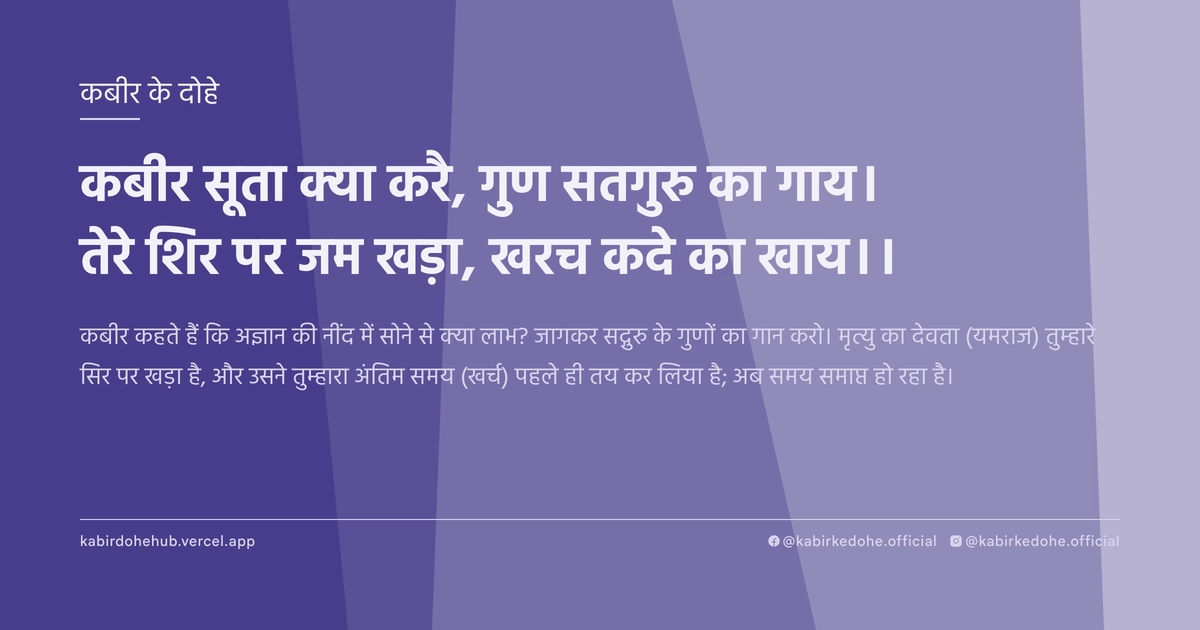
कबीर सूता क्या करै, गुण सतगुरु का गाय।
तेरे शिर पर जम खड़ा, खरच कदे का खाय।।
Kabir suta kya karai, gun satguru ka gaaye. Tere shir par jam khada, kharach kade ka khaaye.
इस पृष्ठ पर इस कबीर दोहे का अर्थ (meaning), हिंदी व्याख्या और अंग्रेज़ी अनुवाद, दार्शनिक विश्लेषण और व्यावहारिक जीवन सीख दी गई है। यह दोहा जागृति (The Wake-up Call) विषय से जुड़ा है — Kabir doha meaning and explanation in Hindi and English.
अर्थ (Meaning):
कबीर कहते हैं कि अज्ञान की नींद में सोने से क्या लाभ? जागकर सद्गुरु के गुणों का गान करो। मृत्यु का देवता (यमराज) तुम्हारे सिर पर खड़ा है, और उसने तुम्हारा अंतिम समय (खर्च) पहले ही तय कर लिया है; अब समय समाप्त हो रहा है।
Kabir asks: what is the point of remaining asleep in ignorance? Wake up and contemplate the virtues of the True Guru. The Lord of Death stands poised over your head, having already consumed the allotted duration of your life; your time is rapidly depleting.
व्याख्या (Interpretation):
यहाँ 'सोना' शारीरिक निद्रा नहीं, बल्कि आध्यात्मिक जड़ता और माया के प्रभाव में होने का प्रतीक है। 'सतगुरु' वह प्रकाश है जो अज्ञान के अंधकार को मिटाता है। यमराज का सिर पर खड़ा होना इस बात का संकेत है कि मृत्यु एक अटल सत्य है और जीवन क्षणभंगुर है। यह दोहा निर्गुण भक्ति के उस मार्ग को दर्शाता है जहाँ साधक को अपनी नश्वरता का बोध कराकर उसे आत्म-साक्षात्कार की ओर धकेला जाता है। यह द्वैत (शरीर और आत्मा) के भ्रम को तोड़कर अद्वैत (एकत्व) की ओर ले जाने का आह्वान है, जहाँ केवल वह सत्य शेष रहता है जो समय और मृत्यु से परे है।
Here, 'sleep' does not refer to physical slumber but symbolizes spiritual inertia and the veil of Maya. The 'Satguru' represents the illuminating consciousness that dissolves the darkness of ignorance. The presence of Yama (the Lord of Death) over the head signifies the absolute certainty of mortality and the fleeting nature of existence. This Doha embodies the path of Nirgun Bhakti, where the seeker is jolted into awareness of their transience to propel them toward self-realization. It is a call to shatter the illusion of duality—the separation between the body and the soul—and move toward Advaita, the non-dual state where only the timeless Truth remains.
दार्शनिक विश्लेषण (Philosophical Analysis):
कबीर का यह दोहा मध्यकालीन भारत के उस सामाजिक-धार्मिक परिवेश से उपजा है जहाँ लोग कर्मकांडों और बाहरी आडंबरों में उलझे थे। कबीर ने स्पष्ट किया कि मोक्ष किसी मंदिर या मस्जिद में नहीं, बल्कि आंतरिक जागृति में है। यह विचार अद्वैत वेदांत के करीब है, जहाँ 'अविद्या' (अज्ञान) ही बंधन का कारण है। जब तक मनुष्य स्वयं को शरीर मानता है, वह मृत्यु के भय से ग्रस्त रहता है; लेकिन जब वह स्वयं को ब्रह्म या शुद्ध चेतना के रूप में पहचानता है, तो यमराज का भय समाप्त हो जाता है।
सूफी मत के 'फना' (अहंकार का विनाश) के सिद्धांत की तरह, कबीर यहाँ 'सोने' यानी अहंकार की नींद को त्यागने की बात कर रहे हैं। उनके लिए गुरु केवल एक व्यक्ति नहीं, बल्कि वह तत्व है जो शिष्य के भीतर के अंधकार को मिटाकर उसे उसके वास्तविक स्वरूप से मिलाता है। यह प्रक्रिया मनोवैज्ञानिक रूपांतरण की है, जहाँ व्यक्ति बाहरी दुनिया के शोर से हटकर आंतरिक मौन की ओर बढ़ता है।
कबीर जाति और धर्म के भेदभाव को नकारते हुए यह संदेश देते हैं कि आध्यात्मिक जागृति सबके लिए समान रूप से उपलब्ध है। वे ritualism (कर्मकांड) का विरोध करते हैं क्योंकि वे मानते हैं कि बाहरी पूजा केवल मन को बहलाने का साधन है, जबकि वास्तविक साधना आत्मा का परमात्मा में विलीनीकरण है।
यहाँ 'खर्च' शब्द का प्रयोग अत्यंत गहरा है। यह जीवन के समय को एक सीमित संसाधन के रूप में दर्शाता है। कबीर चेतावनी देते हैं कि हम समय को व्यर्थ गँवा रहे हैं, जबकि मृत्यु का समय पहले ही निर्धारित है। यह 'Memento Mori' (मृत्यु को याद रखो) का एक भारतीय संस्करण है, जो व्यक्ति को वर्तमान क्षण में पूरी तरह उपस्थित होने के लिए प्रेरित करता है।
अंततः, यह दोहा हमें सिखाता है कि आध्यात्मिक आलस्य सबसे बड़ा पाप है। जब तक हम यह मानते रहेंगे कि हमारे पास बहुत समय है, हम कभी सत्य की खोज शुरू नहीं करेंगे। जागने का अर्थ है—सजग होना, साक्षी भाव में रहना और अपनी चेतना को उस अनंत स्रोत से जोड़ना जो जन्म और मृत्यु के चक्र से मुक्त है।
This Doha emerged from the socio-religious landscape of medieval India, where people were deeply entangled in rituals and external displays of piety. Kabir asserts that liberation is found not in temples or mosques, but in internal awakening. This aligns closely with Advaita Vedanta, where 'Avidya' (ignorance) is the root cause of bondage. As long as a human identifies with the physical body, they remain gripped by the fear of death; however, once they recognize themselves as Brahman or pure consciousness, that fear vanishes.
Similar to the Sufi concept of 'Fana' (the annihilation of the ego), Kabir urges the abandonment of 'sleep'—the slumber of the ego. For him, the Guru is not merely a person but the catalyst that dissolves the disciple's darkness, reuniting them with their true essence. This is a process of psychological transformation, shifting the focus from the external noise of the world to the internal silence of the soul.
By rejecting caste and religious divisions, Kabir emphasizes that spiritual awakening is universally accessible. He opposes ritualism, viewing external worship as a mere distraction, whereas true practice is the merging of the individual soul into the universal consciousness.
The use of the word 'kharach' (expense/allotment) is profoundly poignant. It frames life's duration as a finite resource. Kabir warns that we squander our time while the deadline of death is already fixed. This is a spiritual 'Memento Mori,' urging the individual to be fully present in the current moment.
Ultimately, the Doha teaches that spiritual lethargy is the greatest obstacle. The belief that we have 'plenty of time' prevents us from beginning the quest for Truth. To 'wake up' means to become mindful, to dwell in the state of the witness (Sakshi), and to connect one's consciousness to the infinite source that transcends the cycle of birth and death.
मूल संदेश (Core Message):
- अज्ञान की नींद सबसे गहरा अंधकार है।
- सद्गुरु वह दर्पण है जो हमारा वास्तविक स्वरूप दिखाता है।
- समय सीमित है; आध्यात्मिक जागृति में देरी आत्मघाती है।
- मृत्यु का भय केवल अहंकार की उपज है।
- सत्य का अनुभव वर्तमान क्षण की पूर्ण उपस्थिति में है।
- बाहरी कर्मकांड आंतरिक शून्यता को नहीं भर सकते।
- The sleep of ignorance is the deepest darkness.
- The True Guru is the mirror reflecting our authentic self.
- Time is finite; delaying spiritual awakening is self-destructive.
- The fear of death is merely a byproduct of the ego.
- The experience of Truth lies in total presence in the now.
- External rituals cannot fill the void of internal emptiness.
व्यावहारिक उदाहरण (Practical Example):
वाराणसी के घाटों पर रहने वाला एक वृद्ध विधवा, जिसे सब 'माई' कहते थे, अपना पूरा दिन केवल इस उम्मीद में बिताती थी कि वह अगले जन्म में एक बेहतर जीवन पाएगी। वह घंटों माला जपती और कठोर उपवास करती, लेकिन उसके मन में अपने वर्तमान जीवन के प्रति कोई प्रेम नहीं था। वह केवल मृत्यु के बाद के स्वर्ग की कल्पना करती थी।
एक दिन उसने एक घुमक्कड़ संत को सुना जिसने कबीर का यही दोहा सुनाया। संत ने उससे कहा, 'माई, तुम स्वर्ग की तैयारी कर रही हो, लेकिन तुम अभी भी अज्ञान की नींद में सो रही हो। तुम जिसे पूजा समझ रही हो, वह केवल एक आदत है।'
माई को पहले तो यह बात चुभी, लेकिन फिर उसने गहराई से सोचा। उसने महसूस किया कि वह अपनी भक्ति का उपयोग वर्तमान से भागने के लिए कर रही थी। उसने अपनी माला को केवल एक उपकरण माना और अपना ध्यान इस बात पर लगाया कि वह इस क्षण में वास्तव में कौन है।
उसने देखा कि वह जिस 'स्वर्ग' की तलाश कर रही थी, वह वास्तव में उसके भीतर की शांति थी, जिसे उसने बाहरी नियमों के बोझ तले दबा दिया था। उसने कठोर उपवास छोड़े और दूसरों की सेवा में आनंद खोजने लगी।
उसने महसूस किया कि यमराज का डर तब तक रहता है जब तक हम खुद को इस शरीर और उसकी इच्छाओं से जोड़कर रखते हैं। जब उसने खुद को एक व्यापक चेतना का हिस्सा माना, तो उसका डर गायब हो गया।
वह अब केवल मंत्र नहीं पढ़ती थी, बल्कि उन मंत्रों के अर्थ को अपने जीवन में उतारने लगी। उसने अपने आस-पास के अनाथ बच्चों को पढ़ाना शुरू किया और उन्हें प्रेम का पाठ पढ़ाया।
उसका जीवन अब केवल 'इंतज़ार' नहीं था, बल्कि 'उपस्थिति' बन गया था। वह अब जाग चुकी थी।
जब उसकी मृत्यु का समय आया, तो उसके चेहरे पर कोई भय नहीं था। वह मुस्कुरा रही थी, क्योंकि उसने जान लिया था कि 'खर्च' समाप्त होने के बाद भी वह तत्व शेष रहता है जो कभी मरता ही नहीं।
उसकी यह यात्रा एक बाहरी धार्मिकता से आंतरिक आध्यात्मिकता की ओर बदलाव थी।
उसने यह साबित किया कि जागने का अर्थ केवल आँखें खोलना नहीं, बल्कि भ्रम के पर्दों को हटाना है।
In the ghats of Varanasi lived an elderly widow, known to all as 'Mai.' She spent her entire day in the hope that she would attain a better life in the next birth. She spent hours chanting beads and observing rigorous fasts, yet her heart held no love for her present existence. She lived only in the imagination of a post-death paradise.
One day, she heard a wandering saint recite this very Doha of Kabir. The saint told her, 'Mai, you are preparing for heaven, but you are still asleep in ignorance. What you consider worship is merely a habit.'
Mai was initially offended, but then she reflected deeply. She realized she was using her devotion as a tool to escape the present. She began to view her prayer beads as mere tools and shifted her focus to who she truly was in this moment.
She discovered that the 'heaven' she sought was actually the inner peace she had suppressed under the weight of external rules. She abandoned the harsh fasts and began finding joy in serving others.
She realized that the fear of Yama persists only as long as we identify ourselves with this body and its desires. When she perceived herself as part of a broader consciousness, her fear vanished.
She no longer just recited mantras; she began embodying their meaning in her life. She started teaching orphaned children in her vicinity, imparting lessons of unconditional love.
Her life ceased to be a state of 'waiting' and became a state of 'presence.' She had finally awakened.
When the time of her death arrived, there was no fear on her face. She was smiling, for she knew that even after the 'allotment' of time is spent, the element that never dies remains.
Her journey was a transition from external religiosity to internal spirituality.
She proved that awakening is not merely opening one's eyes, but removing the veils of illusion.
अभ्यास मार्गदर्शन (Practice Guidance):
- प्रतिदिन 20 मिनट मौन ध्यान करें, जहाँ आप केवल अपने श्वास और अपने अस्तित्व के प्रति सजग रहें, बिना किसी निर्णय के।
- एक 'जागरूकता जर्नल' बनाएँ: दिन में तीन बार रुकें और खुद से पूछें, 'क्या मैं इस समय सचेत हूँ या मैं अपनी आदतों और विचारों की नींद में सो रहा हूँ?'
- व्यवहार परिवर्तन: किसी भी कार्य को करते समय (जैसे भोजन करना या चलना), उसे पूरी तरह से वर्तमान क्षण में करें, भविष्य की चिंता या अतीत के पछतावे को त्याग कर।
- निदान चेकलिस्ट: यदि आप अभी भी दूसरों की राय से विचलित हैं, मृत्यु के विचार से डरते हैं, या केवल बाहरी अनुष्ठानों में शांति खोज रहे हैं, तो आप अभी भी 'सो रहे' हैं।
- Practice 20 minutes of silent meditation daily, focusing solely on your breath and existence without judgment.
- Maintain an 'Awareness Journal': Stop three times a day and ask yourself, 'Am I conscious right now, or am I asleep in my habits and conditioned thoughts?'
- Behavioral Change: Perform every action (like eating or walking) with total presence, discarding anxieties about the future or regrets about the past.
- Diagnostic Checklist: If you are still swayed by others' opinions, terrified by the thought of death, or seeking peace only through external rituals, you are still 'asleep'.
चिंतन प्रश्न (Reflection Questions):
- मेरे जीवन का वह कौन सा हिस्सा है जिसे मैं 'आदत' के नाम पर बिना सोचे-समझे जी रहा हूँ?
- यदि मुझे पता चले कि मेरा समय समाप्त होने वाला है, तो मेरी कौन सी उपलब्धियाँ वास्तव में अर्थहीन हो जाएँगी?
- क्या मेरी आध्यात्मिक साधना वास्तव में मुझे जगा रही है, या यह मेरे अहंकार को संतुष्ट करने का एक नया तरीका बन गई है?
- मैं अपनी सार्वजनिक छवि (Digital/Social Ego) को बनाए रखने के लिए अपनी आंतरिक शांति का कितना बलिदान कर रहा हूँ?
- क्या मैं मृत्यु से डरता हूँ, या मैं उस 'मैं' के खो जाने से डरता हूँ जिसे मैंने बड़ी मेहनत से गढ़ा है?
- Which part of my life am I living unconsciously, merely out of habit?
- If I knew my time was running out, which of my achievements would suddenly seem meaningless?
- Is my spiritual practice actually awakening me, or has it become a new way to feed my ego?
- How much of my inner peace am I sacrificing to maintain my public image (Digital/Social Ego)?
- Do I fear death, or do I fear the loss of the 'I' that I have painstakingly constructed?