
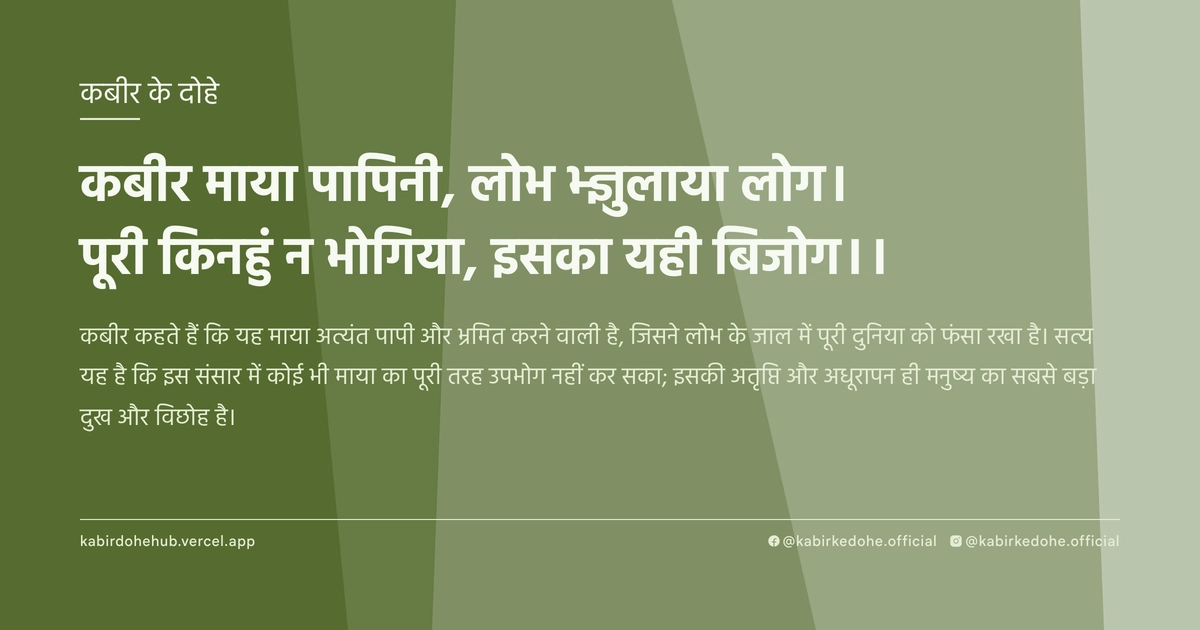
कबीर माया पापिनी, लोभ भ्ज्ञुलाया लोग।
पूरी किनहुं न भोगिया, इसका यही बिजोग।।
Kabir maya papini, lobh bhunjulaya log. Puri kinhu na bhogiya, iska yahi bijog.
इस पृष्ठ पर इस कबीर दोहे का अर्थ (meaning), हिंदी व्याख्या और अंग्रेज़ी अनुवाद, दार्शनिक विश्लेषण और व्यावहारिक जीवन सीख दी गई है। यह दोहा माया (Maya) विषय से जुड़ा है — Kabir doha meaning and explanation in Hindi and English.
अर्थ (Meaning):
कबीर कहते हैं कि यह माया अत्यंत पापी और भ्रमित करने वाली है, जिसने लोभ के जाल में पूरी दुनिया को फंसा रखा है। सत्य यह है कि इस संसार में कोई भी माया का पूरी तरह उपभोग नहीं कर सका; इसकी अतृप्ति और अधूरापन ही मनुष्य का सबसे बड़ा दुख और विछोह है।
Kabir asserts that Maya (the cosmic illusion) is inherently deceptive, trapping humanity in an endless cycle of greed and longing. He emphasizes that no one has ever truly exhausted or satisfied their desires through material pursuit; the eternal incompleteness of such cravings is the very essence of human suffering and separation.
व्याख्या (Interpretation):
यहाँ 'माया' केवल धन-दौलत नहीं, बल्कि वह मानसिक आवरण है जो आत्मा को उसके वास्तविक स्वरूप से अलग करता है। कबीर इसे 'पापिनी' कहते हैं क्योंकि यह सत्य को ढंककर असत्य को सत्य जैसा दिखाती है। लोभ वह सेतु है जिसके माध्यम से माया मनुष्य को बांधती है। जब हम भौतिक वस्तुओं में सुख खोजते हैं, तो हम एक ऐसी प्यास को बढ़ाते हैं जो कभी नहीं बुझती। यह 'बिजोग' या विछोह वास्तव में आत्मा का परमात्मा से अलगाव है। निर्गुण भक्ति के अनुसार, जब तक साधक इस भ्रम को नहीं पहचानता, वह संसार के चक्र में घूमता रहता। यह विरोधाभास है कि जिसे हम प्राप्ति समझते हैं, वह वास्तव में एक अंतहीन अभाव है।
In this context, 'Maya' is not merely material wealth but the psychological veil that obscures the soul's true nature. Kabir labels it 'sinful' because it masks the Absolute Truth, presenting the ephemeral as eternal. Greed serves as the mechanism through which Maya binds the individual. By seeking fulfillment in the external world, the seeker amplifies a thirst that can never be quenched. This 'bijog' or separation is fundamentally the rift between the Atman (individual soul) and Brahman (universal consciousness). According to Nirgun Bhakti, unless the seeker recognizes this illusion, they remain trapped in the cycle of Samsara. The central paradox is that what we perceive as 'acquisition' is actually a state of perpetual lack.
दार्शनिक विश्लेषण (Philosophical Analysis):
कबीर का यह दोहा मध्यकालीन भारत के उस सामाजिक परिवेश में लिखा गया जहाँ कर्मकांड और बाहरी आडंबर चरम पर थे। कबीर ने स्पष्ट रूप से बताया कि मोक्ष किसी मंदिर, मस्जिद या तीर्थ यात्रा से नहीं, बल्कि आंतरिक जागृति से मिलता है। वे माया के उस स्वरूप पर प्रहार करते हैं जो मनुष्य को जाति, धर्म और सामाजिक प्रतिष्ठा के अहंकार में बांधता है।
अद्वैत वेदांत के दृष्टिकोण से, यह दोहा 'अविद्या' (अज्ञान) की चर्चा करता है। जब जीव स्वयं को शरीर और मन मान लेता है, तो वह माया के प्रभाव में आ जाता है। कबीर का दर्शन यहाँ सूफीवाद के 'फना' (अहंकार का विनाश) के करीब है, जहाँ साधक को अपनी इच्छाओं को मिटाकर ईश्वर में विलीन होना होता है।
लोभ को यहाँ एक मनोवैज्ञानिक बंधन के रूप में देखा गया है। कबीर तर्क देते हैं कि इच्छाएं कभी समाप्त नहीं होतीं; वे केवल रूप बदलती हैं। एक इच्छा की पूर्ति दूसरी नई इच्छा को जन्म देती है, जिससे मनुष्य एक अंतहीन दौड़ में फंस जाता है। यह मानसिक स्थिति ही 'पाप' है क्योंकि यह चेतना को संकुचित करती है।
कबीर का विरोध केवल भौतिकता से नहीं, बल्कि उस 'मोह' से है जो सत्य के मार्ग में बाधा है। वे सिखाते हैं कि संसार का त्याग करना आवश्यक नहीं है, बल्कि संसार में रहते हुए उसके प्रति अनासक्त (detached) होना अनिवार्य है। यह 'सहज' मार्ग है जहाँ व्यक्ति कर्म करता है लेकिन फल की लालसा में नहीं डूबता।
अंततः, यह विश्लेषण हमें इस निष्कर्ष पर ले जाता है कि माया का अंत केवल ज्ञान (Gyan) से संभव है। जब व्यक्ति यह जान लेता है कि वह स्वयं ब्रह्म है, तब बाहरी आकर्षण अपनी शक्ति खो देते हैं। अहंकार का विसर्जन ही वह कुंजी है जो माया के इस जटिल जाल को काट सकती है।
This couplet was composed during a medieval Indian era characterized by rigid ritualism and external piety. Kabir strikes a blow against the notion that liberation is achieved through temples, mosques, or pilgrimages, asserting instead that it stems from internal awakening. He targets the specific form of Maya that binds humans through the ego of caste, religion, and social status.
From the perspective of Advaita Vedanta, this verse discusses 'Avidya' (ignorance). When the soul identifies itself with the body and mind, it falls under the spell of Maya. Kabir's philosophy here aligns closely with the Sufi concept of 'Fana' (annihilation of the ego), where the seeker must dissolve their desires to merge with the Divine.
Greed is analyzed here as a psychological shackle. Kabir argues that desires are never extinguished; they merely mutate. The fulfillment of one desire inevitably births another, trapping the human in an infinite loop. This mental state is termed 'sinful' because it constricts consciousness and prevents spiritual expansion.
Kabir's opposition is not to materiality itself, but to the 'attachment' (Moha) that obstructs the path to Truth. He teaches that renouncing the world physically is unnecessary; rather, one must achieve detachment while living within it. This is the 'Sahaj' path, where action is performed without the feverish craving for results.
Ultimately, this analysis concludes that the spell of Maya can only be broken through 'Gyan' (transcendental knowledge). Once the individual realizes their identity as Brahman, external attractions lose their potency. The dissolution of the ego is the only key capable of cutting through the intricate web of cosmic illusion.
मूल संदेश (Core Message):
- माया सत्य का पर्दा है, जिसे केवल ज्ञान से हटाया जा सकता है।
- लोभ एक ऐसा कुआँ है जिसका कोई तल नहीं होता।
- बाहरी उपभोग कभी भी आंतरिक रिक्तता को नहीं भर सकता।
- सच्ची प्राप्ति वस्तुओं का संचय नहीं, बल्कि इच्छाओं का अंत है।
- आत्मा का विछोह भौतिक अभाव से नहीं, बल्कि मानसिक मोह से है।
- Maya is a veil over Truth, removable only through transcendental knowledge.
- Greed is a well with no bottom; it can never be filled.
- External consumption can never fill an internal spiritual void.
- True attainment is not the accumulation of things, but the end of cravings.
- The soul's separation is caused by mental attachment, not material lack.
व्यावहारिक उदाहरण (Practical Example):
वाराणसी के एक पुराने घाट पर रहने वाले एक वृद्ध बुनकर थे, जिनका नाम रामदीन था। रामदीन ने अपना पूरा जीवन बेहतरीन रेशमी साड़ियाँ बुनने में बिताया। उनकी कला इतनी प्रसिद्ध थी कि दूर-दूर से लोग उनके पास आते थे। जैसे-जैसे उनकी प्रसिद्धि बढ़ी, उनके मन में और अधिक धन और सम्मान की लालसा जाग उठी।
उन्होंने अपनी साड़ियों की कीमत बढ़ा दी और केवल अमीर ग्राहकों को प्राथमिकता देने लगे। वे अब केवल रेशम की गुणवत्ता नहीं, बल्कि इस बात पर ध्यान देते थे कि उन्हें कितना मुनाफा होगा। उनके घर में सुख-सुविधाएं बढ़ गईं, लेकिन उनके मन की शांति गायब हो गई।
वे रात भर जागकर हिसाब लगाते कि कैसे वे शहर के सबसे बड़े व्यापारी बन सकते हैं। इस लोभ ने उन्हें इतना अंधा कर दिया कि उन्होंने अपने पुराने शिष्यों और गरीब ग्राहकों को नजरअंदाज करना शुरू कर दिया। वे जितना कमाते, उनकी इच्छाएं उतनी ही बढ़ती जातीं।
एक दिन, एक फकीर उनके पास आया और उसने एक साधारण सूती कपड़ा मांगा। रामदीन ने उसे झिड़क दिया, यह कहकर कि वह केवल महंगे रेशम का काम करता है। फकीर ने मुस्कुराते हुए कहा, 'तुम रेशम तो बुन रहे हो, लेकिन अपनी आत्मा के धागे उलझा रहे हो। क्या तुमने कभी सोचा है कि इस रेशम के ढेर में तुम्हें वह सुकून मिला जिसके लिए तुमने यह सब शुरू किया था?'
यह बात रामदीन के दिल पर लगी। उन्होंने महसूस किया कि पिछले दस वर्षों में उन्होंने धन तो कमाया, लेकिन उनके जीवन से संतोष पूरी तरह गायब हो गया था। वे अब भी उतने ही बेचैन थे जितने तब थे जब उनके पास कुछ नहीं था।
उन्हें समझ आया कि माया का यह खेल ऐसा है कि आप जितना इसे 'भोगने' की कोशिश करते हैं, यह आपको उतना ही अपनी गिरफ्त में ले लेता है। वे जिसे 'सफलता' समझ रहे थे, वह वास्तव में एक अंतहीन प्यास थी।
रामदीन ने उस दिन एक बड़ा निर्णय लिया। उन्होंने अपनी कमाई का एक हिस्सा गरीब बच्चों की शिक्षा के लिए समर्पित कर दिया और फिर से साधारण सूती कपड़े बुनना शुरू किया।
अब वे केवल लाभ के लिए नहीं, बल्कि आनंद के लिए बुनते थे। जब उन्होंने लोभ का त्याग किया, तो उन्हें वह मानसिक शांति मिली जो करोड़ों रुपयों से भी नहीं खरीदी जा सकती थी। उनकी साड़ियाँ अब और भी सुंदर हो गई थीं क्योंकि उनमें अब लालच नहीं, बल्कि प्रेम था।
On an ancient ghat in Varanasi lived an elderly weaver named Ramdeen. Ramdeen spent his entire life crafting exquisite silk sarees. His art was so renowned that people traveled from afar to seek his work. As his fame grew, a deep longing for more wealth and social prestige awakened within him.
He increased the prices of his sarees and began prioritizing only the wealthiest clients. He stopped focusing on the quality of the silk and started obsessing over the profit margins. While the luxuries in his home increased, his inner peace vanished.
He would spend sleepless nights calculating how to become the city's biggest merchant. This greed blinded him to the point where he began ignoring his old disciples and poor customers. The more he earned, the more his desires expanded.
One day, a wandering ascetic approached him and asked for a simple cotton cloth. Ramdeen dismissed him harshly, stating he only worked with expensive silk. The ascetic smiled and said, 'You are weaving silk, but you are tangling the threads of your own soul. Have you ever wondered if this pile of silk gave you the peace you initially sought?'
These words struck a chord in Ramdeen's heart. He realized that over the last decade, while he had accumulated wealth, contentment had completely disappeared from his life. He was just as restless now as he had been when he had nothing.
He understood that the game of Maya is such that the more you try to 'consume' it, the tighter its grip becomes. What he perceived as 'success' was actually an endless, unquenchable thirst.
Ramdeen made a pivotal decision that day. He dedicated a significant portion of his earnings to the education of poor children and returned to weaving simple cotton fabrics.
He no longer wove for profit, but for joy. When he relinquished greed, he found a mental tranquility that millions of rupees could not buy. His sarees became even more beautiful because they were no longer woven with greed, but with love.
अभ्यास मार्गदर्शन (Practice Guidance):
- दैनिक अवलोकन: दिन में तीन बार रुकें और स्वयं से पूछें, 'अभी मैं जिस वस्तु या स्थिति की इच्छा कर रहा हूँ, क्या वह मेरी वास्तविक आवश्यकता है या केवल माया का एक नया प्रलोभन?'
- अनासक्ति अभ्यास: सप्ताह में एक दिन ऐसी वस्तु का त्याग करें जिसे आप बहुत प्रिय मानते हैं, ताकि आप यह अनुभव कर सकें कि आपकी खुशी बाहरी वस्तुओं पर निर्भर नहीं है।
- आत्म-पूछताछ जर्नलिंग: अपनी उन तीन इच्छाओं के बारे में लिखें जिन्हें आपने पिछले एक साल में पूरा किया, और ईमानदारी से विश्लेषण करें कि क्या उनसे मिली खुशी स्थायी थी या क्षणिक।
- डायग्नोस्टिक चेकलिस्ट: यदि आप बार-बार दूसरों की प्रगति से ईर्ष्या महसूस करते हैं, या किसी वस्तु के न मिलने पर अत्यधिक तनाव में रहते हैं, तो समझ लें कि माया का प्रभाव गहरा है।
- Daily Observation: Pause three times a day and ask yourself, 'Is the object or situation I am currently craving a genuine necessity, or merely a new temptation of Maya?'
- Detachment Practice: Once a week, voluntarily give up a possession you hold dear to experience the truth that your happiness does not depend on external objects.
- Self-Inquiry Journaling: List three desires you fulfilled in the past year and honestly analyze whether the resulting happiness was permanent or fleeting.
- Diagnostic Checklist: If you frequently feel envy toward others' progress or experience extreme distress when a desire is unmet, recognize that the influence of Maya is currently dominant.
चिंतन प्रश्न (Reflection Questions):
- यदि आपसे आपकी सभी सामाजिक पहचान और भौतिक उपलब्धियां छीन ली जाएं, तो आपके पास 'स्वयं' के रूप में क्या बचेगा?
- क्या आपकी वर्तमान महत्वाकांक्षाएं आपकी अपनी हैं, या वे समाज द्वारा थोपे गए 'सफलता' के मानक हैं?
- आप अपनी डिजिटल पहचान (सोशल मीडिया) को बनाए रखने के लिए अपनी आंतरिक शांति का कितना हिस्सा बलिदान कर रहे हैं?
- वह कौन सी एक इच्छा है जिसे आप कभी पूरा नहीं करना चाहते, क्योंकि आपको डर है कि उसके बाद जीवन में कोई लक्ष्य नहीं बचेगा?
- क्या आप वास्तव में स्वतंत्र हैं, या आप उन वस्तुओं के गुलाम हैं जिन्हें आप अपना कहते हैं?
- If all your social identities and material achievements were stripped away, what would remain of 'you' as a self?
- Are your current ambitions truly your own, or are they standards of 'success' imposed upon you by society?
- How much of your inner peace are you sacrificing to maintain your digital persona on social media?
- What is the one desire you secretly hope never to fulfill, fearing that life will lose its purpose once it is achieved?
- Are you truly free, or are you a slave to the possessions that you claim to own?