
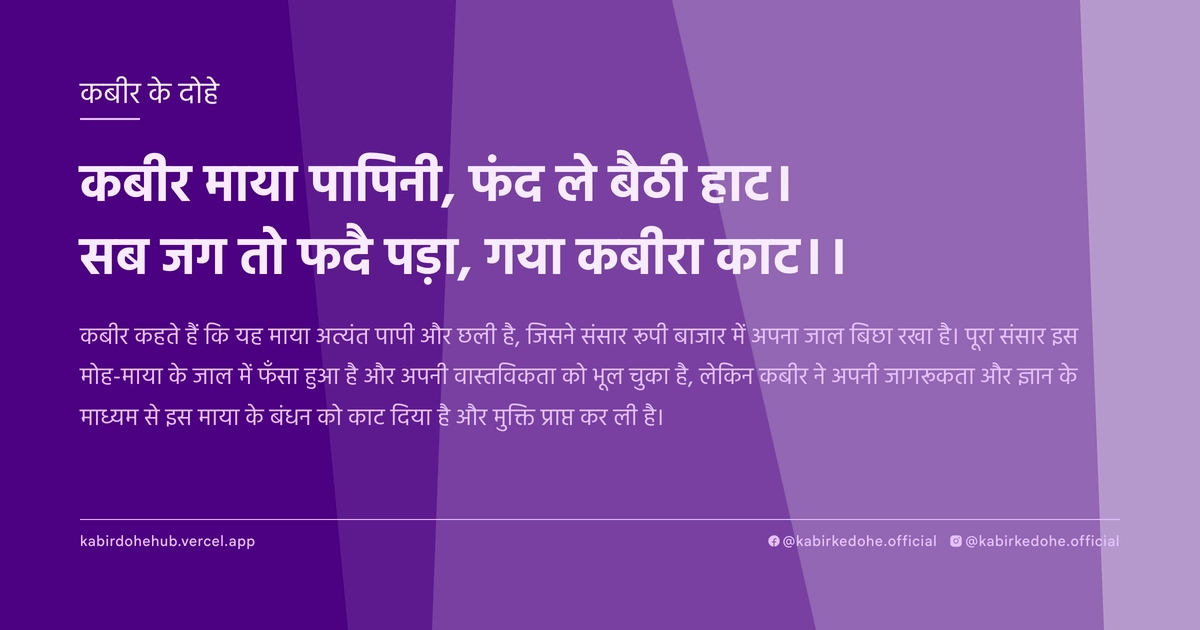
कबीर माया पापिनी, फंद ले बैठी हाट।
सब जग तो फदै पड़ा, गया कबीरा काट।।
Kabir maya papini, phand le baithi haat. Sab jag to phadai pada, gaya Kabira kaat.
इस पृष्ठ पर इस कबीर दोहे का अर्थ (meaning), हिंदी व्याख्या और अंग्रेज़ी अनुवाद, दार्शनिक विश्लेषण और व्यावहारिक जीवन सीख दी गई है। यह दोहा माया (Maya) विषय से जुड़ा है — Kabir doha meaning and explanation in Hindi and English.
अर्थ (Meaning):
कबीर कहते हैं कि यह माया अत्यंत पापी और छली है, जिसने संसार रूपी बाजार में अपना जाल बिछा रखा है। पूरा संसार इस मोह-माया के जाल में फँसा हुआ है और अपनी वास्तविकता को भूल चुका है, लेकिन कबीर ने अपनी जागरूकता और ज्ञान के माध्यम से इस माया के बंधन को काट दिया है और मुक्ति प्राप्त कर ली है।
Kabir declares that Maya, the cosmic illusion, is a sinister deceiver who has spread a wide net within the marketplace of worldly existence. The entire world remains ensnared in this web of attachment and ignorance, blinded by transient desires, but Kabir, through the sword of spiritual awakening and divine knowledge, has severed these bonds and liberated himself.
व्याख्या (Interpretation):
इस दोहे में 'हाट' या बाजार सांसारिक जीवन का प्रतीक है जहाँ हर व्यक्ति अपनी इच्छाओं का व्यापार करता है। माया यहाँ एक शिकारी के रूप में चित्रित है जो सूक्ष्म मोह और आसक्ति के जाल बिछाती है। यह केवल बाहरी धन-संपत्ति नहीं, बल्कि 'मैं' और 'मेरा' का अहंकार है जो आत्मा को सीमित करता है। निरगुण भक्ति के परिप्रेक्ष्य में, माया वह पर्दा है जो ब्रह्म और जीव के बीच खड़ा है। जब साधक अद्वैत वेदांत के ज्ञान को आत्मसात करता है, तो वह समझ जाता है कि वह शरीर नहीं बल्कि शुद्ध चेतना है। कबीर का 'काटना' उस क्षण को दर्शाता है जब विवेक (discrimination) जागृत होता है और अविद्या का नाश होता है। यह विरोधाभास है कि जिसे दुनिया सुख समझती है, वह वास्तव में एक बंधन है।
In this couplet, the 'haat' or marketplace symbolizes the mundane world where every individual trades in desires and expectations. Maya is personified as a cunning hunter who spreads a subtle net of attachment and emotional bondage. This illusion is not merely material wealth, but the profound egoic construct of 'I' and 'Mine' that restricts the infinite soul. From the perspective of Nirgun Bhakti, Maya is the veil that obscures the non-dual reality of Brahman. When the seeker embraces the wisdom of Advaita Vedanta, they realize they are not the transient body but the eternal consciousness. Kabir's act of 'cutting' represents the moment of spiritual awakening where Viveka (discrimination) severs the ties of Avidya (ignorance). It highlights the central paradox: that which the world perceives as pleasure is actually a spiritual prison.
दार्शनिक विश्लेषण (Philosophical Analysis):
कबीर का यह दर्शन उनके समय के कर्मकांडीय धर्म और बाहरी आडंबरों के विरुद्ध एक सशक्त प्रहार है। उन्होंने देखा कि लोग तीर्थों, मूर्तियों और कठोर व्रतों में उलझे हैं, जबकि वास्तविक शत्रु उनके भीतर की माया है। कबीर का दृष्टिकोण सूफी मत के 'फना' (अहंकार का विलीनीकरण) और वेदांत के 'माया' सिद्धांत का एक अनूठा संगम है। वे तर्क देते हैं कि जाति, धर्म और सामाजिक स्थिति केवल माया के अलग-अलग रूप हैं जो मनुष्य को उसकी मूल एकता से अलग करते हैं।
माया का अर्थ यहाँ केवल भ्रम नहीं, बल्कि वह शक्ति है जो सत्य को छिपाती है। कबीर के अनुसार, जब तक मनुष्य स्वयं को इस भौतिक शरीर और सामाजिक पहचान से जोड़कर देखता है, वह माया के जाल में है। यह मनोवैज्ञानिक बंधन है जहाँ भय और इच्छाएं मनुष्य को संचालित करती हैं। वे इस बात पर जोर देते हैं कि मुक्ति किसी बाहरी देवता की कृपा से नहीं, बल्कि आंतरिक जागरूकता और सत्य के साक्षात्कार से आती है।
ऐतिहासिक रूप से, कबीर ने बुनकर समुदाय से होते हुए एक ऐसे मार्ग की खोज की जो सरल और सुलभ था। उन्होंने बताया कि ईश्वर किसी मंदिर या मस्जिद में नहीं, बल्कि हृदय के भीतर है। माया का जाल काटने का अर्थ है—अपनी पहचान को सामाजिक श्रेणियों से ऊपर उठाना। यह एक क्रांतिकारी कदम था जिसने उस समय के कट्टरपंथी समाज की नींव हिला दी।
दार्शनिक स्तर पर, यह दोहा 'सांख्य' और 'वेदांत' के बीच के सेतु का कार्य करता है। जहाँ सांख्य प्रकृति और पुरुष के अलगाव की बात करता है, वहीं कबीर उस अलगाव को मिटाकर एकत्व (Oneness) की बात करते हैं। माया वह 'मायावी' शक्ति है जो एक को अनेक दिखाती है। इस भ्रम को तोड़ना ही वास्तविक ज्ञान है।
अंततः, कबीर यह समझाते हैं कि माया से भागना संभव नहीं है क्योंकि हम उसी में स्थित हैं, लेकिन माया के प्रति 'उदासीन' और 'जागरूक' होना संभव है। जब हम यह जान लेते हैं कि यह संसार एक स्वप्न की तरह है, तो हम इसमें रहते हुए भी इससे मुक्त हो जाते हैं। यही वह 'काट' है जिसका उल्लेख कबीर ने किया है, जो अज्ञान की बेड़ियों को काटकर आत्मा को अनंत विस्तार देता है।
Kabir's philosophy serves as a potent critique of the ritualistic religion and external pomposity of his era. He observed that people were entangled in pilgrimages, idol worship, and rigorous fasts, while the true adversary—the internal Maya—remained unaddressed. Kabir's approach is a unique synthesis of the Sufi concept of 'Fana' (annihilation of the ego) and the Vedantic theory of Maya. He argues that caste, creed, and social status are merely different masks of Maya, designed to alienate the human soul from its primordial unity.
In this context, Maya is not merely a hallucination but the active power that conceals the Absolute Truth. According to Kabir, as long as a human identifies themselves with the physical body and social labels, they remain trapped in the net. This is a psychological bondage where fear and desire dictate existence. He emphasizes that liberation is not granted by the grace of an external deity but is achieved through internal awakening and the direct realization of Truth.
Historically, emerging from the weaver community, Kabir sought a path that was simple and accessible. He proclaimed that the Divine resides not in temples or mosques, but within the heart. Severing the net of Maya means elevating one's identity above social hierarchies. This was a revolutionary act that challenged the foundations of the orthodox society of his time.
On a philosophical plane, this doha acts as a bridge between Samkhya and Vedanta. While Samkhya discusses the separation of Purusha (consciousness) and Prakriti (nature), Kabir speaks of transcending this duality to reach Oneness. Maya is the deceptive force that presents the One as many. Breaking this illusion is the essence of true knowledge.
Ultimately, Kabir explains that escaping Maya is impossible because we exist within it; however, becoming 'indifferent' and 'aware' of it is possible. When we realize that the world is akin to a dream, we remain in it without being bound by it. This is the 'cutting' Kabir refers to—the act of slicing through the chains of ignorance to grant the soul its infinite expansion.
मूल संदेश (Core Message):
- सांसारिक आकर्षण एक सुंदर लेकिन घातक जाल है।
- अहंकार ही वह धागा है जो हमें माया से बांधता है।
- जागरूकता ही वह तलवार है जो मोह के बंधन काटती है।
- सत्य की खोज बाहरी दुनिया में नहीं, आंतरिक शून्य में है।
- मुक्ति का अर्थ संसार छोड़ना नहीं, संसार के प्रति मोह छोड़ना है।
- जब 'मैं' मिटता है, तब 'ब्रह्म' प्रकट होता है।
- Worldly attractions are a beautiful yet lethal snare.
- The ego is the thread that binds us to the illusion.
- Awareness is the only sword that severs the bonds of attachment.
- The search for Truth lies not in the outer world, but in the inner void.
- Liberation is not about leaving the world, but leaving the attachment to it.
- When the 'I' vanishes, the 'Absolute' reveals itself.
व्यावहारिक उदाहरण (Practical Example):
वाराणसी के एक पुराने घाट पर रामदीन नाम का एक वृद्ध नाविक रहता था। उसका पूरा जीवन केवल अधिक पैसे कमाने और अपनी नाव को शहर की सबसे बड़ी नाव बनाने की होड़ में बीता। उसने अपने परिवार को नजरअंदाज किया, अपने स्वास्थ्य की उपेक्षा की और हमेशा इस तनाव में रहा कि कोई दूसरा नाविक उससे आगे न निकल जाए। उसके लिए 'सफलता' का अर्थ था—अधिक धन और सामाजिक प्रतिष्ठा। वह माया के उस जाल में पूरी तरह फँसा था जहाँ वह सोचता था कि अगली बड़ी उपलब्धि उसे शांति देगी।
एक दिन, एक शांत संन्यासी उसकी नाव पर सवार हुए। रामदीन ने अपनी संपत्ति और नाव की श्रेष्ठता का बखान करना शुरू किया। संन्यासी ने मुस्कुराते हुए केवल एक सवाल पूछा, 'रामदीन, यदि आज रात यह नदी सब कुछ बहा ले जाए, तो तुम्हारे पास क्या बचेगा?' रामदीन निशब्द रह गया। उसने महसूस किया कि जिस 'साम्राज्य' को उसने जीवन भर संजोया, वह वास्तव में रेत के महल जैसा था।
उस रात रामदीन सो नहीं पाया। उसने अपनी पूरी जिंदगी का विश्लेषण किया और पाया कि वह केवल बाहरी चमक-धमक के पीछे भाग रहा था, जबकि उसके भीतर का मनुष्य प्यासा था। उसने महसूस किया कि उसकी महत्वाकांक्षाएं वास्तव में उसकी बेड़ियाँ थीं।
अगले कुछ महीनों में, रामदीन का व्यवहार बदलने लगा। उसने अपनी नाव चलाना नहीं छोड़ा, लेकिन अब उसका उद्देश्य बदल गया था। वह अब केवल लाभ के लिए नहीं, बल्कि सेवा के लिए नाव चलाने लगा। उसने गरीब यात्रियों से किराया लेना बंद कर दिया और अपनी कमाई का एक हिस्सा अनाथ बच्चों की शिक्षा में लगाने लगा।
उसके मन का तनाव गायब हो गया। अब वह लहरों को केवल बाधा नहीं, बल्कि संगीत की तरह सुनने लगा। उसके परिवार के साथ उसके संबंध सुधर गए क्योंकि अब वह उनके साथ 'उपस्थित' था, न कि केवल मानसिक रूप से अपने व्यापारिक हिसाबों में खोया हुआ।
गाँव के लोग हैरान थे कि जो रामदीन कभी चिड़चिड़ा और लालची था, वह अब इतना शांत और प्रसन्न कैसे हो गया। रामदीन ने उन्हें बताया कि उसने अपनी 'नाव' नहीं बदली, बल्कि अपनी 'नजर' बदली है।
उसने समझा कि माया वह नहीं है जो हमें दुनिया में रखती है, बल्कि माया वह है जो हमें यह विश्वास दिलाती है कि हम केवल इस दुनिया का हिस्सा हैं। उसने अपनी पहचान को 'नाविक' से ऊपर उठाकर 'मानवता' से जोड़ लिया था।
यह रामदीन का 'कबीर ट्विस्ट' था। उसने माया के जाल को काटा नहीं, बल्कि उसे पारदर्शी बना दिया। अब वह दुनिया में था, लेकिन दुनिया उसके भीतर नहीं थी। वह अब वास्तव में स्वतंत्र था।
On an ancient ghat in Varanasi lived an elderly boatman named Ramdeen. His entire life had been spent in a relentless race to earn more money and make his boat the largest in the city. He ignored his family, neglected his health, and lived in constant anxiety that another boatman might surpass him. For him, 'success' meant more wealth and social prestige. He was completely ensnared in the net of Maya, believing that the next big achievement would finally bring him peace.
One day, a serene monk boarded his boat. Ramdeen began boasting about his wealth and the superiority of his vessel. The monk smiled and asked a single question: 'Ramdeen, if this river swept everything away tonight, what would remain of you?' Ramdeen was speechless. He realized that the 'empire' he had spent a lifetime building was essentially a castle made of sand.
That night, Ramdeen could not sleep. He analyzed his life and found that he had been chasing external glitters while the human within him remained thirsty. He realized that his ambitions were, in reality, his shackles.
Over the next few months, Ramdeen's behavior began to shift. He did not stop rowing his boat, but his purpose had changed. He no longer rowed for profit alone, but for service. He stopped charging poor travelers and began donating a portion of his earnings to the education of orphaned children.
The tension in his mind vanished. He began to hear the river's waves not as obstacles, but as music. His relationship with his family improved because he was now truly 'present' with them, rather than being mentally lost in his business accounts.
Villagers were astonished that the once irritable and greedy Ramdeen had become so calm and joyful. Ramdeen told them that he hadn't changed his boat, but he had changed his vision.
He understood that Maya is not that which keeps us in the world, but that which convinces us that we are *only* a part of this world. He elevated his identity from being a 'boatman' to being a part of 'humanity'.
This was Ramdeen's 'Kabir Twist'. He didn't physically destroy the net of Maya; instead, he made it transparent. He was now in the world, but the world was no longer inside him. He was finally free.
अभ्यास मार्गदर्शन (Practice Guidance):
- दैनिक साक्षी भाव: दिन में तीन बार 10 मिनट के लिए बैठें और अपने विचारों को ऐसे देखें जैसे आप किसी अजनबी को देख रहे हों। यह पहचानें कि 'मैं' विचार नहीं, बल्कि 'विचारों का दृष्टा' हूँ।
- मोह-जांच डायरी: हर शाम उन चीजों की सूची बनाएं जिनसे आप अत्यधिक आसक्त महसूस करते हैं। स्वयं से पूछें, 'यदि यह कल गायब हो जाए, तो क्या मेरी आत्मा की शांति भंग होगी?'
- अहंकार विसर्जन अभ्यास: सप्ताह में एक बार ऐसा कार्य करें जिसमें आपकी कोई प्रशंसा न हो, बल्कि आप गुमनाम रहकर किसी की मदद करें। यह 'मैं' के भ्रम को काटने का तरीका है।
- डायग्नोस्टिक चेकलिस्ट: यदि आप छोटी बातों पर अत्यधिक क्रोधित होते हैं, दूसरों की सफलता से ईर्ष्या करते हैं, या अपनी पहचान को केवल अपने पद/संपत्ति से जोड़ते हैं, तो समझ लें कि माया का जाल अभी भी मजबूत है।
- Daily Witness Consciousness: Sit for 10 minutes three times a day and observe your thoughts as if you are watching a stranger. Recognize that 'I' am not the thought, but the 'witness' of the thought.
- Attachment Audit Journal: Every evening, list the things you feel intensely attached to. Ask yourself, 'If this disappeared tomorrow, would the peace of my soul be disturbed?'
- Ego-Dissolution Practice: Once a week, perform an act of service where you receive no praise and remain anonymous. This is a direct method to sever the illusion of the 'I'.
- Diagnostic Checklist: If you find yourself reacting with excessive anger to trivialities, feeling envy at others' success, or tying your identity solely to your rank or possessions, recognize that the net of Maya is still strong.
चिंतन प्रश्न (Reflection Questions):
- मेरे जीवन का वह कौन सा 'सफेद झूठ' है जिसे मैं सच मानकर जी रहा हूँ?
- यदि मेरी सारी सामाजिक पहचान (पद, नाम, रिश्ता) छीन ली जाए, तो वास्तव में 'मैं' कौन रहूँगा?
- मैं किन चीजों को पाने की दौड़ में अपनी वर्तमान शांति की बलि दे रहा हूँ?
- क्या मेरा धर्म और मेरी आस्था मुझे स्वतंत्र कर रहे हैं, या वे नए बंधन बन गए हैं?
- मेरे भीतर का वह कौन सा डर है जो मुझे सत्य को स्वीकार करने से रोकता है?
- क्या मैं वास्तव में स्वतंत्र हूँ, या मैं केवल अपनी पसंद की जंजीरों में बंधा हूँ?
- What is the 'beautiful lie' in my life that I have mistaken for the truth?
- If all my social identities (rank, name, relationships) were stripped away, who would 'I' actually be?
- In the race to acquire what, am I sacrificing my present peace?
- Is my religion and faith liberating me, or have they become new forms of bondage?
- What is the fear within me that prevents me from accepting the Absolute Truth?
- Am I truly free, or am I merely bound by chains of my own choosing?