
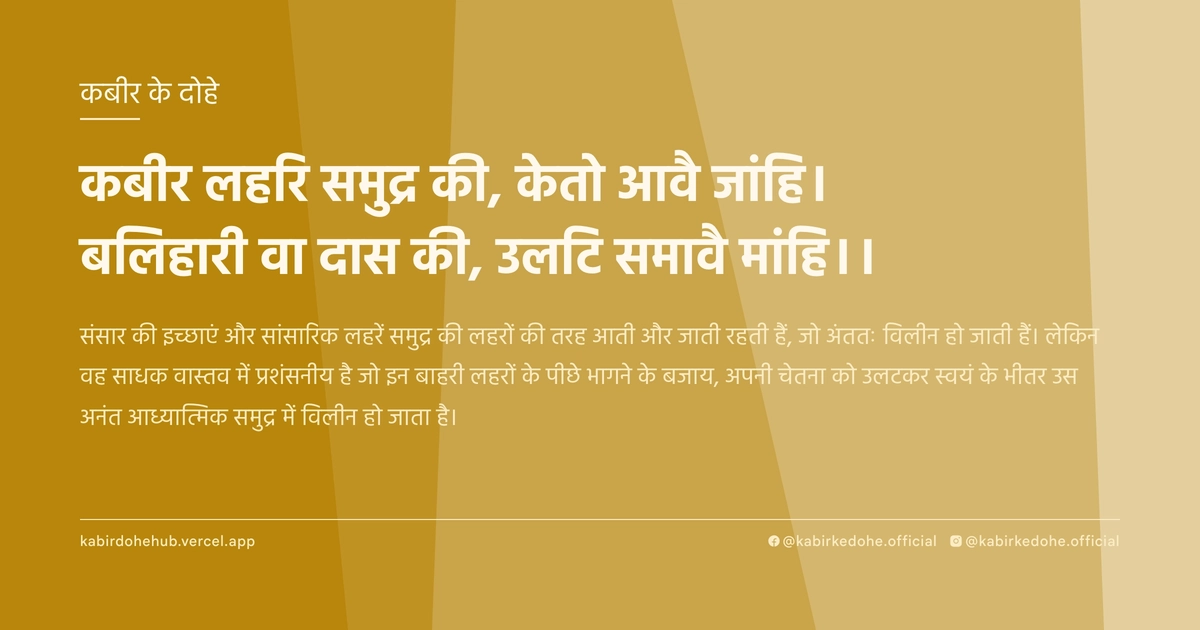
कबीर लहरि समुद्र की, केतो आवै जांहि।
बलिहारी वा दास की, उलटि समावै मांहि।।
Kabir lahari samudra ki, keto aavai jaahin. Balihari va daas ki, ulati samavai maahin.
इस पृष्ठ पर इस कबीर दोहे का अर्थ (meaning), हिंदी व्याख्या और अंग्रेज़ी अनुवाद, दार्शनिक विश्लेषण और व्यावहारिक जीवन सीख दी गई है। यह दोहा प्रपत्ति (Surrender) विषय से जुड़ा है — Kabir doha meaning and explanation in Hindi and English.
अर्थ (Meaning):
संसार की इच्छाएं और सांसारिक लहरें समुद्र की लहरों की तरह आती और जाती रहती हैं, जो अंततः विलीन हो जाती हैं। लेकिन वह साधक वास्तव में प्रशंसनीय है जो इन बाहरी लहरों के पीछे भागने के बजाय, अपनी चेतना को उलटकर स्वयं के भीतर उस अनंत आध्यात्मिक समुद्र में विलीन हो जाता है।
The desires and fluctuations of the worldly existence are like the waves of an ocean, constantly arising and subsiding. However, the true devotee is one who does not merely watch these waves come and go, but instead turns their consciousness inward to merge completely into the primordial ocean of divine consciousness.
व्याख्या (Interpretation):
यहाँ 'समुद्र' माया और संसार का प्रतीक है, जहाँ 'लहरें' हमारी इंद्रियों के सुख और दुखों को दर्शाती हैं। सामान्य मनुष्य इन लहरों के उतार-चढ़ाव में अपना जीवन व्यतीत करता है, जो क्षणभंगुर हैं। 'उलटि समावै' का अर्थ है 'उलटबांसी' या चेतना का विलोम, जहाँ साधक बाहरी जगत से ध्यान हटाकर अंतर्मुखी होता है। यह निर्गुण भक्ति का सार है, जहाँ आत्मा (Atman) यह पहचान लेती है कि वह लहर नहीं, बल्कि स्वयं वह सागर है। यह अद्वैत वेदांत की उस स्थिति को दर्शाता है जहाँ ज्ञाता, ज्ञान और ज्ञेय का भेद समाप्त हो जाता है और केवल शुद्ध चैतन्य शेष रहता है।
In this verse, the 'ocean' symbolizes Maya and the material world, while the 'waves' represent the transient pleasures and pains of sensory experience. The average person spends their life reacting to these fluctuations, which are inherently ephemeral. The phrase 'ulati samavai' refers to the 'inverted' flow of consciousness—a mystical reversal where the seeker shifts their gaze from the external periphery to the internal center. This is the essence of Nirgun Bhakti, where the soul realizes it is not the fleeting wave but the eternal ocean itself. It mirrors the Advaita Vedanta state of non-duality, where the distinction between the observer, the observed, and the process of observation dissolves into pure consciousness.
दार्शनिक विश्लेषण (Philosophical Analysis):
कबीर का यह दोहा मध्यकालीन भारत के उस सामाजिक-धार्मिक संघर्ष का प्रतिबिंब है जहाँ कर्मकांड और बाहरी आडंबरों का बोलबाला था। कबीर ने स्पष्ट किया कि मोक्ष किसी तीर्थ या मंदिर में नहीं, बल्कि चेतना के रूपांतरण में है। वे यहाँ 'उलटबांसी' शैली का प्रयोग कर रहे हैं, जो सूफी मत के 'फना' (अहंकार का विनाश) और वेदांत के 'लय' (विलीन होना) के समान है।
सांसारिक जीवन को लहरों के समान बताकर कबीर यह समझाते हैं कि दुख का कारण लहरों का आना नहीं, बल्कि हमारा उनसे जुड़ाव है। जब तक हम स्वयं को शरीर या मन (लहर) मानते हैं, हम भय और शोक के अधीन रहते हैं। जैसे ही हम यह बोध करते हैं कि हम वह अनंत सागर हैं, भय समाप्त हो जाता है।
यह विश्लेषण जाति और धर्म के भेदभाव को पूरी तरह नकारता है। सागर की लहरों में कोई जाति नहीं होती; उसी तरह, जब आत्मा परमात्मा में विलीन होती है, तो सामाजिक पहचान अर्थहीन हो जाती है। यह एक मनोवैज्ञानिक क्रांति है जहाँ 'मैं' (Ego) का विसर्जन 'हम' (Universal Truth) में होता है।
सूफीवाद के संदर्भ में, यह 'इश्क-ए-हकीकी' (ईश्वरीय प्रेम) की पराकाष्ठा है, जहाँ प्रेमी अपने अस्तित्व को प्रेमी (ईश्वर) में मिटा देता है। यह केवल एक दार्शनिक विचार नहीं, बल्कि एक अनुभवजन्य सत्य है जिसे कबीर ने अपनी सहज साधना से प्राप्त किया था।
अंततः, यह दोहा हमें सिखाता है कि आध्यात्मिक प्रगति का मार्ग बाहर की ओर नहीं, बल्कि भीतर की ओर है। बाहरी दुनिया का शोर केवल एक भ्रम है; वास्तविक शांति उस गहराई में है जहाँ लहरें शांत हो जाती हैं और केवल मौन शेष रहता है।
Kabir's couplet reflects the socio-religious tensions of medieval India, a time dominated by rigid rituals and external displays of piety. He asserts that liberation is not found in pilgrimages or temples, but in the fundamental transformation of consciousness. He employs the 'Ulatbansi' (upside-down language) style, which parallels the Sufi concept of 'Fana' (annihilation of the self) and the Vedantic concept of 'Laya' (dissolution).
By likening worldly life to waves, Kabir explains that suffering stems not from the existence of waves, but from our identification with them. As long as we perceive ourselves as the wave (the individual ego), we remain subjects of fear and grief. The moment we realize we are the ocean (the Absolute), fear vanishes.
This analysis transcends caste and religious boundaries. Just as waves in an ocean have no caste, the soul, upon merging with the Divine, sheds all social identities. This is a psychological revolution where the 'I' is dissolved into the 'All'.
In the context of Sufism, this represents the pinnacle of 'Ishq-e-Haqiqi' (Divine Love), where the lover ceases to exist as a separate entity and becomes one with the Beloved. This is not merely a philosophical proposition but an experiential truth derived from Kabir's intuitive practice.
Ultimately, the verse teaches that the path to spiritual evolution is not outward but inward. The noise of the external world is a mere illusion; true peace resides in the depths where the waves subside and only a profound, primordial silence remains.
मूल संदेश (Core Message):
- बाहरी दुनिया की उथल-पुथल केवल एक भ्रम है।
- दुख का कारण लहरों का होना नहीं, बल्कि उनसे जुड़ाव है।
- सच्ची शांति अंतर्मुखी होने और स्वयं को जानने में है।
- अहंकार का विसर्जन ही परमात्मा में विलीनीकरण है।
- आप वह नहीं हैं जो दुनिया देखती है, आप वह अनंत चेतना हैं।
- The turbulence of the external world is a mere illusion.
- Suffering is not caused by the waves, but by our attachment to them.
- True peace is found in turning inward and knowing the Self.
- The dissolution of the ego is the only path to divine union.
- You are not the identity the world sees; you are the infinite consciousness.
व्यावहारिक उदाहरण (Practical Example):
वाराणसी के एक पुराने घाट पर रहने वाली एक वृद्ध विधवा, जानकी, का जीवन केवल यादों और विलाप की लहरों से भरा था। वह हर दिन गंगा के किनारे बैठकर अपने बीते हुए कल के दुखों को याद करती और मानती कि उसका जीवन केवल अभाव और अकेलेपन का एक अंतहीन सिलसिला है।
उसके लिए, हर नई समस्या एक नई लहर की तरह आती थी—कभी घर की मरम्मत की चिंता, तो कभी स्वास्थ्य की गिरती स्थिति। वह इन लहरों से लड़ती रही, कभी क्रोध में तो कभी गहरे अवसाद में, यह सोचते हुए कि यह संसार उसे केवल पीड़ा देने के लिए बना है।
एक दिन, उसने एक फकीर को देखा जो घाट की भीड़ और शोर के बीच भी एक असीम शांति में डूबा हुआ था। जब जानकी ने उससे पूछा कि वह इस शोर में शांत कैसे है, तो फकीर ने मुस्कुराकर कहा, 'माँ, तुम लहरों को देख रही हो, इसलिए तुम्हें डर लग रहा है। एक बार गहराई में उतरकर देखो, वहाँ कोई लहर नहीं है, केवल शांति है।'
जानकी को पहले यह बात समझ नहीं आई। उसने सोचा कि गहराई में तो केवल अंधेरा और डर होता है। लेकिन उसने फकीर की बात मानकर अपनी आँखें बंद कीं और अपने भीतर के शोर को देखना शुरू किया।
उसने महसूस किया कि उसके मन में उठने वाले दुख, क्रोध और शिकायतें भी ठीक वैसी ही लहरें हैं जैसी गंगा की सतह पर दिखती हैं। उसने यह देखना शुरू किया कि ये भावनाएं आती हैं और चली जाती हैं, लेकिन उसके भीतर कुछ ऐसा है जो इन सबके बावजूद स्थिर है।
धीरे-धीरे, जानकी ने अपनी पहचान अपनी 'दुखियारी विधवा' की छवि से हटाकर उस आंतरिक स्थिरता पर केंद्रित करना शुरू किया। उसने पाया कि जब वह स्वयं को केवल एक 'लहर' नहीं मानती, तो बाहरी परिस्थितियाँ उसे विचलित नहीं करतीं।
अब, जब भी कोई समस्या आती, वह कहती, 'यह केवल एक लहर है, मैं सागर हूँ।' इस छोटे से बदलाव ने उसके जीवन के प्रति दृष्टिकोण को पूरी तरह बदल दिया।
उसने अपने अकेलेपन को 'एकांत' में बदल दिया। वह अब दूसरों के दुखों को देखकर विलाप नहीं करती थी, बल्कि उन्हें यह याद दिलाने लगी कि वे भी उस अनंत शांति का हिस्सा हैं।
उसकी आँखों में अब शोक नहीं, बल्कि एक ऐसी करुणा थी जो केवल उसी व्यक्ति में हो सकती है जिसने अपने भीतर के सागर को खोज लिया हो। वह अब लहरों से डरती नहीं थी, बल्कि उनमें नृत्य करना सीख गई थी।
जानकी का रूपांतरण यह सिद्ध करता है कि जब हम अपनी चेतना को उलटकर भीतर की ओर मोड़ते हैं, तो संसार की सबसे बड़ी समस्या भी एक छोटी सी लहर बनकर रह जाती है।
Janaki, an elderly widow living on an ancient ghat in Varanasi, spent her days immersed in waves of memory and lamentation. Sitting by the Ganges, she viewed her life as an endless sequence of deprivation and loneliness, believing her existence was defined by loss.
For her, every new problem arrived like a wave—sometimes a worry about house repairs, other times a decline in health. She fought these waves with anger and deep depression, convinced that the world existed only to cause her pain.
One day, she noticed a wandering dervish who remained in a state of absolute serenity despite the chaos and noise of the ghats. When Janaki asked how he could be so peaceful amidst the clamor, the dervish smiled and said, 'Mother, you are watching the waves, and that is why you are afraid. Dive into the depths; there are no waves there, only silence.'
Janaki initially struggled to grasp this. She believed the depths held only darkness and fear. However, following the dervish's advice, she closed her eyes and began to observe the noise within her own mind.
She realized that the grief, anger, and complaints arising in her heart were exactly like the waves on the surface of the Ganges. She observed that these emotions arrived and departed, but there was something within her that remained steadfast despite them all.
Gradually, Janaki shifted her identity from the 'suffering widow' to that internal stability. She discovered that when she stopped identifying as a 'wave,' external circumstances lost their power to disturb her.
Now, whenever a problem arose, she would tell herself, 'This is merely a wave; I am the ocean.' This subtle shift in perspective completely transformed her existence.
She turned her loneliness into 'solitude.' Instead of mourning with others, she began reminding them that they too were parts of that infinite peace.
Her eyes no longer held sorrow, but a compassion that only comes to one who has discovered the ocean within. She no longer feared the waves; she learned to dance within them.
Janaki's transformation proves that when we invert our consciousness and turn it inward, the greatest problems of the world shrink into mere ripples on a vast, calm sea.
अभ्यास मार्गदर्शन (Practice Guidance):
- प्रतिदिन 20 मिनट 'साक्षी भाव' का अभ्यास करें: अपने विचारों को लहरों की तरह देखें, उनसे जुड़ें नहीं, बस उन्हें आते-जाते देखें।
- स्व-पूछताछ जर्नल: प्रतिदिन लिखें—'आज किस भावना ने मुझे लहर की तरह विचलित किया और मेरा वह कौन सा हिस्सा था जो स्थिर रहा?'
- व्यवहारिक परिवर्तन: जब भी क्रोध या तनाव महसूस हो, तुरंत रुकें और स्वयं से कहें, 'मैं यह भावना नहीं हूँ, मैं वह आकाश हूँ जिसमें यह भावना उठ रही है।'
- निदान चेकलिस्ट: यदि आप छोटी बातों पर अत्यधिक प्रतिक्रिया दे रहे हैं, तो आप 'लहर' में हैं। यदि आप समस्या के बीच भी तटस्थ महसूस कर रहे हैं, तो आप 'सागर' की ओर बढ़ रहे हैं।
- Practice 'Witness Consciousness' (Sakshi Bhava) for 20 minutes daily: Observe your thoughts as waves; do not attach to them, simply watch them arise and subside.
- Self-Inquiry Journaling: Write daily—'Which emotion acted as a wave that disturbed me today, and which part of me remained the steady ocean?'
- Behavioral Shift: Whenever anger or stress arises, pause immediately and affirm, 'I am not this emotion; I am the vast space in which this emotion is occurring.'
- Diagnostic Checklist: If you are overreacting to trivialities, you are identifying with the 'wave.' If you feel neutral and spacious even amidst chaos, you are aligning with the 'ocean.'
चिंतन प्रश्न (Reflection Questions):
- आपकी वह कौन सी 'सामाजिक पहचान' है जिसे आप लहर मानकर पकड़ कर बैठे हैं, जबकि वह वास्तव में क्षणभंगुर है?
- जब आप अकेले होते हैं और कोई देख नहीं रहा होता, तब आपके भीतर कौन सी लहरें सबसे अधिक शोर करती हैं?
- क्या आपकी डिजिटल पहचान (सोशल मीडिया) आपके वास्तविक 'सागर' को छिपाने का एक माध्यम बन गई है?
- आप किस डर से अपने भीतर की गहराई में उतरने से कतराते हैं—क्या वह अंधेरा है या अपनी वास्तविकता का सामना करना?
- यदि आपकी सारी उपलब्धियाँ और रिश्ते आज समाप्त हो जाएं, तो आपके भीतर क्या शेष बचेगा?
- Which 'social identity' are you clinging to as a wave, even though it is fundamentally transient?
- When you are alone and unobserved, which internal waves create the most noise within you?
- Has your digital persona become a tool to mask the void or hide your true 'ocean' from the world?
- What fear prevents you from diving into your own depths—is it the darkness or the confrontation with your true self?
- If all your achievements and relationships were stripped away today, what would remain of you?