
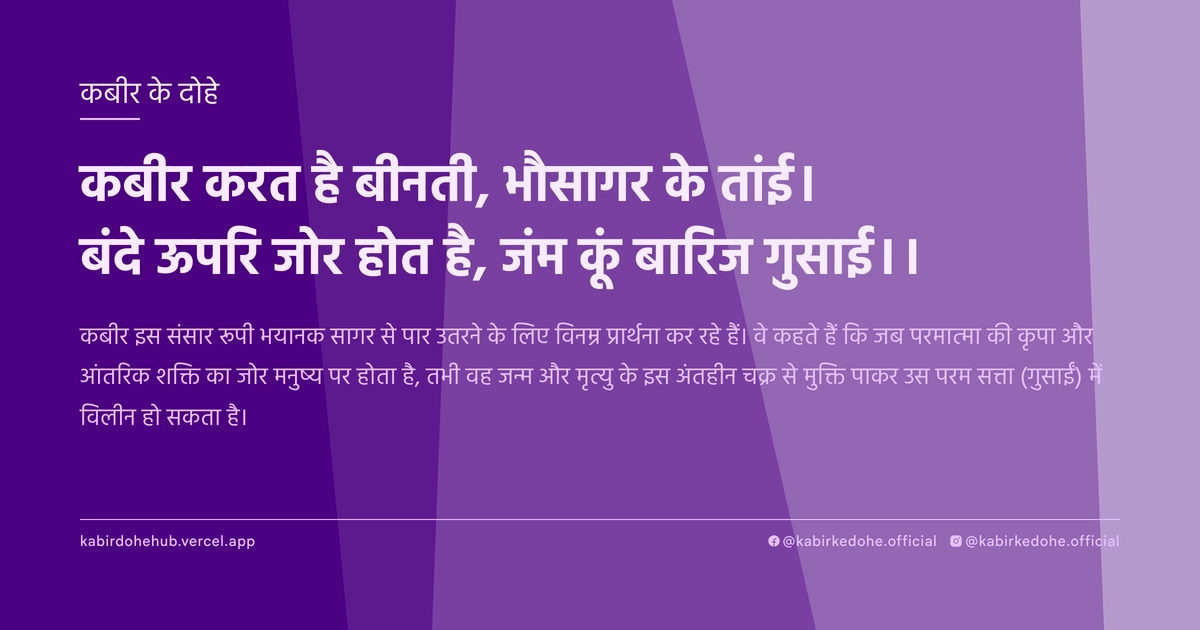
कबीर करत है बीनती, भौसागर के तांई।
बंदे ऊपरि जोर होत है, जंम कूं बारिज गुसाई।।
Kabir karat hai beenati, bhousagar ke taanai. Bande upari jor hot hai, jam koon baarij gusai.
इस पृष्ठ पर इस कबीर दोहे का अर्थ (meaning), हिंदी व्याख्या और अंग्रेज़ी अनुवाद, दार्शनिक विश्लेषण और व्यावहारिक जीवन सीख दी गई है। यह दोहा मुक्ति (Liberation) विषय से जुड़ा है — Kabir doha meaning and explanation in Hindi and English.
अर्थ (Meaning):
कबीर इस संसार रूपी भयानक सागर से पार उतरने के लिए विनम्र प्रार्थना कर रहे हैं। वे कहते हैं कि जब परमात्मा की कृपा और आंतरिक शक्ति का जोर मनुष्य पर होता है, तभी वह जन्म और मृत्यु के इस अंतहीन चक्र से मुक्ति पाकर उस परम सत्ता (गुसाईं) में विलीन हो सकता है।
Kabir offers a humble prayer to cross the formidable ocean of worldly existence. He asserts that only when the divine will and spiritual strength prevail over the individual, can one break the shackles of the cycle of birth and death to merge with the Eternal Master.
व्याख्या (Interpretation):
इस दोहे का शाब्दिक अर्थ संसार रूपी सागर से मुक्ति की पुकार है। रूपक के तौर पर, 'भौसागर' माया के उस मोहजाल को दर्शाता है जिसमें आत्मा फंसी हुई है। यहाँ 'जोर' का अर्थ अहंकार का दमन और ईश्वरीय कृपा का उदय है। यह निर्गुण भक्ति का सार है, जहाँ भक्त यह स्वीकार करता है कि केवल व्यक्तिगत प्रयास पर्याप्त नहीं हैं, बल्कि आत्म-समर्पण आवश्यक है। अद्वैत वेदांत के अनुसार, जब 'मैं' (अहंकार) समाप्त होता है, तब केवल 'ब्रह्म' शेष रहता है। यह विरोधाभास है कि मुक्ति पाने के लिए पहले अपनी इच्छाओं का त्याग करना पड़ता है। अंततः, यह जन्म-मरण के बंधन से छूटकर शुद्ध चेतना में विलीन होने की प्रक्रिया है।
Literally, this verse is a plea for liberation from the ocean of existence. Metaphorically, 'Bhousagar' represents the deceptive web of Maya in which the soul is entangled. The term 'Jor' signifies the suppression of the ego and the descent of divine grace. This encapsulates the essence of Nirgun Bhakti, where the seeker realizes that individual effort alone is insufficient; total surrender is paramount. According to Advaita Vedanta, when the 'I' (ego) dissolves, only 'Brahman' remains. The central paradox is that to attain liberation, one must first relinquish the desire for it. Ultimately, it describes the process of breaking the cycle of Samsara to merge into pure consciousness.
दार्शनिक विश्लेषण (Philosophical Analysis):
कबीर का यह दोहा उस कालखंड का प्रतिबिंब है जब समाज कर्मकांडों और बाहरी आडंबरों में उलझा था। कबीर ने स्पष्ट किया कि मोक्ष किसी तीर्थ या मंदिर से नहीं, बल्कि आंतरिक रूपांतरण से मिलता है। उन्होंने जाति और धर्म की सीमाओं को तोड़कर एक ऐसे मार्ग की बात की जो सीधे आत्मा को परमात्मा से जोड़ता है।
दार्शनिक स्तर पर, यह सूफी मत के 'फना' (अहंकार का विनाश) और वेदांत के 'अद्वैत' (गैर-द्वैत) का संगम है। कबीर यहाँ यह समझा रहे हैं कि मनुष्य अपनी सीमित बुद्धि से इस मायावी सागर को पार नहीं कर सकता। जब तक व्यक्ति स्वयं को कर्ता मानता है, वह बंधन में रहता है। जैसे ही वह स्वयं को परमात्मा की इच्छा के अधीन करता है, वह बंधन टूट जाता है।
यहाँ 'गुसाईं' शब्द केवल एक स्वामी को नहीं, बल्कि उस सार्वभौमिक चेतना को दर्शाता है जो कण-कण में व्याप्त है। कबीर का विरोध उन धर्मगुरुओं से था जो मोक्ष का व्यापार करते थे। उन्होंने सिखाया कि सच्ची भक्ति वह है जो मनुष्य को उसके सामाजिक मुखौटों से मुक्त कर उसे उसकी वास्तविक स्वरूप से परिचित कराए।
मनोवैज्ञानिक रूप से, यह दोहा 'अहंकार के विसर्जन' की बात करता है। जब मनुष्य अपनी सीमाओं को स्वीकार करता है और एक उच्च शक्ति के प्रति समर्पित होता है, तो उसका मानसिक तनाव समाप्त हो जाता है और वह शांति का अनुभव करता है। यह समर्पण कमजोरी नहीं, बल्कि सर्वोच्च मानसिक शक्ति है।
अंततः, कबीर यह संदेश देते हैं कि जन्म और मृत्यु का चक्र केवल उन्हीं के लिए है जो माया के भ्रम में जी रहे हैं। जो व्यक्ति अपनी आत्मा को पहचान लेता है और उसे उस निराकार ब्रह्म में विलीन कर देता है, उसके लिए यह संसार एक खेल मात्र रह जाता है।
This couplet reflects an era where society was deeply entrenched in rituals and outward displays of piety. Kabir clarifies that liberation is not achieved through pilgrimages or temples, but through internal transformation. He transcends the boundaries of caste and religion to propose a path that connects the soul directly to the Divine.
Philosophically, this is a convergence of the Sufi concept of 'Fana' (annihilation of the ego) and the Vedantic principle of 'Advaita' (non-duality). Kabir explains that a human cannot cross the illusory ocean of Maya using limited intellectual effort. As long as one perceives themselves as the 'doer,' they remain bound. The moment they align their will with the Divine, the shackles break.
The term 'Gusai' does not merely refer to a master, but to the universal consciousness pervading every atom. Kabir's rebellion was directed at the religious authorities who commodified salvation. He taught that true devotion is that which strips away social masks and introduces the individual to their true nature.
Psychologically, the verse addresses the 'dissolution of the ego.' When a person accepts their limitations and surrenders to a higher power, mental anguish ceases, and peace emerges. This surrender is not a sign of weakness but the highest form of psychological strength.
Ultimately, Kabir suggests that the cycle of birth and death exists only for those living in the illusion of Maya. For the one who recognizes the soul and merges it into the formless Brahman, the world becomes nothing more than a divine play.
मूल संदेश (Core Message):
- अहंकार का त्याग ही वास्तविक मुक्ति का एकमात्र द्वार है।
- संसार की माया एक सागर है, जिसे केवल समर्पण से पार किया जा सकता है।
- व्यक्तिगत प्रयास जब ईश्वरीय कृपा से मिलते हैं, तब मोक्ष संभव होता है।
- जन्म और मृत्यु का चक्र केवल अज्ञानता और मोह का परिणाम है।
- परम सत्य वह है जहाँ 'मैं' समाप्त होता है और 'वह' शुरू होता है।
- The relinquishment of ego is the only gateway to true liberation.
- The illusion of the world is an ocean crossable only through surrender.
- Moksha is possible when individual effort aligns with divine grace.
- The cycle of birth and death is merely a result of ignorance and attachment.
- The ultimate truth is where the 'I' ends and the 'Divine' begins.
व्यावहारिक उदाहरण (Practical Example):
एक समय की बात है, वाराणसी के घाटों पर माधव नाम का एक वृद्ध नाविक रहता था। माधव का जीवन केवल नाव चलाने और यात्रियों को पार उतारने तक सीमित था, लेकिन उसका मन हमेशा इस बात से परेशान रहता था कि वह अपने जीवन में कुछ बड़ा क्यों नहीं कर पाया। वह अपनी गरीबी और अपनी किस्मत को कोसता रहता था।
माधव का अहंकार उसकी 'बेचारगी' में छिपा था। वह मानता था कि दुनिया उसके साथ अन्याय कर रही है। वह हर दिन गंगा किनारे बैठकर ईश्वर से शिकायत करता कि उसे एक समृद्ध जीवन क्यों नहीं मिला। उसका क्रोध और उसकी शिकायतें ही उसका 'भौसागर' थीं, जिसने उसे शांति से दूर रखा था।
एक दिन, माधव की मुलाकात एक मौन साधु से हुई। साधु ने माधव की बेचैनी देखी और केवल एक वाक्य कहा, "तुम नाव को पार उतारने की कोशिश कर रहे हो, लेकिन क्या तुमने कभी उस धारा को महसूस किया जो नाव को ले जा रही है?"
माधव को पहले तो यह बात समझ नहीं आई। लेकिन अगले कुछ दिनों तक उसने ध्यान देना शुरू किया कि कैसे नदी की धारा बिना किसी प्रयास के नाव को आगे बढ़ाती है। उसने महसूस किया कि वह अब तक केवल चप्पू चलाने के संघर्ष में था, जबकि नदी की शक्ति पहले से ही मौजूद थी।
धीरे-धीरे माधव ने अपनी शिकायतों को छोड़ना शुरू किया। उसने यह स्वीकार किया कि वह इस ब्रह्मांड की एक छोटी सी इकाई है और उसकी इच्छाएं केवल भ्रम हैं। उसने अपनी मेहनत को 'सेवा' में बदल दिया। अब वह यात्रियों को केवल पैसे के लिए नहीं, बल्कि प्रेम के लिए पार उतारता था।
एक दिन एक बड़ा तूफान आया। अन्य नाविक डर गए और अपनी नावों को बचाने के लिए संघर्ष करने लगे, जिससे कई नावें आपस में टकराकर डूब गईं। लेकिन माधव ने अपनी नाव को धारा के हवाले कर दिया और केवल सही दिशा देने पर ध्यान केंद्रित किया।
उसने महसूस किया कि जब वह लड़ना छोड़कर 'समर्पण' करता है, तो वह सुरक्षित रहता है। उसने अपनी नाव को डूबने से बचा लिया और कई अन्य लोगों की जान भी बचाई।
इस अनुभव ने माधव के भीतर के अहंकार को पूरी तरह नष्ट कर दिया। उसे समझ आया कि 'जोर' उसकी अपनी ताकत में नहीं, बल्कि उस परम धारा (ईश्वर) के साथ बहने में है।
अब माधव के लिए गरीबी कोई समस्या नहीं थी। वह उसी छोटी सी नाव में उस परम आनंद को महसूस करने लगा जिसे वह महलों में खोज रहा था।
उसका जीवन अब जन्म-मृत्यु के भय से मुक्त था, क्योंकि उसने जीवित रहते हुए ही उस 'गुसाईं' के चरणों में खुद को समर्पित कर दिया था।
Once, on the ghats of Varanasi, lived an elderly boatman named Madhav. Madhav's life was limited to rowing his boat and ferrying passengers, yet his mind was perpetually troubled by the feeling that he had achieved nothing significant in life. He constantly lamented his poverty and his fate.
Madhav's ego was hidden in his 'victimhood.' He believed the world was unfair to him. Every day, sitting by the Ganges, he complained to God about why he wasn't born into wealth. His anger and grievances were his 'Bhousagar,' keeping him far from peace.
One day, Madhav encountered a silent monk. Observing Madhav's restlessness, the monk spoke a single sentence: "You are trying to push the boat across, but have you ever felt the current that is already carrying the boat?"
At first, Madhav didn't understand. But over the next few days, he began to notice how the river's current moved the boat forward without any effort. He realized he had been struggling solely with the oars, ignoring the power that was already present.
Gradually, Madhav stopped complaining. He accepted that he was a tiny unit in this vast universe and that his desires were mere illusions. He transformed his hard work into 'service.' He no longer ferried passengers for money alone, but out of love.
One day, a massive storm hit. Other boatmen panicked and struggled violently to save their boats, causing many to collide and sink. However, Madhav surrendered his boat to the current, focusing only on steering it in the right direction.
He realized that when he stopped fighting and practiced 'surrender,' he remained safe. He saved his boat and rescued many others in the process.
This experience completely annihilated the ego within Madhav. He understood that 'strength' did not lie in his own muscles, but in flowing with the supreme current (the Divine).
Now, poverty was no longer a problem for Madhav. In that small boat, he began to feel the supreme bliss he had once searched for in palaces.
His life was now free from the fear of birth and death, for while still alive, he had surrendered himself to the feet of the 'Gusai.'
अभ्यास मार्गदर्शन (Practice Guidance):
- प्रतिदिन 20 मिनट के लिए 'साक्षी भाव' का अभ्यास करें, जहाँ आप अपने विचारों को बिना किसी निर्णय के केवल एक दर्शक की तरह देखें।
- एक डायरी लिखें जिसमें आप उन स्थितियों को दर्ज करें जहाँ आपका अहंकार (I-ness) आपको तनाव दे रहा है, और फिर उसे 'परमात्मा की इच्छा' के रूप में समर्पित करने का प्रयास करें।
- व्यवहार परिवर्तन: दिन में कम से कम एक कार्य ऐसा करें जिसमें आपको कोई श्रेय (credit) न मिले और आप उसे पूरी तरह गुमनाम रहकर करें।
- निदान चेकलिस्ट: क्या मैं अभी भी परिणामों को नियंत्रित करने की कोशिश कर रहा हूँ? क्या मैं अपनी विफलताओं के लिए दूसरों को दोष दे रहा हूँ? यदि हाँ, तो मैं अभी भी 'भौसागर' में हूँ।
- Practice 'Witness Consciousness' (Sakshi Bhav) for 20 minutes daily, observing your thoughts as a detached spectator without judgment.
- Maintain a journal recording situations where your ego (I-ness) causes stress, and then consciously practice surrendering those outcomes to the Divine Will.
- Behavioral Change: Perform at least one act of service daily where you receive no credit and remain completely anonymous.
- Diagnostic Checklist: Am I still trying to control the outcomes? Am I blaming others for my failures? If yes, I am still entangled in the 'Bhousagar'.
चिंतन प्रश्न (Reflection Questions):
- मेरी वह कौन सी 'उपलब्धियाँ' हैं जिन्हें मैं अपनी निजी संपत्ति मानता हूँ, जबकि वे वास्तव में समय और परिस्थिति की देन हैं?
- जब मैं कहता हूँ कि 'मैं दुखी हूँ', तो वह 'मैं' कौन है? क्या वह मेरी आत्मा है या मेरा निर्मित सामाजिक व्यक्तित्व?
- क्या मेरा आध्यात्मिक मार्ग वास्तव में मुक्ति के लिए है, या यह केवल मेरे अहंकार को एक 'धार्मिक' पहचान देने का नया तरीका है?
- यदि आज मेरा सारा सामाजिक सम्मान और पद छीन लिया जाए, तो मेरे भीतर क्या बचेगा?
- मैं किन चीजों को पकड़े हुए हूँ जिन्हें छोड़ने पर मुझे डर लगता है, और वह डर वास्तव में किस चीज का है?
- Which of my 'achievements' do I claim as personal property, while they are actually gifts of time and circumstance?
- When I say 'I am sad,' who is this 'I'? Is it my soul or my constructed social persona?
- Is my spiritual path truly for liberation, or is it just a new way for my ego to acquire a 'religious' identity?
- If all my social respect and status were stripped away today, what would remain within me?
- What am I clinging to that I fear letting go of, and what is the actual root of that fear?