
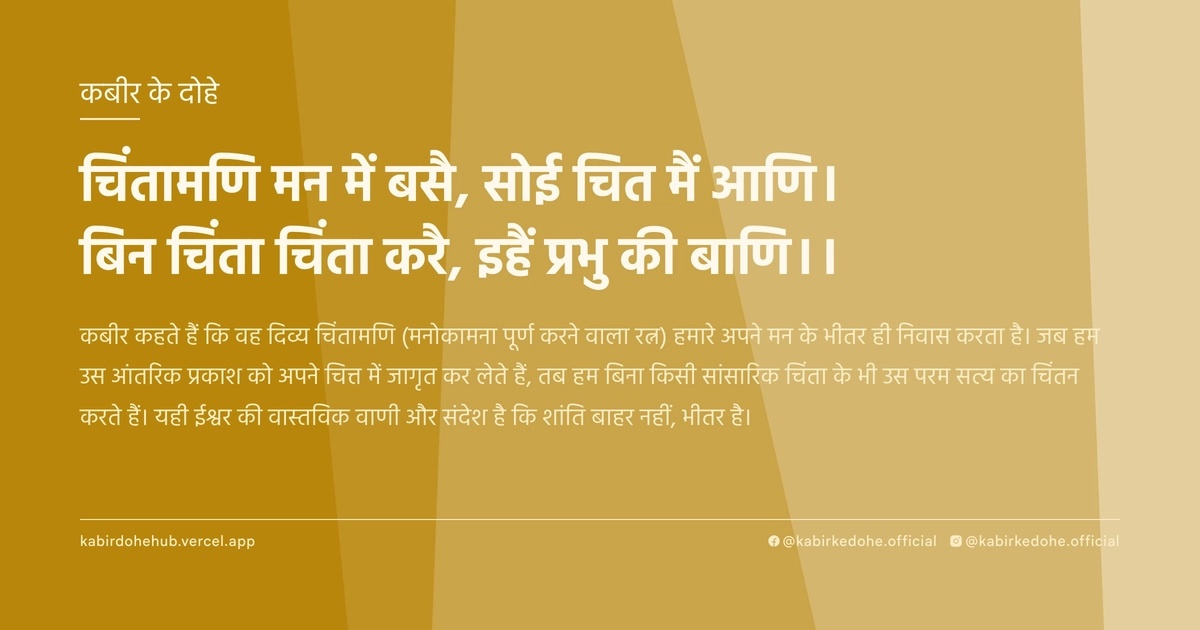
चिंतामणि मन में बसै, सोई चित मैं आणि।
बिन चिंता चिंता करै, इहैं प्रभु की बाणि।।
Chintamani man mein basai, soi chit main aani. Bin chinta chinta karai, ihai prabhu ki baani.
इस पृष्ठ पर इस कबीर दोहे का अर्थ (meaning), हिंदी व्याख्या और अंग्रेज़ी अनुवाद, दार्शनिक विश्लेषण और व्यावहारिक जीवन सीख दी गई है। यह दोहा मन नियंत्रण (Mind Control) विषय से जुड़ा है — Kabir doha meaning and explanation in Hindi and English.
अर्थ (Meaning):
कबीर कहते हैं कि वह दिव्य चिंतामणि (मनोकामना पूर्ण करने वाला रत्न) हमारे अपने मन के भीतर ही निवास करता है। जब हम उस आंतरिक प्रकाश को अपने चित्त में जागृत कर लेते हैं, तब हम बिना किसी सांसारिक चिंता के भी उस परम सत्य का चिंतन करते हैं। यही ईश्वर की वास्तविक वाणी और संदेश है कि शांति बाहर नहीं, भीतर है।
Kabir asserts that the 'Chintamani'—the mythical wish-fulfilling gem—resides within the human mind. When one brings this inner awareness into their conscious focus, they engage in a 'worry-less worry,' which is the meditative contemplation of the Divine. This is the true word of the Lord: that the source of all fulfillment is internal, not external.
व्याख्या (Interpretation):
शाब्दिक रूप से, यह दोहा मन के भीतर छिपे खजाने की बात करता है। रूपकात्मक स्तर पर, 'चिंतामणि' हमारी अंतरात्मा या शुद्ध चेतना (Pure Consciousness) का प्रतीक है। कबीर यहाँ एक विरोधाभास प्रस्तुत करते हैं: 'बिन चिंता चिंता करै'। इसका अर्थ है कि सांसारिक व्याकुलता (Anxiety) को त्यागकर आध्यात्मिक चिंतन (Contemplation) को अपनाना। यह निर्गुण भक्ति का सार है, जहाँ ईश्वर किसी मूर्ति में नहीं, बल्कि स्वयं के भीतर स्थित है। जब माया का पर्दा हटता है, तो आत्मा और ब्रह्म की एकता का अनुभव होता है। यह द्वैत से अद्वैत की ओर संक्रमण है, जहाँ साधक यह समझता है कि जिसे वह बाहर खोज रहा था, वह उसके हृदय में ही था।
Literally, the verse speaks of a hidden treasure within the mind. Metaphorically, the 'Chintamani' symbolizes the Atman or Pure Consciousness. Kabir presents a profound paradox: 'worrying without worry.' This signifies the transition from worldly anxiety (Chinta) to spiritual contemplation (Dhyana). It is the essence of Nirgun Bhakti, where the Divine is not an external entity but the innermost core of the self. When the veil of Maya is lifted, the non-duality of Atman and Brahman is realized. The central paradox highlights the human condition: we suffer from lack while possessing the very source of abundance within us, blinded by the ego's outward gaze.
दार्शनिक विश्लेषण (Philosophical Analysis):
कबीर का यह दोहा उस कालखंड की प्रतिक्रिया है जब धर्म केवल बाहरी कर्मकांडों और तीर्थयात्राओं तक सीमित था। उन्होंने स्पष्ट किया कि मोक्ष किसी बाहरी स्थान पर जाने से नहीं, बल्कि आंतरिक रूपांतरण से मिलता है। यह विचार अद्वैत वेदांत के 'अहं ब्रह्मास्मि' (मैं ही ब्रह्म हूँ) के सिद्धांत से गहराई से जुड़ा है, जहाँ व्यक्तिगत चेतना और सार्वभौमिक चेतना का भेद समाप्त हो जाता है।
सूफीवाद के 'इंसान-ए-कामिल' (पूर्ण मानव) की अवधारणा यहाँ झलकती है, जहाँ हृदय को ईश्वर का दर्पण माना गया है। कबीर तर्क देते हैं कि यदि मन ही दूषित है, तो बाहरी पूजा व्यर्थ है। वे जाति और संप्रदाय के भेदभाव को नकारते हुए यह संदेश देते हैं कि आध्यात्मिक क्षमता किसी विशेष वर्ग की बपौती नहीं है, बल्कि हर मनुष्य के भीतर वह 'चिंतामणि' मौजूद है।
मनोवैज्ञानिक स्तर पर, यह दोहा 'चिंता' (Anxiety) और 'चिंतन' (Reflection) के बीच के सूक्ष्म अंतर को स्पष्ट करता है। चिंता भविष्य के डर और अभाव से पैदा होती है, जबकि चिंतन वर्तमान की पूर्णता और अस्तित्व के बोध से। अहंकार का विसर्जन ही वह कुंजी है जिससे इस आंतरिक रत्न तक पहुँचा जा सकता है।
सांसारिक लोग अक्सर 'चिंतामणि' को एक जादुई वस्तु मानते हैं, लेकिन कबीर इसे एक मानसिक अवस्था के रूप में परिभाषित करते हैं। यह वह अवस्था है जहाँ इच्छाएँ समाप्त हो जाती हैं और केवल 'होने' का आनंद शेष रहता है। यहाँ भक्ति का अर्थ किसी देवता की चापलूसी नहीं, बल्कि स्वयं की वास्तविकता को पहचानना है।
अंततः, यह शिक्षण हमें सिखाता है कि बाहरी दुनिया केवल एक प्रतिबिंब है। जब हम अपने भीतर के केंद्र (Center) को पा लेते हैं, तो बाहरी उथल-पुथल हमें विचलित नहीं करती। यह पूर्ण समर्पण और आत्म-साक्षात्कार का मार्ग है, जो मनुष्य को मानसिक गुलामी से मुक्त कर उसे आध्यात्मिक स्वतंत्रता प्रदान करता है।
This verse is a direct critique of the ritualistic rigidity of Kabir's era, where spirituality was reduced to external pilgrimages and priestly intermediaries. Kabir asserts that liberation is not a destination but an internal transformation. This aligns profoundly with the Advaita Vedanta principle of 'Aham Brahmasmi' (I am Brahman), where the distinction between the individual soul and the universal consciousness dissolves.
There is a strong resonance with the Sufi concept of 'Insan-i-Kamil' (the Perfect Human), viewing the heart as a mirror reflecting the Divine. Kabir argues that if the mind is clouded by ego and desire, external rituals are futile. By rejecting caste and creed, he democratizes spirituality, suggesting that the 'Chintamani' is an innate capacity available to all, regardless of social standing.
Psychologically, the verse distinguishes between 'Chinta' (anxiety rooted in lack and fear) and 'Chintan' (contemplation rooted in presence and being). The annihilation of the ego is the only mechanism through which one can access this inner gem. Most people mistake the Chintamani for a magical object, but Kabir defines it as a state of consciousness.
In the context of the Bhakti movement, this represents the shift from Saguna (form) to Nirgun (formless). The devotee stops pleading with a distant deity and starts observing the silent witness within. This internal shift corrects the common misconception that spirituality requires the abandonment of the world; rather, it requires the abandonment of the 'false self' while living in the world.
Ultimately, Kabir teaches that the external world is merely a reflection. Once the center is found, the periphery ceases to disturb. This is the path of total surrender to the Truth, liberating the human spirit from the psychological bondage of desire and the illusion of separation.
मूल संदेश (Core Message):
- बाहरी खोज एक भ्रम है; वास्तविक समाधान भीतर है।
- चिंता को चिंतन में बदलकर ही शांति प्राप्त होती है।
- अहंकार का विसर्जन ही आंतरिक रत्न की प्राप्ति है।
- आप वह नहीं हैं जो आप सोचते हैं, आप वह हैं जो देख रहा है।
- पूर्णता कहीं पहुँचने में नहीं, बल्कि स्वयं में ठहरने में है।
- External searching is an illusion; the true solution lies within.
- Peace is attained only by transforming anxiety into contemplation.
- The dissolution of ego is the only key to the inner gem.
- You are not the one who thinks, but the one who observes the thinking.
- Wholeness is not about arriving somewhere, but about resting in oneself.
व्यावहारिक उदाहरण (Practical Example):
वाराणसी के एक पुराने घाट पर माधव नाम का एक वृद्ध नाविक रहता था। माधव का पूरा जीवन दूसरों को नदी पार कराने में बीता, लेकिन उसका अपना मन हमेशा अशांति और अभावों से घिरा रहता था। वह हमेशा इस चिंता में रहता कि कल उसके पास पर्याप्त सवारी होगी या नहीं, या उसका पुराना नाव कब टूट जाएगा। वह अक्सर मंदिरों में जाकर अपनी गरीबी दूर करने की मन्नतें माँगता था।
एक दिन उसने एक फकीर को देखा जो घाट की सीढ़ियों पर चुपचाप बैठा था। फकीर के चेहरे पर एक ऐसी शांति थी जिसे माधव ने कभी महसूस नहीं किया था। माधव ने उनसे पूछा, "बाबा, मेरे पास सब कुछ है—एक नाव, एक परिवार—फिर भी मैं हमेशा चिंतित रहता हूँ। मुझे वह शांति कैसे मिलेगी जो आपके पास है?"
फकीर ने मुस्कुराते हुए कहा, "माधव, तू नाव चलाने के लिए नदी की लहरों को देखता है, लेकिन तूने कभी उस गहरे पानी को नहीं देखा जो लहरों के नीचे बिल्कुल शांत है। तेरा मन भी वैसा ही है। तू लहरों (चिंताओं) को ही अपनी पहचान मान बैठा है, जबकि तेरे भीतर वह शांत गहराई (चिंतामणि) मौजूद है।"
माधव को बात समझ नहीं आई, लेकिन उसने फकीर के कहे अनुसार हर दिन सुबह दस मिनट केवल अपनी साँसों को देखने का अभ्यास शुरू किया। वह अब यह नहीं सोचता था कि कल क्या होगा, बल्कि यह देखता था कि वह इस क्षण में कैसे जीवित है।
धीरे-धीरे माधव ने महसूस किया कि उसकी चिंताएँ कम नहीं हुई थीं, बल्कि उनका उस पर प्रभाव खत्म हो गया था। वह अब भी नाव चलाता था, लेकिन अब वह सवारी के इंतज़ार में व्याकुल नहीं रहता था।
एक दिन उसकी नाव वास्तव में टूट गई। पहले की स्थिति में वह टूट जाता, लेकिन अब उसने शांति से सोचा, "यह तो केवल लकड़ी का ढांचा था, मेरी शांति तो मेरे भीतर है।"
उसने अपनी जमा पूँजी से एक नई नाव खरीदी, लेकिन इस बार उसके काम में एक नई ऊर्जा थी। वह अब केवल पैसे के लिए नहीं, बल्कि सेवा के भाव से नाव चलाता था।
उसकी इस शांति ने अन्य नाविकों को भी प्रभावित किया। जो लोग पहले आपस में झगड़ते थे, वे अब माधव के पास बैठकर जीवन की सरलता पर चर्चा करते थे।
माधव ने जान लिया था कि 'चिंतामणि' कोई बाहरी चमत्कार नहीं, बल्कि स्वयं के भीतर की उस स्थिरता को पहचानना है जो बाहरी परिस्थितियों से अप्रभावित रहती है।
इस प्रकार, एक साधारण नाविक ने अपनी आंतरिक चेतना को जागृत कर जीवन के तूफानों के बीच भी शांति का अनुभव करना सीख लिया।
On the ancient ghats of Varanasi lived an elderly boatman named Madhav. Madhav had spent his entire life ferrying others across the river, yet his own mind was a storm of anxiety and perceived lack. He lived in constant fear—fear that he wouldn't find enough passengers tomorrow, or that his aging boat would finally give way.
He spent hours at temples, pleading with deities to remove his poverty and restlessness. One day, he noticed a wandering dervish sitting silently on the stone steps. The dervish possessed a serenity that Madhav had never encountered in his life.
Madhav approached him and asked, "Baba, I have a boat and a family, yet I am always plagued by worry. How can I attain the peace that radiates from you?"
The dervish smiled and replied, "Madhav, when you row your boat, you focus only on the choppy waves. But have you ever considered the deep water beneath those waves, which remains absolutely still? Your mind is the same. You have mistaken the waves of anxiety for your true identity, forgetting the silent depth—the Chintamani—within you."
Confused but curious, Madhav began a simple practice: every morning, he spent ten minutes simply observing his breath, ignoring the noise of the market. He stopped obsessing over tomorrow and started noticing the simple act of existing in the present.
Slowly, Madhav realized that while his external problems hadn't vanished, his relationship with them had changed. He still rowed his boat, but the desperate hunger for more had been replaced by a quiet contentment.
One day, his boat actually broke. In the past, this would have been a catastrophe. Now, he calmly thought, "This was merely a structure of wood; my true stability resides within."
He used his modest savings to build a new boat, but this time, his work was infused with a new energy. He no longer rowed for mere survival, but as an act of service to the travelers.
His transformation began to influence other boatmen. Those who once fought over passengers now gathered around Madhav to discuss the simplicity of a peaceful life.
Madhav had discovered that the 'Chintamani' was not a magical object to be found, but the realization of a stillness that remains untouched by the storms of the world.
Thus, a simple boatman transformed his life by shifting his gaze from the turbulent waves of the ego to the silent depths of the soul.
अभ्यास मार्गदर्शन (Practice Guidance):
- प्रतिदिन 20 मिनट 'साक्षी भाव' का अभ्यास करें: अपने विचारों को बिना किसी निर्णय के केवल एक दर्शक की तरह देखें, जैसे आप सड़क पर चलती गाड़ियों को देखते हैं।
- स्व-पूछताछ जर्नल: प्रतिदिन लिखें—"आज मेरी कौन सी चिंता मुझे यह विश्वास दिला रही है कि मैं अधूरा हूँ?" और फिर विश्लेषण करें कि क्या वह चिंता वास्तविक है या केवल एक मानसिक धारणा।
- व्यवहारिक परिवर्तन: जब भी किसी समस्या के कारण घबराहट हो, तो तुरंत 5 गहरी साँसें लें और स्वयं से कहें, "मैं इस समस्या से बड़ा हूँ, क्योंकि मैं वह चेतना हूँ जिसमें यह समस्या घट रही है।"
- निदान चेकलिस्ट: यदि आप अभी भी बाहरी प्रशंसा या भौतिक वस्तुओं में खुशी खोज रहे हैं, या छोटी बातों पर अत्यधिक विचलित होते हैं, तो इसका अर्थ है कि आप अभी भी 'लहरों' में उलझे हैं और 'चिंतामणि' से दूर हैं।
- Practice 'Witness Consciousness' for 20 minutes daily: Observe your thoughts without judgment, as if you are a spectator watching cars pass by on a busy street.
- Self-Inquiry Journaling: Daily write—"Which anxiety today is making me believe that I am incomplete?" Then analyze whether that worry is a factual reality or a mental construct.
- Behavioral Shift: Whenever anxiety strikes, take five deep breaths and affirm, "I am larger than this problem, for I am the consciousness in which this problem is occurring."
- Diagnostic Checklist: If you are still seeking happiness in external validation or material acquisitions, or if minor inconveniences trigger deep distress, you are still entangled in the 'waves' and disconnected from the 'Chintamani'.
चिंतन प्रश्न (Reflection Questions):
- यदि आपकी सभी भौतिक उपलब्धियाँ और सामाजिक पहचान आज छीन ली जाएँ, तो आपके भीतर क्या शेष बचेगा?
- आपकी कौन सी ऐसी 'छिपी हुई चिंता' है जिसे आप दुनिया के सामने कभी स्वीकार नहीं करते, और वह आपकी चेतना को कैसे सीमित कर रही है?
- क्या आप वास्तव में शांति चाहते हैं, या आप केवल अपनी इच्छाओं की पूर्ति के बाद मिलने वाले अस्थायी सुख को शांति समझ रहे हैं?
- आपकी डिजिटल पहचान (सोशल मीडिया) आपके वास्तविक आंतरिक स्वरूप से कितनी अलग है, और यह अंतराल आपको कितना तनाव देता है?
- क्या आप अपने जीवन के संघर्षों को एक बोझ मानते हैं, या उन्हें उस 'चिंतामणि' को खोजने के साधन के रूप में देखते हैं?
- If all your material achievements and social identities were stripped away today, what would remain within you?
- What is the 'hidden anxiety' you never admit to the world, and how is it limiting your consciousness?
- Do you truly desire peace, or are you mistaking the temporary pleasure following the fulfillment of a desire for peace?
- How far does your digital persona diverge from your actual internal state, and how much stress does this gap create?
- Do you view your life's struggles as a burden, or as the very tools required to uncover the 'Chintamani' within?