
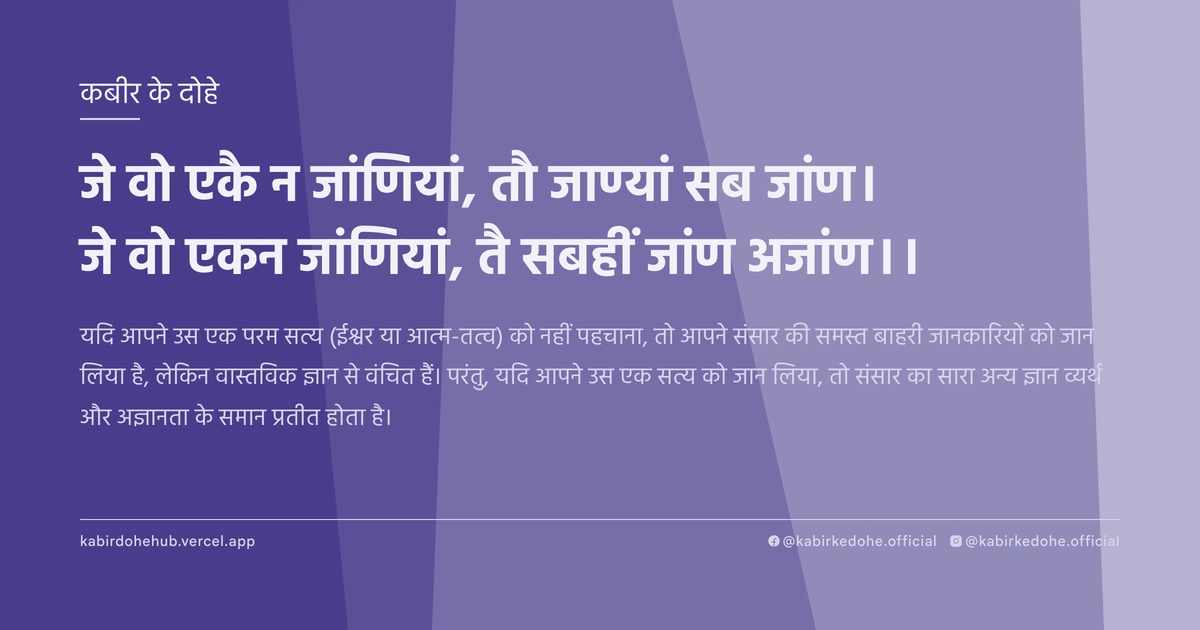
जे वो एकै न जांणियां, तौ जाण्यां सब जांण।
जे वो एकन जांणियां, तै सबहीं जांण अजांण।।
Je vo ekai na jaaniya, tau jaaniya sab jaan. Je vo ekan jaaniya, tai sabhi jaan ajaan.
इस पृष्ठ पर इस कबीर दोहे का अर्थ (meaning), हिंदी व्याख्या और अंग्रेज़ी अनुवाद, दार्शनिक विश्लेषण और व्यावहारिक जीवन सीख दी गई है। यह दोहा निर्गुण ब्रह्म (Nirguna Brahman) विषय से जुड़ा है — Kabir doha meaning and explanation in Hindi and English.
अर्थ (Meaning):
यदि आपने उस एक परम सत्य (ईश्वर या आत्म-तत्व) को नहीं पहचाना, तो आपने संसार की समस्त बाहरी जानकारियों को जान लिया है, लेकिन वास्तविक ज्ञान से वंचित हैं। परंतु, यदि आपने उस एक सत्य को जान लिया, तो संसार का सारा अन्य ज्ञान व्यर्थ और अज्ञानता के समान प्रतीत होता है।
If you have not recognized that One Supreme Truth (the Divine or the Self), then you may claim to know everything in the world, yet you remain ignorant of the essential. Conversely, once you realize that One Truth, all other worldly knowledge is revealed as superficial and irrelevant, rendering the 'learned' ignorant in comparison.
व्याख्या (Interpretation):
कबीर यहाँ 'एक' शब्द का प्रयोग निर्गुण ब्रह्म के लिए करते हैं। शाब्दिक अर्थ यह है कि सांसारिक विद्या और आध्यात्मिक बोध में गहरा अंतर है। रूपक के तौर पर, संसार का ज्ञान एक लहर की तरह है, जबकि उस 'एक' को जानना पूरे सागर को जान लेना है। यह अद्वैत वेदांत के उस सिद्धांत को दर्शाता है जहाँ आत्मा और परमात्मा का भेद मिट जाता है। माया हमें विविधता के भ्रम में उलझाती है, जिससे हम टुकड़ों में ज्ञान खोजते हैं। जब साधक उस एक अखंड तत्व को पहचानता है, तो वह समझ जाता है कि जिसे वह 'सब कुछ' समझ रहा था, वह केवल एक परछाई थी। यह विरोधाभास यह स्पष्ट करता है कि वास्तविक ज्ञान संचय नहीं, बल्कि विसर्जन है।
Kabir uses the word 'One' to signify the Nirgun Brahman, the formless Absolute. Literally, he distinguishes between intellectual accumulation and spiritual realization. Metaphorically, worldly knowledge is like observing a single wave, while knowing the 'One' is realizing the entire ocean. This aligns with Advaita Vedanta, where the duality between Atman and Brahman dissolves. Maya creates the illusion of multiplicity, leading humans to seek fragmented truths. When the seeker recognizes the singular, indivisible essence, they realize that what they perceived as 'everything' was merely a shadow. This paradox emphasizes that true knowledge is not about acquisition, but about the dissolution of the egoic mind.
दार्शनिक विश्लेषण (Philosophical Analysis):
कबीर का यह दोहा उनके युग के धार्मिक पाखंड और शास्त्र-केंद्रित ज्ञान के विरुद्ध एक सशक्त प्रहार है। उस समय पंडित और मौलवी ग्रंथों के रटने को ही ज्ञान मानते थे, जबकि कबीर 'अनुभव' (Direct Experience) को प्राथमिकता देते थे। वे तर्क देते हैं कि यदि ज्ञान केवल शब्दों और रस्मों तक सीमित है, तो वह वास्तव में अज्ञानता का ही एक परिष्कृत रूप है।
दार्शनिक स्तर पर, यह सूफी मत के 'वहदत-अल-वजूद' (अस्तित्व की एकता) और शंकराचार्य के अद्वैतवाद का संगम है। यहाँ 'एक' का अर्थ किसी व्यक्ति या मूर्ति से नहीं, बल्कि उस चेतना से है जो कण-कण में व्याप्त है। जब तक मनुष्य स्वयं को शरीर या सामाजिक पहचान (जाति, धर्म) से जोड़ता है, वह 'सब' को जानने का दावा करता है, लेकिन वह केवल बाहरी आवरणों को जान रहा होता है।
कबीर के अनुसार, अहंकार ही वह पर्दा है जो हमें 'एक' को देखने से रोकता है। जब अहंकार नष्ट होता है, तब यह बोध होता है कि ज्ञाता, ज्ञान और ज्ञेय एक ही हैं। यह मनोवैज्ञानिक रूपांतरण है जहाँ व्यक्ति बाहरी दुनिया की खोज छोड़कर अंतर्मुखी हो जाता है।
ritualism या कर्मकांडों का विरोध यहाँ स्पष्ट है; कबीर कहते हैं कि हज़ारों किताबें पढ़ने से बेहतर है कि एक बार उस आंतरिक सत्य का साक्षात्कार किया जाए। यह ज्ञान बौद्धिक नहीं, बल्कि प्रयोगात्मक है।
अंततः, यह दोहा हमें सिखाता है कि सत्य सरल है, लेकिन हमारी जटिलताएं उसे कठिन बना देती हैं। जो 'सब' को जानने की दौड़ में है, वह वास्तव में केंद्र से दूर जा रहा है। वास्तविक विद्वान वह है जो अपनी सीमित पहचान को उस अनंत 'एक' में विलीन कर दे।
This couplet is a powerful critique of the scriptural obsession and religious hypocrisy prevalent during Kabir's era. At a time when pundits and maulvis equated the rote memorization of texts with enlightenment, Kabir championed 'Anubhav' (Direct Experience) as the only valid path to truth.
Philosophically, this is a convergence of the Sufi concept of 'Wahdat-al-Wujud' (Unity of Existence) and Shankara's Advaita Vedanta. The 'One' does not refer to a deity in a anthropomorphic sense, but to the universal consciousness that permeates every atom. As long as a human identifies with the body or social constructs like caste and creed, they claim to know 'everything,' yet they are merely studying the surface layers of existence.
According to Kabir, the ego is the veil that obscures the vision of the 'One.' When the ego is annihilated, the realization dawns that the knower, the known, and the process of knowing are identical. This is a psychological transformation where the individual shifts from outward seeking to inward contemplation.
His rejection of ritualism is explicit; Kabir suggests that experiencing the internal truth once is superior to reading a thousand scriptures. This knowledge is not intellectual or academic, but experimental and visceral.
Ultimately, the doha teaches that Truth is simple, but our complexities make it seem elusive. Those racing to know 'everything' are actually drifting away from the center. The true scholar is one who dissolves their limited identity into the infinite 'One.'
मूल संदेश (Core Message):
- सूचना ज्ञान नहीं है; बोध ही वास्तविक ज्ञान है।
- बाहरी दुनिया की विविधता केवल एक मायावी पर्दा है।
- अहंकार का अंत ही सत्य के द्वार की कुंजी है।
- एकल सत्य का अनुभव समस्त बौद्धिक विमर्शों से ऊपर है।
- जब 'मैं' मिटता है, तब 'वह एक' प्रकट होता है।
- Information is not wisdom; realization is the only true knowledge.
- The diversity of the external world is but a deceptive veil.
- The annihilation of ego is the key to the gates of Truth.
- The experience of the Singular Truth transcends all intellectual discourse.
- When the 'I' vanishes, the 'One' is revealed.
व्यावहारिक उदाहरण (Practical Example):
वाराणसी के एक पुराने घाट पर माधव नाम का एक वृद्ध बुनकर रहता था। माधव ने अपना पूरा जीवन बेहतरीन रेशमी साड़ियाँ बुनने में बिताया था। उसे कपड़ों के हर धागे, हर रंग और बाज़ार की हर चाल का ज्ञान था। वह खुद को शहर का सबसे जानकार व्यक्ति मानता था क्योंकि उसने व्यापार की हर बारीकी सीख ली थी।
एक दिन उसकी मुलाकात एक फकीर से हुई जो घाट की सीढ़ियों पर चुपचाप बैठा था। माधव ने गर्व से फकीर को अपने काम के बारे में बताया और पूछा, "क्या आप जानते हैं कि इस कपड़े की बुनावट में कितनी जटिलता है?" फकीर ने मुस्कुराकर कहा, "तुम धागों को जानते हो, लेकिन क्या तुम उस हाथ को जानते हो जो इन धागों को चला रहा है?"
माधव को लगा कि फकीर उसकी कला का अपमान कर रहा है। उसने तर्क दिया कि उसने दुनिया के सबसे बड़े व्यापारियों से सीखा है और उसे 'सब कुछ' पता है। फकीर ने केवल इतना कहा, "जिसने धागे को जान लिया, वह कपड़े को जानता है; लेकिन जिसने बुनकर को जान लिया, वह पूरे संसार के रहस्य को जान गया।"
अगले कुछ दिनों तक माधव ने फकीर को देखा। उसने महसूस किया कि फकीर के पास कोई धन नहीं था, कोई किताब नहीं थी, फिर भी उसके चेहरे पर एक ऐसी शांति थी जो माधव के पास अपनी सारी 'जानकारी' के बावजूद नहीं थी। माधव को एहसास हुआ कि वह केवल 'वस्तुओं' का संग्रह कर रहा था, 'सत्य' का नहीं।
एक रात, जब माधव अपनी करघे पर काम कर रहा था, उसे अचानक महसूस हुआ कि वह खुद भी एक धागा है जिसे कोई अज्ञात शक्ति बुन रही है। उसका अहंकार, जो उसकी कुशलता पर टिका था, अचानक ढह गया। उसने महसूस किया कि उसकी सारी व्यावसायिक जानकारी उस एक शांति के सामने शून्य थी जो उसे अब महसूस हो रही थी।
उसने अपनी सारी तकनीकी श्रेष्ठता का मोह छोड़ दिया। अब वह केवल कपड़े नहीं बुनता था, बल्कि हर धागे में उस 'एक' परमात्मा का ध्यान करता था। उसकी साड़ियों में अब एक अलग ही चमक थी, क्योंकि वे अब लालच से नहीं, बल्कि प्रेम से बनी थीं।
गाँव के लोग हैरान थे कि माधव अब पहले से अधिक शांत और विनम्र हो गया था। जब किसी ने उससे पूछा कि उसने क्या नया सीखा, तो उसने बस इतना कहा, "मैं पहले सब कुछ जानता था, इसलिए मैं वास्तव में कुछ नहीं जानता था। अब मैं केवल 'एक' को जानता हूँ, इसलिए मुझे अब कुछ और जानने की ज़रूरत नहीं।"
माधव का जीवन अब एक प्रदर्शन नहीं, बल्कि एक प्रार्थना बन गया था। उसने जान लिया था कि बाहरी दुनिया की जानकारी केवल एक शोर है, जबकि आंतरिक मौन ही वास्तविक ज्ञान है।
On an ancient ghat in Varanasi lived an elderly weaver named Madhav. Madhav had spent his entire life weaving the finest silk sarees. He possessed exhaustive knowledge of every thread, every dye, and every market trend. He considered himself the most knowledgeable man in the city because he had mastered every nuance of his trade.
One day, he encountered a Fakir sitting silently on the steps of the ghat. With pride, Madhav described his craft to the Fakir and asked, "Do you know the complexity involved in this weave?" The Fakir smiled and replied, "You know the threads, but do you know the Hand that moves these threads?"
Madhav felt the Fakir was insulting his art. He argued that he had learned from the greatest merchants in the land and knew 'everything.' The Fakir simply said, "He who knows the thread knows the cloth; but he who knows the Weaver knows the secret of the entire universe."
Over the next few days, Madhav observed the Fakir. He noticed that despite having no wealth and no books, the Fakir possessed a serenity that Madhav lacked, despite all his 'information.' Madhav realized he had been collecting 'objects,' not 'Truth.'
One night, while working at his loom, Madhav suddenly felt that he himself was but a single thread being woven by an unknown power. His ego, built upon his technical skill, collapsed. He realized that all his professional knowledge was void compared to the singular peace he was now experiencing.
He let go of his attachment to technical superiority. He no longer just wove fabric; he meditated on the 'One' with every pass of the shuttle. His sarees now possessed a different radiance, for they were created from love, not greed.
The villagers were amazed that Madhav had become calmer and more humble. When asked what new knowledge he had acquired, he simply said, "Earlier, I knew everything, and therefore I knew nothing. Now, I know only the 'One,' and thus I need to know nothing more."
Madhav's life ceased to be a performance and became a prayer. He understood that worldly information is merely noise, while inner silence is the only true knowledge.
अभ्यास मार्गदर्शन (Practice Guidance):
- दैनिक मौन अभ्यास: प्रतिदिन 20 मिनट पूर्ण मौन में बैठें। बाहरी सूचनाओं (समाचार, सोशल मीडिया) को त्यागकर केवल अपनी श्वास और आंतरिक उपस्थिति पर ध्यान केंद्रित करें।
- स्व-पूछताछ (Self-Inquiry): जब भी आप किसी विषय पर अपनी विशेषज्ञता का दावा करें, स्वयं से पूछें—"क्या यह ज्ञान मुझे अहंकार दे रहा है या मुक्ति?"
- अहंकार का विसर्जन: दिन में एक बार ऐसी स्थिति पैदा करें जहाँ आप जानबूझकर अपनी 'विशेषज्ञता' को किनारे रखकर एक जिज्ञासु या शिष्य की तरह दूसरों को सुनें।
- निदान चेकलिस्ट: यदि आप दूसरों को छोटा महसूस कराते हैं या ज्ञान के माध्यम से श्रेष्ठता सिद्ध करना चाहते हैं, तो आप 'सब' के भ्रम में हैं। यदि आप हर व्यक्ति में उसी एक तत्व को देखते हैं, तो आप 'एक' की ओर बढ़ रहे हैं।
- Daily Silence Practice: Spend 20 minutes in absolute silence. Disconnect from external information (news, social media) and focus solely on your breath and internal presence.
- Self-Inquiry: Whenever you claim expertise in a subject, ask yourself—"Is this knowledge feeding my ego or leading me toward liberation?"
- Dissolution of Ego: Once a day, consciously set aside your 'expertise' and listen to others with the humility of a curious student or a disciple.
- Diagnostic Checklist: If you find yourself belittling others or using knowledge to prove superiority, you are trapped in the illusion of 'everything.' If you perceive the same singular essence in every person, you are moving toward the 'One.'
चिंतन प्रश्न (Reflection Questions):
- मेरी वह कौन सी 'जानकारी' है जिसे मैं अपनी पहचान मानता हूँ, और यदि वह मुझसे छीन ली जाए, तो मेरा अस्तित्व क्या बचेगा?
- क्या मैं वास्तव में सत्य की खोज कर रहा हूँ, या मैं केवल अपनी बौद्धिक श्रेष्ठता को पुष्ट करने के लिए ज्ञान इकट्ठा कर रहा हूँ?
- मेरे जीवन में 'सब कुछ जानने' की इच्छा मुझे शांति से दूर ले जा रही है या पास?
- डिजिटल युग में, जहाँ सूचना की बाढ़ है, मैं अपनी आंतरिक शांति और 'एक' के साथ जुड़ाव को कैसे सुरक्षित रख सकता हूँ?
- क्या मैं अपनी मान्यताओं और धारणाओं के बिना किसी व्यक्ति को देख सकता हूँ, या मैं केवल अपनी पूर्व-निर्धारित श्रेणियों को देखता हूँ?
- What specific 'knowledge' do I mistake for my identity, and if it were stripped away, what would remain of my existence?
- Am I truly seeking Truth, or am I merely accumulating information to validate my intellectual superiority?
- Is my desire to 'know everything' distancing me from peace or bringing me closer to it?
- In a digital age flooded with information, how can I protect my inner silence and connection to the 'One'?
- Can I see a person without the filter of my beliefs and assumptions, or do I only see the categories I have pre-assigned to them?