
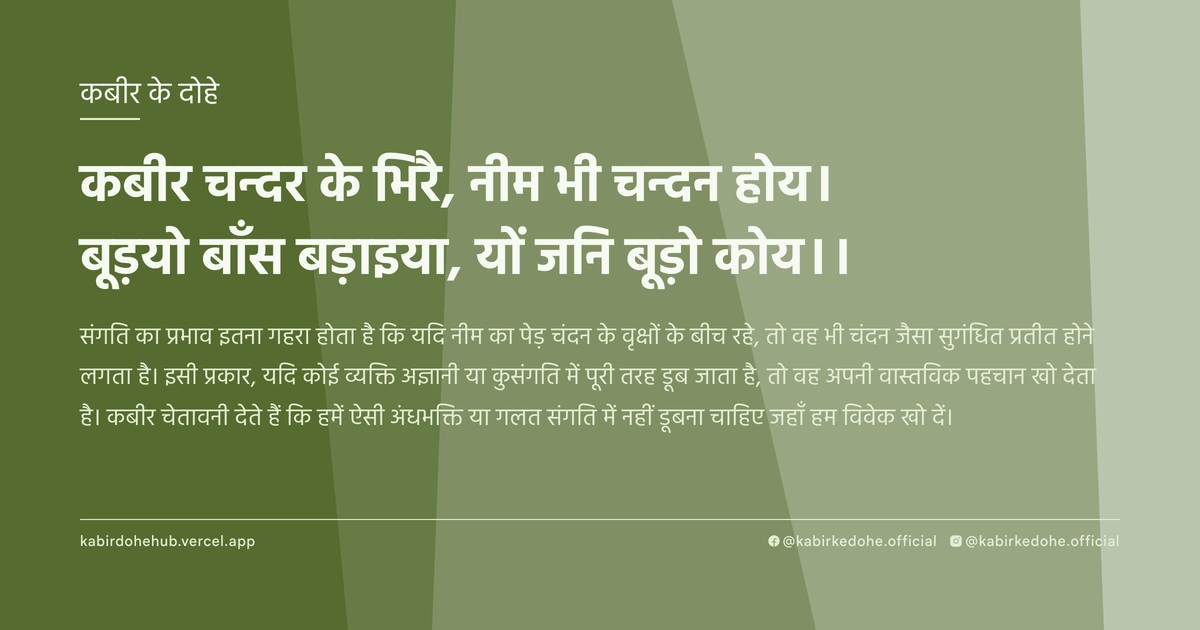
कबीर चन्दर के भिरै, नीम भी चन्दन होय।
बूड़यो बाँस बड़ाइया, यों जनि बूड़ो कोय।।
Kabir chandar ke bhirai, neem bhi chandan hoye. Budyo baans badaiya, yon jani budo koy.
इस पृष्ठ पर इस कबीर दोहे का अर्थ (meaning), हिंदी व्याख्या और अंग्रेज़ी अनुवाद, दार्शनिक विश्लेषण और व्यावहारिक जीवन सीख दी गई है। यह दोहा माया (Maya) विषय से जुड़ा है — Kabir doha meaning and explanation in Hindi and English.
अर्थ (Meaning):
संगति का प्रभाव इतना गहरा होता है कि यदि नीम का पेड़ चंदन के वृक्षों के बीच रहे, तो वह भी चंदन जैसा सुगंधित प्रतीत होने लगता है। इसी प्रकार, यदि कोई व्यक्ति अज्ञानी या कुसंगति में पूरी तरह डूब जाता है, तो वह अपनी वास्तविक पहचान खो देता है। कबीर चेतावनी देते हैं कि हमें ऐसी अंधभक्ति या गलत संगति में नहीं डूबना चाहिए जहाँ हम विवेक खो दें।
The influence of association is so profound that if a Neem tree dwells among Sandalwood trees, it begins to be perceived as fragrant as Sandalwood. Similarly, if a person becomes completely immersed in the company of the ignorant or the misguided, they lose their true identity. Kabir warns against falling into such blind devotion or toxic associations where one's discernment is entirely extinguished.
व्याख्या (Interpretation):
इस दोहे में कबीर 'संगति' के मनोवैज्ञानिक और आध्यात्मिक प्रभाव का विश्लेषण करते हैं। नीम कड़वाहट का प्रतीक है और चंदन पवित्रता और सुगंध का। जब नीम चंदन के साथ रहता है, तो वह अपनी कड़वाहट नहीं छोड़ता, लेकिन बाहरी दुनिया उसे चंदन समझने लगती है। यह 'माया' के भ्रम को दर्शाता है जहाँ बाहरी दिखावा वास्तविक स्वभाव को ढक लेता है। आध्यात्मिक स्तर पर, यह 'अद्वैत' की उस स्थिति की ओर इशारा करता है जहाँ साधक गुरु या सत्संग के प्रभाव से अपनी अशुद्धियों को भूल जाता है, परंतु यदि यह केवल बाहरी नकल है, तो यह खतरनाक है। 'बाँस' का डूबना इस बात का प्रतीक है कि जो लोग बिना विवेक के किसी विचारधारा में डूब जाते हैं, वे अपनी मौलिकता खो देते हैं। यह दोहा हमें सचेत करता है कि वास्तविक रूपांतरण आंतरिक होना चाहिए, न कि केवल परिवेश का प्रभाव।
In this couplet, Kabir analyzes the psychological and spiritual impact of 'Satsang' or association. Neem symbolizes bitterness, while Sandalwood represents purity and fragrance. When Neem dwells with Sandalwood, it does not actually lose its bitterness, but the external world begins to perceive it as fragrant. This illustrates the illusion of 'Maya,' where external appearances mask the true nature. On a spiritual level, this points to a state in Advaita where a seeker, influenced by a Guru, may forget their impurities; however, if this is mere imitation, it is perilous. The 'sinking of the bamboo' symbolizes those who immerse themselves in an ideology without discernment, thereby losing their original essence. The Doha warns that true transformation must be internal and ontological, not merely a reflection of one's environment.
दार्शनिक विश्लेषण (Philosophical Analysis):
कबीर का यह दर्शन सामाजिक और धार्मिक पाखंड के विरुद्ध एक प्रहार है। उनके समय में, लोग केवल किसी विशेष संप्रदाय या जाति में जन्म लेने या उसके साथ रहने से खुद को पवित्र मानने लगे थे। कबीर यहाँ 'बाह्य आडंबर' बनाम 'आंतरिक सत्य' की चर्चा कर रहे हैं। वे बताते हैं कि केवल पवित्र लोगों के साथ रहने से कोई पवित्र नहीं हो जाता, जब तक कि वह स्वयं के अहंकार का विसर्जन न कर दे।
अद्वैत वेदांत के परिप्रेक्ष्य में, यह दोहा 'विवेक' (Discernment) की आवश्यकता पर बल देता है। माया हमें यह विश्वास दिलाती है कि हम बाहरी वातावरण के कारण बदल गए हैं, जबकि आत्मा का मूल स्वभाव अपरिवर्तित रहता है। यदि हम केवल बाहरी प्रभाव में बहते हैं, तो हम 'अविद्या' के जाल में फंसे रहते हैं।
सूफी मत के 'फ़ना' (annihilation) के सिद्धांत से जोड़कर देखें तो, कबीर कह रहे हैं कि अहंकार का विनाश आवश्यक है, लेकिन वह विनाश सत्य में होना चाहिए, न कि किसी भ्रमित भीड़ में। यदि आप गलत संगत में 'फ़ना' हो जाते हैं, तो आप केवल अपनी पहचान खोते हैं, सत्य को प्राप्त नहीं करते।
कबीर का विरोध उन लोगों से है जो बिना सोचे-समझे किसी भी परंपरा का पालन करते हैं। वे 'सहज मार्ग' की बात करते हैं, जहाँ व्यक्ति अपनी अंतरात्मा की आवाज सुनता है। उनके लिए धर्म कोई बाहरी पोशाक नहीं है जिसे पहना जा सके, बल्कि वह एक आंतरिक अनुभव है।
अंततः, यह विश्लेषण हमें सिखाता है कि संगति का उपयोग केवल एक उत्प्रेरक (catalyst) के रूप में किया जाना चाहिए। जिस प्रकार चंदन नीम को सुगंधित महसूस कराता है, सत्संग हमें हमारी वास्तविक दिव्यता की याद दिलाता है, लेकिन उस दिव्यता को जीना स्वयं साधक का उत्तरदायित्व है। बिना आत्म-साक्षात्कार के, संगति केवल एक अस्थायी मुखौटा है।
Kabir's philosophy here is a sharp critique of social and religious hypocrisy. In his era, people believed that merely being born into a certain sect or associating with a specific group rendered them holy. Kabir discusses 'External Ritualism' versus 'Internal Truth,' arguing that associating with the pure does not make one pure unless there is a conscious dissolution of the ego.
From the perspective of Advaita Vedanta, this Doha emphasizes the necessity of 'Viveka' (Discernment). Maya leads us to believe that we have changed because of our environment, while the fundamental nature of the Atman remains unchanged. If we merely drift with external influences, we remain trapped in 'Avidya' (ignorance).
Connecting this to the Sufi concept of 'Fana' (annihilation), Kabir suggests that while the ego must be annihilated, this process must happen within the Truth, not within a misguided crowd. If one is 'annihilated' in bad company, they lose their identity without attaining the Divine.
Kabir opposes the blind adherence to tradition. He advocates for the 'Sahaj Marg' (the natural path), where an individual listens to the inner voice. For him, religion is not an external garment to be worn but an internal realization.
Ultimately, this analysis teaches us that association should be used only as a catalyst. Just as Sandalwood makes Neem feel fragrant, Satsang reminds us of our inherent divinity, but embodying that divinity is the seeker's own responsibility. Without self-realization, association is merely a temporary mask.
मूल संदेश (Core Message):
- बाहरी संगति केवल एक संकेत है, गंतव्य नहीं।
- नकल और रूपांतरण के बीच के सूक्ष्म अंतर को पहचानें।
- अहंकार को दबाना नहीं, बल्कि उसे पूरी तरह मिटाना आवश्यक है।
- विवेक के बिना भक्ति केवल एक मानसिक भ्रम है।
- सत्य वह है जो एकांत और समाज दोनों में समान रहे।
- External association is merely a signpost, not the destination.
- Recognize the subtle difference between imitation and transformation.
- It is necessary to annihilate the ego, not merely suppress it.
- Devotion without discernment is nothing but a mental illusion.
- Truth is that which remains consistent in both solitude and society.
व्यावहारिक उदाहरण (Practical Example):
एक समय की बात है, वाराणसी के घाटों पर माधव नाम का एक वृद्ध बुनकर रहता था। माधव स्वभाव से अत्यंत क्रोधी और कटुभाषी था, जिसे पूरा मोहल्ला 'कड़वा माधव' कहता था। वह हमेशा दूसरों की कमियाँ निकालता और छोटी बातों पर झगड़ पड़ता था।
एक दिन माधव की मुलाकात एक शांत और सौम्य संन्यासी से हुई, जो पास की कुटिया में रहते थे। संन्यासी की वाणी में ऐसी मिठास और व्यवहार में ऐसी करुणा थी कि माधव धीरे-धीरे उनके करीब आने लगा। वह हर दिन उनके साथ समय बिताने लगा और उनकी बातों को सुनने लगा।
कुछ महीनों बाद, मोहल्ले के लोगों ने देखा कि माधव अब चिल्लाता नहीं है। वह अब शांत रहता है और सबकी मदद करता है। लोगों ने कहना शुरू किया, 'देखो, माधव अब चंदन जैसा पवित्र हो गया है।' माधव को भी लगने लगा कि वह बदल गया है और वह खुद को दूसरों से श्रेष्ठ समझने लगा।
लेकिन यह बदलाव केवल बाहरी था। माधव के भीतर का क्रोध अभी भी सुलग रहा था, बस उसने उसे दबा दिया था। वह संन्यासी की नकल कर रहा था, लेकिन उसने अपने क्रोध के मूल कारण पर काम नहीं किया था।
एक दिन, जब संन्यासी वहां नहीं थे, एक छोटे बच्चे से गलती से माधव का कीमती कपड़ा फट गया। अचानक, माधव का पुराना स्वभाव वापस आ गया। वह उस बच्चे पर इतनी जोर से चिल्लाया और उसे गालियां दीं कि पूरा मोहल्ला दंग रह गया।
उसे अहसास हुआ कि वह केवल 'चंदन की संगति' में रहकर सुगंधित होने का ढोंग कर रहा था। वह नीम था, जो चंदन के बीच रहकर खुद को चंदन समझ बैठा था, लेकिन उसकी कड़वाहट अभी भी उसके भीतर थी।
जब संन्यासी लौटे, तो माधव उनके चरणों में गिर पड़ा और रोने लगा। उसने पूछा, 'महाराज, मैं आपकी संगति में रहकर भी वैसा क्यों नहीं बन पाया?' संन्यासी ने मुस्कुराकर कहा, 'पुत्र, संगति केवल रास्ता दिखाती है, चलना तुम्हें स्वयं पड़ता है। तुमने मेरी नकल की, लेकिन अपने भीतर के क्रोध से युद्ध नहीं किया।'
माधव को अपनी गलती समझ आई। उसने अब केवल संन्यासी के साथ बैठना नहीं, बल्कि उनके द्वारा सिखाए गए आत्म-निरीक्षण के अभ्यास को अपनाना शुरू किया। उसने सीखा कि बाहरी शांति केवल एक मुखौटा है यदि आंतरिक द्वंद्व समाप्त न हो।
धीरे-धीरे, माधव ने वास्तव में अपने क्रोध को करुणा में बदलना शुरू किया। अब वह केवल चंदन के बीच रहने वाला नीम नहीं था, बल्कि उसने अपनी कड़वाहट को तपकर सुगंध में बदल लिया था।
Once, in the ghats of Varanasi, lived an elderly weaver named Madhav. Madhav was naturally irritable and sharp-tongued; the entire neighborhood called him 'Bitter Madhav.' He constantly criticized others and fought over trivial matters.
One day, Madhav met a serene and gentle monk who lived in a nearby cottage. The monk's speech was so sweet and his demeanor so compassionate that Madhav gradually grew close to him. He began spending every day in the monk's presence, listening to his discourses.
After a few months, the neighbors noticed that Madhav no longer shouted. He remained calm and helped everyone. People began saying, 'Look, Madhav has become pure like sandalwood.' Madhav also began to believe he had changed and started feeling superior to others.
However, this change was merely external. The anger within Madhav was still simmering; he had simply suppressed it. He was imitating the monk but had not addressed the root cause of his rage.
One day, while the monk was away, a small child accidentally tore a piece of Madhav's expensive fabric. Suddenly, Madhav's old nature resurfaced. He screamed at the child and hurled insults so violently that the entire neighborhood was shocked.
He realized that he had only been pretending to be fragrant by staying in the 'company of sandalwood.' He was the Neem tree that, while surrounded by Sandalwood, believed itself to be Sandalwood, yet the bitterness remained within.
When the monk returned, Madhav fell at his feet and wept. He asked, 'Maharaj, why could I not become like you despite your company?' The monk smiled and said, 'Son, association only shows the path; you must walk it yourself. You imitated me, but you did not wage war against the anger within.'
Madhav understood his mistake. He stopped merely sitting with the monk and began practicing the self-inquiry the monk had taught. He learned that external peace is but a mask if internal conflict is not resolved.
Slowly, Madhav began to truly transform his anger into compassion. He was no longer just a Neem tree among Sandalwood; he had burned away his own bitterness to create a genuine fragrance.
अभ्यास मार्गदर्शन (Practice Guidance):
- दैनिक आत्म-निरीक्षण: प्रतिदिन 15 मिनट मौन बैठें और विचार करें कि क्या आपका व्यवहार केवल दूसरों की नकल है या वह आपके आंतरिक मूल्यों से उपजा है।
- विवेकपूर्ण संगति: ऐसे लोगों के साथ समय बिताएं जो आपको चुनौती दें और आपके अहंकार को तोड़ें, न कि केवल वे जो आपकी प्रशंसा करें।
- जर्नलिंग प्रॉम्प्ट: 'आज मैंने किस परिस्थिति में अपनी पुरानी प्रतिक्रिया (कड़वाहट) को महसूस किया, और मैंने उसे बाहरी शांति के पीछे कैसे छिपाया?'
- डायग्नोस्टिक चेकलिस्ट: यदि आप दूसरों की उपस्थिति में शांत हैं लेकिन अकेले में या तनाव में अत्यधिक क्रोधित हो जाते हैं, तो आप 'नीम-चंदन' भ्रम में हैं। यदि आपकी शांति हर परिस्थिति में स्थिर है, तो रूपांतरण वास्तविक है।
- Daily Self-Inquiry: Sit in silence for 15 minutes daily and contemplate whether your behavior is a mere imitation of others or stems from your own internal values.
- Discriminating Association: Spend time with people who challenge you and break your ego, rather than those who only offer validation and praise.
- Journaling Prompt: 'In which situation today did I feel my old reaction (bitterness) resurface, and how did I hide it behind a mask of external peace?'
- Diagnostic Checklist: If you are calm in the presence of others but become excessively angry when alone or stressed, you are in the 'Neem-Sandalwood' illusion. If your peace remains stable in all circumstances, the transformation is real.
चिंतन प्रश्न (Reflection Questions):
- क्या मेरी 'आध्यात्मिक छवि' केवल उन लोगों के प्रभाव का परिणाम है जिनके साथ मैं समय बिताता हूँ?
- जब मैं अकेला होता हूँ और कोई मुझे देख नहीं रहा होता, तब मेरा वास्तविक स्वभाव कैसा होता है?
- क्या मैं वास्तव में बदल रहा हूँ, या मैं केवल एक नए 'पवित्र' मुखौटे को अपना रहा हूँ?
- मेरे जीवन में ऐसा कौन सा 'नीम' (कड़वाहट) है जिसे मैं चंदन की सुगंध के पीछे छिपाने की कोशिश कर रहा हूँ?
- क्या मेरी विनम्रता वास्तविक है, या यह सामाजिक स्वीकृति पाने का एक रणनीतिक तरीका है?
- Is my 'spiritual image' merely a result of the influence of the people I associate with?
- When I am alone and no one is watching, what is my true nature?
- Am I truly transforming, or am I simply adopting a new 'holy' mask?
- What is the 'Neem' (bitterness) in my life that I am trying to hide behind the fragrance of sandalwood?
- Is my humility genuine, or is it a strategic tool to gain social acceptance?