
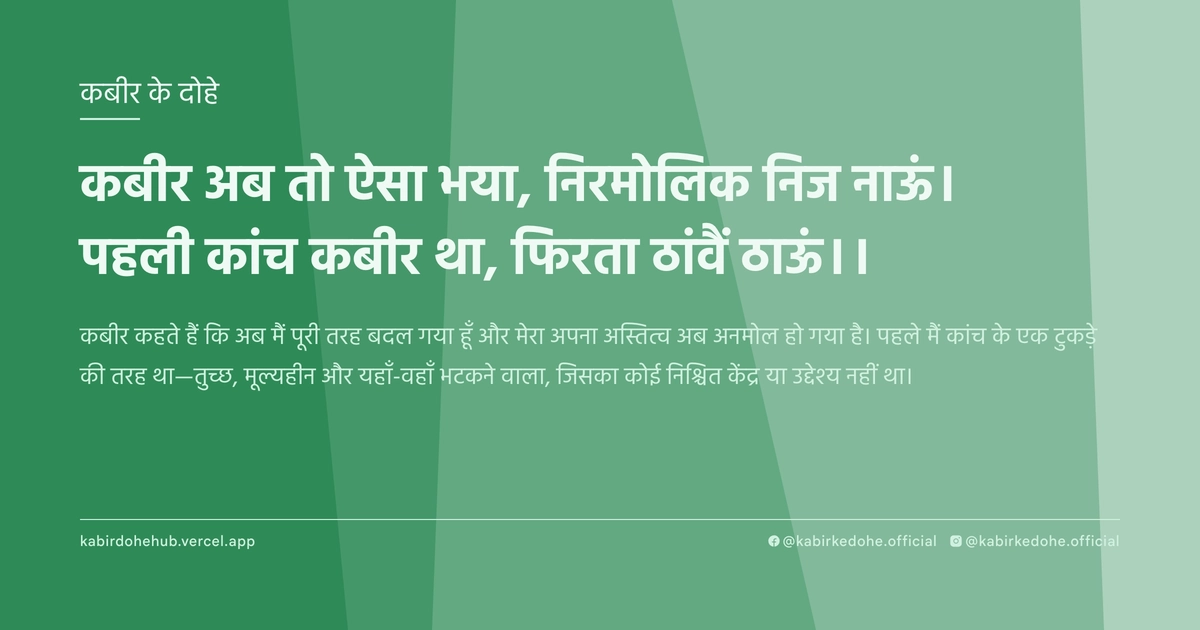
कबीर अब तो ऐसा भया, निरमोलिक निज नाऊं।
पहली कांच कबीर था, फिरता ठांवैं ठाऊं।।
Kabir ab to aisa bhaya, nirmolik nij naun. Pahli kaanch kabir tha, phirta thavan thaun.
इस पृष्ठ पर इस कबीर दोहे का अर्थ (meaning), हिंदी व्याख्या और अंग्रेज़ी अनुवाद, दार्शनिक विश्लेषण और व्यावहारिक जीवन सीख दी गई है। यह दोहा मुक्ति (Liberation) विषय से जुड़ा है — Kabir doha meaning and explanation in Hindi and English.
अर्थ (Meaning):
कबीर कहते हैं कि अब मैं पूरी तरह बदल गया हूँ और मेरा अपना अस्तित्व अब अनमोल हो गया है। पहले मैं कांच के एक टुकड़े की तरह था—तुच्छ, मूल्यहीन और यहाँ-वहाँ भटकने वाला, जिसका कोई निश्चित केंद्र या उद्देश्य नहीं था।
Kabir proclaims a total transformation of his being, stating that his true identity has now become priceless. Previously, he describes himself as a piece of glass—fragile, worthless, and drifting aimlessly from one place to another without a spiritual center.
व्याख्या (Interpretation):
इस दोहे में कबीर अपनी आध्यात्मिक यात्रा के चरम को दर्शाते हैं। 'कांच' यहाँ अज्ञानता और माया के प्रभाव का प्रतीक है, जहाँ मनुष्य अपनी वास्तविक पहचान भूलकर बाहरी दुनिया के भ्रमों में भटकता रहता है। 'निरमोलिक' शब्द उस अवस्था को इंगित करता है जहाँ साधक को आत्म-साक्षात्कार (Self-realization) हो जाता है और वह ब्रह्म के साथ एकाकार हो जाता है। यह निरगुण भक्ति का सार है, जहाँ व्यक्ति अपनी सीमित अहंकार-युक्त पहचान को त्यागकर अनंत शून्य में विलीन हो जाता है। यहाँ विरोधाभास यह है कि जब व्यक्ति स्वयं को पूरी तरह मिटा देता है, तभी वह वास्तव में 'अनमोल' बनता है। यह अद्वैत वेदांत के उस सिद्धांत को पुष्ट करता है कि आत्मा और परमात्मा मूलतः एक ही हैं।
In this couplet, Kabir illustrates the pinnacle of his spiritual journey. 'Glass' symbolizes ignorance and the influence of Maya, where a human wanders through worldly illusions, forgetting their true essence. The term 'priceless' refers to the state of Self-realization, where the seeker merges with the Formless Divine. This is the essence of Nirgun Bhakti, where one transcends the limited, ego-driven identity to dissolve into the infinite void. The central paradox is that only when the individual ego is completely annihilated does the being become truly 'priceless.' This reinforces the Advaita Vedanta principle that the Atman and Brahman are non-dual and identical.
दार्शनिक विश्लेषण (Philosophical Analysis):
कबीर का यह कथन उनके युग के सामाजिक और धार्मिक पाखंडों के विरुद्ध एक सशक्त प्रतिक्रिया है। उन्होंने तत्कालीन समाज में व्याप्त जातिगत श्रेष्ठता और कर्मकांडीय धर्म को सिरे से नकार दिया, क्योंकि उनके अनुसार ईश्वर किसी मंदिर, मस्जिद या विशेष कुल में नहीं, बल्कि स्वयं के भीतर स्थित है। यह दर्शन सूफीवाद के 'फना' (अहंकार का विनाश) और वेदांत के 'अहं ब्रह्मास्मि' का संगम है।
कांच का उदाहरण मनोवैज्ञानिक स्तर पर हमारी अस्थिरता को दर्शाता है। जिस प्रकार कांच पारदर्शी तो होता है लेकिन उसमें कोई मूल्य नहीं होता जब तक कि वह हीरा न बन जाए, उसी प्रकार मनुष्य का जीवन केवल सांसारिक गतिविधियों में व्यतीत करना व्यर्थ है। कबीर यहाँ 'मूल्य' को बाहरी संपदा से नहीं, बल्कि आंतरिक शुद्धि और सत्य के अनुभव से जोड़ते हैं।
उनका दृष्टिकोण यह है कि जब तक हम 'मैं' और 'मेरा' के भ्रम में रहते हैं, हम कांच की तरह नाजुक और अस्थिर होते हैं। जैसे ही यह अहंकार टूटता है, हम उस शाश्वत सत्य का हिस्सा बन जाते हैं जो समय और स्थान से परे है। यह परिवर्तन अचानक नहीं, बल्कि निरंतर आत्म-मंथन और साधना का परिणाम है।
कबीर की यह दृष्टि हमें सिखाती है कि आध्यात्मिक प्रगति का अर्थ नई चीज़ें प्राप्त करना नहीं, बल्कि उन परतों को हटाना है जो हमें हमारे वास्तविक स्वरूप से अलग करती हैं। वे ritualism (कर्मकांड) को एक बाधा मानते हैं क्योंकि वह व्यक्ति को बाहरी दिखावे में उलझाए रखता है, जबकि सत्य आंतरिक मौन में छिपा है।
अंततः, यह दोहा एक घोषणा है कि मुक्ति किसी बाहरी शक्ति द्वारा नहीं दी जाती, बल्कि यह स्वयं के भीतर छिपे उस 'हीरे' को पहचानने की प्रक्रिया है जिसे हमने अज्ञानता की धूल से ढक दिया था। यह मानव चेतना के निम्नतम स्तर से उच्चतम स्तर तक के आरोहण की गाथा है।
Kabir's statement is a powerful reaction against the social and religious hypocrisies of his era. He categorically rejected the caste-based superiority and ritualistic religion prevalent at the time, asserting that the Divine resides not in temples, mosques, or specific lineages, but within the self. This philosophy is a confluence of the Sufi concept of 'Fana' (annihilation of the ego) and the Vedantic realization of 'Aham Brahmasmi' (I am Brahman).
The metaphor of glass represents psychological instability. Just as glass is transparent but lacks intrinsic value until it is recognized as a diamond, a human life spent merely in worldly activities is devoid of spiritual worth. Kabir links 'value' not to external wealth, but to internal purification and the direct experience of Truth.
His perspective suggests that as long as we dwell in the illusion of 'I' and 'mine,' we remain as fragile and unstable as glass. The moment this ego shatters, we become part of the eternal Truth that transcends time and space. This transformation is not instantaneous but the result of continuous self-inquiry and disciplined practice.
Kabir teaches us that spiritual progress is not about acquiring new attributes, but about stripping away the layers that separate us from our true nature. He views ritualism as a hindrance because it entangles the seeker in external appearances, while the Truth remains hidden in internal silence.
Ultimately, this doha is a declaration that liberation is not granted by an external deity but is a process of recognizing the 'diamond' within, which had been obscured by the dust of ignorance. It is a narrative of the ascent of human consciousness from its lowest state to its highest potential.
मूल संदेश (Core Message):
- बाहरी पहचान एक भ्रम है, आंतरिक सत्य ही वास्तविक मूल्य है।
- अहंकार का टूटना ही आध्यात्मिक मूल्य की प्राप्ति का एकमात्र मार्ग है।
- भटकाव तब समाप्त होता है जब हम स्वयं को ब्रह्म के रूप में पहचानते हैं।
- अज्ञानता हमें कांच बनाती है, आत्म-ज्ञान हमें हीरा बनाता है।
- सत्य किसी स्थान में नहीं, बल्कि स्वयं की गहराई में स्थित है।
- External identity is an illusion; internal truth is the only real value.
- The shattering of the ego is the sole path to attaining spiritual worth.
- Wandering ends the moment we recognize ourselves as the Divine.
- Ignorance renders us as glass; self-knowledge transforms us into diamonds.
- Truth resides not in a location, but in the depths of one's own being.
व्यावहारिक उदाहरण (Practical Example):
वाराणसी के एक पुराने घाट पर रहने वाली एक वृद्ध विधवा, जानकी, का जीवन केवल दूसरों की सेवा और मंदिर की सीढ़ियों पर बैठकर समय बिताने में बीत रहा था। वह स्वयं को समाज की नजरों में 'बेचारी' और 'अधूरा' मानती थी, ठीक उसी कांच की तरह जिसका कोई मूल्य नहीं। वह हर दिन अपनी किस्मत को कोसती और सोचती कि उसका जीवन व्यर्थ है।
एक दिन उसकी मुलाकात एक घुमक्कड़ फकीर से हुई, जिसने उससे पूछा, 'माँ, तुम खुद को क्या मानती हो?' जानकी ने दुखी होकर कहा, 'मैं तो बस एक बोझ हूँ, जिसका अब कोई मोल नहीं।' फकीर ने मुस्कुराते हुए उसे एक गंदा, मिट्टी से सना हुआ पत्थर दिया और कहा, 'इसे साफ करो और देखो यह क्या है।'
जानकी ने उत्सुकता में उस पत्थर को रगड़ना शुरू किया। जैसे-जैसे मिट्टी हटती गई, नीचे से एक चमकता हुआ स्फटिक निकला। फकीर ने कहा, 'यह पत्थर पहले भी अनमोल था, बस मिट्टी ने इसे ढका हुआ था। तुम भी इसी तरह मिट्टी में लिपटे हुए एक हीरा हो, जिसे तुम कांच समझ रही हो।'
यह बात जानकी के हृदय में गहराई तक उतर गई। उसने महसूस किया कि उसकी 'बेचारे' होने की पहचान केवल एक सामाजिक मुखौटा था। उसने बाहरी दुनिया से अपनी कीमत माँगना बंद कर दिया और अपने भीतर के मौन और करुणा को खोजना शुरू किया।
उसने अब अपनी सेवा को 'कर्तव्य' नहीं, बल्कि 'प्रेम' बनाना शुरू किया। वह अब किसी की दया की प्रतीक्षा नहीं करती थी, बल्कि वह स्वयं प्रेम का स्रोत बन गई। उसकी आँखों में एक नई चमक थी, जो किसी बाहरी गहने से नहीं, बल्कि आंतरिक संतोष से आई थी।
गाँव के लोग हैरान थे कि जो महिला कभी सिर झुकाकर चलती थी, अब वह इतनी गरिमा और शांति के साथ बात करती थी। उसने अपनी पहचान को 'विधवा' से बदलकर 'आत्मा' के रूप में देखना शुरू किया।
उसने पाया कि जब उसने खुद को 'कांच' मानना छोड़ दिया, तो दुनिया ने भी उसे 'अनमोल' मानना शुरू कर दिया। उसका जीवन अब भटकन से मुक्त होकर एक केंद्र पर टिक गया था।
यह जानकी का 'कबीर ट्विस्ट' था—अपनी तुच्छता के भ्रम को तोड़कर अपनी ईश्वरीय गरिमा को पहचानना। वह अब उस अनमोल नाम की स्वामिनी थी, जिसे कबीर ने अपने दोहे में वर्णित किया था।
Janaki, an elderly widow living on an ancient ghat in Varanasi, spent her days serving others and sitting on temple steps. She perceived herself as 'pitiful' and 'incomplete' in the eyes of society, much like a piece of glass with no value. Every day, she lamented her fate, believing her life was wasted.
One day, she met a wandering fakir who asked her, 'Mother, what do you consider yourself to be?' Janaki replied sadly, 'I am merely a burden, someone who no longer holds any value.' The fakir smiled and handed her a dirty, mud-covered stone, saying, 'Clean this and see what it is.'
Intrigued, Janaki began to scrub the stone. As the mud washed away, a brilliant crystal emerged from beneath. The fakir remarked, 'This stone was always priceless; it was only covered in dirt. You are similarly a diamond wrapped in mud, whom you have mistaken for glass.'
These words resonated deeply within Janaki. She realized that her identity as 'pitiful' was merely a social mask. She stopped seeking validation or value from the external world and began exploring the silence and compassion within her own heart.
She transformed her service from a 'duty' into an act of 'pure love.' She no longer waited for someone's pity; she became a source of love herself. There was a new radiance in her eyes, born not from external jewelry, but from internal contentment.
Villagers were astonished that the woman who once walked with a bowed head now spoke with such dignity and peace. She shifted her identity from being a 'widow' to recognizing herself as a 'soul.'
She discovered that once she stopped viewing herself as 'glass,' the world began to see her as 'priceless.' Her life, once a fragmented drift, finally found its center.
This was Janaki's 'Kabir Twist'—shattering the illusion of insignificance to recognize her divine dignity. She had finally become the owner of that priceless name described in Kabir's poetry.
अभ्यास मार्गदर्शन (Practice Guidance):
- प्रतिदिन 20 मिनट मौन अभ्यास करें, जहाँ आप अपने विचारों को केवल साक्षी भाव से देखें, बिना किसी निर्णय के।
- एक डायरी लिखें जिसमें आप उन सभी 'सामाजिक लेबल्स' (जैसे पद, जाति, रिश्ता) की सूची बनाएं जो आपको लगता है कि आपकी पहचान हैं, और फिर उनके सामने लिखें कि यदि ये सब हटा दिए जाएं, तो आप वास्तव में कौन हैं।
- व्यवहार परिवर्तन: जब भी आप स्वयं को छोटा, अक्षम या मूल्यहीन महसूस करें, तो तुरंत रुकें और स्वयं से कहें, 'मैं कांच नहीं, मैं वह अनंत चेतना हूँ जो इस शरीर में अनुभव कर रही है।'
- डायग्नोस्टिक चेकलिस्ट: क्या आप अभी भी दूसरों की प्रशंसा या आलोचना से विचलित होते हैं? क्या आपकी शांति बाहरी परिस्थितियों पर निर्भर है? यदि हाँ, तो आप अभी भी 'कांच' की अवस्था में हैं।
- Practice 20 minutes of daily silence, observing your thoughts as a witness without judgment or attachment.
- Maintain a journal listing all 'social labels' (position, caste, relationship) you believe define you, and then write who you truly are if all these were stripped away.
- Behavioral Shift: Whenever you feel small, incapable, or worthless, pause immediately and affirm, 'I am not glass; I am the infinite consciousness experiencing this body.'
- Diagnostic Checklist: Do you still fluctuate based on others' praise or criticism? Is your peace dependent on external circumstances? If yes, you are still operating from the 'glass' state of consciousness.
चिंतन प्रश्न (Reflection Questions):
- मेरी वह कौन सी 'कांच जैसी' पहचान है जिसे मैं दुनिया के सामने सबसे अधिक सहेज कर रखता हूँ?
- यदि मेरा नाम, मेरा पेशा और मेरा इतिहास मुझसे छीन लिया जाए, तो मेरे पास क्या बचेगा?
- मैं अपनी कीमत दूसरों की नजरों में क्यों खोजता हूँ, जबकि मेरा मूल्य जन्मजात और ईश्वरीय है?
- मेरे जीवन का वह कौन सा हिस्सा है जहाँ मैं अभी भी बिना उद्देश्य के 'यहाँ-वहाँ' भटक रहा हूँ?
- क्या मैं वास्तव में स्वतंत्र हूँ, या मैं अपनी सामाजिक छवि का कैदी हूँ?
- मेरे भीतर का वह कौन सा डर है जो मुझे अपनी 'अनमोल' प्रकृति को स्वीकार करने से रोकता है?
- What is that 'glass-like' identity of mine that I most carefully preserve for the world to see?
- If my name, profession, and history were stripped away, what would remain of me?
- Why do I seek my value in the eyes of others when my worth is innate and divine?
- Which part of my life is still characterized by 'wandering' without a spiritual center?
- Am I truly free, or am I a prisoner of my own social image?
- What is the fear within me that prevents me from accepting my 'priceless' nature?