
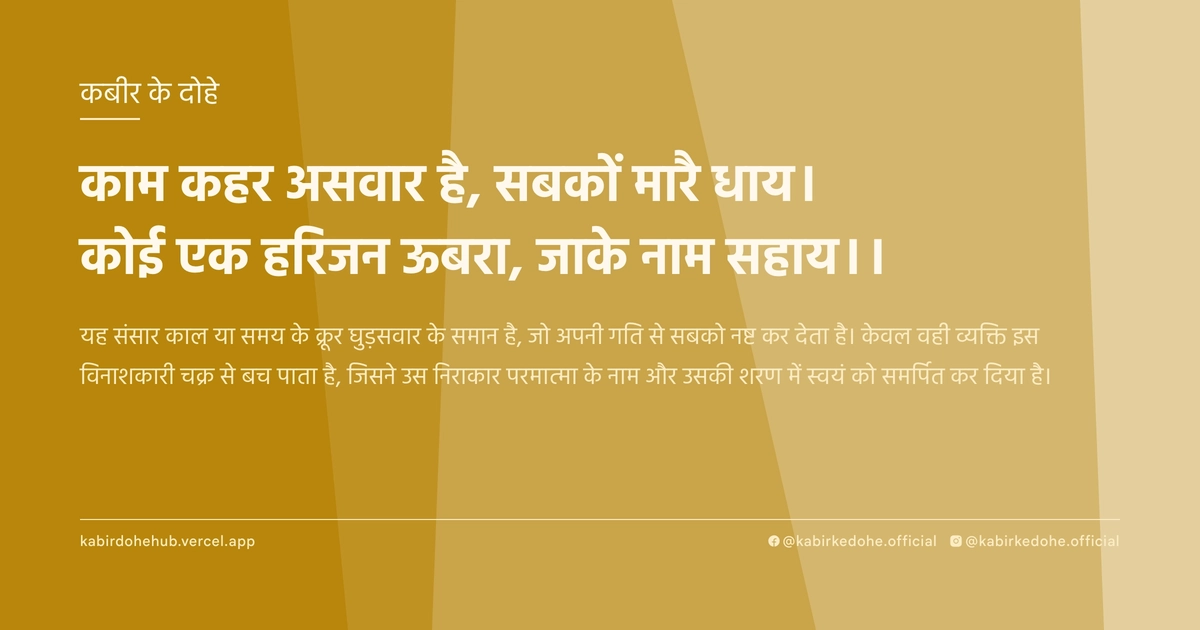
काम कहर असवार है, सबकों मारै धाय।
कोई एक हरिजन ऊबरा, जाके नाम सहाय।।
Kaam kahar aswar hai, sabkon marai dhay. Koi ek harijan oobra, jaake naam sahay.
इस पृष्ठ पर इस कबीर दोहे का अर्थ (meaning), हिंदी व्याख्या और अंग्रेज़ी अनुवाद, दार्शनिक विश्लेषण और व्यावहारिक जीवन सीख दी गई है। यह दोहा प्रपत्ति (Surrender) विषय से जुड़ा है — Kabir doha meaning and explanation in Hindi and English.
अर्थ (Meaning):
यह संसार काल या समय के क्रूर घुड़सवार के समान है, जो अपनी गति से सबको नष्ट कर देता है। केवल वही व्यक्ति इस विनाशकारी चक्र से बच पाता है, जिसने उस निराकार परमात्मा के नाम और उसकी शरण में स्वयं को समर्पित कर दिया है।
The world is like a cruel rider of Time (Kaal), relentlessly striking down every living being. Only that soul survives this inevitable destruction who has sought refuge in the Divine Name and aligned themselves with the Eternal Truth.
व्याख्या (Interpretation):
साब्दिक अर्थ में, कबीर समय को एक ऐसे योद्धा के रूप में चित्रित करते हैं जो किसी पर दया नहीं करता। रूपकात्मक स्तर पर, 'कहर असवार' माया और अहंकार के उस चक्र का प्रतीक है जो मनुष्य को जन्म और मृत्यु के बंधन में जकड़े रखता है। निर्गुण भक्ति के अनुसार, जब तक साधक 'मैं' और 'मेरा' के भ्रम में रहता है, वह काल के प्रहार का शिकार होता है। अद्वैत वेदांत के परिप्रेक्ष्य में, यह मृत्यु शरीर की होती है, आत्मा की नहीं; परंतु अज्ञानता के कारण मनुष्य इसे अंत मानता है। केवल वह 'हरिजन' (ईश्वर का प्रेमी) बचता है जिसने द्वैत को मिटाकर ब्रह्म के साथ एकाकार कर लिया है। यह विरोधाभास है कि विनाश के बीच ही एकमात्र मुक्ति का मार्ग मिलता है, जो केवल पूर्ण समर्पण से संभव है।
Literally, Kabir portrays Time as a ruthless warrior who spares no one. Metaphorically, the 'cruel rider' symbolizes the cycle of Maya and ego that keeps humanity shackled to the wheel of birth and death. In the context of Nirgun Bhakti, as long as the seeker remains trapped in the illusion of 'I' and 'mine,' they are vulnerable to the strikes of temporal existence. From the lens of Advaita Vedanta, death occurs only to the physical shell, not the eternal Atman; however, ignorance makes this transition seem like an end. Only the 'Harijan' (beloved of God), who has dissolved the duality between self and Source, transcends this carnage. It is a profound paradox that within the heart of inevitable destruction lies the only path to liberation, accessible only through absolute surrender.
दार्शनिक विश्लेषण (Philosophical Analysis):
कबीर का यह दोहा उस कालखंड का प्रतिबिंब है जहाँ धार्मिक कर्मकांडों और बाहरी आडंबरों का बोलबाला था। कबीर ने स्पष्ट किया कि न तो तीर्थयात्रा और न ही कठोर व्रत काल के प्रहार से बचा सकते हैं। उनका प्रहार सीधे तौर पर उस सामाजिक और धार्मिक संरचना पर है जो मृत्यु के भय को बेचकर मोक्ष का व्यापार करती है।
दार्शनिक रूप से, यह सूफी मत के 'फना' (अहंकार का विनाश) और अद्वैत के 'माया' सिद्धांत का संगम है। जब तक मनुष्य स्वयं को एक अलग इकाई मानता है, वह समय की सीमाओं में कैद रहता है। जैसे ही वह अपनी पहचान को सार्वभौमिक चेतना (Brahman) में विलीन करता है, वह 'काल' के प्रभाव से मुक्त हो जाता है क्योंकि अनंत का कोई अंत नहीं होता।
यहाँ 'नाम' का अर्थ किसी विशिष्ट शब्द का जाप नहीं, बल्कि उस शाश्वत सत्य का अनुभव है जो श्वास-श्वास में व्याप्त है। कबीर ritualism (कर्मकांड) को नकारते हुए आंतरिक रूपांतरण पर बल देते हैं। वे बताते हैं कि बाहरी सुरक्षा के साधन व्यर्थ हैं; एकमात्र सुरक्षा आंतरिक जागरण है।
मनोवैज्ञानिक स्तर पर, यह दोहा मृत्यु के भय (Thanatophobia) का सामना करने की चुनौती देता है। कबीर सिखाते हैं कि भय का कारण अहंकार है। यदि 'मैं' ही नहीं रहेगा, तो मरने वाला कौन होगा? इस बोध के साथ, साधक मृत्यु को एक परिवर्तन के रूप में देखता है, न कि अंत के रूप में।
अंततः, यह संदेश देता है कि भक्ति केवल ईश्वर की स्तुति नहीं, बल्कि स्वयं के सीमित स्वरूप को तोड़कर असीम में प्रवेश करने की प्रक्रिया है। यह एक क्रांतिकारी आह्वान है जो मनुष्य को उसकी सामाजिक पहचान (जाति, धर्म) से ऊपर उठाकर उसे एक 'हरिजन' या 'ईश्वर का अंश' बनाने की प्रेरणा देता है।
This couplet reflects an era dominated by rigid religious rituals and outward displays of piety. Kabir asserts that neither pilgrimages nor austere fasts can shield a person from the relentless strike of Time. His critique is aimed directly at the social and religious structures that commodified the fear of death to sell a false sense of salvation.
Philosophically, this is a convergence of the Sufi concept of 'Fana' (annihilation of the ego) and the Advaita Vedanta principle of 'Maya.' As long as a human perceives themselves as a separate entity, they remain imprisoned within the temporal boundaries of existence. The moment they merge their identity into the Universal Consciousness (Brahman), they transcend the influence of Time, for the Infinite knows no end.
Here, the 'Name' (Naam) does not refer to the mere repetition of a word, but to the experiential realization of the Eternal Truth that permeates every breath. Kabir rejects ritualism in favor of internal transformation, arguing that external safeguards are futile; the only true security is inner awakening.
On a psychological level, this verse challenges the primal fear of death (Thanatophobia). Kabir teaches that fear is a byproduct of the ego. If the 'I' is dissolved, who is there left to perish? With this realization, the seeker views death not as a termination, but as a transition.
Ultimately, the message is that devotion is not the praise of a distant deity, but the process of breaking one's limited self to enter the Boundless. It is a revolutionary call that elevates the human being above social identities—caste or creed—and transforms them into a 'Harijan,' a true fragment of the Divine.
मूल संदेश (Core Message):
- समय का प्रहार अटल है, केवल जागरूकता ही ढाल है।
- अहंकार का त्याग ही वास्तविक सुरक्षा का एकमात्र मार्ग है।
- बाहरी कर्मकांड समय की गति को नहीं रोक सकते।
- परमात्मा का 'नाम' बाहरी शब्द नहीं, आंतरिक अनुभव है।
- मृत्यु शरीर का अंत है, आत्मा का नहीं; बोध ही मुक्ति है।
- समर्पण में ही वह शक्ति है जो काल को जीत लेती है।
- The strike of Time is inevitable; only awareness serves as a shield.
- Relinquishing the ego is the only true path to security.
- External rituals cannot halt the relentless march of Time.
- The Divine 'Name' is not a word, but an internal realization.
- Death ends the body, not the soul; realization is liberation.
- Surrender is the only power that transcends the temporal.
व्यावहारिक उदाहरण (Practical Example):
वाराणसी के एक पुराने घाट पर रहने वाले रामदीन नाम के एक वृद्ध नाविक की कहानी है। रामदीन ने अपना पूरा जीवन लोगों को नदी पार कराने में बिताया था, लेकिन उसका मन हमेशा इस बात से परेशान रहता था कि उसकी उम्र बढ़ रही है और वह अपनी संपत्ति और परिवार को कैसे सुरक्षित रखेगा। वह हर समय भविष्य की चिंता में डूबा रहता था, जैसे कोई डरपोक सिपाही युद्ध के मैदान में खड़ा हो।
एक दिन उसकी मुलाकात एक घुमक्कड़ फकीर से हुई, जिसने उसे कबीर का यह दोहा सुनाया। फकीर ने उससे पूछा, 'रामदीन, तू नाव तो चलाता है, पर क्या तूने कभी सोचा है कि तू खुद समय की एक ऐसी नाव पर सवार है जिसे कोई किनारा नहीं मिलता?' रामदीन को पहली बार महसूस हुआ कि उसकी सारी चिंताएँ उस 'कहर असवार' (समय) के सामने कितनी तुच्छ हैं।
उसने महसूस किया कि वह अपनी संपत्ति को बचाने की कोशिश में उस संपत्ति का गुलाम बन गया था। उसने देखा कि कैसे उसके आस-पास के लोग बड़े-बड़े महलों और नाम की चाहत में अपनी शांति खो चुके थे, फिर भी समय उन्हें एक-एक कर लील रहा था।
रामदीन ने एक बड़ा बदलाव करने का निर्णय लिया। उसने अपनी जमा पूँजी का एक बड़ा हिस्सा उन अनाथ बच्चों की शिक्षा के लिए दान कर दिया जो घाटों पर भीख मांगते थे। उसने अपनी पहचान एक 'संपत्ति मालिक' से बदलकर एक 'सेवक' की बना ली।
अब वह नाव चलाते समय केवल पैसे नहीं कमाता था, बल्कि हर यात्री के साथ प्रेम और करुणा से बात करता था। उसने अपनी दिनचर्या में मौन का अभ्यास शुरू किया, जहाँ वह केवल अपनी सांसों पर ध्यान केंद्रित करता और उस निराकार शक्ति को याद करता।
एक समय ऐसा आया जब रामदीन को एक गंभीर बीमारी ने घेर लिया। उसके परिवार वाले घबरा गए, लेकिन रामदीन के चेहरे पर एक अद्भुत शांति थी। वह अब समय के प्रहार से डर नहीं रहा था, क्योंकि उसने अपना अहंकार पहले ही त्याग दिया था।
उसने अपने बेटों से कहा, 'मैं अब उस महान घुड़सवार के साथ चलने को तैयार हूँ, क्योंकि मैंने अपना बोझ हल्का कर लिया है।' उसने अपनी अंतिम सांसें लेते समय किसी संपत्ति या रिश्ते का मोह नहीं किया, बल्कि केवल उस 'नाम' का स्मरण किया जिसने उसे मुक्त किया था।
रामदीन की यह यात्रा एक भौतिक नाविक से एक आध्यात्मिक यात्री में बदलने की थी। उसने यह सिद्ध किया कि जब हम समय से लड़ना बंद कर देते हैं और स्वयं को परमात्मा में विलीन कर देते हैं, तो मृत्यु एक अंत नहीं, बल्कि एक उत्सव बन जाती है।
In the ancient ghats of Varanasi lived an elderly boatman named Ramdeen. Ramdeen had spent his entire life ferrying people across the river, yet his mind was perpetually plagued by the anxiety of aging and the desire to secure his wealth and family. He lived in a constant state of apprehension, like a frightened soldier standing in a battlefield.
One day, he encountered a wandering fakir who recited this specific Doha of Kabir. The fakir asked him, 'Ramdeen, you steer the boat for others, but have you realized that you yourself are aboard a boat of Time that finds no shore?' For the first time, Ramdeen felt how trivial all his worries were in the face of the 'cruel rider' of Time.
He realized that in trying to protect his wealth, he had become a slave to it. He observed how people around him, chasing mansions and fame, lost their inner peace, yet Time consumed them all regardless of their status.
Ramdeen decided to make a radical change. He donated a significant portion of his savings to the education of orphaned children who begged along the ghats. He shifted his identity from a 'property owner' to a 'servant of humanity.'
Now, while rowing his boat, he didn't just earn money; he spoke with love and compassion to every passenger. He began a daily practice of silence, focusing on his breath and remembering the Formless Power.
Eventually, a severe illness struck Ramdeen. While his family panicked, a strange and profound peace radiated from his face. He no longer feared the strike of Time because he had already discarded his ego.
He told his sons, 'I am now ready to ride with the Great Rider, for I have lightened my load.' As he drew his final breaths, he held no attachment to wealth or kinship, remembering only the 'Name' that had set him free.
Ramdeen's journey was a transition from a physical boatman to a spiritual voyager. He proved that when we stop fighting Time and merge ourselves into the Divine, death ceases to be an end and becomes a celebration.
अभ्यास मार्गदर्शन (Practice Guidance):
- दैनिक चिंतन: प्रतिदिन 15 मिनट मौन बैठें और विचार करें कि आपकी कौन सी पहचान (पद, नाम, संबंध) अस्थायी है और कौन सी शाश्वत।
- आत्म-पूछताछ जर्नल: लिखें कि आप किन चीजों को पकड़ने की कोशिश कर रहे हैं जो समय के साथ नष्ट हो रही हैं। पूछें—'यदि मैं यह सब छोड़ दूँ, तो मैं वास्तव में कौन हूँ?'
- व्यवहार परिवर्तन: दिन में कम से कम एक ऐसा कार्य करें जिसमें कोई व्यक्तिगत लाभ न हो और अहंकार की कोई भूमिका न रहे (निस्वार्थ सेवा)।
- निदान चेकलिस्ट: क्या आप छोटी सी हानि पर विचलित होते हैं? क्या आप मृत्यु या बुढ़ापे के विचार से डरते हैं? यदि हाँ, तो आप अभी भी 'कहर असवार' के भय में हैं।
- Daily Contemplation: Sit in silence for 15 minutes daily and reflect on which of your identities (status, name, relationships) are transient and which is eternal.
- Self-Inquiry Journal: Document the things you are desperately trying to hold onto that are inevitably decaying. Ask—'If I let go of all this, who am I really?'
- Behavioral Shift: Perform at least one act of selfless service daily where there is no personal gain and no role for the ego.
- Diagnostic Checklist: Do you become distressed over minor losses? Do you feel fear at the thought of aging or death? If yes, you are still living under the shadow of the 'cruel rider'.
चिंतन प्रश्न (Reflection Questions):
- आप अपनी सामाजिक छवि को बचाने के लिए अपनी आंतरिक शांति का कितना बलिदान देते हैं?
- यदि आज आपकी सारी उपलब्धियाँ छीन ली जाएँ, तो आपके भीतर क्या शेष बचेगा?
- क्या आपका 'भक्ति' मार्ग वास्तव में समर्पण है, या यह ईश्वर से सुरक्षा माँगने का एक सौदा है?
- आप समय के साथ चलने की कोशिश कर रहे हैं या समय के प्रवाह में विलीन होने की?
- आपके जीवन का वह कौन सा हिस्सा है जिसे आप 'अमर' बनाने की कोशिश कर रहे हैं, और क्या यह संभव है?
- क्या आप अपनी डिजिटल पहचान (Social Media Ego) को ही अपनी वास्तविक पहचान मान बैठे हैं?
- How much of your inner peace do you sacrifice to maintain your social image?
- If all your achievements were stripped away today, what would remain within you?
- Is your path of 'devotion' true surrender, or is it a bargain for security from God?
- Are you trying to race against Time, or are you attempting to merge with its flow?
- Which part of your life are you trying to make 'immortal,' and is such a feat even possible?
- Have you mistaken your digital identity (Social Media Ego) for your true self?