
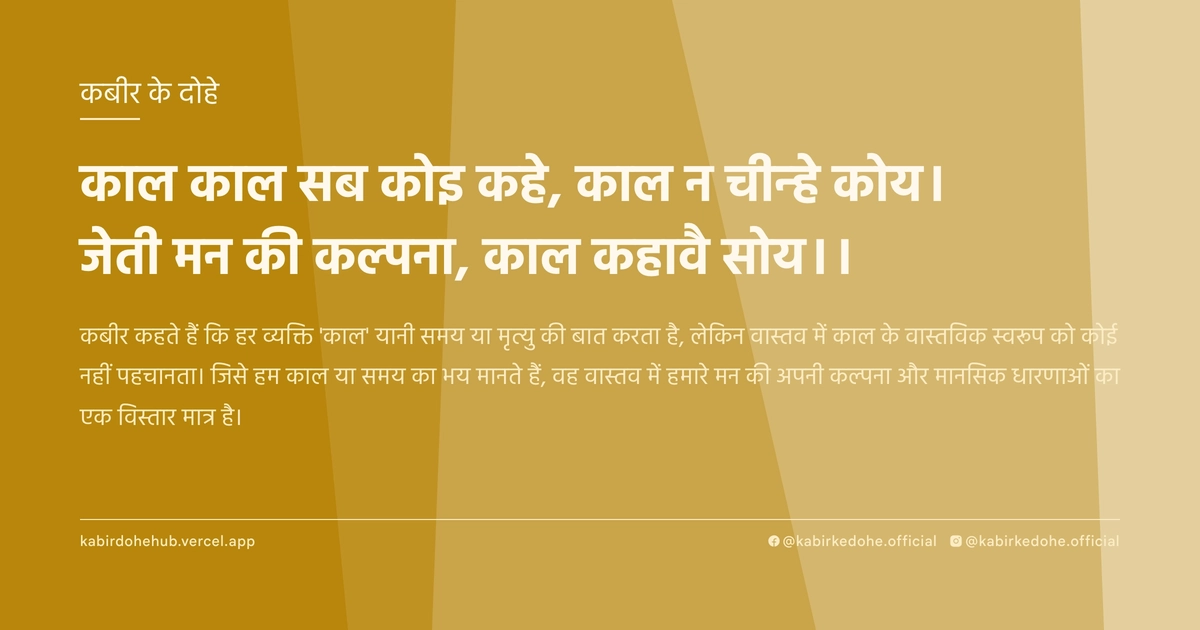
काल काल सब कोइ कहे, काल न चीन्हे कोय।
जेती मन की कल्पना, काल कहावै सोय।।
Kaal kaal sab koi kahe, kaal na chinhe koy. Jeti man ki kalpana, kaal kahavai soy.
इस पृष्ठ पर इस कबीर दोहे का अर्थ (meaning), हिंदी व्याख्या और अंग्रेज़ी अनुवाद, दार्शनिक विश्लेषण और व्यावहारिक जीवन सीख दी गई है। यह दोहा सत्य (Truth) विषय से जुड़ा है — Kabir doha meaning and explanation in Hindi and English.
अर्थ (Meaning):
कबीर कहते हैं कि हर व्यक्ति 'काल' यानी समय या मृत्यु की बात करता है, लेकिन वास्तव में काल के वास्तविक स्वरूप को कोई नहीं पहचानता। जिसे हम काल या समय का भय मानते हैं, वह वास्तव में हमारे मन की अपनी कल्पना और मानसिक धारणाओं का एक विस्तार मात्र है।
Kabir asserts that while everyone speaks of 'Kaal'—referring to time or death—no one truly recognizes its essence. That which we perceive as the relentless march of time or the dread of death is, in reality, nothing more than a projection of the mind's own imagination and conceptual constructs.
व्याख्या (Interpretation):
इस दोहे का शाब्दिक अर्थ है कि समय का भय सार्वभौमिक है, परंतु इसका ज्ञान दुर्लभ है। रूपकात्मक रूप से, कबीर यहाँ 'काल' को केवल घड़ी के समय के रूप में नहीं, बल्कि उस मायावी पर्दे के रूप में देखते हैं जो आत्मा को उसके शाश्वत स्वरूप से अलग करता है। यह निर्गुण भक्ति का सार है, जहाँ ईश्वर समय और स्थान से परे है। जब मन कल्पनाओं के जाल में फंसता है, तो वह समय के बंधन को सत्य मान लेता है। अद्वैत वेदांत के अनुसार, केवल ब्रह्म सत्य है और समय एक मिथ्या आभास है। इस विरोधाभास को समझना ही मुक्ति है: हम समय से नहीं, बल्कि समय के बारे में अपनी धारणाओं से डरते हैं।
Literally, the verse suggests that the fear of time is universal, yet the knowledge of its nature is rare. Metaphorically, Kabir views 'Kaal' not merely as chronological time, but as the illusory veil of Maya that separates the Atman from its eternal essence. This aligns with Nirgun Bhakti, where the Divine exists beyond the constraints of time and space. When the mind becomes entangled in conceptual projections, it mistakes the illusion of temporal limitation for ultimate reality. According to Advaita Vedanta, only Brahman is absolute; time is a superimposed perception. The central paradox is that we do not fear time itself, but rather the mental constructs we have built around the concept of ending.
दार्शनिक विश्लेषण (Philosophical Analysis):
कबीर का यह दोहा उस युग की उपज है जहाँ मृत्यु और समय का भय धार्मिक कर्मकांडों के माध्यम से नियंत्रित किया जाता था। कबीर ने इस भय को मनोवैज्ञानिक स्तर पर चुनौती दी। उन्होंने बताया कि 'काल' कोई बाहरी शक्ति नहीं है जो हमें नष्ट करती है, बल्कि यह हमारी अपनी अहंकार-केंद्रित चेतना का एक उत्पाद है।
यह विचार सूफीवाद के 'फना' (अहंकार का विनाश) और अद्वैत वेदांत के 'माया' सिद्धांत से गहराई से जुड़ा है। जब तक व्यक्ति स्वयं को शरीर मानता है, वह समय के अधीन रहता है। जैसे ही वह स्वयं को शुद्ध चेतना (Atman) के रूप में पहचानता है, समय का अस्तित्व समाप्त हो जाता है।
कबीर ने ritualism का विरोध किया क्योंकि कर्मकांड अक्सर मृत्यु के बाद के भय या स्वर्ग-नरक की कल्पनाओं पर आधारित होते हैं। उनके लिए, सत्य का अनुभव वर्तमान क्षण की पूर्णता में है, न कि भविष्य की चिंता या अतीत के शोक में।
मनोवैज्ञानिक रूप से, यह दोहा संज्ञानात्मक पुनर्गठन की बात करता है। हम जिसे 'समय की कमी' या 'बुढ़ापे का डर' कहते हैं, वह वास्तव में मन की एक ऐसी स्थिति है जो पूर्णता को स्वीकार करने में असमर्थ है।
अंततः, कबीर यह संदेश देते हैं कि काल का विनाश केवल तभी संभव है जब मन की कल्पनाओं का विनाश हो। जब 'मैं' (अहंकार) मिट जाता है, तो समय का पहिया रुक जाता है और केवल अनंत वर्तमान शेष रहता है।
This Doha emerges from an era where the fear of death and time was often weaponized through religious rituals and dogmas. Kabir challenges this fear at a psychological level, asserting that 'Kaal' is not an external entity that destroys us, but a product of our ego-centric consciousness.
This perspective resonates deeply with the Sufi concept of 'Fana' (the annihilation of the self) and the Advaita Vedanta doctrine of 'Maya'. As long as an individual identifies with the physical body, they remain subject to the laws of time. However, upon realizing the self as pure consciousness (Atman), the concept of temporal limitation vanishes.
Kabir rejected ritualism because most rituals are predicated on the fear of death or the desire for a heavenly afterlife. For him, truth is experienced in the absolute fullness of the present moment, rather than in the anxiety of the future or the grief of the past.
Psychologically, this verse advocates for a cognitive restructuring of reality. What we perceive as 'running out of time' or the 'dread of aging' is actually a mental state unable to accept the inherent wholeness of existence.
Ultimately, Kabir suggests that the conquest of time is achieved only through the dissolution of the mind's imaginative projections. When the 'I' (the ego) is extinguished, the wheel of time ceases to turn, leaving only the eternal Now.
मूल संदेश (Core Message):
- समय का भय वास्तव में मन का एक मानसिक भ्रम है।
- अहंकार के मिटते ही काल का बंधन समाप्त हो जाता है।
- सत्य समय के पार है, केवल कल्पना समय में बंधी है।
- वर्तमान क्षण ही एकमात्र वास्तविक सत्य और मुक्ति का द्वार है।
- स्वयं को शरीर नहीं, बल्कि शाश्वत आत्मा के रूप में पहचानें।
- The fear of time is actually a mental illusion of the mind.
- When the ego dissolves, the shackles of time vanish.
- Truth exists beyond time; only imagination is bound by it.
- The present moment is the only reality and the gateway to liberation.
- Identify yourself not as the body, but as the eternal soul.
व्यावहारिक उदाहरण (Practical Example):
एक समय की बात है, बनारस के घाटों पर रहने वाले एक वृद्ध बुनकर थे, जिनका नाम माधव था। माधव अपने जीवन के अंतिम पड़ाव पर थे और हर पल मृत्यु के भय से घिरे रहते थे। वे अपनी हर सांस को गिनते थे और सोचते थे कि समय उनके हाथ से रेत की तरह फिसल रहा है।
वे अक्सर मंदिर जाते और लंबी प्रार्थनाएं करते कि उन्हें और समय मिले, या उनकी मृत्यु शांतिपूर्ण हो। उनका पूरा दिन इस चिंता में बीतता कि 'अब बहुत देर हो गई है' या 'काश मैंने यह काम पहले किया होता'।
एक दिन उनकी मुलाकात एक घुमंतू फकीर से हुई। फकीर ने देखा कि माधव का चेहरा चिंता से मुरझाया हुआ है। फकीर ने उनसे पूछा, 'माधव, तुम किस चीज़ से डर रहे हो?'
माधव ने कहा, 'बाबा, मैं काल से डर रहा हूँ। वह मुझे निगल जाएगा। मेरा समय समाप्त हो रहा है।'
फकीर मुस्कुराया और उसने माधव को एक खाली फ्रेम दिखाया जिसमें कोई कपड़ा नहीं बुना गया था। फकीर ने कहा, 'इस फ्रेम को देखो। क्या इसमें समय है?'
माधव ने कहा, 'नहीं, यह तो बस एक ढांचा है।'
फकीर ने समझाया, 'ठीक वैसे ही, तुम्हारा मन एक फ्रेम है। तुमने इसमें 'मृत्यु' और 'समय' का एक डरावना चित्र बुन लिया है। समय बाहर नहीं है, तुमने इसे अपने भीतर बुना है। जिस दिन तुम इस कल्पना के धागों को तोड़ दोगे, तुम देखोगे कि तुम स्वयं वह अनंत आकाश हो जिसे कोई समय नहीं मिटा सकता।'
माधव को एक गहरा झटका लगा। उन्होंने महसूस किया कि उनका डर समय से नहीं, बल्कि उस 'कहानी' से था जो उन्होंने अपने मन में समय के बारे में बनाई थी।
उस दिन के बाद, माधव ने समय को गिनना बंद कर दिया। उन्होंने अपनी बुनाई को केवल एक कार्य नहीं, बल्कि एक ध्यान बना लिया।
अब जब वे सुबह उठते, तो वे यह नहीं सोचते थे कि उनके पास कितने दिन बचे हैं, बल्कि यह कि इस क्षण में वे कितने जीवित हैं। उनका भय समाप्त हो गया और वे एक ऐसी शांति में जीने लगे जो समय की सीमाओं से परे थी।
Once, in the sacred ghats of Varanasi, lived an elderly weaver named Madhav. Madhav was in the twilight of his life and lived in a constant state of dread regarding death. He counted every breath, feeling as though time was slipping through his fingers like dry sand.
He spent his days visiting temples, offering long prayers for more time or a peaceful end. His entire existence was consumed by thoughts like 'It is too late now' or 'I wish I had done this sooner.'
One day, he encountered a wandering fakir. The fakir noticed the withered expression of anxiety on Madhav's face and asked, 'Madhav, what is it that you fear so deeply?'
Madhav replied, 'Baba, I fear Kaal (Time). It will devour me. My time is running out.'
The fakir smiled and showed Madhav an empty weaving frame with no cloth on it. He asked, 'Look at this frame. Is there any time inside it?'
Madhav replied, 'No, it is just a structure.'
The fakir explained, 'Similarly, your mind is a frame. You have woven a terrifying image of death and time within it. Time is not an external force; you have constructed it inside yourself. The day you break these imaginative threads, you will realize that you are the infinite sky, which no amount of time can erase.'
Madhav felt a profound shift in consciousness. He realized that his fear was not of time itself, but of the 'story' he had authored about time in his mind.
From that day forward, Madhav stopped counting the hours. He transformed his weaving from a mere chore into a meditative practice.
Now, upon waking, he no longer wondered how many days he had left, but how fully alive he was in this single moment. His fear vanished, and he entered a state of peace that existed beyond the boundaries of time.
अभ्यास मार्गदर्शन (Practice Guidance):
- प्रतिदिन 20 मिनट 'शून्य ध्यान' का अभ्यास करें, जहाँ आप समय के विचार को पूरी तरह त्याग दें और केवल अपनी श्वास के साक्षी बनें।
- एक जर्नल लिखें जिसमें आप उन सभी 'समय-आधारित' भयों की सूची बनाएं (जैसे- बुढ़ापा, करियर की दौड़) और विश्लेषण करें कि ये वास्तविक हैं या मन की कल्पना।
- व्यवहार परिवर्तन: दिन में तीन बार सचेत रूप से रुकें और स्वयं से कहें, 'इस क्षण में न कोई अतीत है, न भविष्य, केवल मैं और मेरी चेतना है।'
- डायग्नोस्टिक चेकलिस्ट: यदि आप बार-बार 'देर हो रही है' या 'समय कम है' महसूस करते हैं, तो समझें कि आप काल की कल्पना में फंसे हैं। यदि आप वर्तमान कार्य में पूर्णतः लीन हैं, तो आप काल से मुक्त हो रहे हैं।
- Practice 20 minutes of 'Shunya Meditation' daily, where you completely drop the concept of time and remain a witness to your breath.
- Maintain a journal listing all 'time-based' fears (e.g., aging, career race) and analyze whether these are objective realities or mental projections.
- Behavioral Shift: Three times a day, consciously pause and affirm, 'In this moment, there is no past, no future, only I and my consciousness.'
- Diagnostic Checklist: If you frequently feel 'I am running late' or 'time is short,' recognize that you are trapped in the imagination of Kaal. If you are fully absorbed in the present task, you are transcending time.
चिंतन प्रश्न (Reflection Questions):
- यदि समय का अस्तित्व केवल एक मानसिक कल्पना है, तो आप अपनी उपलब्धियों और असफलताओं को किस तराजू में तौलेंगे?
- आपका 'डिजिटल ईगो' (सोशल मीडिया प्रोफाइल) समय की किस कृत्रिम दौड़ में शामिल है और यह आपको आपकी वास्तविकता से कैसे दूर करता है?
- क्या आप वास्तव में मृत्यु से डरते हैं, या उस पहचान के खोने से जिसे आपने वर्षों की कल्पना से बनाया है?
- आपके जीवन का वह कौन सा क्षण था जब आप समय को पूरी तरह भूल गए थे? उस स्थिति में आपकी मानसिक अवस्था क्या थी?
- यदि आप आज ही इस शरीर को त्याग दें, तो वह क्या बचेगा जिसे आप 'मैं' कहते हैं?
- If the existence of time is merely a mental projection, by what scale will you measure your achievements and failures?
- In what artificial race of time is your 'digital ego' (social media profile) engaged, and how does it detach you from your true reality?
- Do you truly fear death, or do you fear the loss of the identity you have spent years imagining?
- What was the moment in your life when you completely forgot about time? What was your state of consciousness then?
- If you were to shed this body today, what would remain of the entity you call 'I'?