
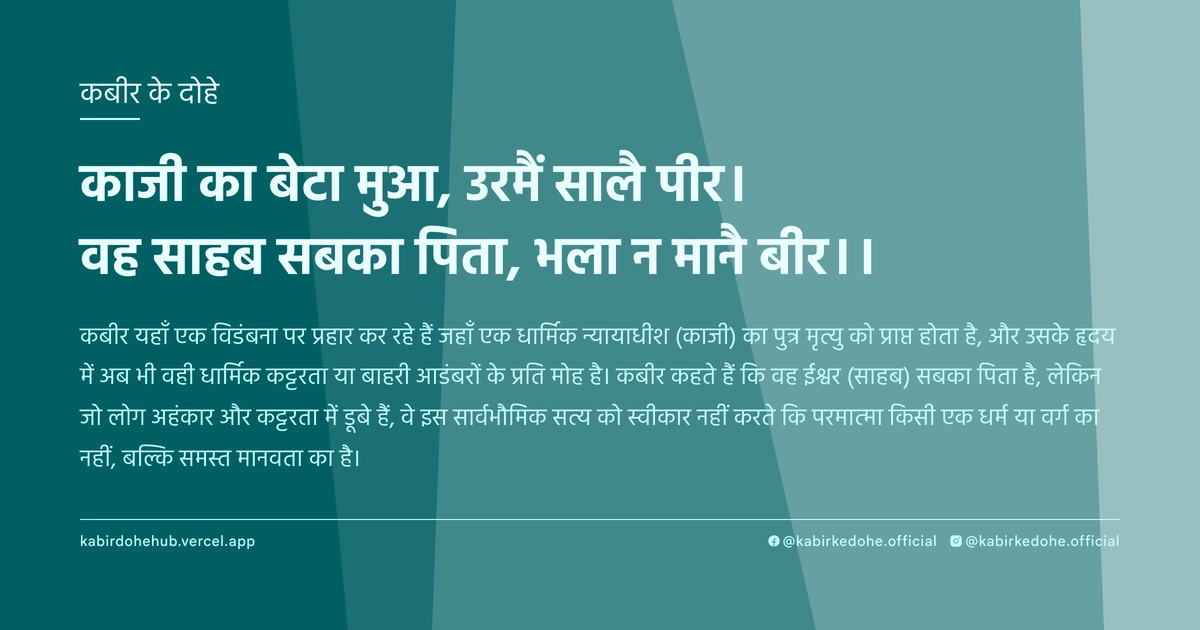
काजी का बेटा मुआ, उरमैं सालै पीर।
वह साहब सबका पिता, भला न मानै बीर।।
Kaaji ka beta mua, urmain saalai peer. Vah sahab sabka pita, bhala na maanai beer.
इस पृष्ठ पर इस कबीर दोहे का अर्थ (meaning), हिंदी व्याख्या और अंग्रेज़ी अनुवाद, दार्शनिक विश्लेषण और व्यावहारिक जीवन सीख दी गई है। यह दोहा पंडित-मुल्ला विरोध (Anti-clericalism) विषय से जुड़ा है — Kabir doha meaning and explanation in Hindi and English.
अर्थ (Meaning):
कबीर यहाँ एक विडंबना पर प्रहार कर रहे हैं जहाँ एक धार्मिक न्यायाधीश (काजी) का पुत्र मृत्यु को प्राप्त होता है, और उसके हृदय में अब भी वही धार्मिक कट्टरता या बाहरी आडंबरों के प्रति मोह है। कबीर कहते हैं कि वह ईश्वर (साहब) सबका पिता है, लेकिन जो लोग अहंकार और कट्टरता में डूबे हैं, वे इस सार्वभौमिक सत्य को स्वीकार नहीं करते कि परमात्मा किसी एक धर्म या वर्ग का नहीं, बल्कि समस्त मानवता का है।
Kabir highlights a poignant irony where the son of a Qazi (a religious judge) passes away, yet the heart remains clung to the rigidities of ritual and dogma. Kabir asserts that the Divine (Sahab) is the Universal Father to all, yet those blinded by religious arrogance and sectarian pride refuse to acknowledge this primordial unity, clinging instead to the illusion of spiritual superiority.
व्याख्या (Interpretation):
यह दोहा बाहरी धार्मिक पहचान और आंतरिक सत्य के बीच के गहरे संघर्ष को दर्शाता है। 'काजी का बेटा' यहाँ उस व्यक्ति का प्रतीक है जो जन्म से ही धार्मिक सत्ता और नियमों के बीच पला है, फिर भी मृत्यु के समय वह सत्य से अछूता है। यह स्थिति माया के उस प्रभाव को दिखाती है जहाँ व्यक्ति धर्म को ईश्वर तक पहुँचने का मार्ग नहीं, बल्कि अपनी श्रेष्ठता सिद्ध करने का साधन बना लेता है। निर्गुण भक्ति के परिप्रेक्ष्य में, कबीर यह समझाते हैं कि ईश्वर किसी विशेष धर्मग्रंथ या पद का मोहताज नहीं है। जब तक 'मैं' और 'मेरा धर्म' का अहंकार जीवित है, तब तक 'साहब' (परमात्मा) का अनुभव असंभव है। यह दोहा द्वैत से अद्वैत की ओर जाने की चुनौती है, जहाँ व्यक्ति को अपनी संकीर्ण पहचान को मिटाकर उस विराट चेतना में विलीन होना होता है जो जाति, धर्म और पद से परे है।
This couplet exposes the profound conflict between external religious identity and internal spiritual truth. The 'son of the Qazi' symbolizes an individual born into the lap of religious authority and dogma, yet remaining spiritually void even at the threshold of death. This illustrates the grip of Maya, where religion is transformed from a bridge to the Divine into a tool for establishing social and spiritual superiority. From the lens of Nirgun Bhakti, Kabir argues that the Formless Divine is not bound by scriptures or titles. As long as the ego of 'I' and 'my religion' persists, the experience of the 'Sahab' (Universal Spirit) remains elusive. This verse serves as a challenge to move from duality to Advaita (non-duality), urging the seeker to dissolve their narrow identity into the vast consciousness that transcends caste, creed, and status.
दार्शनिक विश्लेषण (Philosophical Analysis):
कबीर का यह प्रहार उनके युग की उस सामाजिक और धार्मिक जड़ता के विरुद्ध है जहाँ धर्म केवल बाहरी कर्मकांडों और कानूनी व्याख्याओं तक सीमित हो गया था। काजी, जो कानून और धर्म का रक्षक माना जाता था, उसका पुत्र भी उसी भ्रम का शिकार है। यह दर्शाता है कि ज्ञान केवल किताबों या पद से नहीं आता, बल्कि अनुभव से आता है। कबीर यहाँ सूफी मत के 'वहदत-अल-वजूद' (अस्तित्व की एकता) और वेदांत के 'अहं ब्रह्मास्मि' के करीब हैं, जहाँ वे तर्क देते हैं कि यदि ईश्वर सबका पिता है, तो उसकी संतानें आपस में भेदभाव कैसे कर सकती हैं?
वे ritualism (कर्मकांड) का विरोध करते हुए यह स्पष्ट करते हैं कि ईश्वर को पाने के लिए किसी मध्यस्थ या विशेष धार्मिक पहचान की आवश्यकता नहीं है। उनके लिए धर्म का अर्थ है 'मानवता' और 'सत्य'। जब कबीर 'साहब' शब्द का प्रयोग करते हैं, तो वे एक ऐसे निराकार सत्ता की बात कर रहे होते हैं जो हर हृदय में व्याप्त है, लेकिन अहंकार की धूल के कारण दिखाई नहीं देती।
मनोवैज्ञानिक स्तर पर, यह दोहा 'पहचान के संकट' की बात करता है। मनुष्य अपनी पहचान अपने धर्म, जाति या पद से जोड़ लेता है, जिससे वह स्वयं को दूसरों से अलग और श्रेष्ठ समझने लगता है। यह अलगाव ही दुख का मूल कारण है। कबीर इस 'अहं' के विलोपन की बात करते हैं, क्योंकि जब तक 'मैं' है, तब तक 'वह' (ईश्वर) नहीं मिल सकता।
ऐतिहासिक रूप से, कबीर ने हिंदू और मुस्लिम दोनों समुदायों के कट्टरपंथियों को समान रूप से चुनौती दी। उन्होंने यह स्थापित किया कि सत्य किसी एक धर्म की बपौती नहीं है। उनका दर्शन एक ऐसे समाज की कल्पना करता है जहाँ मनुष्य अपनी बाहरी खाल (धर्म) को उतारकर अपनी आंतरिक आत्मा (रूह) को पहचाने।
अंततः, यह दोहा हमें सिखाता है कि मृत्यु के समय न तो काजी का पद काम आता है और न ही उसकी धार्मिक श्रेष्ठता। केवल वह प्रेम और सत्य शेष रहता है जो हमने जीवन भर जिया है। यह एक चेतावनी है कि हम बाहरी आवरणों में इतने न खो जाएँ कि हम उस मूल पिता (परमात्मा) को ही भूल जाएँ जिसने हमें जन्म दिया है।
Kabir's critique is aimed at the social and religious rigidity of his era, where faith had been reduced to external rituals and legalistic interpretations. The Qazi, seen as the guardian of law and faith, fails to protect his own son from spiritual ignorance, proving that true knowledge does not stem from books or titles, but from direct experience. Here, Kabir aligns with the Sufi concept of 'Wahdat-al-Wujud' (Unity of Existence) and the Vedantic 'Aham Brahmasmi,' arguing that if the Divine is the Father of all, how can His children maintain sectarian divisions?
By rejecting ritualism, he clarifies that no intermediary or specific religious identity is required to reach the Divine. For Kabir, true religion is synonymous with 'Humanity' and 'Truth.' When he uses the term 'Sahab,' he refers to a Formless Reality permeating every heart, obscured only by the dust of ego.
On a psychological level, this verse addresses the 'crisis of identity.' Humans tether their identity to religion, caste, or status, creating a perceived separation and superiority. This fragmentation is the root of all suffering. Kabir advocates for the annihilation of this 'I-ness,' for as long as the ego exists, the Divine remains hidden.
Historically, Kabir challenged the orthodoxies of both Hinduism and Islam with equal vigor. He established that Truth is not the monopoly of any single faith. His philosophy envisions a society where individuals shed their external skins (religious labels) to recognize the internal soul (Ruh).
Ultimately, the couplet teaches that at the moment of death, neither the Qazi's rank nor his religious prestige holds value. Only the love and truth lived during one's lifetime remain. It is a stark warning against becoming so lost in external veneers that we forget the Primordial Father who breathed life into us.
मूल संदेश (Core Message):
- धार्मिक कट्टरता आत्मा की आँखों पर बंधी एक पट्टी है।
- ईश्वर किसी एक धर्म का नहीं, बल्कि संपूर्ण अस्तित्व का मूल है।
- बाहरी आडंबर मृत्यु के समय शून्य हो जाते हैं, केवल प्रेम बचता है।
- अहंकार का विसर्जन ही परमात्मा से मिलन का एकमात्र मार्ग है।
- सच्ची आध्यात्मिकता मानवता की सेवा और करुणा में निहित है।
- Religious bigotry is a blindfold draped over the eyes of the soul.
- The Divine is not the property of one faith, but the root of all existence.
- External rituals vanish at death; only love remains as a legacy.
- The dissolution of ego is the only gateway to union with the Divine.
- True spirituality resides in the service of humanity and unconditional compassion.
व्यावहारिक उदाहरण (Practical Example):
एक समय की बात है, वाराणसी के घाटों पर रहने वाला एक वृद्ध बुनकर था, जिसका नाम माधव था। माधव बहुत ही सरल स्वभाव का था, लेकिन उसके पड़ोस में एक बहुत बड़ा पंडित रहता था जो अपनी विद्वत्ता और कठोर नियमों के लिए जाना जाता था। वह पंडित हमेशा माधव को नीचा दिखाता था कि वह शास्त्रों को नहीं जानता और उसकी पूजा पद्धति गलत है।
एक दिन उस पंडित के घर में भारी शोक छा गया; उसका इकलौता बेटा, जो स्वयं बहुत बड़ा विद्वान बन चुका था, अचानक गंभीर बीमारी से मृत्यु के करीब पहुँच गया। पंडित ने शहर के सबसे बड़े विद्वानों और पुरोहितों को बुलाया, महंगे अनुष्ठान किए और हर संभव धार्मिक विधि अपनाई, लेकिन उसका बेटा तड़पता रहा।
पंडित ने देखा कि माधव, जिसे वह तुच्छ समझता था, चुपचाप उसके बेटे के सिरहाने बैठा था और उसकी आँखों में एक ऐसी करुणा थी जो किसी शास्त्र में नहीं मिलती। माधव ने केवल इतना कहा, "पंडित जी, इस समय मंत्रों की नहीं, उस पिता के प्रेम की ज़रूरत है जो हम सबके भीतर है।"
पंडित को पहले तो गुस्सा आया, लेकिन जब उसने अपने बेटे की अंतिम साँसों में माधव की शांति और करुणा को देखा, तो उसका अहंकार टूटने लगा। उसे महसूस हुआ कि जिस 'धर्म' पर वह जीवन भर गर्व करता रहा, वह उसके बेटे के दर्द को कम नहीं कर पाया, जबकि एक अनपढ़ बुनकर की निस्वार्थ सेवा ने उसे सुकून दिया।
उस क्षण पंडित को कबीर की वह बात याद आई कि ईश्वर किसी पद या शास्त्र का मोहताज नहीं है। उसने महसूस किया कि वह अब तक केवल 'धर्म के नियमों' को पूज रहा था, 'धर्म के सार' (प्रेम) को नहीं।
उसने अपनी आँखों से आँसू बहाते हुए माधव का हाथ पकड़ लिया और पहली बार उसे 'गुरु' मानकर प्रणाम किया। उसने समझा कि असली धर्म वह है जो मनुष्य को मनुष्य से जोड़े, न कि वह जो उसे श्रेष्ठता के भ्रम में बाँधे।
पंडित का जीवन पूरी तरह बदल गया। उसने अपनी कठोरता त्याग दी और गाँव के गरीब बच्चों को मुफ्त में पढ़ाना शुरू किया, बिना यह देखे कि वे किस जाति या धर्म के हैं।
अब वह घाटों पर बैठकर शास्त्रार्थ नहीं करता था, बल्कि माधव के साथ बैठकर शांति से मौन का अभ्यास करता था। उसने जान लिया था कि 'साहब' मंदिर या मस्जिद में नहीं, बल्कि करुणा और सेवा में बसता है।
इस प्रकार, एक गहरे व्यक्तिगत दुख ने पंडित के अहंकार की दीवार को ढहा दिया और उसे उस सार्वभौमिक पिता के करीब लाया, जिसे वह अब तक केवल किताबों में खोज रहा था।
यह बदलाव केवल बाहरी नहीं था, बल्कि उसकी आत्मा का रूपांतरण था, जिसने उसे एक कट्टरपंथी से एक मानवतावादी बना दिया।
Once, in the ghats of Varanasi, lived an elderly weaver named Madhav. Madhav was a man of simple nature, but his neighbor was a high-ranking priest, renowned for his scholarly brilliance and rigid adherence to religious laws. The priest frequently belittled Madhav, claiming he was ignorant of the scriptures and his way of worship was flawed.
One day, a heavy shadow of grief fell upon the priest's house; his only son, who had become a great scholar himself, suddenly fell gravely ill and approached the threshold of death. The priest summoned the most learned pundits and priests of the city, performed expensive rituals, and employed every possible religious rite, yet his son continued to suffer in agony.
The priest noticed that Madhav, whom he had deemed insignificant, sat quietly by his son's bedside. In Madhav's eyes was a depth of compassion that could not be found in any scripture. Madhav softly said, "Pandit ji, at this moment, there is no need for mantras, but for the love of that Father who resides within all of us."
Initially, the priest felt a surge of anger, but as he witnessed the peace and compassion in Madhav's presence during his son's final breaths, his ego began to crumble. He realized that the 'religion' he had spent his life boasting about could not alleviate his son's pain, while the selfless service of an illiterate weaver provided solace.
In that moment, the priest recalled Kabir's teaching that the Divine is not dependent on rank or scripture. He realized he had been worshipping the 'rules of religion' rather than the 'essence of faith'—which is love.
With tears streaming down his face, he grasped Madhav's hand and, for the first time, bowed to him as a teacher. He understood that true religion is that which binds human to human, not that which traps one in the illusion of superiority.
The priest's life underwent a complete transformation. He abandoned his rigidity and began teaching the village's poor children for free, regardless of their caste or creed.
He no longer spent his days in aggressive theological debates on the ghats; instead, he sat with Madhav, practicing the art of silence. He had learned that the 'Sahab' does not dwell in temples or mosques, but in compassion and service.
Thus, a profound personal tragedy tore down the walls of the priest's ego and brought him closer to the Universal Father, whom he had previously sought only in books.
This change was not merely superficial but a spiritual alchemy that transformed a bigot into a humanist.
अभ्यास मार्गदर्शन (Practice Guidance):
- प्रतिदिन 20 मिनट मौन ध्यान करें, जहाँ आप अपनी सभी सामाजिक, धार्मिक और पेशेवर पहचानों को मानसिक रूप से उतार दें और केवल एक 'चेतना' के रूप में स्वयं को देखें।
- एक 'अहंकार डायरी' बनाएँ। जब भी आप किसी को अपने से छोटा या कम जानकार महसूस करें, तो उस भावना को लिखें और विश्लेषण करें कि यह श्रेष्ठता की भावना आपको सत्य से कैसे दूर कर रही है।
- सप्ताह में एक बार किसी ऐसे व्यक्ति की निस्वार्थ सेवा करें जिससे आपके वैचारिक या धार्मिक मतभेद हों, ताकि आप उनके भीतर भी उसी 'साहब' (परमात्मा) को देख सकें।
- निदान चेकलिस्ट: क्या मैं किसी की आलोचना करते समय अपनी धार्मिक/नैतिक श्रेष्ठता का उपयोग करता हूँ? क्या मैं ईश्वर को केवल अपने धर्म के दायरे में देखता हूँ? यदि हाँ, तो यह संकेत है कि अहंकार अभी भी प्रभावी है।
- Practice 20 minutes of silent meditation daily, mentally stripping away all social, religious, and professional identities, viewing yourself solely as 'pure consciousness.'
- Maintain an 'Ego Journal.' Whenever you feel superior to someone based on knowledge or faith, record the emotion and analyze how this sense of superiority distances you from the Truth.
- Once a week, perform a selfless act of service for someone with whom you have deep ideological or religious disagreements, striving to see the same 'Sahab' (Divine) within them.
- Diagnostic Checklist: Do I use my religious or moral standing to justify criticizing others? Do I perceive the Divine only within the boundaries of my own faith? If yes, it is a sign that the ego is still dominating your perception.
चिंतन प्रश्न (Reflection Questions):
- यदि आज मेरी सारी उपाधियाँ और धार्मिक पहचान छीन ली जाएँ, तो मेरे पास क्या बचेगा?
- क्या मेरा धर्म मुझे दूसरों के प्रति अधिक दयालु बनाता है, या मुझे यह विश्वास दिलाता है कि मैं दूसरों से बेहतर हूँ?
- मैं अपने जीवन में किन 'काजी' जैसे नियमों का पालन कर रहा हूँ जो मुझे वास्तव में ईश्वर से दूर कर रहे हैं?
- क्या मैं उस व्यक्ति को प्रेम कर सकता हूँ जो मेरे सबसे गहरे विश्वासों का विरोध करता है?
- मेरे भीतर का वह कौन सा हिस्सा है जो अभी भी 'श्रेष्ठता' की भूख रखता है?
- If all my titles and religious identities were stripped away today, what would remain of me?
- Does my faith make me more compassionate toward others, or does it convince me that I am superior to them?
- Which 'Qazi-like' rigid rules am I following in my life that are actually distancing me from the Divine?
- Can I truly love a person who fundamentally opposes my deepest beliefs?
- Which part of my inner self still hungers for the validation of being 'superior'?