
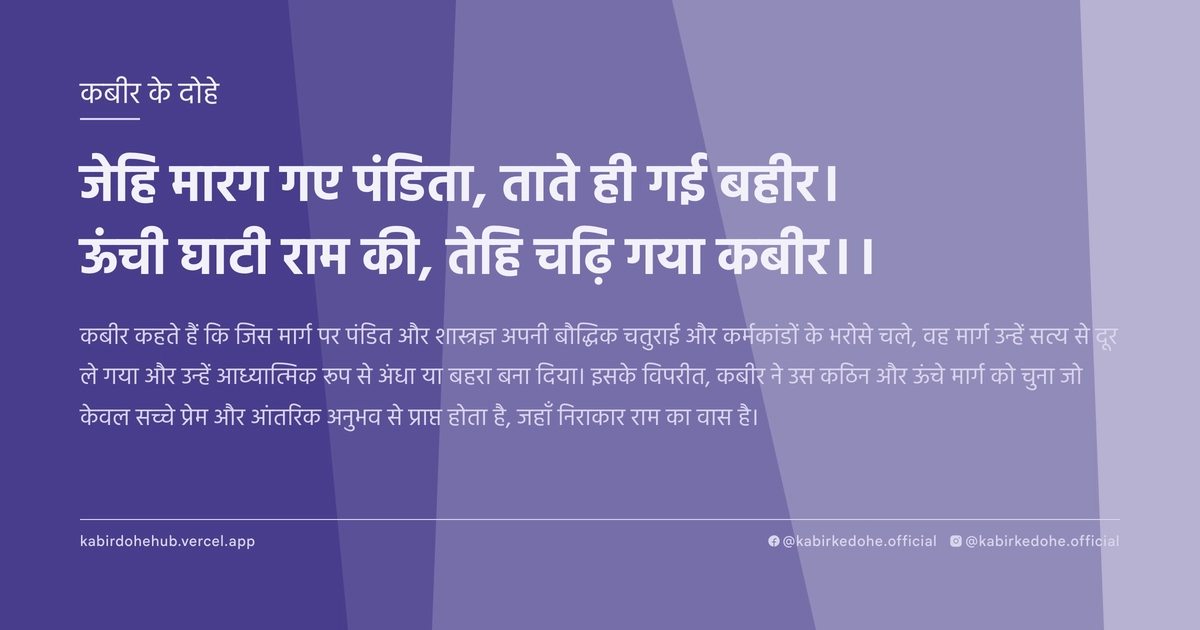
जेहि मारग गए पंडिता, ताते ही गई बहीर।
ऊंची घाटी राम की, तेहि चढ़ि गया कबीर।।
Jehi maarag gaye pandita, taate hi gai baheer. Unchi ghati Ram ki, tehi chadhi gaya Kabir.
इस पृष्ठ पर इस कबीर दोहे का अर्थ (meaning), हिंदी व्याख्या और अंग्रेज़ी अनुवाद, दार्शनिक विश्लेषण और व्यावहारिक जीवन सीख दी गई है। यह दोहा पंडित-मुल्ला विरोध (Anti-clericalism) विषय से जुड़ा है — Kabir doha meaning and explanation in Hindi and English.
अर्थ (Meaning):
कबीर कहते हैं कि जिस मार्ग पर पंडित और शास्त्रज्ञ अपनी बौद्धिक चतुराई और कर्मकांडों के भरोसे चले, वह मार्ग उन्हें सत्य से दूर ले गया और उन्हें आध्यात्मिक रूप से अंधा या बहरा बना दिया। इसके विपरीत, कबीर ने उस कठिन और ऊंचे मार्ग को चुना जो केवल सच्चे प्रेम और आंतरिक अनुभव से प्राप्त होता है, जहाँ निराकार राम का वास है।
Kabir asserts that the path trodden by the scholars and pundits, relying on intellectual vanity and rigid rituals, ultimately led them away from the truth, rendering them spiritually deaf and blind. In contrast, Kabir ascended the 'high valley' of Ram—a steep, challenging path of direct experience and unconditional love that transcends mere bookish knowledge.
व्याख्या (Interpretation):
इस दोहे का शाब्दिक अर्थ है कि विद्वानों का रास्ता व्यर्थ था, जबकि कबीर का रास्ता कठिन पर सत्य था। रूपक के स्तर पर, 'पंडित' यहाँ केवल डिग्री धारकों को नहीं, बल्कि उस अहंकार को दर्शाते हैं जो मानता है कि ईश्वर को तर्क या ग्रंथों से पाया जा सकता है। 'बहीर' (बहरा) होना उस स्थिति का प्रतीक है जहाँ व्यक्ति बाहरी शोर और धार्मिक आडंबरों में इतना खो जाता है कि वह अपनी अंतरात्मा की आवाज़ नहीं सुन पाता। 'ऊंची घाटी' उस कठिन आध्यात्मिक यात्रा का प्रतीक है जिसमें अहंकार का पूर्ण विसर्जन आवश्यक है। यह निर्गुण भक्ति का सार है, जहाँ राम कोई व्यक्ति नहीं बल्कि वह सार्वभौमिक चेतना (Brahman) हैं। यहाँ कबीर यह विरोधाभास प्रस्तुत करते हैं कि जो मार्ग सरल और स्वीकृत लगता है, वह वास्तव में भटकाव है, और जो मार्ग कठिन और तिरस्कृत लगता है, वही मुक्ति का द्वार है।
Literally, the verse contrasts the futile path of the learned with Kabir's successful ascent. Metaphorically, the 'pundits' represent the egoic intellect that believes the Divine can be captured through logic or scripture. Being 'bahir' (deaf) symbolizes a state where one is so immersed in the noise of ritualism and dogma that the inner voice of the Atman is silenced. The 'high valley' represents the arduous spiritual climb requiring the total annihilation of the self. This aligns with Nirgun Bhakti, where 'Ram' is not a deity in a temple but the formless, omnipresent consciousness. Kabir presents a profound paradox: the socially accepted, 'easy' path of scholarship is a detour, while the lonely, steep path of experiential realization is the only true ascent toward non-duality.
दार्शनिक विश्लेषण (Philosophical Analysis):
कबीर का यह दोहा उनके युग के गहरे सामाजिक और धार्मिक संघर्ष को दर्शाता है। मध्यकालीन भारत में, धर्म पूरी तरह से ब्राह्मणवादी कर्मकांडों और संस्कृत ग्रंथों के एकाधिकार में था। कबीर ने इस व्यवस्था को चुनौती दी, यह तर्क देते हुए कि ईश्वर किसी विशेष भाषा, जाति या शास्त्र का बंधक नहीं है। उनका प्रहार उन 'पंडितों' पर है जो ज्ञान को केवल सूचना (Information) समझते हैं, जबकि वास्तविक ज्ञान (Wisdom) अनुभव से आता है।
अद्वैत वेदांत के दृष्टिकोण से, कबीर यहाँ 'माया' के प्रभाव की बात कर रहे हैं। शास्त्र और तर्क अक्सर माया के सूक्ष्म रूप होते हैं जो साधक को 'कर्ता' होने के भ्रम में रखते हैं। जब तक व्यक्ति यह सोचता है कि 'मैं' पढ़ रहा हूँ या 'मैं' पूजा कर रहा हूँ, वह द्वैत में फंसा रहता है। कबीर की 'ऊंची घाटी' उस अवस्था की ओर संकेत करती है जहाँ ज्ञाता, ज्ञान और ज्ञेय का भेद समाप्त हो जाता है।
सूफी मत के 'फना' (अहंकार का विनाश) और भक्ति मार्ग के 'शरणागति' के बीच एक गहरा सेतु है। कबीर का मार्ग 'इश्क' या प्रेम का मार्ग है। सूफी संतों की तरह, वे मानते हैं कि ईश्वर तक पहुँचने का रास्ता मस्तिष्क से नहीं, हृदय से होकर गुजरता है। बौद्धिक विश्लेषण केवल किनारे तक ले जा सकता है, लेकिन डुबकी तो स्वयं को मिटाकर ही लगानी पड़ती है।
कबीर का यह दृष्टिकोण जाति व्यवस्था और सामाजिक पदानुक्रम पर भी प्रहार करता है। यदि ज्ञान केवल शास्त्रों से मिलता, तो केवल उच्च जातियों के पास मुक्ति होती। लेकिन कबीर ने सिद्ध किया कि एक जुलाहा, जो अनपढ़ है, अपनी आंतरिक पवित्रता और ईमानदारी के कारण उस 'ऊंची घाटी' तक पहुँच सकता है जहाँ बड़े-बड़े विद्वान असफल रहे।
अंततः, यह दोहा मनोवैज्ञानिक रूपांतरण की बात करता है। यह हमें चेतावनी देता है कि हम अपनी बौद्धिक उपलब्धियों को आध्यात्मिक प्रगति समझने की गलती न करें। वास्तविक रूपांतरण तब होता है जब हम 'जानने' की इच्छा को छोड़कर 'होने' की स्थिति में प्रवेश करते हैं। यह सूचना से बोध की ओर संक्रमण है।
This couplet reflects the intense socio-religious friction of Kabir's era. In medieval India, spirituality was largely monopolized by Brahmanical rituals and Sanskrit texts. Kabir challenged this hegemony, arguing that the Divine is not a prisoner of a specific language, caste, or scripture. His critique is aimed at 'pundits' who mistake information for wisdom, failing to realize that true liberation comes from direct experience, not rote learning.
From the lens of Advaita Vedanta, Kabir is addressing the veil of Maya. Scriptures and logic, while useful as pointers, can become subtle traps of the ego, reinforcing the illusion of the 'doer.' As long as a seeker believes 'I' am studying or 'I' am performing a ritual, they remain trapped in duality. The 'high valley' signifies the state where the distinction between the knower, the known, and the act of knowing dissolves into oneness.
There is a profound bridge here between the Sufi concept of 'Fana' (annihilation of the self) and the Bhakti path of total surrender. Kabir’s ascent is fueled by 'Ishq' or divine love. Like the Sufi mystics, he posits that the path to the Truth bypasses the intellect and travels through the heart. Intellectual analysis can bring one to the shore, but the dive into the ocean of consciousness requires the death of the ego.
Furthermore, this teaching dismantles the caste hierarchy. If liberation were a product of scriptural literacy, it would be the exclusive property of the elite. By claiming the 'high valley' for himself—a humble weaver—Kabir democratizes spirituality, asserting that inner purity and sincerity outweigh social status or academic credentials.
Ultimately, the verse focuses on psychological transformation. It warns against the 'spiritual bypass' where intellectual mastery is used to avoid the painful process of ego-death. True transformation occurs when one stops trying to 'know' God as an object and starts 'being' the Divine as their own essence. It is a transition from information to realization.
मूल संदेश (Core Message):
- बौद्धिक अहंकार सत्य की प्राप्ति में सबसे बड़ी बाधा है।
- वास्तविक ज्ञान सूचनाओं का संग्रह नहीं, बल्कि अनुभव का रूपांतरण है।
- ईश्वर तक पहुँचने का मार्ग तर्क से नहीं, प्रेम और सरलता से खुलता है।
- बाहरी कर्मकांड आंतरिक शून्यता को कभी नहीं भर सकते।
- जब 'मैं' मिटता है, तभी 'राम' (अनंत चेतना) का उदय होता है।
- Intellectual arrogance is the primary obstacle to realizing the Truth.
- True knowledge is not a collection of information, but a transformation of experience.
- The gateway to the Divine opens through love and simplicity, not through logic.
- External rituals can never fill the void of internal emptiness.
- Only when the 'I' is annihilated does 'Ram' (Infinite Consciousness) emerge.
व्यावहारिक उदाहरण (Practical Example):
एक समय की बात है, वाराणसी के घाटों पर रहने वाला एक वृद्ध बुनकर था, जिसका नाम माधव था। माधव जीवन भर केवल सूत काता और कपड़े बुने, उसने कभी कोई बड़ा ग्रंथ नहीं पढ़ा। उसी शहर में एक प्रसिद्ध विद्वान पंडित जी रहते थे, जिन्होंने दुनिया भर के शास्त्रों का अध्ययन किया था और अपनी विद्वत्ता के लिए जाने जाते थे।
पंडित जी अक्सर माधव को देखते और मन ही मन उसका उपहास करते कि यह अनपढ़ व्यक्ति कैसे ईश्वर को जान सकता है। पंडित जी घंटों शास्त्रों की व्याख्या करते, जटिल तर्क देते और यह सिद्ध करने की कोशिश करते कि मोक्ष का मार्ग केवल कठिन अनुष्ठानों और शुद्ध संस्कृत मंत्रों से ही संभव है।
माधव का जीवन सरल था। वह अपने करघे पर काम करते हुए बस एक ही धुन में रहता—'राम, राम'। उसके लिए राम कोई मूर्ति नहीं थे, बल्कि वह प्रेम था जो वह अपने काम में, अपने पड़ोसियों की मदद में और अपनी पत्नी की सेवा में डालता था। वह चुपचाप रहता और अपनी आत्मा की गहराई में उस निराकार शक्ति का अनुभव करता।
एक दिन शहर में एक महान संत आए। पंडित जी उनके पास गए और अपनी लंबी सूची पेश की कि उन्होंने कितने ग्रंथ पढ़े हैं और कितनी कठिन साधनाएं की हैं। उन्होंने संत से पूछा, 'क्या मैं अब उस परम सत्य के करीब हूँ?' संत ने उनकी आँखों में देखा और मुस्कुराकर कहा, 'तुमने नक्शे तो बहुत पढ़े हैं, लेकिन तुम कभी यात्रा पर निकले ही नहीं।'
तभी माधव वहाँ से गुजर रहा था, उसके कंधे पर एक साधारण सा कपड़ा था। संत ने उसे बुलाया और उसकी आँखों में एक ऐसी शांति और चमक देखी जो पंडित जी की आँखों में नहीं थी। संत ने कहा, 'यह व्यक्ति उस शिखर पर पहुँच चुका है जहाँ तुम केवल किताबों में ढूँढ रहे हो।'
पंडित जी हैरान रह गए। उन्होंने माधव से पूछा, 'तुमने कौन सा मंत्र पढ़ा? कौन सा कठिन व्रत किया?' माधव ने विनम्रता से सिर झुकाया और कहा, 'पंडित जी, मैंने कभी मंत्र नहीं पढ़े। मैंने बस अपने अहंकार को इस करघे के धागों की तरह सुलझाया और खुद को उस परमात्मा के प्रेम में बुन दिया।'
पंडित जी को पहली बार महसूस हुआ कि उनकी सारी बौद्धिक उपलब्धियां एक दीवार बन गई थीं, जिसने उन्हें वास्तविक अनुभव से दूर रखा था। उन्होंने महसूस किया कि वे 'बहरे' हो गए थे—वे शब्दों को सुन रहे थे, लेकिन सत्य की गूँज को नहीं।
उस दिन पंडित जी ने अपनी किताबों को किनारे रखा और माधव के पास बैठकर यह सीखना शुरू किया कि कैसे मौन रहकर सुना जाता है। उन्होंने समझा कि ज्ञान का अहंकार एक बोझ है, और जब तक वह बोझ उतारा नहीं जाता, 'ऊंची घाटी' की चढ़ाई असंभव है।
माधव की सरलता ने पंडित जी के अहंकार को तोड़ दिया। पंडित जी ने अब कर्मकांडों के बजाय सेवा और प्रेम को अपना मार्ग बनाया। उन्होंने सीखा कि ईश्वर शास्त्रों में नहीं, बल्कि उस जीवंत प्रेम में है जो बिना किसी शर्त के बहता है।
अंत में, पंडित जी और माधव एक ही मार्ग पर चल पड़े—वह मार्ग जहाँ कोई छोटा या बड़ा नहीं था, केवल एक अनंत चेतना थी जो सबको एक सूत्र में पिरोए हुए थी।
Once, in the sacred alleys of Varanasi, lived an elderly weaver named Madhav. Madhav spent his entire life spinning yarn and weaving cloth; he had never read a single scholarly text. In the same city lived a renowned scholar, Pandit Ji, who had mastered the vast libraries of the world and was celebrated for his intellectual prowess.
Pandit Ji often observed Madhav and secretly mocked him, wondering how an illiterate man could possibly comprehend the Divine. The Pandit spent hours interpreting scriptures, constructing complex logical arguments to prove that liberation was only possible through rigorous rituals and the precise chanting of Sanskrit mantras.
Madhav’s life was simple. While working at his loom, he remained in a constant state of remembrance, chanting 'Ram, Ram' not as a name, but as a vibration. For him, Ram was not an idol in a temple, but the love he poured into his craft, his help for neighbors, and his devotion to his wife. He remained silent, experiencing the formless power within the depths of his own soul.
One day, a great enlightened saint visited the city. Pandit Ji approached him, presenting a long list of the texts he had mastered and the austerities he had performed. He asked the saint, 'Am I now close to the Ultimate Truth?' The saint looked into his eyes and smiled, saying, 'You have studied many maps, but you have never actually set out on the journey.'
Just then, Madhav happened to pass by, carrying a simple piece of cloth on his shoulder. The saint called him over and saw in his eyes a peace and radiance that was entirely absent in the Pandit’s gaze. The saint proclaimed, 'This man has reached the peak that you are merely searching for in books.'
Pandit Ji was stunned. He asked Madhav, 'Which mantra did you recite? Which grueling fast did you observe?' Madhav bowed humbly and replied, 'Pandit Ji, I never read mantras. I simply untangled my ego like the threads of my loom and wove myself into the love of the Divine.'
Pandit Ji realized for the first time that his intellectual achievements had become a wall, separating him from actual experience. He understood that he had become 'deaf'—he was hearing the words, but missing the resonance of Truth.
That day, the Pandit set aside his books and sat beside Madhav to learn the art of listening in silence. He understood that the ego of knowledge is a heavy burden, and until that burden is dropped, the ascent to the 'high valley' is impossible.
Madhav’s simplicity shattered the Pandit’s pride. The scholar began to replace ritualism with service and love. He learned that God does not reside in the ink of scriptures, but in the living love that flows without condition.
Eventually, the Pandit and the weaver walked the same path—a path where there was no high or low, only an infinite consciousness weaving everyone into a single, divine tapestry.
अभ्यास मार्गदर्शन (Practice Guidance):
- दैनिक मौन अभ्यास: प्रतिदिन 30 मिनट पूर्ण मौन में बैठें। शब्दों और विचारों के शोर को शांत करें ताकि आप 'बहीर' होने की स्थिति से बाहर निकल सकें और आंतरिक संगीत को सुन सकें।
- अहंकार का निरीक्षण (Journaling): एक डायरी लिखें जिसमें उन क्षणों को दर्ज करें जब आपने अपनी बौद्धिक श्रेष्ठता का उपयोग दूसरों को नीचा दिखाने के लिए किया। पूछें—'क्या मेरा ज्ञान मुझे विनम्र बना रहा है या अहंकारी?'
- सेवा का अभ्यास: बिना किसी धार्मिक या सामाजिक पहचान के, किसी ऐसे व्यक्ति की मदद करें जिससे आपका कोई संबंध न हो। यह अभ्यास आपको 'पंडित' (अहंकारी ज्ञाता) से 'सेवक' की ओर ले जाएगा।
- निदान चेकलिस्ट (Diagnostic Checklist): क्या आप सत्य को केवल किताबों में ढूँढ रहे हैं? क्या आप दूसरों की आस्था का मजाक उड़ाते हैं? क्या आप शांति के बजाय तर्कों में अधिक समय बिताते हैं? यदि हाँ, तो आप अभी भी निचले मार्ग पर हैं।
- Daily Silence Practice: Spend 30 minutes in absolute silence every day. Quiet the noise of words and intellectual constructs to move beyond the state of being 'deaf' and begin hearing the inner resonance.
- Ego Observation (Journaling): Keep a journal recording moments where you used your intellectual superiority to diminish others. Ask yourself: 'Is my knowledge making me humble or arrogant?'
- Practice of Selfless Service: Help someone with whom you have no social or religious connection, without any expectation. This shifts your identity from the 'Pandit' (the arrogant knower) to the 'Servant' of the Divine.
- Diagnostic Checklist: Are you searching for Truth only in books? Do you find yourself mocking the faith of others? Do you spend more time in arguments than in stillness? If yes, you are still traversing the lower path.
चिंतन प्रश्न (Reflection Questions):
- मेरी कितनी मान्यताएं वास्तव में मेरी अपनी हैं, और कितनी मैंने केवल समाज या किताबों से उधार ली हैं?
- क्या मैं अपनी शिक्षा या पद का उपयोग सत्य को खोजने के लिए कर रहा हूँ, या केवल अपनी श्रेष्ठता सिद्ध करने के लिए?
- मेरे जीवन का वह कौन सा 'शोर' है जो मुझे मेरी अंतरात्मा की धीमी आवाज़ सुनने से रोक रहा है?
- यदि मुझसे मेरी सारी डिग्रियां और सामाजिक पहचान छीन ली जाए, तो क्या मेरे पास ईश्वर से जुड़ने का कोई रास्ता बचेगा?
- क्या मैं वास्तव में सत्य की खोज में हूँ, या मैं केवल यह साबित करना चाहता हूँ कि मैं सही हूँ?
- How many of my beliefs are truly my own, and how many have I merely borrowed from society or books?
- Am I using my education or status to seek the Truth, or simply to validate my superiority?
- What is the specific 'noise' in my life that prevents me from hearing the subtle whisper of my soul?
- If all my degrees and social identities were stripped away, would I still have a way to connect with the Divine?
- Am I genuinely seeking the Truth, or am I merely trying to prove that I am right?