
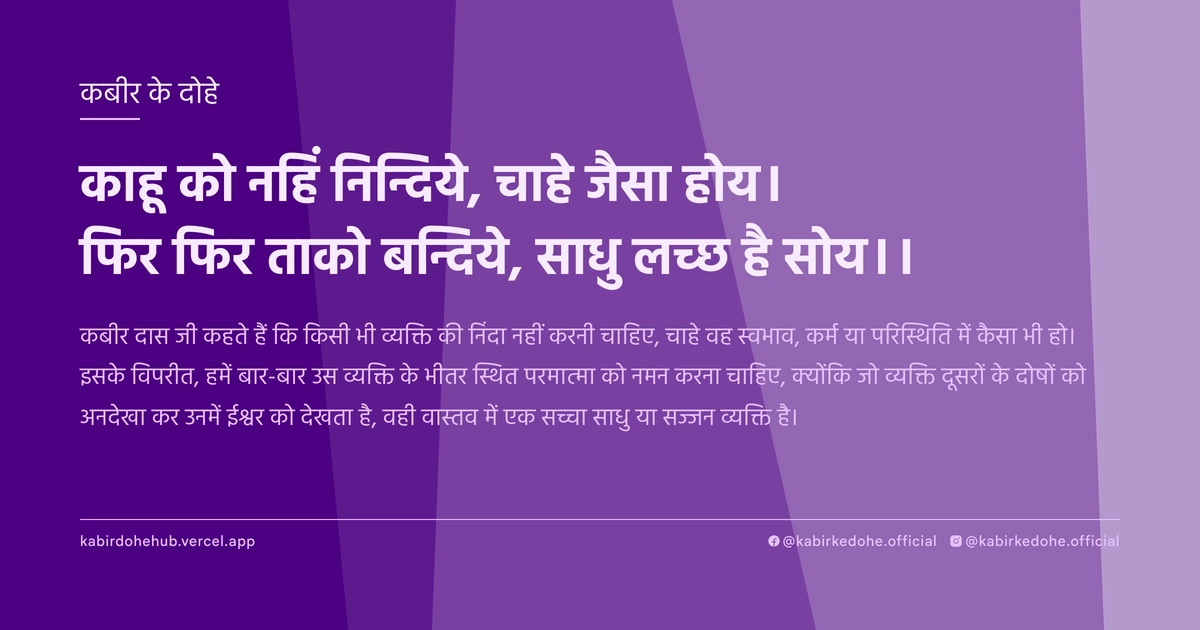
काहू को नहिं निन्दिये, चाहे जैसा होय।
फिर फिर ताको बन्दिये, साधु लच्छ है सोय।।
Kaahu ko nahin nindiye, chahe jaisa hoye. Phir phir taako bandiye, sadhu lachh hai soy.
इस पृष्ठ पर इस कबीर दोहे का अर्थ (meaning), हिंदी व्याख्या और अंग्रेज़ी अनुवाद, दार्शनिक विश्लेषण और व्यावहारिक जीवन सीख दी गई है। यह दोहा करुणा (Compassion) विषय से जुड़ा है — Kabir doha meaning and explanation in Hindi and English.
अर्थ (Meaning):
कबीर दास जी कहते हैं कि किसी भी व्यक्ति की निंदा नहीं करनी चाहिए, चाहे वह स्वभाव, कर्म या परिस्थिति में कैसा भी हो। इसके विपरीत, हमें बार-बार उस व्यक्ति के भीतर स्थित परमात्मा को नमन करना चाहिए, क्योंकि जो व्यक्ति दूसरों के दोषों को अनदेखा कर उनमें ईश्वर को देखता है, वही वास्तव में एक सच्चा साधु या सज्जन व्यक्ति है।
Kabir teaches that one must never criticize or disparage another human being, regardless of their flaws, behavior, or social standing. Instead, one should repeatedly bow to the divine spark within them. The true mark of a saint or a realized soul is the ability to see the Eternal Presence in everyone, transcending the superficial imperfections of the ego.
व्याख्या (Interpretation):
यह दोहा बाहरी आलोचना के त्याग और आंतरिक दिव्यता की पहचान का आह्वान है। शाब्दिक अर्थ में यह दूसरों की बुराई न करने की सलाह देता है, लेकिन आध्यात्मिक स्तर पर यह 'अद्वैत' की स्थिति है। जब हम किसी की निंदा करते हैं, तो हम वास्तव में अपने ही अहंकार को पुष्ट कर रहे होते हैं क्योंकि निंदा करने वाला स्वयं को श्रेष्ठ मानता है। 'बन्दिये' शब्द यहाँ केवल शारीरिक झुकने का नहीं, बल्कि चेतना के समर्पण का प्रतीक है। यह निरगुण भक्ति का सार है, जहाँ ईश्वर किसी मंदिर या मस्जिद में नहीं, बल्कि हर जीव के भीतर व्याप्त है। माया हमें यह भ्रम कराती है कि हम और दूसरे अलग हैं, जबकि आत्मा एक ही है। इस विरोधाभास को समझना कि 'पापी' में भी 'परमात्मा' है, ही वास्तविक आध्यात्मिक जागृति है।
This couplet is a call for the cessation of external judgment and the recognition of internal divinity. Literally, it advises against criticism, but metaphorically, it points toward the state of 'Advaita' or non-duality. When we criticize another, we are merely reinforcing our own ego, as the act of judging assumes a position of superiority. The word 'bandiye' (to bow) symbolizes not just a physical gesture, but a surrender of consciousness. This is the essence of Nirgun Bhakti, where the Divine is not confined to idols or structures but permeates every living being. Maya creates the illusion of separation and 'otherness,' while the Atman remains one. Understanding the paradox that the Divine resides even within the flawed is the hallmark of true spiritual awakening.
दार्शनिक विश्लेषण (Philosophical Analysis):
कबीर का यह दृष्टिकोण उनके समय के सामाजिक और धार्मिक पाखंडों के विरुद्ध एक सशक्त प्रहार था। उस युग में जाति, वर्ण और धार्मिक शुद्धता के आधार पर लोगों को विभाजित किया गया था और 'अपवित्र' माने जाने वालों की निंदा करना धर्म का हिस्सा समझा जाता था। कबीर ने इस व्यवस्था को चुनौती देते हुए यह प्रतिपादित किया कि आत्मा का कोई धर्म या जाति नहीं होती।
दार्शनिक रूप से, यह विचार अद्वैत वेदांत के 'सर्वं खल्विदं ब्रह्म' (सब कुछ ब्रह्म है) से मेल खाता है। यदि संपूर्ण ब्रह्मांड एक ही चेतना का विस्तार है, तो किसी की निंदा करना स्वयं की ही निंदा करने के समान है। सूफी मत के 'वहदत-अल-वजूद' (अस्तित्व की एकता) की तरह, कबीर भी मानते हैं कि प्रेमी और प्रियतम, या भक्त और भगवान, वास्तव में एक ही हैं।
यहाँ अहंकार (Ego) का विलोपन सबसे महत्वपूर्ण है। निंदा अहंकार का पोषण करती है, जबकि विनम्रता और नमन अहंकार को नष्ट करते हैं। जब साधक यह अनुभव करता है कि सामने वाला व्यक्ति उसके अपने ही अस्तित्व का एक प्रतिबिंब है, तब घृणा स्वतः समाप्त हो जाती है। यह केवल नैतिक उपदेश नहीं है, बल्कि एक मनोवैज्ञानिक रूपांतरण है जहाँ 'मैं' और 'तू' का भेद मिट जाता है।
कबीर ritualism (कर्मकांड) के बजाय 'सहज' मार्ग पर बल देते हैं। उनके लिए सबसे बड़ी पूजा किसी मूर्ति की नहीं, बल्कि मानवता की सेवा और सम्मान है। वे समझाते हैं कि बाहरी शुद्धता (जैसे स्नान या तिलक) व्यर्थ है यदि मन में दूसरों के प्रति द्वेष है।
अंततः, यह दोहा हमें सिखाता है कि 'साधु' वह नहीं है जिसने बहुत शास्त्र पढ़े हों, बल्कि वह है जिसने अपने भीतर के निर्णयकर्ता (Judge) को मार दिया है। यह करुणा का उच्चतम स्तर है, जहाँ व्यक्ति दूसरे की त्रुटियों को उसकी अज्ञानता मानकर क्षमा करता है और उसके भीतर छिपे प्रकाश को प्रणाम करता है।
Kabir's perspective was a powerful strike against the social and religious hypocrisies of his era. In a time when people were stratified by caste, varna, and notions of ritual purity, criticizing those deemed 'impure' was often seen as a religious duty. Kabir challenged this by asserting that the soul possesses no caste or creed.
Philosophically, this aligns with the Advaita Vedanta principle of 'Sarvam Khalvidam Brahma' (All this is indeed Brahman). If the entire universe is an extension of a single consciousness, then criticizing another is equivalent to criticizing oneself. Similarly, mirroring the Sufi concept of 'Wahdat-al-Wujud' (Unity of Existence), Kabir posits that the seeker and the Divine are fundamentally one.
The annihilation of the ego (Ahamkara) is central here. Criticism feeds the ego, while humility and bowing dismantle it. When a seeker realizes that the other person is merely a reflection of their own existence, hatred naturally dissolves. This is not mere moralizing but a psychological transformation where the duality of 'I' and 'Thou' vanishes.
Kabir emphasizes the 'Sahaja' (natural/spontaneous) path over rigid ritualism. For him, the highest form of worship is not found in idols, but in the service and respect of humanity. He argues that external purity—such as ritual bathing or wearing sacred marks—is futile if the heart harbors malice.
Ultimately, this doha teaches that a 'Sadhu' is not one who has mastered scriptures, but one who has slain the internal judge. This represents the pinnacle of compassion, where one views another's flaws as a product of ignorance and bows to the latent light within them.
मूल संदेश (Core Message):
- निंदा अहंकार का दर्पण है, इसे तोड़ें।
- दोष बाहरी हैं, आत्मा सदैव शुद्ध है।
- विनम्रता ही वास्तविक आध्यात्मिक शक्ति है।
- हर मनुष्य ईश्वर का एक अधूरा प्रतिबिंब है।
- करुणा ही अद्वैत की ओर पहला कदम है।
- सच्चा साधु वह है जो प्रेम को चुनता है।
- Criticism is a mirror of ego; shatter it.
- Flaws are external; the soul is eternally pure.
- Humility is the only true spiritual power.
- Every human is an imperfect reflection of the Divine.
- Compassion is the first step toward non-duality.
- A true saint is one who chooses love over judgment.
व्यावहारिक उदाहरण (Practical Example):
वाराणसी के एक पुराने घाट पर रामदीन नाम का एक वृद्ध नाविक रहता था। वह स्वभाव से अत्यंत क्रोधी और कड़वा था। वह अक्सर आने-जाने वाले यात्रियों को कोसता और छोटी-छोटी बातों पर चिल्लाता था। घाट के अन्य नाविक और दुकानदार उसे 'पागल' और 'अभद्र' कहकर उसका उपहास करते थे और उससे दूरी बनाकर रखते थे।
उसी घाट पर एक युवा जिज्ञासु, माधव, आया जो शांति की खोज में था। उसने देखा कि कैसे लोग रामदीन की निंदा करते थे। माधव ने तय किया कि वह रामदीन के प्रति कबीर की इस सीख को लागू करेगा। जब रामदीन ने एक दिन माधव पर बिना कारण चिल्लाया, तो माधव ने पलटकर जवाब देने के बजाय, शांत रहकर उसकी आँखों में देखा और मन ही मन कहा, 'इस क्रोध के पीछे छिपी उस आत्मा को प्रणाम, जो केवल प्रेम चाहती है।'
माधव ने रामदीन की निंदा करने के बजाय उसके प्रति करुणा दिखाई। वह हर दिन रामदीन के पास जाता और उससे उसकी पुरानी कहानियाँ पूछता। शुरू में रामदीन को यह बहुत अजीब लगा। उसने माधव को डराने और भगाने की बहुत कोशिश की, लेकिन माधव की अटूट विनम्रता और सम्मान ने रामदीन के भीतर के रक्षा-कवच को तोड़ दिया।
एक शाम, रामदीन अचानक फूट-फूट कर रोने लगा। उसने बताया कि वर्षों पहले उसने अपने परिवार को एक दुर्घटना में खो दिया था और तब से वह दुनिया से नफरत करने लगा था। उसका क्रोध वास्तव में उसका गहरा दुख था, जिसे दुनिया ने केवल 'बुरा व्यवहार' समझा था।
माधव ने उसे गले लगाया और कहा, 'बाबा, आपकी तकलीफ बड़ी थी, लेकिन आप अब भी पूजनीय हैं।' इस एक वाक्य ने रामदीन के जीवन की दिशा बदल दी। उसे पहली बार महसूस हुआ कि कोई उसे उसके दोषों के बावजूद स्वीकार कर रहा है।
धीरे-धीरे रामदीन का व्यवहार बदलने लगा। वह अब यात्रियों का स्वागत मुस्कुराहट के साथ करता था। जो लोग पहले उसकी निंदा करते थे, वे अब उसकी विनम्रता देखकर हैरान थे।
रामदीन ने अब अपनी नाव का उपयोग केवल पैसे कमाने के लिए नहीं, बल्कि बीमारों और असहायों को मुफ्त में घाट तक पहुँचाने के लिए करना शुरू कर दिया।
यह 'कबीर ट्विस्ट' था—जहाँ निंदा के स्थान पर 'नमन' ने एक पत्थर दिल इंसान को करुणा के सागर में बदल दिया। माधव ने साबित किया कि जब हम दूसरे की बुराई को नहीं, बल्कि उसकी दिव्यता को देखते हैं, तो हम सामने वाले को बदलने की शक्ति रखते हैं।
On an ancient ghat in Varanasi lived an elderly boatman named Ramdeen. He was notoriously irritable and caustic, often cursing passengers and shouting over trivial matters. Other boatmen and shopkeepers mocked him, calling him 'mad' and 'vulgar,' and deliberately avoided him.
To this ghat came Madhav, a young seeker in search of peace. He observed how everyone criticized Ramdeen. Madhav decided to apply Kabir's teaching to this situation. One day, when Ramdeen shouted at him without provocation, instead of reacting, Madhav looked into his eyes and whispered in his heart, 'I bow to the soul behind this anger, which seeks only love.'
Rather than judging, Madhav showed compassion. He visited Ramdeen daily, asking about his old stories. Initially, Ramdeen found this bizarre. He tried everything to scare Madhav away, but Madhav's unwavering humility and respect eventually pierced Ramdeen's defensive armor.
One evening, Ramdeen suddenly broke down in tears. He revealed that years ago, he had lost his entire family in a tragic accident, and since then, he had cultivated a hatred for the world. His anger was actually deep-seated grief, which the world had mislabeled as 'bad behavior.'
Madhav embraced him and said, 'Baba, your pain was great, but you are still worthy of reverence.' This single sentence shifted the trajectory of Ramdeen's life. For the first time, he felt accepted despite his flaws.
Gradually, Ramdeen's demeanor changed. He began welcoming passengers with a smile. Those who had previously criticized him were now astonished by his humility.
Ramdeen began using his boat not just for profit, but to transport the sick and helpless to the ghats for free.
This was the 'Kabir Twist'—where 'bowing' instead of 'criticizing' transformed a stone-hearted man into an ocean of compassion. Madhav proved that when we stop seeing the flaw and start seeing the divinity, we possess the power to transform another.
अभ्यास मार्गदर्शन (Practice Guidance):
- दैनिक अभ्यास: दिन भर में कम से कम तीन ऐसे व्यक्तियों को पहचानें जिनके प्रति आप स्वाभाविक रूप से निर्णय (Judge) लेते हैं। मानसिक रूप से उनके भीतर के ईश्वर को नमन करें और कहें, 'मैं तुम्हारे भीतर के प्रकाश को प्रणाम करता हूँ'।
- आत्म-पूछताछ जर्नल: जब भी आप किसी की निंदा करें, तो लिखें: 'मैं इस व्यक्ति में किस कमी को देख रहा हूँ और यह कमी मेरे अपने किस डर या अहंकार को दर्शाती है?'
- व्यवहार परिवर्तन: किसी की गलती पर प्रतिक्रिया देने से पहले 5 सेकंड का मौन रखें। यह मौन आपको 'निंदा' से 'करुणा' की ओर ले जाने का पुल बनेगा।
- डायग्नोस्टिक चेकलिस्ट: (1) क्या मैं दूसरों की गलतियों पर तुरंत प्रतिक्रिया देता हूँ? (2) क्या मैं खुद को दूसरों से नैतिक रूप से श्रेष्ठ महसूस करता हूँ? (3) क्या मैं किसी व्यक्ति के व्यवहार को उसकी आत्मा से अलग देख पाता हूँ? यदि उत्तर 'हाँ' है, तो आप अभी भी अहंकार के प्रभाव में हैं।
- Daily Practice: Identify at least three people during the day whom you naturally judge. Mentally bow to the divinity within them and affirm, 'I bow to the light within you.'
- Self-Inquiry Journal: Whenever you find yourself criticizing someone, write down: 'What flaw am I seeing in this person, and what fear or ego within myself does this flaw mirror?'
- Behavioral Shift: Implement a 5-second silence before reacting to someone's mistake. This pause acts as a bridge moving you from 'judgment' to 'compassion.'
- Diagnostic Checklist: (1) Do I react instantly to others' mistakes? (2) Do I feel morally superior to others? (3) Can I separate a person's behavior from their essence? If you answer 'Yes' to the first two, you are still operating under the influence of the ego.
चिंतन प्रश्न (Reflection Questions):
- वह कौन सा गुण है जिसे आप दूसरों में नापसंद करते हैं, लेकिन वह आपके अपने व्यक्तित्व का छिपा हुआ हिस्सा है?
- यदि आप आज अपनी सामाजिक पहचान (पद, प्रतिष्ठा) खो दें, तो क्या आप अभी भी दूसरों को सम्मान दे पाएंगे?
- क्या आपकी 'नैतिकता' वास्तव में करुणा है, या यह केवल दूसरों को छोटा दिखाकर खुद को बड़ा महसूस करने का एक तरीका है?
- जब आप किसी की निंदा करते हैं, तो आपके भीतर कौन सा हिस्सा संतुष्ट होता है?
- क्या आप किसी ऐसे व्यक्ति को बिना शर्त प्रेम कर सकते हैं जिसने आपके साथ बुरा किया हो?
- आपकी डिजिटल पहचान (Social Media) पर आप दूसरों की आलोचना कैसे करते हैं, और वह आपके वास्तविक स्वरूप के बारे में क्या बताता है?
- What trait do you dislike in others that is actually a hidden part of your own personality?
- If you lost your social identity (status, title) today, would you still be able to offer respect to others?
- Is your 'morality' truly compassion, or is it just a way to feel superior by belittling others?
- Which part of your internal self feels satisfied when you criticize someone?
- Can you love someone unconditionally who has intentionally caused you harm?
- How do you criticize others in your digital identity (social media), and what does that reveal about your true nature?