
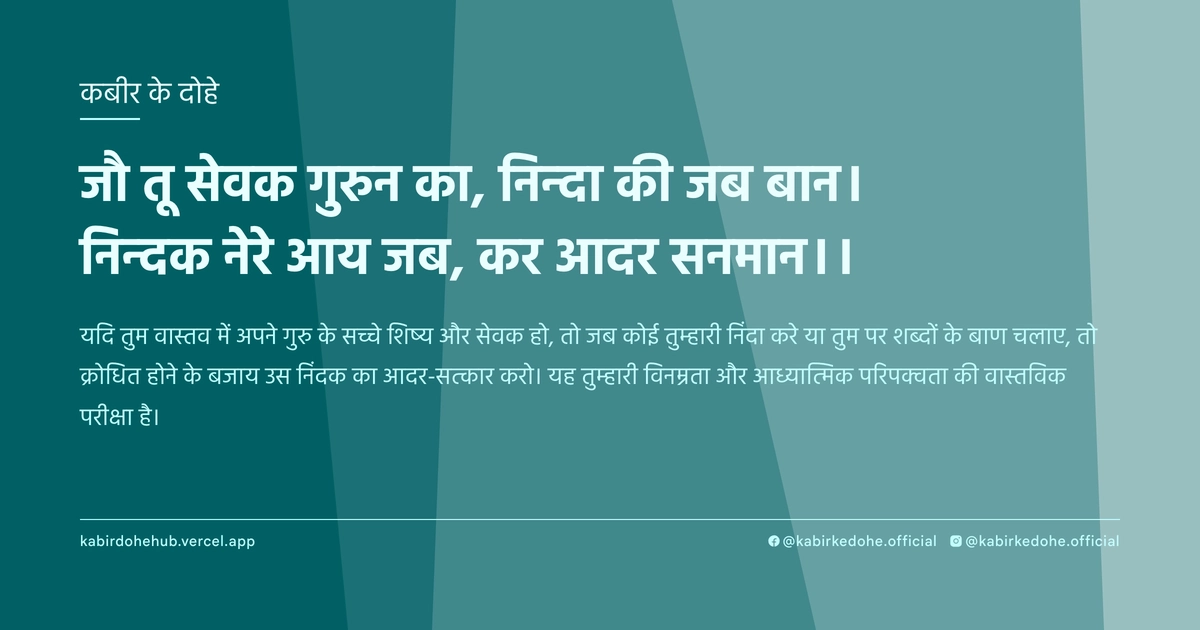
जौ तू सेवक गुरुन का, निन्दा की जब बान।
निन्दक नेरे आय जब, कर आदर सनमान।।
Jau tu sevak gurun ka, ninda ki jab baan. Nindak nere aay jab, kar aadar sanmaan.
इस पृष्ठ पर इस कबीर दोहे का अर्थ (meaning), हिंदी व्याख्या और अंग्रेज़ी अनुवाद, दार्शनिक विश्लेषण और व्यावहारिक जीवन सीख दी गई है। यह दोहा विनम्रता (Humility) विषय से जुड़ा है — Kabir doha meaning and explanation in Hindi and English.
अर्थ (Meaning):
यदि तुम वास्तव में अपने गुरु के सच्चे शिष्य और सेवक हो, तो जब कोई तुम्हारी निंदा करे या तुम पर शब्दों के बाण चलाए, तो क्रोधित होने के बजाय उस निंदक का आदर-सत्कार करो। यह तुम्हारी विनम्रता और आध्यात्मिक परिपक्वता की वास्तविक परीक्षा है।
If you truly claim to be a devoted disciple of the Guru, then when someone showers you with criticism or launches arrows of slander, do not react with anger. Instead, welcome the critic with honor and respect, treating their presence as a catalyst for your own spiritual growth.
व्याख्या (Interpretation):
यह दोहा अहंकार के विसर्जन की प्रक्रिया को दर्शाता है। शाब्दिक अर्थ है कि निंदक का सम्मान करें, परंतु गहरा अर्थ यह है कि निंदक वास्तव में एक दर्पण है जो हमारे उन दोषों को उजागर करता है जिन्हें हम स्वयं नहीं देख पाते। निर्गुण भक्ति में, 'गुरु' केवल एक व्यक्ति नहीं बल्कि वह आंतरिक बोध है जो हमें माया के भ्रम से मुक्त करता है। जब हम निंदा पर प्रतिक्रिया देना बंद कर देते हैं, तो हम द्वैत (मैं और वह) से ऊपर उठकर अद्वैत की स्थिति में पहुँचते हैं, जहाँ न कोई शत्रु है और न कोई मित्र, केवल शुद्ध चेतना शेष रहती है।
This couplet illustrates the process of ego dissolution. While the literal meaning suggests honoring the critic, the metaphorical depth reveals the critic as a mirror reflecting the hidden flaws we ignore. In Nirgun Bhakti, the 'Guru' is not merely a physical teacher but the inner awakening that liberates us from Maya. By ceasing to react to slander, the seeker transcends the duality of 'I' and 'Other,' moving toward the non-dual state of Advaita, where the concepts of enemy and friend vanish, leaving only pure, undisturbed consciousness.
दार्शनिक विश्लेषण (Philosophical Analysis):
कबीर का यह दर्शन तत्कालीन समाज में व्याप्त बाहरी आडंबरों और जातिगत श्रेष्ठता के अहंकार पर प्रहार करता है। वे बताते हैं कि वास्तविक धर्म मंदिर या मस्जिद में नहीं, बल्कि अपने क्रोध और अहंकार को जीतने में है। यह दृष्टिकोण सूफीवाद के 'फना' (अहंकार का विनाश) और अद्वैत वेदांत के 'अहं ब्रह्मास्मि' के करीब है, जहाँ व्यक्ति यह समझता है कि सामने वाला निंदक भी उसी एक परमात्मा का अंश है।
ritualism के विरुद्ध कबीर का तर्क है कि माला जपने से अधिक कठिन है अपने स्वभाव को बदलना। निंदा को स्वीकार करना वास्तव में मनोवैज्ञानिक रूपांतरण है; यह व्यक्ति को बाहरी प्रशंसा की भूख से मुक्त करता है। जब हम निंदक का सम्मान करते हैं, तो हम वास्तव में अपनी उस छवि का सम्मान कर रहे होते हैं जिसे दुनिया देख रही है, जिससे हमारा आंतरिक 'अहं' टूट जाता है।
ऐतिहासिक रूप से, कबीर ने एक ऐसे समाज में यह बात कही जहाँ सम्मान और प्रतिष्ठा (इज्जत) को जीवन से बढ़कर माना जाता था। उन्होंने 'इज्जत' के इस सामाजिक भ्रम को तोड़कर 'आत्मा' की शांति का मार्ग दिखाया। यह शिक्षण सिखाता है कि प्रतिक्रिया ही बंधन है और तटस्थता ही मुक्ति है।
दार्शनिक स्तर पर, यह दोहा सिखाता है कि द्वेष का उत्तर द्वेष से देने पर केवल अंधकार बढ़ता है। प्रेम और सम्मान के माध्यम से शत्रु को मित्र में बदलना ही वास्तविक विजय है। यह 'अहिंसा' का उच्चतम रूप है, जहाँ मानसिक हिंसा का अंत किया जाता है।
अंततः, कबीर यह स्पष्ट करते हैं कि गुरु की सेवा का अर्थ केवल उनके चरणों में गिरना नहीं है, बल्कि उनके द्वारा सिखाए गए धैर्य और क्षमा के सिद्धांतों को जीवन में उतारना है। बिना अहंकार के विसर्जन के, कोई भी ज्ञान केवल सूचना बनकर रह जाता है, रूपांतरण नहीं।
Kabir's philosophy here strikes at the heart of the external rituals and the ego of caste superiority prevalent in his era. He asserts that true religion is found not in temples or mosques, but in the conquest of one's own anger and pride. This perspective aligns closely with the Sufi concept of 'Fana' (annihilation of the self) and the Advaita Vedanta realization of 'Aham Brahmasmi,' where the seeker recognizes the critic as another manifestation of the same Universal Divine.
Against ritualism, Kabir argues that transforming one's nature is far more difficult and rewarding than the mechanical act of chanting beads. Accepting criticism is a profound psychological transformation; it liberates the individual from the hunger for external validation. By honoring the critic, we acknowledge the external perception of our flaws, thereby shattering the illusory 'ego' that seeks perfection.
Historically, Kabir spoke these words in a society where 'honor' (izzat) was guarded more fiercely than life itself. He dismantled this social illusion of prestige to reveal the path toward spiritual peace. He teaches that reaction is the chain, and neutrality is the key to liberation.
On a philosophical level, the couplet posits that responding to hatred with hatred only amplifies the darkness. Transforming an enemy into a friend through love and respect is the only true victory. This represents the highest form of 'Ahimsa' (non-violence), where mental violence is extinguished at its source.
Ultimately, Kabir clarifies that serving the Guru does not mean mere physical prostration, but embodying the principles of patience and forgiveness. Without the dissolution of the ego, all spiritual knowledge remains mere information rather than a transformative experience.
मूल संदेश (Core Message):
- निंदा को शत्रु नहीं, बल्कि आत्म-सुधार का साधन मानें।
- क्रोध का त्याग ही वास्तविक आध्यात्मिक शक्ति है।
- अहंकार का विसर्जन ही परमात्मा से मिलन का एकमात्र मार्ग है।
- बाहरी सम्मान की भूख ही मानसिक अशांति का मूल कारण है।
- विनम्रता वह अग्नि है जो द्वेष को भस्म कर देती है।
- View criticism not as an attack, but as a tool for self-refinement.
- The surrender of anger is the truest form of spiritual power.
- Dissolving the ego is the only path to union with the Divine.
- The hunger for external validation is the root of all mental unrest.
- Humility is the fire that incinerates the seeds of hatred.
व्यावहारिक उदाहरण (Practical Example):
वाराणसी के एक पुराने घाट पर रामदीन नाम का एक वृद्ध बुनकर रहता था। वह अपनी सादगी और ईमानदारी के लिए जाना जाता था, लेकिन गाँव का एक प्रभावशाली जमींदार उसे हमेशा 'नीच' और 'अकुशल' कहकर अपमानित करता था। जमींदार अक्सर सबके सामने रामदीन के कपड़ों की गुणवत्ता का मजाक उड़ाता और उसे नीचा दिखाता था।
रामदीन ने वर्षों तक इस अपमान को सहा, लेकिन उसके मन में कभी द्वेष नहीं आया। एक दिन, जब जमींदार ने बहुत ही कठोर शब्दों में उसकी जाति और काम का उपहास किया, तो रामदीन ने शांत भाव से मुस्कुराकर जमींदार के पैर छुए और उसे अपने घर पर शुद्ध भोजन के लिए आमंत्रित किया।
पूरा गाँव हैरान था कि जो व्यक्ति उसे गाली दे रहा है, वह उसका इतना सम्मान क्यों कर रहा है। रामदीन ने कहा, 'यह व्यक्ति मुझे मेरी उन कमियों के बारे में बता रहा है जिन्हें मैं अपनी आँखों से नहीं देख पाता। वह मेरा सबसे बड़ा शुभचिंतक है क्योंकि वह मुझे अहंकार से बचने की चेतावनी दे रहा है।'
जमींदार, जो अब तक रामदीन की चुप्पी को उसकी कमजोरी समझ रहा था, अंदर से हिल गया। उसे पहली बार महसूस हुआ कि उसकी सत्ता और धन उसके भीतर के खालीपन और क्रोध को नहीं भर सकते। रामदीन की निस्वार्थ विनम्रता ने जमींदार के अहंकार के किले को ढहा दिया।
अगले कुछ हफ्तों तक जमींदार ने रामदीन से दूरी बनाने की कोशिश की, लेकिन रामदीन का व्यवहार नहीं बदला। वह हर बार जमींदार से मिलते समय उसी सम्मान के साथ पेश आता, जैसे वह कोई महान गुरु हो।
धीरे-धीरे जमींदार के मन में ग्लानि पैदा हुई। उसने महसूस किया कि जिस व्यक्ति को वह 'नीच' कह रहा था, वह वास्तव में उससे कहीं अधिक समृद्ध और शांत था। उसने अपनी गलती स्वीकार की और रामदीन से क्षमा मांगी।
रामदीन ने उसे गले लगाया और कहा कि क्षमा माँगने वाला और क्षमा करने वाला, दोनों ही उस समय परमात्मा के सबसे करीब होते हैं। जमींदार का जीवन पूरी तरह बदल गया; उसने गरीबों की मदद करना शुरू किया और अपने अहंकार का त्याग कर दिया।
इस कहानी में 'कबीर ट्विस्ट' यह है कि रामदीन ने निंदा को एक हथियार के बजाय एक औषधि की तरह इस्तेमाल किया। उसने निंदक को शत्रु नहीं, बल्कि अपना आध्यात्मिक शिक्षक मान लिया, जिससे न केवल उसका अपना मन शांत रहा, बल्कि एक क्रूर व्यक्ति का हृदय परिवर्तन भी हो गया।
On an ancient ghat in Varanasi lived an elderly weaver named Ramdeen. He was known for his simplicity and honesty, but a powerful local landlord constantly insulted him, calling him 'lowly' and 'unskilled.' The landlord would often mock the quality of Ramdeen's fabrics in public to humiliate him.
Ramdeen endured this abuse for years, yet never harbored malice. One day, when the landlord used particularly cruel words to ridicule his caste and craft, Ramdeen simply smiled, touched the landlord's feet in respect, and invited him to his humble home for a meal.
The entire village was astonished. They wondered why Ramdeen would honor a man who spoke so vilely of him. Ramdeen replied, 'This man is pointing out the flaws I cannot see myself. He is my greatest well-wisher because he warns me against the trap of pride.'
The landlord, who had mistaken Ramdeen's silence for weakness, was shaken to his core. For the first time, he realized that his wealth and power could not fill the void of anger and restlessness within him. Ramdeen's selfless humility dismantled the fortress of the landlord's ego.
For the following weeks, the landlord tried to avoid Ramdeen, but Ramdeen's behavior remained unchanged. Every time they met, he greeted the landlord with the same profound respect, as if he were a great master.
Gradually, a sense of remorse grew within the landlord. He realized that the man he called 'lowly' was infinitely richer in spirit and peace than he ever was. Overwhelmed, he approached Ramdeen and begged for forgiveness.
Ramdeen embraced him, stating that in the moment of forgiveness, both the one who asks and the one who grants it are closest to the Divine. The landlord's life underwent a total transformation; he began helping the poor and abandoned his arrogance.
The 'Kabir Twist' here is that Ramdeen treated criticism not as a weapon, but as medicine. By perceiving the critic as a spiritual teacher rather than an enemy, he maintained his own inner peace and triggered a profound moral awakening in a cruel man.
अभ्यास मार्गदर्शन (Practice Guidance):
- दैनिक अभ्यास: जब भी कोई आपकी आलोचना करे, तुरंत प्रतिक्रिया देने के बजाय 10 सेकंड का मौन रखें और मन में कहें, 'यह मेरा अहंकार कम करने का एक अवसर है'।
- आत्म-निरीक्षण जर्नल: प्रतिदिन रात को उन घटनाओं को लिखें जब आपको क्रोध आया। विश्लेषण करें कि निंदा का कौन सा हिस्सा आपके 'अहं' को चोट पहुँचा रहा था।
- व्यवहारिक परिवर्तन: सप्ताह में एक बार ऐसे व्यक्ति से विनम्रतापूर्वक बात करें जिसके साथ आपके वैचारिक मतभेद हैं, और उनके दृष्टिकोण में छिपे सत्य को खोजने का प्रयास करें।
- डायग्नोस्टिक चेकलिस्ट: क्या आप आलोचना सुनकर बेचैन होते हैं? क्या आप सामने वाले को गलत साबित करने की तीव्र इच्छा रखते हैं? यदि हाँ, तो आप अभी भी 'अहं' के प्रभाव में हैं।
- Daily Practice: Whenever you face criticism, instead of reacting instantly, maintain silence for 10 seconds and tell yourself, 'This is an opportunity to diminish my ego.'
- Self-Inquiry Journal: Every night, record instances where you felt anger. Analyze which specific part of the criticism wounded your 'ego' or public image.
- Behavioral Shift: Once a week, engage in a polite conversation with someone you fundamentally disagree with, attempting to find the grain of truth in their perspective.
- Diagnostic Checklist: Do you feel restless after being criticized? Do you have an intense urge to prove the other person wrong? If yes, you are still operating under the influence of the ego.
चिंतन प्रश्न (Reflection Questions):
- क्या मेरी 'इज्जत' वास्तव में मेरी आत्मा की शांति से अधिक महत्वपूर्ण है?
- जब कोई मेरी बुराई करता है, तो मुझे वास्तव में क्या बुरा लगता है—वह व्यक्ति, या मेरी वह छवि जो दुनिया के सामने है?
- क्या मैं वास्तव में दूसरों को क्षमा करता हूँ, या मैं केवल अपनी श्रेष्ठता सिद्ध करने के लिए क्षमा का ढोंग करता हूँ?
- मेरे जीवन में वह कौन सा 'निंदक' है जिसे मैं वास्तव में अपना गुरु मान सकता हूँ?
- यदि कल मेरी सारी सामाजिक प्रतिष्ठा समाप्त हो जाए, तो मेरे भीतर क्या बचेगा?
- Is my 'reputation' truly more important than the peace of my soul?
- When someone slanders me, what am I actually grieving—the person's words, or the curated image I present to the world?
- Do I truly forgive others, or do I perform forgiveness to maintain a sense of moral superiority?
- Who is the 'critic' in my life whom I could actually transform into my spiritual teacher?
- If all my social prestige were stripped away tomorrow, what would remain of my identity?