
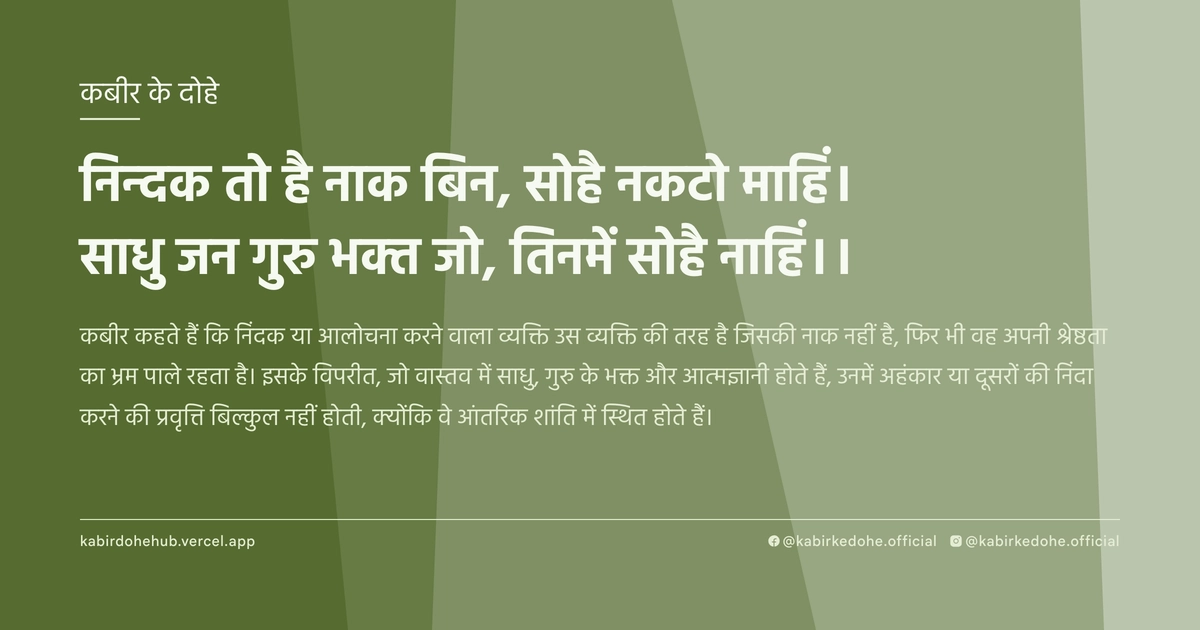
निन्दक तो है नाक बिन, सोहै नकटो माहिं।
साधु जन गुरु भक्त जो, तिनमें सोहै नाहिं।।
Nindak to hai naak bin, sohai nakto maahin. Sadhu jan guru bhakt jo, tinme sohai naahin.
इस पृष्ठ पर इस कबीर दोहे का अर्थ (meaning), हिंदी व्याख्या और अंग्रेज़ी अनुवाद, दार्शनिक विश्लेषण और व्यावहारिक जीवन सीख दी गई है। यह दोहा विनम्रता (Humility) विषय से जुड़ा है — Kabir doha meaning and explanation in Hindi and English.
अर्थ (Meaning):
कबीर कहते हैं कि निंदक या आलोचना करने वाला व्यक्ति उस व्यक्ति की तरह है जिसकी नाक नहीं है, फिर भी वह अपनी श्रेष्ठता का भ्रम पाले रहता है। इसके विपरीत, जो वास्तव में साधु, गुरु के भक्त और आत्मज्ञानी होते हैं, उनमें अहंकार या दूसरों की निंदा करने की प्रवृत्ति बिल्कुल नहीं होती, क्योंकि वे आंतरिक शांति में स्थित होते हैं।
Kabir suggests that a critic or slanderer is like a person without a nose, yet they imagine themselves to be complete or superior. In contrast, those who are truly saintly, devoted to the Guru, and awakened in spirit do not possess the urge to criticize others, as they reside in a state of profound inner peace and equanimity.
व्याख्या (Interpretation):
यह दोहा बाहरी दिखावे और आंतरिक रिक्तता के बीच के विरोधाभास को दर्शाता है। 'नाक' यहाँ सम्मान और आत्म-जागरूकता का प्रतीक है; निंदक दूसरों की कमियाँ निकालता है क्योंकि वह अपनी स्वयं की आध्यात्मिक शून्यता को नहीं देख पाता। यह माया का एक सूक्ष्म रूप है जहाँ अहंकार स्वयं को दूसरों को नीचा दिखाकर ऊपर उठाने की कोशिश करता है। निर्गुण भक्ति के परिप्रेक्ष्य में, जब साधक अपनी आत्मा (Atman) को ब्रह्म (Brahman) में विलीन कर देता है, तो 'दूसरा' समाप्त हो जाता है। यदि कोई दूसरा नहीं है, तो निंदा किसके प्रति होगी? अतः, गुरु-भक्तों में निंदा का अभाव उनकी अद्वैत अवस्था की पुष्टि करता है।
This couplet highlights the paradox between outward projection and inner emptiness. The 'nose' serves as a metaphor for dignity and self-awareness; the critic points out the flaws of others because they are blind to their own spiritual void. This is a subtle manifestation of Maya, where the ego attempts to elevate itself by diminishing others. From the perspective of Nirgun Bhakti, when the seeker merges the Atman into Brahman, the concept of 'the other' vanishes. If there is no other, there is no object for criticism. Thus, the absence of slander in the lives of the Guru's devotees confirms their realization of non-duality.
दार्शनिक विश्लेषण (Philosophical Analysis):
कबीर का यह विचार उनके युग के धार्मिक पाखंड और सामाजिक श्रेणीबद्धता पर एक कड़ा प्रहार है। उस समय समाज में बाहरी प्रतीकों और कर्मकांडों को पवित्रता का पैमाना माना जाता था, जबकि कबीर ने आंतरिक शुद्धि को प्राथमिकता दी। वे तर्क देते हैं कि जो व्यक्ति स्वयं को 'पवित्र' मानकर दूसरों की निंदा करता है, वह वास्तव में आध्यात्मिक रूप से अपंग है।
अद्वैत वेदांत के अनुसार, संपूर्ण ब्रह्मांड एक ही चेतना का विस्तार है। यदि मैं दूसरे की निंदा करता हूँ, तो मैं वास्तव में स्वयं की ही निंदा कर रहा हूँ। कबीर इस सत्य को सरल भाषा में समझाते हुए बताते हैं कि निंदा अहंकार का एक रक्षा तंत्र (defense mechanism) है। जब व्यक्ति अपनी आंतरिक कुरूपता को स्वीकार नहीं कर पाता, तो वह उसे दूसरों पर आरोपित करता है।
सूफीवाद के 'फना' (Fana) के सिद्धांत से इसे जोड़ें तो, जब तक 'मैं' (अहंकार) जीवित है, तब तक द्वैत बना रहता है। निंदक का अस्तित्व केवल इस द्वैत पर टिका है। साधु और गुरु-भक्त वह हैं जिन्होंने अपने अहंकार को मिटा दिया है, इसलिए उनके भीतर किसी के प्रति द्वेष या आलोचना की भावना नहीं बचती।
यहाँ कबीर ritualism (कर्मकांड) के बजाय experience (अनुभव) पर जोर देते हैं। वे कहते हैं कि माला जपना या तिलक लगाना तब तक व्यर्थ है जब तक कि हृदय से दूसरों के प्रति घृणा समाप्त न हो जाए। यह मनोवैज्ञानिक रूपांतरण की प्रक्रिया है जहाँ व्यक्ति बाहरी दुनिया के निर्णय (judgment) से हटकर आंतरिक साक्षी (witness) बन जाता है।
अंततः, यह दोहा हमें सिखाता है कि आलोचना की प्रवृत्ति वास्तव में एक आध्यात्मिक बीमारी है। जो व्यक्ति वास्तव में 'पूर्ण' है, उसे किसी को छोटा दिखाने की आवश्यकता नहीं होती। पूर्णता का अर्थ है—सब कुछ स्वीकार करना और स्वयं को सबके भीतर देखना।
Kabir's insight is a sharp critique of the religious hypocrisy and social hierarchies of his era. During his time, external symbols and rituals were considered the benchmarks of purity, whereas Kabir prioritized inner purification. He argues that someone who considers themselves 'pure' while criticizing others is, in reality, spiritually crippled.
According to Advaita Vedanta, the entire universe is an extension of a single consciousness. If I criticize another, I am essentially criticizing myself. Kabir explains this truth in simple terms, suggesting that criticism is a defense mechanism of the ego. When an individual cannot accept their own inner ugliness, they project it onto others.
Connecting this to the Sufi concept of 'Fana' (annihilation), as long as the 'I' (ego) exists, duality persists. The critic's existence depends entirely on this duality. The saint and the devotee are those who have annihilated their ego; therefore, no residue of hatred or judgment remains within them.
Here, Kabir emphasizes experience over ritualism. He suggests that chanting beads or wearing tilaks is futile unless the hatred for others is eradicated from the heart. This is a process of psychological transformation where the individual shifts from judging the external world to becoming an internal witness.
Ultimately, this doha teaches us that the tendency to criticize is actually a spiritual ailment. A person who is truly 'complete' feels no need to belittle anyone. Completeness means accepting everything and seeing oneself in everyone.
मूल संदेश (Core Message):
- निंदा अहंकार का मुखौटा है, जिसे हम अपनी कमियों को छिपाने के लिए पहनते हैं।
- सच्ची आध्यात्मिकता दूसरों को बदलने में नहीं, बल्कि स्वयं को मिटाने में है।
- जब 'मैं' समाप्त होता है, तब 'वह' (दूसरा) भी समाप्त हो जाता है और द्वेष मिट जाता है।
- आलोचना बाहरी शोर है; शांति आंतरिक मौन है।
- गुरु-भक्ति का अर्थ है—सबके भीतर उसी एक नूर को देखना।
- Criticism is a mask of the ego, worn to conceal our own inadequacies.
- True spirituality lies not in changing others, but in annihilating the self.
- When the 'I' vanishes, the 'Other' also disappears, and hatred ceases to exist.
- Criticism is external noise; peace is internal silence.
- Devotion to the Guru means seeing the same Divine Light in everyone.
व्यावहारिक उदाहरण (Practical Example):
वाराणसी के एक पुराने घाट पर रहने वाली एक वृद्ध विधवा, जानकी, अपनी पूरी जिंदगी दूसरों की गलतियाँ गिनने में बिता चुकी थी। वह मोहल्ले की हर महिला के चरित्र और व्यवहार पर टिप्पणी करती थी। वह मानती थी कि उसकी कठोरता उसे दूसरों से अधिक 'धार्मिक' और 'शुद्ध' बनाती है।
एक दिन वह एक शांत साधु के पास गई और अपनी आध्यात्मिक प्रगति के बारे में पूछा। साधु ने उसे एक मिट्टी का बर्तन दिया जिसमें एक छोटा सा छेद था और कहा, 'इस बर्तन में पानी भरो।' जानकी ने कोशिश की, लेकिन पानी नीचे से बह जाता था।
साधु ने मुस्कुराते हुए कहा, 'तुम दूसरों की कमियों को देख रही हो, लेकिन तुम्हारे अपने चरित्र में वह छेद है जिससे तुम्हारी सारी शांति बह रही है। तुम दूसरों की निंदा करके अपना खालीपन भरने की कोशिश कर रही हो, लेकिन वह कभी नहीं भरेगा।'
जानकी को पहली बार महसूस हुआ कि उसकी निंदा वास्तव में उसकी अपनी आंतरिक असुरक्षा और अकेलेपन का शोर था। उसने महसूस किया कि वह जिसे 'शुद्धता' समझ रही थी, वह वास्तव में उसका अहंकार था जो उसे दूसरों से अलग कर रहा था।
अगले कुछ महीनों तक, जानकी ने एक कठिन अभ्यास शुरू किया। जब भी उसे किसी की बुराई करने की इच्छा होती, वह चुपचाप अपनी आँखें बंद करती और सोचती कि सामने वाले व्यक्ति के भीतर भी वही ईश्वर है जो उसके भीतर है।
धीरे-धीरे उसका व्यवहार बदलने लगा। उसने मोहल्ले की उन महिलाओं की मदद करना शुरू किया जिन्हें वह पहले नीचा दिखाती थी। उसने पाया कि जब उसने दूसरों को आंकना बंद किया, तो उसके मन का भारीपन कम होने लगा।
उसकी शांति अब बाहरी प्रशंसा पर निर्भर नहीं थी। वह अब घाट पर बैठकर चुपचाप गंगा को देखती और महसूस करती कि जैसे नदी सब कुछ स्वीकार कर लेती है, वैसे ही उसे भी संसार को स्वीकार करना है।
एक दिन एक युवती उसके पास आई और उसकी प्रशंसा की कि वह कितनी शांत हो गई है। जानकी ने केवल मुस्कुराकर कहा, 'मैंने बस अपनी नाक ढूँढ ली है, जो मुझे दूसरों की गंध सूंघने से रोकती थी।'
यह 'कबीर ट्विस्ट' था—अपनी कमियों को पहचानकर दूसरों के प्रति करुणा विकसित करना। जानकी का जीवन अब निंदा के शोर से मुक्त होकर मौन के संगीत में बदल गया था।
Janaki, an elderly widow living on an old ghat in Varanasi, had spent her entire life counting the mistakes of others. She commented on the character and behavior of every woman in her neighborhood, believing her harshness made her more 'religious' and 'pure' than the rest.
One day, she approached a serene monk and asked about her spiritual progress. The monk handed her a clay pot with a small hole at the bottom and told her, 'Fill this pot with water.' Janaki tried, but the water kept leaking out.
The monk smiled and said, 'You are observing the flaws of others, but there is a hole in your own character through which all your peace is leaking. You are trying to fill your inner void by criticizing others, but it will never be filled.'
For the first time, Janaki realized that her criticism was actually the noise of her own inner insecurity and loneliness. She understood that what she perceived as 'purity' was actually her ego, separating her from everyone else.
Over the next few months, Janaki began a rigorous practice. Whenever she felt the urge to speak ill of someone, she would silently close her eyes and contemplate that the same Divine residing in her also resided in the other person.
Slowly, her behavior began to shift. She started helping the very women she had previously belittled. She discovered that as she stopped judging others, the heaviness in her heart began to lift.
Her peace was no longer dependent on external validation. She would sit by the Ganges, observing the river and realizing that just as the river accepts everything, she too must accept the world.
One day, a young woman approached her and praised how peaceful she had become. Janaki simply smiled and said, 'I have finally found my own nose, which stopped me from smelling the faults of others.'
This was the 'Kabir Twist'—developing compassion for others by recognizing one's own flaws. Janaki's life, once filled with the noise of criticism, was now transformed into the music of silence.
अभ्यास मार्गदर्शन (Practice Guidance):
- दैनिक मौन अभ्यास: प्रतिदिन 20 मिनट पूर्ण मौन रहें। जब भी मन में किसी के प्रति निर्णय या निंदा आए, उसे केवल एक 'विचार' के रूप में देखें, सत्य के रूप में नहीं।
- आत्म-पूछताछ जर्नल: हर रात लिखें—'आज मैंने किसकी निंदा की और उस व्यक्ति की वह कमी मेरे अपने भीतर किस रूप में मौजूद है?'
- व्यवहारात्मक परिवर्तन: जब कोई आपकी आलोचना करे, तो प्रतिक्रिया देने के बजाय मन में कहें, 'यह व्यक्ति मुझे मेरा वह दर्पण दिखा रहा है जिसे मैं देख नहीं पा रहा था।'
- निदान चेकलिस्ट: क्या आप दूसरों की गलतियों पर तुरंत प्रतिक्रिया देते हैं? क्या आप दूसरों को सुधारने की तीव्र इच्छा रखते हैं? यदि हाँ, तो आप अभी भी 'नाक बिन' (अहंकार) की स्थिति में हैं।
- Daily Silence Practice: Spend 20 minutes in complete silence daily. Whenever a judgment or criticism arises in the mind, observe it merely as a 'thought,' not as a truth.
- Self-Inquiry Journal: Every night, write—'Whom did I criticize today, and in what form does that same flaw exist within me?'
- Behavioral Shift: When someone criticizes you, instead of reacting, mentally say, 'This person is showing me the mirror that I was unable to see.'
- Diagnostic Checklist: Do you react instantly to others' mistakes? Do you feel an intense urge to 'correct' others? If yes, you are still in the state of being 'without a nose' (ego-driven).
चिंतन प्रश्न (Reflection Questions):
- वह कौन सी कमी है जिसे आप दूसरों में सबसे ज्यादा नापसंद करते हैं, और वह आपके अपने व्यक्तित्व का कौन सा छिपा हुआ हिस्सा है?
- क्या आपकी 'नैतिक श्रेष्ठता' वास्तव में करुणा है, या यह केवल दूसरों को छोटा महसूस कराने का एक तरीका है?
- यदि आपकी सामाजिक पहचान (पद, प्रतिष्ठा, धर्म) छीन ली जाए, तो क्या आपके पास दूसरों को आंकने का कोई आधार बचेगा?
- आप अपनी डिजिटल पहचान (सोशल मीडिया) पर दूसरों की आलोचना करके किस आंतरिक रिक्तता को भरने की कोशिश कर रहे हैं?
- क्या आप उस व्यक्ति को क्षमा कर सकते हैं जिसने आपकी सबसे गहरी कमजोरी का सार्वजनिक मजाक उड़ाया हो?
- What is the flaw you dislike most in others, and which hidden part of your own personality does it mirror?
- Is your 'moral superiority' truly compassion, or is it merely a way to make others feel inferior?
- If your social identity (status, prestige, religion) were stripped away, would you have any basis left to judge others?
- What inner void are you trying to fill by criticizing others through your digital identity (social media)?
- Can you truly forgive the person who publicly mocked your deepest vulnerability?