
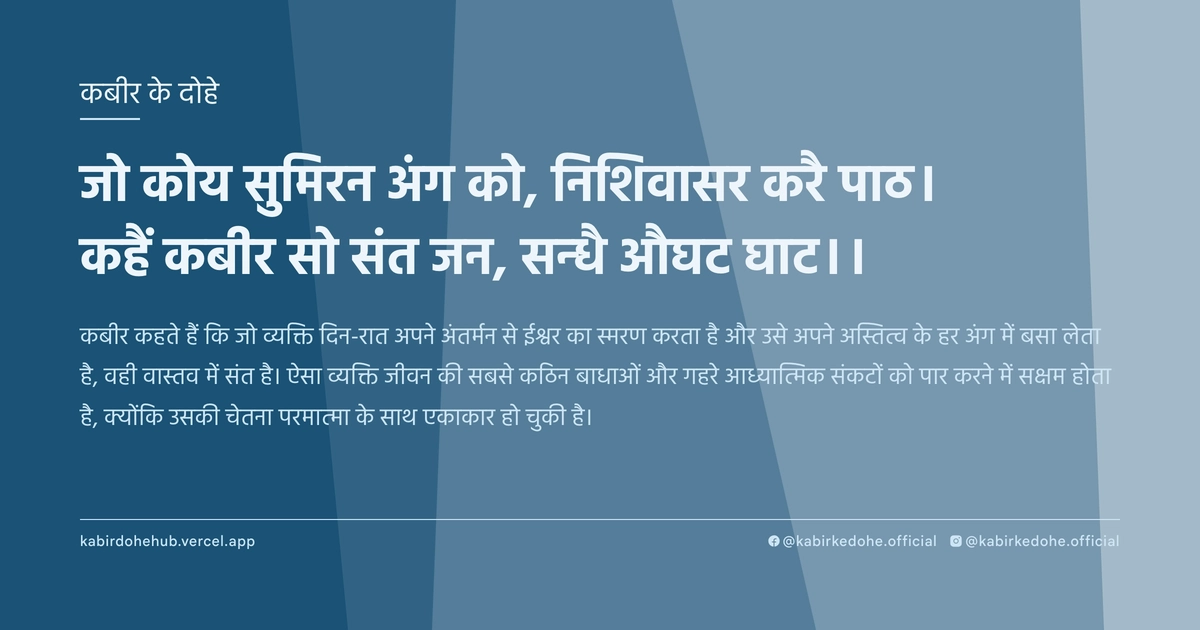
जो कोय सुमिरन अंग को, निशिवासर करै पाठ।
कहैं कबीर सो संत जन, सन्धै औघट घाट।।
Jo koy sumiran ang ko, nishivasar karai paath. Kahain kabir so sant jan, sandhai aughat ghaat.
इस पृष्ठ पर इस कबीर दोहे का अर्थ (meaning), हिंदी व्याख्या और अंग्रेज़ी अनुवाद, दार्शनिक विश्लेषण और व्यावहारिक जीवन सीख दी गई है। यह दोहा भक्ति (Bhakti) विषय से जुड़ा है — Kabir doha meaning and explanation in Hindi and English.
अर्थ (Meaning):
कबीर कहते हैं कि जो व्यक्ति दिन-रात अपने अंतर्मन से ईश्वर का स्मरण करता है और उसे अपने अस्तित्व के हर अंग में बसा लेता है, वही वास्तव में संत है। ऐसा व्यक्ति जीवन की सबसे कठिन बाधाओं और गहरे आध्यात्मिक संकटों को पार करने में सक्षम होता है, क्योंकि उसकी चेतना परमात्मा के साथ एकाकार हो चुकी है।
Kabir asserts that the one who remembers the Divine not merely as a ritual, but integrates that remembrance into every fiber of their being day and night, is a true saint. Such an individual possesses the spiritual fortitude to navigate the most treacherous crossings and deepest depths of existence, as their consciousness has merged with the Eternal.
व्याख्या (Interpretation):
इस दोहे में 'सुमिरन अंग को' का अर्थ केवल शब्दों का जाप नहीं, बल्कि एक ऐसी अवस्था है जहाँ स्मृति शरीर के रोम-रोम में व्याप्त हो जाती है। यह निरगुण भक्ति का सार है, जहाँ ईश्वर बाहर नहीं बल्कि भीतर खोजा जाता है। 'निशिवासर' (दिन-रात) निरंतरता को दर्शाता है, जो मन के चंचल स्वभाव को स्थिर करने की प्रक्रिया है। 'औघट घाट' एक रूपक है जो जीवन के उन कठिन मोड़ों, मानसिक द्वंद्वों और माया के जाल को दर्शाता है जहाँ साधारण मनुष्य डूब जाता है। जब साधक अपनी आत्मा (Atman) और ब्रह्म (Brahman) की एकता को पहचान लेता है, तो वह द्वैत के भ्रम से मुक्त हो जाता है। यह अवस्था अद्वैत वेदांत की उस स्थिति के समान है जहाँ ज्ञाता, ज्ञान और ज्ञेय का भेद समाप्त हो जाता है। अंततः, यह दोहा सिखाता है कि निरंतर जागरूकता ही वह नौका है जो हमें संसार रूपी कठिन घाट से पार ले जाती है।
In this couplet, 'sumiran ang ko' signifies not a mechanical recitation of names, but a state where remembrance permeates every cell of the physical and subtle body. This is the essence of Nirgun Bhakti, where the Divine is sought not in external idols but within the self. 'Nishivasar' (day and night) emphasizes an unbroken continuity, a discipline intended to still the flickering nature of the mind. The 'aughat ghaat' (difficult crossing/ghat) serves as a potent metaphor for the existential crises, psychological turbulence, and the veil of Maya that entrap the ordinary soul. When the seeker realizes the non-duality of Atman and Brahman, the illusion of separation dissolves. This state mirrors the Advaita Vedanta pinnacle where the knower, the known, and the act of knowing merge into one. Ultimately, the verse teaches that constant, embodied awareness is the only vessel capable of ferrying the soul across the treacherous currents of worldly existence.
दार्शनिक विश्लेषण (Philosophical Analysis):
कबीर का यह दृष्टिकोण उनके समय के कर्मकांडीय धर्म के विरुद्ध एक सशक्त प्रहार था। उस युग में धर्म को केवल बाहरी क्रियाओं, जैसे माला जपने या तीर्थ यात्रा करने तक सीमित कर दिया गया था। कबीर ने 'अंग' शब्द का प्रयोग कर यह स्पष्ट किया कि भक्ति कोई बाहरी आवरण नहीं, बल्कि एक आंतरिक रूपांतरण है। यह सूफी मत के 'फना' (अहंकार का विनाश) और अद्वैत वेदांत के 'अहम ब्रह्मास्मि' का संगम है।
यहाँ 'सुमिरन' का अर्थ मनोवैज्ञानिक स्तर पर 'सजगता' (Mindfulness) है। जब कोई व्यक्ति निरंतर जागरूक रहता है, तो उसका अहंकार (Ego) धीरे-धीरे गलने लगता है। कबीर के अनुसार, अहंकार ही वह सबसे बड़ी बाधा है जो हमें 'औघट घाट' पर फँसाती है। जब तक 'मैं' मौजूद है, तब तक संघर्ष है; जैसे ही 'मैं' मिटता है, केवल वह अनंत सत्ता बचती है जो सहज ही पार उतर जाती है।
यह दर्शन जाति और वर्ग के भेदों को पूरी तरह नकारता है। एक जुलाहा होकर कबीर ने यह सिद्ध किया कि मोक्ष किसी विशेष कुल या शास्त्र के ज्ञान से नहीं, बल्कि हृदय की शुद्धता और निरंतर अभ्यास से मिलता है। यह 'सहज मार्ग' है, जहाँ साधना जीवन के दैनिक कार्यों के साथ चलती है, न कि उनसे अलग किसी गुफा या मंदिर में।
सांस्कृतिक रूप से, यह दोहा उस समय के सामाजिक तनावों के बीच एक मानसिक शांति का मार्ग प्रशस्त करता है। यह बताता है कि बाहरी दुनिया चाहे कितनी भी उथल-पुथल भरी हो, यदि आंतरिक केंद्र स्थिर है, तो व्यक्ति अडिग रहता है। यह एक प्रकार का आध्यात्मिक मनोविज्ञान है जो व्यक्ति को बाहरी परिस्थितियों का दास बनने के बजाय आंतरिक साम्राज्य का स्वामी बनाता है।
अंततः, कबीर यह चेतावनी देते हैं कि केवल दिखावे की भक्ति संकट के समय काम नहीं आती। जब जीवन में वास्तविक दुख या मृत्यु का सामना होता है, तब केवल वही 'सुमिरन' काम आता है जो रक्त और मांस में समाया हो। यह बौद्धिक ज्ञान और अनुभवजन्य ज्ञान के बीच का अंतर है; शास्त्र पढ़ा हुआ ज्ञान है, जबकि 'अंग का सुमिरन' जीवित अनुभव है।
Kabir's perspective here is a powerful critique of the ritualistic religion prevalent during his era. In that time, spirituality had been reduced to external performances—beading a rosary or visiting pilgrimage sites. By using the word 'ang' (limb/body), Kabir clarifies that devotion is not an external garment but an internal metamorphosis. This is a confluence of the Sufi concept of 'Fana' (annihilation of the ego) and the Advaita Vedanta realization of 'Aham Brahmasmi' (I am Brahman).
On a psychological level, 'sumiran' translates to an unwavering state of mindfulness. When an individual remains perpetually aware, the ego—the primary architect of suffering—begins to erode. According to Kabir, the ego is the very obstacle that makes the 'ghat' (crossing) difficult. As long as the 'I' exists, there is conflict; once the 'I' vanishes, only the Infinite remains, which crosses the threshold effortlessly.
This philosophy radically rejects caste and class hierarchies. As a weaver, Kabir demonstrated that liberation is not the prerogative of a specific lineage or scriptural erudition, but is attained through purity of heart and constant practice. This is the 'Sahaj Marg' (the Natural Path), where spiritual discipline is integrated into daily chores rather than isolated in a cave or temple.
Culturally, this verse provides a sanctuary of mental peace amidst the social upheavals of the 15th century. It suggests that regardless of the external chaos, if the internal center is anchored, the individual remains unshakable. This is a form of spiritual psychology that empowers the individual to be the sovereign of their inner empire rather than a slave to external circumstances.
Ultimately, Kabir warns that performative piety is useless during the hour of crisis. When faced with profound grief or the inevitability of death, only the remembrance that has permeated the blood and bone provides solace. This highlights the distinction between intellectual knowledge and experiential realization; scriptural learning is borrowed, while 'sumiran of the limb' is a lived truth.
मूल संदेश (Core Message):
- बाहरी अनुष्ठान केवल ढोंग हैं; वास्तविक भक्ति अंतर्मन का रूपांतरण है।
- निरंतर जागरूकता ही वह एकमात्र नौका है जो माया के सागर को पार कराती है।
- जब ईश्वर स्मृति शरीर के अंग बन जाते हैं, तब भय समाप्त हो जाता है।
- अहंकार का विसर्जन ही 'कठिन घाट' को पार करने की एकमात्र कुंजी है।
- आध्यात्मिक उपलब्धि शास्त्रों के रटने में नहीं, बल्कि जीने में है।
- External rituals are mere facades; true devotion is the metamorphosis of the inner self.
- Unbroken awareness is the only vessel capable of crossing the ocean of Maya.
- When Divine remembrance permeates the physical being, fear ceases to exist.
- The dissolution of the ego is the sole key to crossing the 'treacherous ghat'.
- Spiritual attainment lies not in the rote learning of scriptures, but in lived experience.
व्यावहारिक उदाहरण (Practical Example):
वाराणसी के एक पुराने घाट पर माधव नाम का एक वृद्ध नाविक रहता था। माधव का जीवन अत्यंत कठिन था; वह दिन भर भारी नाव खींचता और रात को एक छोटी सी झोपड़ी में सोता। उसके पास न तो कोई बड़ा मंदिर था, न ही वह किसी बड़े गुरु का शिष्य था।
माधव की एक विशेषता थी। वह नाव चलाते समय, चप्पू चलाते समय और यहाँ तक कि मछली पकड़ते समय भी एक मंद मुस्कान के साथ कुछ गुनगुनाता रहता था। लोग उसे पागल समझते थे क्योंकि वह किसी विशेष मंत्र का जाप नहीं करता था, बल्कि बस एक गहरी शांति में डूबा रहता था।
एक समय ऐसा आया जब गंगा में भीषण बाढ़ आई। शहर के बड़े-बड़े पंडित और धनी व्यापारी, जिन्होंने जीवन भर दान-पुण्य किया था, भयभीत होकर चिल्ला रहे थे। वे अपनी जान बचाने के लिए संघर्ष कर रहे थे और उनके चेहरे पर घोर आतंक था।
उसी समय, एक नाव पलट गई और उसमें कई लोग फंस गए। माधव ने अपनी छोटी सी नाव ली और उफनती लहरों के बीच कूद पड़ा। जहाँ अन्य नाविक डर के मारे पीछे हट रहे थे, माधव की एकाग्रता अद्भुत थी।
वह लहरों के साथ लड़ नहीं रहा था, बल्कि उनके प्रवाह को समझ रहा था। उसकी आँखों में कोई डर नहीं था, क्योंकि उसका मन उस 'अनंत' में लीन था जिसे उसने हर पल याद किया था।
उसने एक-एक कर कई लोगों की जान बचाई। जब एक धनी व्यापारी ने उससे पूछा, 'तुम्हें डर नहीं लगा? इस प्रलय में तुम इतने शांत कैसे हो?'
माधव ने सरलता से उत्तर दिया, 'साहब, मैंने जीवन भर इस लहर को ही अपना ईश्वर माना और हर सांस में उसे याद किया। जब लहर ही मेरा घर बन गई, तो मैं डूबने से कैसे डरूँ?'
व्यापारी हैरान था। उसने महसूस किया कि उसने मंदिर की दीवारों के बीच ईश्वर को खोजा, जबकि माधव ने ईश्वर को अपने चप्पू, अपनी नाव और अपनी सांसों में बसा लिया था।
यह 'कबीर ट्विस्ट' था—माधव की भक्ति कोई क्रिया नहीं थी, बल्कि उसकी जीवनशैली थी। उसकी निरंतर जागरूकता ने उसे उस मानसिक शक्ति से भर दिया था जिसने उसे मृत्यु के भय से मुक्त कर दिया।
उस दिन के बाद, उस घाट के कई लोगों ने बाहरी दिखावे को छोड़कर अपने भीतर की शांति को खोजने का प्रयास शुरू किया, यह समझकर कि असली 'घाट' तो मन का है।
On an ancient ghat in Varanasi lived an elderly boatman named Madhav. Madhav's life was grueling; he spent his days hauling heavy boats and his nights in a tiny, leaking hut. He possessed neither a grand temple nor the patronage of a renowned guru.
Madhav had one peculiar trait. Whether he was rowing, casting a net, or simply resting, he always wore a faint, serene smile and hummed a wordless tune. People dismissed him as eccentric because he didn't chant formal mantras; he simply existed in a state of profound, quiet immersion.
There came a year when the Ganges swelled into a catastrophic flood. The city's prominent priests and wealthy merchants, who had spent lifetimes in performative charity, were gripped by terror. They screamed in panic, fighting desperately for survival, their faces etched with primal fear.
During the peak of the storm, a large vessel capsized, trapping several passengers in the churning waters. Madhav launched his small boat and dove into the raging torrent. While other boatmen recoiled in fear, Madhav's focus was supernatural.
He was not fighting the waves; he was flowing with them. There was no trace of panic in his eyes because his mind was anchored in that 'Infinite' which he had remembered in every waking second.
One by one, he rescued the stranded souls. When a wealthy merchant, shivering and drenched, asked him, 'Were you not afraid? How can you be so calm in the midst of this apocalypse?'
Madhav replied simply, 'Sir, I have treated every ripple of this river as my Divine, remembering Him in every breath. When the wave itself becomes my home, how can I fear drowning?'
The merchant was stunned. He realized that while he had searched for God within the confines of temple walls, Madhav had embedded the Divine into his oars, his boat, and his very breath.
This was the 'Kabir Twist'—Madhav's devotion was not an act; it was his existence. His constant awareness had endowed him with a psychological fortitude that rendered the fear of death obsolete.
After that day, many on the ghat abandoned their superficial rituals and began seeking an internal stillness, realizing that the most difficult 'ghat' to cross is the one within the mind.
अभ्यास मार्गदर्शन (Practice Guidance):
- साक्षी भाव का अभ्यास: दिन भर में तीन बार (सुबह, दोपहर, शाम) 5 मिनट के लिए रुकें और केवल अपनी सांसों को देखें। यह महसूस करें कि आप शरीर नहीं, बल्कि वह चेतना हैं जो शरीर को देख रही है।
- कार्य-सुमिरन: किसी भी एक दैनिक कार्य (जैसे चलना, बर्तन धोना या लिखना) को चुनें और उसे पूरी जागरूकता के साथ करें। उस कार्य को ही अपनी प्रार्थना बना लें।
- आत्म-पूछताछ जर्नल: प्रतिदिन रात को लिखें—'आज कितनी बार मैं अपने अहंकार (मैं/मेरा) के वश में था और कितनी बार मैं केवल एक साक्षी था?'
- निदान चेकलिस्ट: यदि आप छोटी बातों पर क्रोधित हो रहे हैं या भविष्य की चिंता में डूबे हैं, तो समझें कि आपका 'सुमिरन' टूट गया है। यदि आप विपरीत परिस्थितियों में भी तटस्थ हैं, तो आप सही मार्ग पर हैं।
- Practice of the Witness: Three times a day (morning, noon, evening), pause for 5 minutes and observe your breath. Feel that you are not the body, but the consciousness observing the body.
- Action-Remembrance: Choose one mundane daily task (like walking, washing dishes, or writing) and perform it with total presence. Transform that specific action into your prayer.
- Self-Inquiry Journaling: Every night, record: 'How many times today was I driven by the ego (I/Mine), and how many times was I purely the Witness?'
- Diagnostic Checklist: If you find yourself reacting with anger to trivialities or drowning in future anxieties, recognize that your 'sumiran' has been severed. If you remain neutral amidst adversity, you are aligning with the wisdom.
चिंतन प्रश्न (Reflection Questions):
- क्या मेरी भक्ति केवल सामाजिक प्रतिष्ठा के लिए है, या यह मेरे एकांत में भी उतनी ही गहरी है?
- मेरे जीवन का वह 'औघट घाट' (सबसे कठिन बाधा) क्या है जिसे मैं अपनी बुद्धि से नहीं, बल्कि समर्पण से पार करना चाहता हूँ?
- यदि आज मेरी सारी बाहरी पहचान (पद, नाम, संपत्ति) छीन ली जाए, तो मेरे भीतर क्या शेष रहेगा?
- मैं अपनी डिजिटल पहचान (सोशल मीडिया) को कितना सच मानता हूँ, और वह मेरे वास्तविक स्वरूप से कितना दूर है?
- क्या मैं ईश्वर को एक बाहरी सत्ता के रूप में खोज रहा हूँ, या अपनी हर सांस में उसकी उपस्थिति महसूस करने का साहस रखता हूँ?
- Is my spirituality merely for social prestige, or does it hold the same depth in my absolute solitude?
- What is the 'treacherous ghat' (the hardest obstacle) in my life that I wish to cross not through intellect, but through surrender?
- If all my external identities (title, name, wealth) were stripped away today, what would remain within me?
- How much of my digital persona do I mistake for my true self, and how far is it from my authentic being?
- Am I searching for the Divine as an external entity, or do I have the courage to feel His presence in every single breath?