
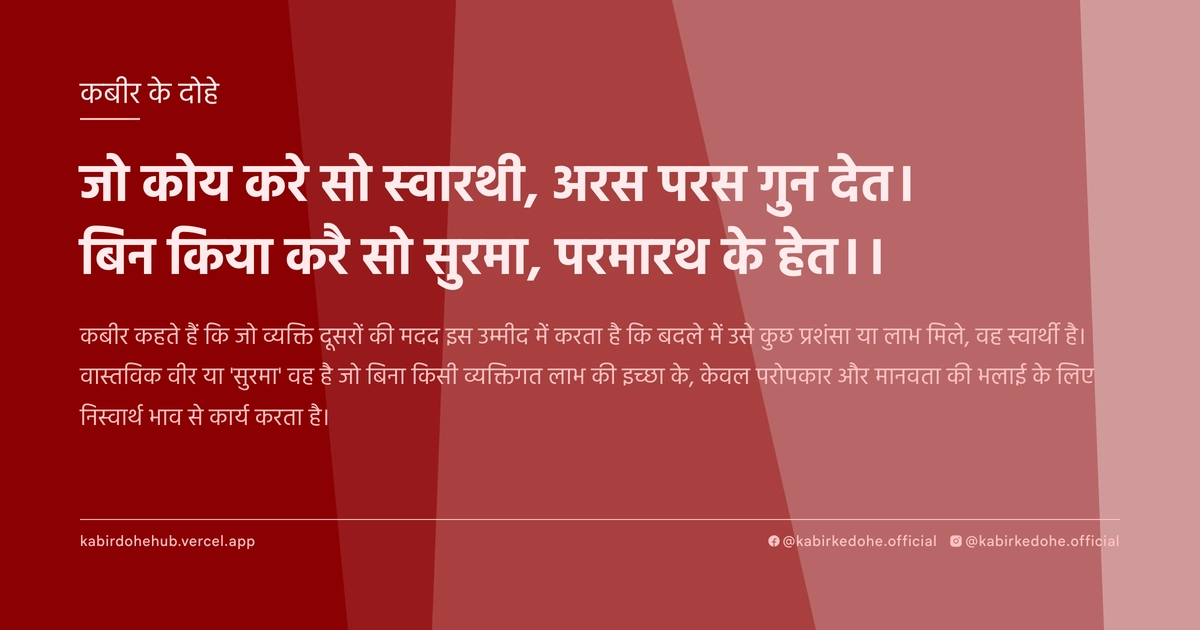
जो कोय करे सो स्वारथी, अरस परस गुन देत।
बिन किया करै सो सुरमा, परमारथ के हेत।।
Jo koy kare so swarthi, aras paras gun det. Bin kiya karai so surma, parmarath ke het.
इस पृष्ठ पर इस कबीर दोहे का अर्थ (meaning), हिंदी व्याख्या और अंग्रेज़ी अनुवाद, दार्शनिक विश्लेषण और व्यावहारिक जीवन सीख दी गई है। यह दोहा निष्ठा (Integrity) विषय से जुड़ा है — Kabir doha meaning and explanation in Hindi and English.
अर्थ (Meaning):
कबीर कहते हैं कि जो व्यक्ति दूसरों की मदद इस उम्मीद में करता है कि बदले में उसे कुछ प्रशंसा या लाभ मिले, वह स्वार्थी है। वास्तविक वीर या 'सुरमा' वह है जो बिना किसी व्यक्तिगत लाभ की इच्छा के, केवल परोपकार और मानवता की भलाई के लिए निस्वार्थ भाव से कार्य करता है।
Kabir asserts that one who performs acts of kindness expecting a return, whether in the form of praise or material gain, remains bound by selfishness. The true spiritual warrior, the 'Surma', is the one who serves others without any desire for reward, acting solely for the collective welfare and the higher good of all beings.
व्याख्या (Interpretation):
इस दोहे का शाब्दिक अर्थ है कि लेन-देन पर आधारित मदद स्वार्थ है। गहरे स्तर पर, कबीर यहाँ 'अहंकार' और 'निस्वार्थता' के बीच के सूक्ष्म अंतर को स्पष्ट कर रहे हैं। जब हम किसी के लिए कुछ करते हैं और बदले में 'गुण' या प्रशंसा की अपेक्षा करते हैं, तो हम वास्तव में अपनी ईगो (अहं) को पोषण दे रहे होते हैं। यह 'माया' का एक जाल है जहाँ पुण्य भी एक व्यापार बन जाता है। निर्गुण भक्ति के अनुसार, जब कर्ता का भाव समाप्त हो जाता है और व्यक्ति स्वयं को ब्रह्मांडीय चेतना का एक उपकरण मात्र मानता है, तब वह 'सुरमा' बनता है। यह अद्वैत वेदांत की उस स्थिति को दर्शाता है जहाँ 'मैं' और 'तू' का भेद मिट जाता है, और परोपकार केवल स्वयं की सेवा बन जाता है क्योंकि दूसरा व्यक्ति भी उसी एक आत्मा का अंश है।
Literally, the verse distinguishes between transactional kindness and selfless service. Metaphorically, Kabir dissects the subtle boundary between altruism and the ego. When an act of service is tied to the expectation of 'gun' (merit or praise), it becomes a transaction of the ego, fueling the illusion of a separate 'I' who is the benefactor. This is the grip of Maya, where even virtue becomes a currency for social or spiritual status. In the context of Nirgun Bhakti, the 'Surma' or spiritual warrior is one who has transcended the 'doer-ship' (Kartrutva). By aligning with Advaita Vedanta, the practitioner realizes that there is no 'other' to help; serving the world is simply the Atman recognizing itself in another form. The paradox is that true power is found not in the assertion of the will, but in the complete annihilation of the personal desire for reward.
दार्शनिक विश्लेषण (Philosophical Analysis):
कबीर का यह दोहा उनके समय के सामाजिक और धार्मिक पाखंड पर एक तीखा प्रहार है। मध्यकालीन भारत में, दान और पुण्य को अक्सर मोक्ष प्राप्ति के एक साधन के रूप में देखा जाता था, जहाँ लोग इस उम्मीद में दान करते थे कि उन्हें स्वर्ग मिलेगा या समाज में उनकी प्रतिष्ठा बढ़ेगी। कबीर इस 'व्यापारिक आध्यात्मिकता' को खारिज करते हैं। उनके लिए, धर्म बाहरी कर्मकांडों में नहीं, बल्कि आंतरिक शुद्धि में है।
दार्शनिक रूप से, यह विचार सूफीवाद के 'फना' (अहंकार का विलीनीकरण) के करीब है। जब एक व्यक्ति अपनी व्यक्तिगत पहचान को ईश्वर या मानवता की सेवा में विलीन कर देता है, तब वह वास्तव में स्वतंत्र होता है। यहाँ 'सुरमा' शब्द का प्रयोग अत्यंत महत्वपूर्ण है; वीरता युद्ध जीतने में नहीं, बल्कि अपने भीतर के स्वार्थ और लालच को जीतने में है।
अद्वैत वेदांत के परिप्रेक्ष्य में, यह दोहा 'साक्षी भाव' की बात करता है। यदि हम यह मानते हैं कि पूरी सृष्टि एक ही चेतना है, तो परोपकार कोई बाहरी कार्य नहीं रह जाता, बल्कि वह स्वाभाविक गुण बन जाता है। जो व्यक्ति 'बिना किया' (बिना किसी फल की इच्छा के) कार्य करता है, वह कर्म बंधन से मुक्त हो जाता है।
कबीर यहाँ यह समझा रहे हैं कि मनोवैज्ञानिक रूप से, अपेक्षा ही दुख का मूल कारण है। जब हम मदद करते हैं और वह व्यक्ति आभार व्यक्त नहीं करता, तो हमें क्रोध या दुख होता है। यह दुख इस बात का प्रमाण है कि हमारी मदद निस्वार्थ नहीं थी। अतः, वास्तविक आध्यात्मिक प्रगति तब होती है जब हम फल की चिंता छोड़कर केवल कर्म की पवित्रता पर ध्यान केंद्रित करते हैं।
अंततः, यह शिक्षण हमें सिखाता है कि मानवता की सेवा ही सर्वोच्च पूजा है। जब सेवा का उद्देश्य केवल 'परमारथ' (परम अर्थ या सार्वभौमिक कल्याण) होता है, तब वह कार्य व्यक्ति को सांसारिक बंधनों से मुक्त कर उसे परमात्मा के करीब ले जाता है। यह मार्ग कठिन है क्योंकि यह मनुष्य की सबसे गहरी प्रवृत्ति—स्वयं को केंद्र में रखने की आदत—को चुनौती देता है।
This Doha serves as a profound critique of the social and religious hypocrisy prevalent during Kabir's era. In medieval India, charity and merit-making were often viewed as transactional tools for salvation, where donations were made with the explicit hope of securing a place in heaven or elevating one's social standing. Kabir rejects this 'commercial spirituality,' arguing that true religion resides not in external rituals or strategic piety, but in the absolute purification of intent.
Philosophically, this aligns closely with the Sufi concept of 'Fana'—the annihilation of the self. When an individual dissolves their personal identity and ego into the service of the Divine or humanity, they achieve true liberation. The use of the word 'Surma' (warrior) is pivotal; Kabir redefines bravery. Valor is not found in conquering lands or enemies, but in conquering the internal impulse of selfishness and the craving for validation.
From the lens of Advaita Vedanta, this verse emphasizes the state of non-duality. If the entire universe is perceived as a single, undivided consciousness, then altruism ceases to be an 'act' performed for another; it becomes a natural expression of the self recognizing itself. The one who acts 'without doing' (meaning without the sense of agency or desire for fruit) transcends the cycle of Karma and attains a state of spiritual equilibrium.
Psychologically, Kabir addresses the root of human suffering: expectation. When we help others expecting gratitude, the absence of that gratitude leads to resentment. This resentment is the diagnostic proof that the act was not selfless. Therefore, spiritual evolution occurs only when the focus shifts from the outcome (the reward) to the purity of the action itself.
Ultimately, Kabir posits that service to humanity is the highest form of worship. When the motive is purely 'Parmarath' (the universal good), the action liberates the practitioner from the shackles of the ego. This path is arduous because it demands the dismantling of the most fundamental human instinct—the tendency to place oneself at the center of the universe.
मूल संदेश (Core Message):
- अपेक्षा ही आध्यात्मिक बंधन की सबसे मजबूत जंजीर है।
- सच्ची वीरता बाहरी विजय में नहीं, आंतरिक निस्वार्थता में है।
- जब 'मैं' मिटता है, तभी 'परमारथ' का उदय होता है।
- बिना फल की इच्छा के किया गया कर्म ही वास्तविक मुक्ति है।
- परोपकार व्यापार नहीं, बल्कि आत्मा का स्वभाव होना चाहिए।
- Expectation is the strongest chain of spiritual bondage.
- True bravery is found in internal selflessness, not external conquest.
- Only when the 'I' dissolves does universal welfare truly emerge.
- Action performed without desire for fruit is the only path to liberation.
- Altruism should be the nature of the soul, not a commercial transaction.
व्यावहारिक उदाहरण (Practical Example):
वाराणसी के एक पुराने घाट पर, माधव नाम का एक वृद्ध व्यक्ति रहता था। वह शहर के सबसे गरीब लोगों में से एक था, जो केवल दूसरों के पुराने कपड़े धोकर अपना गुजारा करता था। माधव की दिनचर्या बहुत सरल थी, लेकिन उसकी एक अजीब आदत थी। वह हर दिन अपनी कमाई का एक छोटा हिस्सा उन अनाथ बच्चों के लिए बचाकर रखता था जो घाट की सीढ़ियों पर भीख मांगते थे, ताकि उन्हें रात में एक समय का भरपेट भोजन मिल सके।
शहर के एक अमीर सेठ, जो अपनी बड़ी दानशालाओं के लिए प्रसिद्ध थे, ने माधव को देखा। सेठ ने सोचा कि यह गरीब आदमी अपनी छोटी सी कमाई से दूसरों की मदद कैसे कर सकता है। उन्होंने माधव को बुलाया और कहा, "मैं तुम्हें बहुत सारा धन दूंगा, बशर्ते तुम मेरे नाम की तख्ती लगाकर इन बच्चों को खाना खिलाओ। इससे दुनिया को पता चलेगा कि मैं कितना दयालु हूँ।"
माधव ने विनम्रता से मना कर दिया। उसने कहा, "सेठ जी, मैं तो बस एक छोटा सा सेवक हूँ। अगर मैं आपका नाम लेकर यह काम करूँगा, तो यह आपकी महानता बन जाएगी, मेरी सेवा नहीं। और अगर मैं इसे अपने नाम से करूँगा, तो मेरा अहंकार बढ़ जाएगा। मैं चाहता हूँ कि यह भोजन बस उन बच्चों तक पहुँचे, और उन्हें यह भी न पता चले कि देने वाला कौन है।"
सेठ हैरान थे। उन्होंने अब तक दान को अपनी प्रतिष्ठा बढ़ाने का जरिया माना था। उन्होंने देखा कि माधव के चेहरे पर एक ऐसी शांति थी जो उनके पास करोड़ों रुपयों के बाद भी नहीं थी। माधव की निस्वार्थता ने सेठ के भीतर के 'स्वार्थी' को झकझोर दिया।
सेठ को समझ आया कि वे अब तक केवल 'गुण' (प्रशंसा) बटोर रहे थे, जबकि माधव 'परमारथ' (परम कल्याण) जी रहा था। उस दिन के बाद, सेठ ने अपनी तख्तियां हटवा दीं और गुप्त रूप से लोगों की मदद करना शुरू किया।
माधव ने बिना किसी उपदेश के, केवल अपने आचरण से सेठ को यह सिखा दिया कि असली वीरता दूसरों को नीचा दिखाने या अपनी महानता सिद्ध करने में नहीं है।
असली 'सुरमा' वह है जो अंधेरे में दीया जलाता है और यह भी नहीं चाहता कि कोई उसे देखे।
माधव की कहानी हमें सिखाती है कि जब हम फल की इच्छा छोड़ देते हैं, तो हमारा कर्म ही हमारी प्रार्थना बन जाता है।
यही वह 'कबीर ट्विस्ट' है जहाँ एक साधारण धोबी एक अमीर सेठ के लिए आध्यात्मिक गुरु बन गया, क्योंकि उसने अहंकार का त्याग कर दिया था।
On an ancient ghat in Varanasi lived an elderly man named Madhav. He was among the city's poorest, earning a meager living by washing the old clothes of pilgrims. Madhav's life was simple, but he possessed a peculiar habit: every day, he saved a small portion of his earnings for the orphaned children who begged on the river steps, ensuring they had at least one full meal at night.
A wealthy merchant, renowned for his lavish charitable institutions, noticed Madhav. The merchant wondered how a man with so little could afford to give. He summoned Madhav and offered a deal: "I will give you a vast sum of money to feed these children, provided you place a plaque with my name on it. This way, the world will know of my generosity."
Madhav politely declined. He replied, "Sir, I am but a humble servant. If I do this in your name, it becomes a monument to your greatness, not an act of service. And if I do it in my own name, my ego will swell. I only wish for the food to reach the children, without them ever knowing who the provider is."
The merchant was stunned. Until then, he had viewed charity as a vehicle for prestige. He observed a profound peace on Madhav's weathered face—a serenity that his millions had never purchased. Madhav's selfless resolve shook the 'selfish' core of the merchant.
The merchant realized that while he had been collecting 'gun' (praise), Madhav was living 'Parmarath' (universal welfare). From that day forward, the merchant removed the plaques from his institutions and began practicing anonymous giving.
Without a single sermon, Madhav had taught the wealthy man that true bravery does not lie in asserting one's superiority or proving one's nobility.
The real 'Surma' is the one who lights a lamp in the dark and does not wish for anyone to see the hand that holds the match.
Madhav's story teaches us that when we relinquish the desire for reward, our action itself becomes our prayer.
This is the 'Kabir Twist': a simple washerman became the spiritual guide for a tycoon, simply by annihilating his own ego.
अभ्यास मार्गदर्शन (Practice Guidance):
- प्रतिदिन कम से कम एक ऐसा कार्य करें जिसके बारे में आप किसी को न बताएं, यहाँ तक कि अपने परिवार को भी नहीं।
- जब भी आप किसी की मदद करें, तो मन में उठने वाले 'मैं यह कर रहा हूँ' के भाव को पहचानें और उसे धीरे से विसर्जित करें।
- जर्नलिंग प्रॉम्प्ट: 'आज मैंने किस कार्य में प्रशंसा की इच्छा रखी? यदि मुझे कोई श्रेय न मिले, तो क्या मैं वह कार्य फिर भी करता?'
- डायग्नोस्टिक चेकलिस्ट: क्या मुझे मदद न मिलने पर क्रोध आता है? क्या मैं दूसरों की मदद करते समय अपनी छवि के बारे में सोचता हूँ? यदि हाँ, तो मैं अभी भी 'स्वार्थी' श्रेणी में हूँ।
- Perform at least one act of kindness daily that remains completely secret, shared with no one, not even your closest family.
- Whenever you help someone, consciously observe the rising thought of 'I am doing this' and gently dissolve it into the void.
- Journaling Prompt: 'In which act today did I crave validation? If no one ever knew of this deed, would I still have performed it with the same love?'
- Diagnostic Checklist: Do I feel resentment when my help is not acknowledged? Do I curate my image while serving others? If yes, I am still operating within the 'selfish' paradigm.
चिंतन प्रश्न (Reflection Questions):
- क्या मेरी उदारता वास्तव में दूसरों के लिए है, या यह मेरे अपने 'अच्छे इंसान' होने के भ्रम को पुष्ट करने का एक तरीका है?
- यदि समाज से 'सम्मान' और 'प्रतिष्ठा' के सभी पैमाने हटा दिए जाएं, तो मेरे जीवन में सेवा का क्या मूल्य बचेगा?
- मैं अपनी डिजिटल पहचान (सोशल मीडिया) पर अपनी अच्छाइयों का प्रदर्शन क्यों करता हूँ? क्या वह प्रशंसा मेरी भूख है?
- क्या मैं उन लोगों की मदद करने में सक्षम हूँ जो कभी मेरा आभार व्यक्त नहीं कर सकते या जो शायद मुझसे घृणा करते हैं?
- मेरे भीतर का 'सुरमा' कब जागता है—जब मैं जीतता हूँ, या जब मैं अपनी इच्छाओं को त्याग देता हूँ?
- Is my generosity truly for others, or is it a tool to reinforce the illusion of my own 'goodness'?
- If all social metrics of 'honor' and 'prestige' were erased, what intrinsic value would remain in my acts of service?
- Why do I feel the need to curate and display my virtues on digital platforms? Is that praise a hunger I cannot satisfy?
- Am I capable of serving those who can never reciprocate, or those who may even despise me?
- When does the 'Surma' within me awaken—in the moment of victory, or in the moment of relinquishing all desire?