
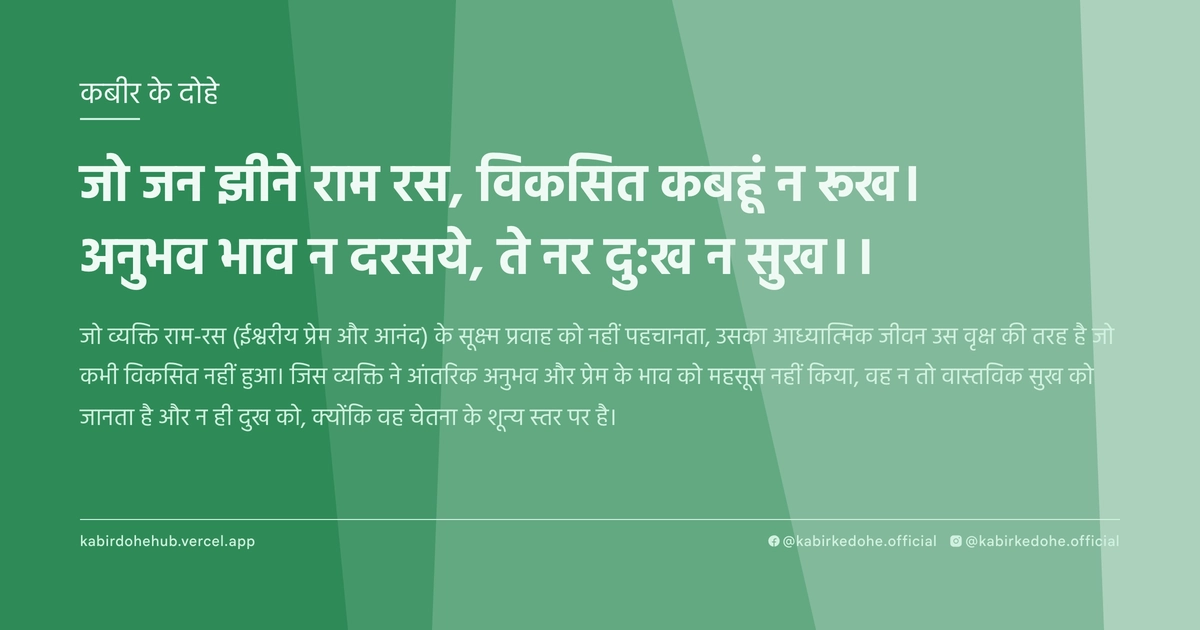
जो जन झीने राम रस, विकसित कबहूं न रूख।
अनुभव भाव न दरसये, ते नर दु:ख न सुख।।
Jo jan jheene ram ras, vikasit kabahun na rukh. Anubhav bhaav na darsaye, te nar dukh na sukh.
इस पृष्ठ पर इस कबीर दोहे का अर्थ (meaning), हिंदी व्याख्या और अंग्रेज़ी अनुवाद, दार्शनिक विश्लेषण और व्यावहारिक जीवन सीख दी गई है। यह दोहा भक्ति (Bhakti) विषय से जुड़ा है — Kabir doha meaning and explanation in Hindi and English.
अर्थ (Meaning):
जो व्यक्ति राम-रस (ईश्वरीय प्रेम और आनंद) के सूक्ष्म प्रवाह को नहीं पहचानता, उसका आध्यात्मिक जीवन उस वृक्ष की तरह है जो कभी विकसित नहीं हुआ। जिस व्यक्ति ने आंतरिक अनुभव और प्रेम के भाव को महसूस नहीं किया, वह न तो वास्तविक सुख को जानता है और न ही दुख को, क्योंकि वह चेतना के शून्य स्तर पर है।
Those who fail to perceive the subtle essence of Divine Love (Ram Ras) are like trees that never bloomed. A person who has not experienced the internal flow of spiritual emotion remains trapped in a state of spiritual numbness, where they cannot truly grasp the depth of either joy or sorrow, existing in a void of ignorance.
व्याख्या (Interpretation):
कबीर यहाँ 'राम रस' को एक सूक्ष्म ऊर्जा के रूप में प्रस्तुत करते हैं, जो केवल बाहरी पूजा से नहीं बल्कि आंतरिक अनुभव से प्राप्त होती है। 'विकसित न रूख' एक रूपक है उस आत्मा के लिए जो ज्ञान के बिना मुरझाई हुई है। यह दोहा निर्गुण भक्ति के उस सिद्धांत पर आधारित है जहाँ ईश्वर किसी मूर्ति में नहीं, बल्कि अनुभव (Anubhav) में है। जब तक साधक माया के पर्दे को हटाकर अपनी आत्मा (Atman) का ब्रह्म (Brahman) से मिलन नहीं करता, वह जीवन के द्वंद्वों में फँसा रहता है। यहाँ 'दुख न सुख' का अर्थ उदासीनता नहीं, बल्कि एक ऐसी अज्ञानता है जहाँ व्यक्ति यह भी नहीं जानता कि वह क्या खो रहा है। यह अद्वैत वेदांत की उस स्थिति को दर्शाता है जहाँ अविद्या (ignorance) के कारण व्यक्ति अपनी वास्तविक प्रकृति को भूल चुका है।
Kabir presents 'Ram Ras' not as a religious ritual, but as a subtle spiritual current accessible only through internal realization. The 'unbloomed tree' serves as a poignant metaphor for a soul stunted by the lack of spiritual awakening. This aligns with Nirgun Bhakti, where the Divine is formless and found within the experience (Anubhav) rather than in external idols. Until the seeker pierces the veil of Maya to realize the non-duality of Atman and Brahman, they remain in a state of spiritual dormancy. The phrase 'neither sorrow nor joy' does not imply peace, but rather a profound numbness—a state of Avidya (ignorance) where the individual is unaware of their own spiritual poverty. It highlights the paradox that without the capacity for deep spiritual longing, one cannot experience true liberation or the authentic spectrum of existence.
दार्शनिक विश्लेषण (Philosophical Analysis):
कबीर का यह दोहा मध्यकालीन भारत के उस सामाजिक और धार्मिक परिवेश में लिखा गया था जहाँ कर्मकांड और बाहरी आडंबरों का बोलबाला था। कबीर ने पुरोहितवाद और जातिगत श्रेष्ठता को सिरे से नकारते हुए 'अनुभव' को सर्वोच्च प्रमाण माना। उनका दर्शन सूफी मत के 'इश्क-ए-हकीकी' (ईश्वरीय प्रेम) और अद्वैत वेदांत के 'अहं ब्रह्मास्मि' का एक अनूठा संगम है। वे तर्क देते हैं कि यदि ईश्वर सर्वव्यापी है, तो उसे मंदिर या मस्जिद में खोजने के बजाय अपने भीतर के 'रस' को पहचानना चाहिए।
यहाँ 'राम रस' का अर्थ किसी विशिष्ट देवता से नहीं, बल्कि उस सार्वभौमिक चेतना से है जो कण-कण में व्याप्त है। कबीर के अनुसार, जो व्यक्ति केवल शास्त्रों को पढ़ता है लेकिन अनुभव नहीं करता, वह उस सूखे पेड़ के समान है जिसमें जीवन तो है पर फल नहीं। यह बौद्ध धर्म के शून्यता के सिद्धांत और सूफी मत के 'फना' (अहंकार का विनाश) के करीब है, जहाँ व्यक्ति अपनी सीमित पहचान को मिटाकर अनंत में विलीन हो जाता है।
दार्शनिक स्तर पर, यह दोहा 'माया' के प्रभाव की व्याख्या करता है। माया केवल भ्रम नहीं है, बल्कि वह पर्दा है जो हमें हमारी वास्तविक प्रकृति से अलग करता है। जब तक यह पर्दा नहीं हटता, मनुष्य सुख और दुख के चक्र में घूमता रहता है, लेकिन वह इन दोनों के मूल कारण को नहीं समझ पाता। कबीर यहाँ मनोवैज्ञानिक रूपांतरण की बात कर रहे हैं—एक ऐसी स्थिति जहाँ व्यक्ति बाहरी दुनिया की शोर-शराबे वाली खुशी के बजाय आंतरिक मौन के आनंद को चुनता है।
कबीर का प्रहार उन लोगों पर है जो धर्म को एक सामाजिक पहचान या रस्म के रूप में अपनाते हैं। उनके लिए धर्म एक आंतरिक यात्रा है। वे स्पष्ट करते हैं कि बिना 'भाव' (emotion/devotion) के ज्ञान केवल एक बौद्धिक व्यायाम है, जो मोक्ष दिलाने में असमर्थ है। यह ज्ञान और भक्ति का समन्वय है, जहाँ ज्ञान मार्ग (Jnana Marga) और भक्ति मार्ग (Bhakti Marga) एक बिंदु पर मिलते हैं।
अंततः, यह विश्लेषण हमें बताता है कि आध्यात्मिक विकास एक जैविक प्रक्रिया की तरह है। जैसे एक बीज को वृक्ष बनने के लिए जल और धूप की आवश्यकता होती है, वैसे ही आत्मा को विकसित होने के लिए 'राम रस' या ईश्वरीय प्रेम की आवश्यकता होती है। इसके बिना मनुष्य केवल एक हाड़-मांस का पुतला है, जिसका अस्तित्व तो है, पर सार्थकता नहीं।
This couplet emerges from the socio-religious turbulence of medieval India, a time dominated by rigid ritualism and caste hierarchies. Kabir vehemently rejected the mediation of priests and the sanctity of external shrines, elevating 'Anubhav' (direct experience) as the only valid spiritual authority. His philosophy represents a sophisticated synthesis of the Sufi concept of 'Ishq-e-Haqiqi' (Divine Love) and the Advaita Vedanta realization of 'Aham Brahmasmi' (I am Brahman).
In this context, 'Ram Ras' does not refer to a sectarian deity but to the universal consciousness permeating every atom of existence. Kabir argues that reading scriptures without internalizing the essence is akin to a dry tree—it possesses the form of life but lacks the fruit of realization. This mirrors the Buddhist concept of emptiness and the Sufi path of 'Fana' (annihilation of the ego), where the individual self must dissolve to merge with the Infinite.
Philosophically, the poem dissects the mechanism of 'Maya'. Maya is not merely an illusion but a veil of ignorance that separates the seeker from their primordial nature. Until this veil is lifted, the human being oscillates between pleasure and pain without ever understanding the source of either. Kabir is advocating for a psychological metamorphosis—a shift from seeking external validation to cultivating an internal sanctuary of silence and bliss.
Kabir's critique is aimed at those who treat religion as a social identity or a set of mechanical rituals. For him, spirituality is an internal odyssey. He asserts that knowledge without 'Bhaav' (devotional emotion) is mere intellectual gymnastics, incapable of granting liberation. This is the convergence of the path of knowledge (Jnana) and the path of devotion (Bhakti), suggesting that one cannot exist fully without the other.
Ultimately, this analysis reveals that spiritual growth is an organic process. Just as a seed requires water and sunlight to become a tree, the soul requires the 'Ram Ras' to blossom. Without this spiritual nourishment, a human being remains a biological entity devoid of existential purpose, existing in a state of spiritual atrophy where the true meaning of life remains undiscovered.
मूल संदेश (Core Message):
- बाहरी कर्मकांड केवल खोल हैं, आंतरिक अनुभव ही वास्तविक सार है।
- बिना प्रेम और करुणा के, आध्यात्मिक ज्ञान केवल एक बोझ है।
- ईश्वर किसी स्थान में नहीं, बल्कि चेतना की गहराई में स्थित है।
- अहंकार का विसर्जन ही आत्मा के वास्तविक विकास की पहली शर्त है।
- सच्चा सुख और दुख केवल वही जानता है जिसने अपनी आत्मा को जगाया है।
- External rituals are mere shells; internal experience is the only true essence.
- Without love and compassion, spiritual knowledge is nothing but a burden.
- The Divine resides not in a location, but in the depths of conscious awareness.
- The dissolution of ego is the primary prerequisite for the soul's growth.
- True joy and sorrow are accessible only to those who have awakened their spirit.
व्यावहारिक उदाहरण (Practical Example):
वाराणसी के एक पुराने घाट पर रहने वाले माधव नाम के एक वृद्ध बुनकर थे। माधव का पूरा जीवन केवल धागों को सुलझाने और कपड़े बुनने में बीता। वे बहुत धार्मिक थे—प्रतिदिन गंगा स्नान करते, घंटों मंदिर में बैठते और कठिन उपवास रखते। समाज उन्हें एक 'आदर्श भक्त' मानता था, लेकिन माधव के भीतर एक अजीब सी रिक्तता थी। वे सुख और दुख को केवल शब्दों में जानते थे, महसूस नहीं करते थे।
एक दिन उनकी मुलाकात एक घुमक्कड़ फकीर से हुई, जिसने माधव के महंगे रेशमी वस्त्रों को देखा और मुस्कुराकर कहा, 'माधव, तुम्हारा कपड़ा तो बहुत सुंदर है, लेकिन क्या तुम्हारे भीतर का धागा रंगा हुआ है?' माधव हैरान थे। उन्होंने अपने सारे अनुष्ठानों की सूची गिनाई, लेकिन फकीर ने बस इतना कहा, 'तुम मंदिर जाते हो, पर क्या तुम मंदिर के भीतर के सन्नाटे को सुनते हो? तुम पूजा करते हो, पर क्या तुम उस प्रेम को महसूस करते हो जो तुम्हें इस सृष्टि से जोड़ता है?'
माधव को पहली बार अहसास हुआ कि वे अब तक केवल 'धर्म का अभिनय' कर रहे थे। उन्होंने कभी अपनी सांसों के संगीत पर ध्यान नहीं दिया था, न ही कभी किसी अजनबी के दुख को अपना मानकर रोए थे। वे एक ऐसे वृक्ष थे जो बाहर से हरा-भरा दिखता था, लेकिन जिसके भीतर कोई रस नहीं था।
अगले कुछ महीनों तक माधव ने बाहरी दिखावे छोड़ दिए। उन्होंने मंदिर जाना कम किया और अपने करघे पर काम करते समय अपनी सांसों और वर्तमान क्षण के प्रति जागरूक होना शुरू किया। उन्होंने महसूस किया कि जब वे किसी गरीब को बिना किसी स्वार्थ के अपनी चादर देते हैं, तो उनके हृदय में जो स्पंदन होता है, वही 'राम रस' है।
एक दिन, जब उनके घर में भारी आर्थिक संकट आया और उनकी एकमात्र बेटी बीमार पड़ गई, माधव टूटे नहीं। पहले वे इस स्थिति में घबरा जाते या ईश्वर को कोसते, लेकिन अब उनके भीतर एक गहरा ठहराव था। उन्होंने दुख को महसूस किया, लेकिन उस दुख के पार एक असीम शांति का अनुभव किया।
उन्होंने पाया कि जब अहंकार मिट जाता है, तब दुख भी एक उत्सव बन जाता है क्योंकि वह हमें हमारी मानवीयता से जोड़ता है। अब माधव केवल एक बुनकर नहीं थे, बल्कि वे जीवन के रस को पीने वाले एक साधक बन चुके थे।
उनके व्यवहार में एक अद्भुत परिवर्तन आया। वे अब केवल पूजा नहीं करते थे, बल्कि हर व्यक्ति में ईश्वर का अंश देखते थे। उनके चेहरे पर एक ऐसी चमक थी जो किसी भी मंदिर की आरती से अधिक पवित्र थी।
गाँव के लोग अब उनसे केवल कपड़े खरीदने नहीं, बल्कि मानसिक शांति के लिए आने लगे। माधव ने उन्हें सिखाया कि असली धर्म मंदिर की सीढ़ियों पर नहीं, बल्कि हृदय की गहराई में छिपे प्रेम के रस में है।
In the ancient lanes of Varanasi lived an elderly weaver named Madhav. Madhav's entire life was spent untangling threads and weaving fabrics. He was deeply religious—bathing in the Ganges daily, spending hours in temples, and observing rigorous fasts. Society viewed him as a 'model devotee,' yet inside, Madhav felt a strange, persistent void. He knew joy and sorrow only as concepts, never as lived experiences.
One day, he encountered a wandering fakir who looked at Madhav's expensive silk garments and smiled, asking, 'Madhav, your cloth is beautiful, but is the thread within you dyed in the Divine color?' Madhav was bewildered. He listed his countless rituals, but the fakir simply replied, 'You go to the temple, but do you hear the silence within the temple? You pray, but do you feel the love that binds you to this entire creation?'
For the first time, Madhav realized he had been 'performing' religion. He had never paid attention to the music of his own breath, nor had he ever wept for a stranger's grief as if it were his own. He was like a tree that looked lush from the outside but possessed no sap within.
Over the next few months, Madhav abandoned external pretenses. He reduced his temple visits and began practicing mindfulness while working at his loom, focusing on the present moment. He discovered that when he gave a shawl to a shivering beggar without any expectation of reward, the vibration in his heart was the true 'Ram Ras'.
One day, a severe financial crisis hit his home, and his only daughter fell gravely ill. In the past, Madhav would have panicked or cursed God, but now there was a profound stillness within him. He felt the sorrow, but beyond that sorrow, he experienced a boundless peace.
He realized that when the ego dissolves, even pain becomes a celebration because it connects us to our shared humanity. Madhav was no longer just a weaver of cloth; he had become a seeker who drank the essence of life.
His behavior underwent a radical transformation. He stopped merely practicing rituals and began seeing a spark of the Divine in every person he encountered. A radiance settled on his face that was more sacred than any temple lamp.
People from the village began visiting him not just for fabric, but for mental solace. Madhav taught them that true religion is not found on the steps of a temple, but in the depths of the heart's loving essence.
अभ्यास मार्गदर्शन (Practice Guidance):
- प्रतिदिन 20 मिनट 'साक्षी भाव' का अभ्यास करें: अपने विचारों को बिना किसी निर्णय के देखें, जैसे आप किसी फिल्म को देख रहे हों।
- स्व-अन्वेषण जर्नल: प्रतिदिन एक ऐसी घटना लिखें जहाँ आपने अपने अहंकार (Ego) को किसी की मदद करने से ऊपर रखा, या जहाँ आपका अहंकार आपको प्रेम करने से रोक रहा था।
- चेतना का विस्तार: दिन में तीन बार रुकें और गहराई से महसूस करें कि आपके शरीर के भीतर कौन सी ऊर्जा प्रवाहित हो रही है। इसे 'राम रस' के रूप में अनुभव करने का प्रयास करें।
- डायग्नोस्टिक चेकलिस्ट: क्या मैं केवल सामाजिक दबाव में पूजा कर रहा हूँ? क्या मैं दूसरों की सफलता से ईर्ष्या करता हूँ? क्या मैं दुख में विचलित होता हूँ या उसे स्वीकार करता हूँ? यदि उत्तर 'हाँ' है, तो समझें कि 'रस' अभी विकसित नहीं हुआ है।
- Practice 'Witness Consciousness' for 20 minutes daily: Observe your thoughts without judgment, as if you are watching a movie of your own mind.
- Self-Inquiry Journaling: Daily record one instance where you prioritized compassion over ego, or identify a moment where your ego blocked you from feeling genuine love.
- Expansion of Awareness: Three times a day, pause and deeply feel the energy flowing within your body. Attempt to experience this as the 'Ram Ras' or the universal current.
- Diagnostic Checklist: Am I practicing rituals only due to social pressure? Do I feel envy at others' success? Do I react with panic to sorrow or with acceptance? If the answers are 'yes', recognize that the spiritual 'sap' has not yet blossomed.
चिंतन प्रश्न (Reflection Questions):
- क्या मेरी धार्मिक पहचान मेरे वास्तविक स्वभाव को छिपाने का एक मुखौटा है?
- यदि मुझसे मेरे सभी सामाजिक पद और धार्मिक लेबल छीन लिए जाएं, तो मेरे भीतर क्या बचेगा?
- मैं अपनी डिजिटल पहचान (Social Media Ego) को बनाए रखने के लिए कितनी ऊर्जा खर्च करता हूँ, और उस ऊर्जा का कितना हिस्सा आत्म-साक्षात्कार में जाता है?
- क्या मैं वास्तव में दूसरों के दुख के प्रति संवेदनशील हूँ, या मैं केवल अपनी 'अच्छाई' की छवि को निखार रहा हूँ?
- मेरे जीवन का वह कौन सा क्षेत्र है जहाँ मैं अभी भी एक 'सूखे वृक्ष' की तरह हूँ—जहाँ जीवन तो है पर प्रेम और रस गायब है?
- Is my religious identity a mask used to hide my authentic nature?
- If all my social titles and religious labels were stripped away, what would remain of me?
- How much energy do I expend maintaining my digital ego, and how much of that energy is directed toward self-realization?
- Am I genuinely sensitive to the suffering of others, or am I merely polishing the image of my own 'goodness'?
- Which area of my life currently resembles a 'dry tree'—where existence persists, but love and essence are missing?