
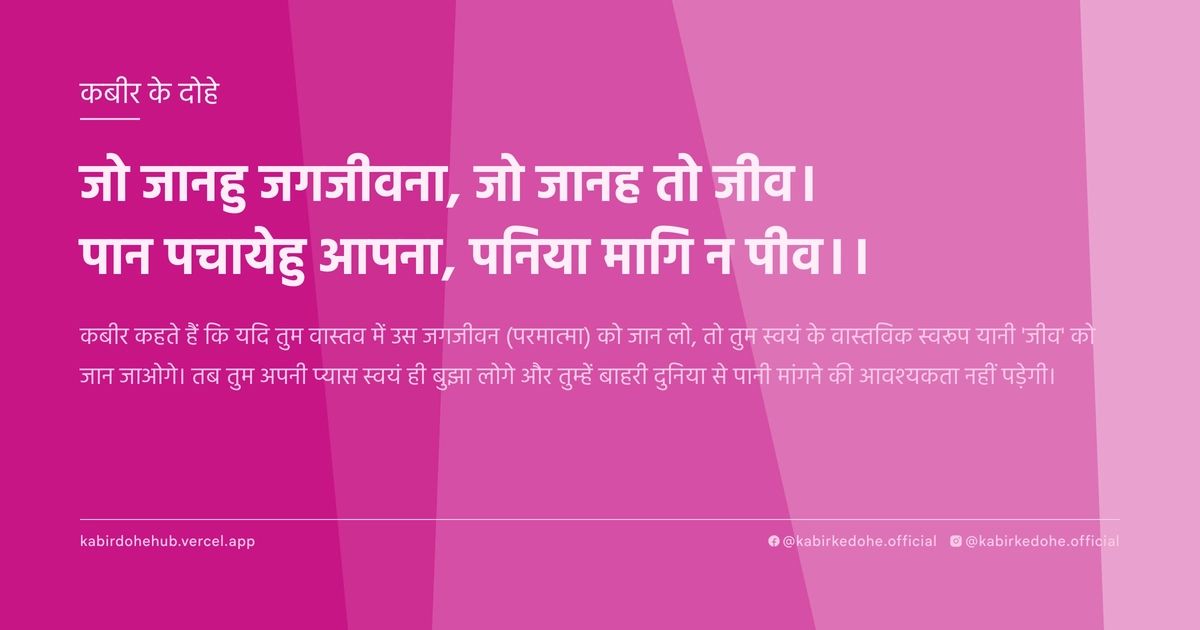
जो जानहु जगजीवना, जो जानह तो जीव।
पान पचायेहु आपना, पनिया मागि न पीव।।
Jo jaanhu jagjeevana, jo jaanah to jeev. Paan pachayyehu aapna, paniya maagi na peev.
इस पृष्ठ पर इस कबीर दोहे का अर्थ (meaning), हिंदी व्याख्या और अंग्रेज़ी अनुवाद, दार्शनिक विश्लेषण और व्यावहारिक जीवन सीख दी गई है। यह दोहा आत्मनिरीक्षण (Self-introspection) विषय से जुड़ा है — Kabir doha meaning and explanation in Hindi and English.
अर्थ (Meaning):
कबीर कहते हैं कि यदि तुम वास्तव में उस जगजीवन (परमात्मा) को जान लो, तो तुम स्वयं के वास्तविक स्वरूप यानी 'जीव' को जान जाओगे। तब तुम अपनी प्यास स्वयं ही बुझा लोगे और तुम्हें बाहरी दुनिया से पानी मांगने की आवश्यकता नहीं पड़ेगी।
Kabir asserts that if you truly realize the Life-Sustainer of the universe, you will simultaneously realize your own true essence as a living soul. In that state of enlightenment, you will quench your own spiritual thirst from within, rendering the act of begging for water from external sources unnecessary.
व्याख्या (Interpretation):
इस दोहे का शाब्दिक अर्थ है कि जो परमात्मा को जानता है, वह स्वयं को जान लेता है। रूपक के स्तर पर, 'पानी' यहाँ सांसारिक सुखों, मान्यताओ और बाहरी समर्थन का प्रतीक है। कबीर निरगुण भक्ति के माध्यम से समझाते हैं कि आत्मा और परमात्मा एक ही हैं (अद्वैत)। जब साधक माया के पर्दे को हटाकर अपने भीतर के ब्रह्म को पहचानता है, तो उसकी समस्त इच्छाएं और अभाव समाप्त हो जाते हैं। यह एक विरोधाभास है: हम पूरी दुनिया में शांति और प्रेम खोजते हैं, जबकि वह स्रोत हमारे अपने भीतर ही स्थित है। जब आंतरिक पूर्णता प्राप्त होती है, तो बाहरी निर्भरता समाप्त हो जाती है।
Literally, the verse suggests that knowing the Divine leads to self-knowledge. Metaphorically, 'water' symbolizes worldly pleasures, external validations, and spiritual crutches. Kabir utilizes the lens of Nirgun Bhakti to illustrate that the Atman (soul) and Brahman (universal consciousness) are non-dual. When the seeker pierces the veil of Maya, they discover that the thirst for fulfillment is an illusion because the source of all satisfaction resides within. This highlights the central paradox of human existence: we spend our lives searching the horizon for a treasure that is buried in our own heart. Once internal wholeness is achieved, the desperate craving for external sustenance vanishes.
दार्शनिक विश्लेषण (Philosophical Analysis):
कबीर का यह दर्शन अद्वैत वेदांत और सूफी मत के 'वहदत-अल-वजूद' (अस्तित्व की एकता) का संगम है। उन्होंने अपने समय के उस धार्मिक पाखंड का खंडन किया जहाँ लोग मोक्ष के लिए तीर्थों, मूर्तियों और बाहरी गुरुओं पर निर्भर थे। कबीर का तर्क है कि यदि ईश्वर सर्वव्यापी है, तो वह मनुष्य के भीतर भी है। ritualism (कर्मकांड) केवल एक बाहरी आवरण है जो मनुष्य को उसके वास्तविक स्वरूप से दूर ले जाता है।
यहाँ 'जगजीवन' केवल एक देवता नहीं, बल्कि वह चेतना है जो पूरे ब्रह्मांड को संचालित करती है। जब व्यक्ति 'अहं' (ego) का त्याग करता है, तो वह महसूस करता है कि वह अलग नहीं, बल्कि उसी अनंत चेतना का हिस्सा है। यह मनोवैज्ञानिक रूपांतरण है जहाँ 'मैं' और 'तू' का भेद मिट जाता है।
सूफी परंपरा की तरह, कबीर यहाँ 'इश्क-ए-हकीकी' या ईश्वरीय प्रेम की बात कर रहे हैं, जो व्यक्ति को आत्मनिर्भर बनाता है। जब आत्मा परमात्मा में विलीन होती है, तो वह 'पूर्ण' हो जाती है। यह पूर्णता उसे किसी बाहरी सहारे की मोहताज नहीं रहने देती।
कबीर जाति और धर्म की सीमाओं को तोड़कर एक सार्वभौमिक सत्य प्रस्तुत करते हैं। उनके लिए ज्ञान कोई ऐसी वस्तु नहीं है जिसे पढ़कर या सुनकर प्राप्त किया जाए, बल्कि यह एक अनुभव है। यह अनुभव तब होता है जब हम बाहरी दुनिया की खोज बंद कर आंतरिक यात्रा शुरू करते हैं।
अंततः, यह दोहा हमें सिखाता है कि हमारी सारी मानसिक पीड़ा और अधूरापन इस गलतफहमी से पैदा होता है कि हम 'अधूरे' हैं। वास्तविकता यह है कि हम पहले से ही पूर्ण हैं, बस उस पूर्णता को पहचानने की दृष्टि की आवश्यकता है।
Kabir’s philosophy here is a profound synthesis of Advaita Vedanta and the Sufi concept of 'Wahdat-al-Wujud' (Unity of Existence). He vehemently rejects the ritualism of his era, where salvation was sought through pilgrimages, idols, and external intermediaries. Kabir argues that if the Divine is omnipresent, the Divine must necessarily reside within the human heart. Rituals are merely superficial layers that distance the individual from their authentic self.
In this context, 'Jagjeevana' is not a distant deity but the primordial consciousness animating the entire cosmos. When the practitioner annihilates the 'Aham' (ego), the perceived separation between the observer and the observed dissolves. This is not a mere intellectual exercise but a psychological transmutation where the duality of 'I' and 'Thou' vanishes.
Mirroring Sufi mysticism, Kabir speaks of a divine love that renders the seeker self-sufficient. When the Atman merges with the Brahman, it attains a state of 'Purnatva' (completeness). This wholeness eliminates the desperate need for external validation or spiritual crutches, as the source of all nourishment is now internal.
Kabir transcends caste and creed to present a universal truth: knowledge is not an accumulation of information but a direct experiential realization. This realization occurs only when the outward gaze is turned inward, shifting from the periphery of existence to its core.
Ultimately, the verse addresses the root of human suffering—the perceived sense of lack. We suffer because we believe we are fragmented pieces of a whole, whereas the truth is that we are the whole appearing as a fragment. The 'thirst' is an illusion; the 'water' is our own inherent nature.
मूल संदेश (Core Message):
- बाहरी खोज एक भ्रम है; सत्य भीतर स्थित है।
- अहंकार का विसर्जन ही वास्तविक तृप्ति का द्वार है।
- जब आप स्वयं को जान लेते हैं, तो दुनिया की कमी महसूस नहीं होती।
- आत्मा पूर्ण है, उसे किसी बाहरी पूरक की आवश्यकता नहीं।
- परमात्मा कोई बाहरी सत्ता नहीं, बल्कि आपकी अपनी शुद्ध चेतना है।
- निर्भरता से मुक्ति ही वास्तविक स्वतंत्रता है।
- External searching is a mirage; the Truth resides within.
- The dissolution of ego is the only gateway to true fulfillment.
- Once you know yourself, the world's deficiencies cease to matter.
- The soul is inherently complete; it requires no external supplement.
- The Divine is not an external entity, but your own pure consciousness.
- Freedom from dependency is the ultimate liberation.
व्यावहारिक उदाहरण (Practical Example):
वाराणसी के घाटों पर रहने वाला एक वृद्ध विधवा, जिसे लोग 'माई' कहते थे, जीवन भर दूसरों की सेवा और दान-पुण्य में लगी रही। वह मानती थी कि उसकी शांति केवल दूसरों की संतुष्टि और मंदिर की पूजा में है।
वह हर दिन मंदिर जाती और घंटों प्रार्थना करती कि उसे मानसिक शांति मिले। वह अपनी खुशियों के लिए अपने बच्चों और समाज की स्वीकृति पर निर्भर थी।
एक दिन वह एक शांत कोने में बैठी थी, तभी उसने एक साधु को देखा जो बिना किसी बाहरी सहारे के गहरे आनंद में डूबा था। उसने पूछा, 'बाबा, मैं इतनी पूजा करती हूँ, फिर भी मन अशांत है। मैं कहाँ शांति ढूँढूँ?'
साधु ने मुस्कुराकर कहा, 'माई, तुम प्यासी हो लेकिन कुआँ तुम्हारे अपने पैरों के नीचे है। तुम बाहर पानी माँग रही हो, जबकि तुम स्वयं जल का सागर हो।'
यह बात माई के हृदय पर गहरा प्रभाव डाल गई। उसने महसूस किया कि वह अब तक अपनी पहचान दूसरों की नजरों में खोज रही थी।
उसने धीरे-धीरे बाहरी शोर को कम किया और मौन का अभ्यास शुरू किया। उसने पाया कि जब वह दूसरों की सेवा करती थी, तो वह अक्सर बदले में प्रशंसा की उम्मीद करती थी।
उसने अपनी सेवा को 'अहंकार' से मुक्त किया। अब वह सेवा इसलिए नहीं करती थी कि उसे 'पुण्य' मिले, बल्कि इसलिए कि वह स्वयं को उसी परमात्मा का विस्तार मानती थी।
धीरे-धीरे उसकी निर्भरता खत्म हो गई। अब उसे किसी के शब्दों या मंदिर की घंटियों की जरूरत नहीं थी।
उसका चेहरा एक अलौकिक चमक से भर गया। वह अब माँगने वाली नहीं, बल्कि देने वाली बन गई थी, क्योंकि उसने अपने भीतर के स्रोत को पा लिया था।
माई ने जान लिया कि वास्तविक तृप्ति बाहर से नहीं, बल्कि स्वयं के भीतर की गहराई में उतरने से मिलती है।
In the ancient alleys of Varanasi lived an elderly widow known as 'Mai,' who spent her entire life in service and religious charity. She believed her peace depended entirely on the satisfaction of others and the rituals of the temple.
Every day, she visited the shrines, praying fervently for mental peace. Her emotional well-being was tethered to the approval of her children and the social standing she held as a 'pious' woman.
One afternoon, while resting by the ghats, she encountered a silent ascetic who radiated an inexplicable joy. She asked, 'Baba, I perform endless prayers, yet my mind remains restless. Where can I find true peace?'
The ascetic smiled and replied, 'Mai, you are thirsty, yet the well is beneath your own feet. You beg for water from the world, unaware that you are the ocean itself.'
These words struck a chord deep within her. She realized that for decades, she had been searching for her identity and worth in the eyes of others.
She began to cultivate silence, withdrawing from the noise of external expectations. She noticed that even her acts of service were often laced with a subconscious desire for praise.
She consciously stripped the ego from her kindness. She no longer served to earn 'punya' (merit) but because she recognized the same divine spark in others that resided in her.
Slowly, her dependency vanished. She no longer needed the validation of the community or the rhythmic ringing of temple bells to feel secure.
Her countenance transformed into one of serene luminosity. She ceased being a beggar for peace and became a source of peace for others.
Mai finally understood that true fulfillment is not a gift bestowed by the world, but a discovery made within the depths of one's own being.
अभ्यास मार्गदर्शन (Practice Guidance):
- प्रतिदिन 20 मिनट 'शून्य ध्यान' का अभ्यास करें, जहाँ आप किसी विचार या मंत्र के बजाय केवल अपनी उपस्थिति (Presence) को महसूस करें।
- एक डायरी लिखें जिसमें उन क्षणों को दर्ज करें जब आपने बाहरी प्रशंसा या सहायता की तीव्र इच्छा महसूस की। विश्लेषण करें कि वह कमी आपके भीतर कहाँ है।
- व्यवहार परिवर्तन: दिन में कम से कम एक बार ऐसा कार्य करें जिसका श्रेय आप किसी को न दें और न ही उसकी अपेक्षा करें, ताकि 'कर्ता' का अहंकार मिट सके।
- डायग्नोस्टिक चेकलिस्ट: क्या मैं अपनी खुशी के लिए दूसरों की राय पर निर्भर हूँ? क्या मैं अकेला होने पर बेचैनी महसूस करता हूँ? क्या मैं अपनी आंतरिक शांति के लिए बाहरी परिस्थितियों को जिम्मेदार ठहराता हूँ?
- Practice 20 minutes of 'Sunya Dhyana' (Void Meditation) daily, focusing not on a mantra or thought, but on the raw sense of your own Presence.
- Maintain a journal to record moments when you felt an intense craving for external validation or help. Analyze the specific void within you that triggered this need.
- Behavioral Shift: Perform at least one act of kindness daily in total anonymity, ensuring no one knows and you seek no reward, to dissolve the 'doer' ego.
- Diagnostic Checklist: Am I relying on others' opinions for my happiness? Do I feel anxiety when alone? Do I blame external circumstances for my lack of inner peace?
चिंतन प्रश्न (Reflection Questions):
- मेरी वह कौन सी 'प्यास' है जिसे मैं जीवन भर बाहरी चीजों से बुझाने की कोशिश कर रहा हूँ?
- यदि समाज की सारी प्रशंसा और पहचान छीन ली जाए, तो मेरे भीतर क्या बचेगा?
- क्या मेरा आध्यात्मिक अभ्यास मुझे वास्तव में स्वतंत्र बना रहा है, या यह एक नया 'धार्मिक अहंकार' पैदा कर रहा है?
- मैं अपनी डिजिटल पहचान (Social Media Ego) को बनाए रखने के लिए कितनी मानसिक ऊर्जा खर्च करता हूँ?
- क्या मैं वास्तव में अकेला रहने से डरता हूँ, या मैं अपने भीतर के खालीपन से डरता हूँ?
- मेरे जीवन का वह कौन सा हिस्सा है जहाँ मैं अभी भी 'भीख' माँग रहा हूँ (प्यार, सम्मान, या सुरक्षा)?
- What is that specific 'thirst' in my life that I have been trying to quench with external acquisitions?
- If all social praise and identity were stripped away, what would remain of my core self?
- Is my spiritual practice actually liberating me, or is it merely constructing a new 'religious ego'?
- How much mental energy do I expend maintaining my digital persona and social media ego?
- Do I truly fear solitude, or do I fear the emptiness I encounter within myself?
- In which area of my life am I still 'begging'—whether for love, respect, or security?