
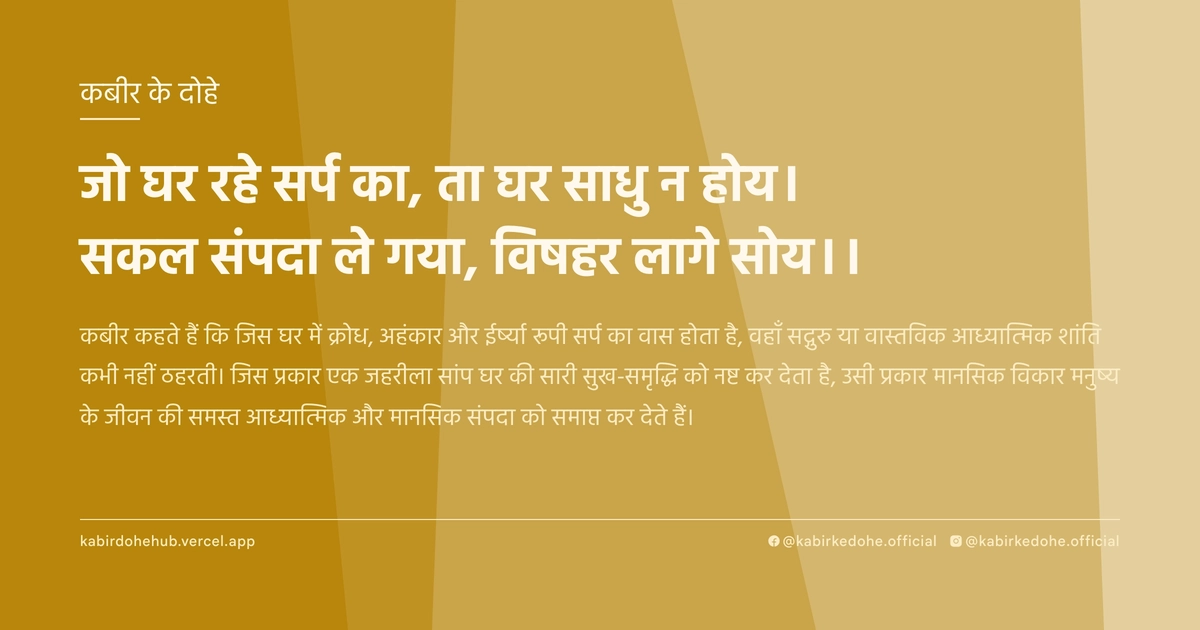
जो घर रहे सर्प का, ता घर साधु न होय।
सकल संपदा ले गया, विषहर लागे सोय।।
Jo ghar rahe sarp ka, ta ghar sadhu na hoye. Sakal sampada le gaya, vishhar laage soy.
इस पृष्ठ पर इस कबीर दोहे का अर्थ (meaning), हिंदी व्याख्या और अंग्रेज़ी अनुवाद, दार्शनिक विश्लेषण और व्यावहारिक जीवन सीख दी गई है। यह दोहा अहंकार (The Ego) विषय से जुड़ा है — Kabir doha meaning and explanation in Hindi and English.
अर्थ (Meaning):
कबीर कहते हैं कि जिस घर में क्रोध, अहंकार और ईर्ष्या रूपी सर्प का वास होता है, वहाँ सद्गुरु या वास्तविक आध्यात्मिक शांति कभी नहीं ठहरती। जिस प्रकार एक जहरीला सांप घर की सारी सुख-समृद्धि को नष्ट कर देता है, उसी प्रकार मानसिक विकार मनुष्य के जीवन की समस्त आध्यात्मिक और मानसिक संपदा को समाप्त कर देते हैं।
Kabir asserts that a home inhabited by the 'serpent' of anger, ego, and jealousy can never host a true saint or the presence of divine peace. Just as a venomous snake consumes the prosperity and safety of a household, these toxic mental impurities devour the spiritual wealth and inner tranquility of an individual, leaving behind only void and suffering.
व्याख्या (Interpretation):
यहाँ 'सर्प' केवल एक जीव नहीं, बल्कि मानवीय अहंकार और क्रोध का प्रतीक है। शाब्दिक अर्थ में, एक सांप वाले घर में साधु नहीं रुकते, लेकिन आध्यात्मिक स्तर पर, यह मन की स्थिति को दर्शाता है। जब मन में द्वेष और अहंकार का विष होता है, तो वह 'साधु' (शुद्ध चेतना या आत्म-ज्ञान) के लिए अनुपयुक्त हो जाता है। यह निरगुण भक्ति के उस सिद्धांत को पुष्ट करता है जहाँ बाहरी पूजा से अधिक आंतरिक शुद्धि महत्वपूर्ण है। माया यहाँ उस भ्रम के रूप में है जो हमें विश्वास दिलाता है कि हम क्रोध के माध्यम से अपनी रक्षा कर रहे हैं, जबकि वास्तव में हम अपनी ही आत्मा का विनाश कर रहे हैं। यह द्वैतवाद की स्थिति है जहाँ मनुष्य स्वयं को ईश्वर से अलग मानकर अहंकार पालता है, जबकि अद्वैत वेदांत के अनुसार, जब यह 'सर्प' मरता है, तभी आत्मा और ब्रह्म की एकता का अनुभव होता है।
In this verse, the 'serpent' is not a biological creature but a potent metaphor for human ego, anger, and malice. Literally, a saint avoids a house with a snake; spiritually, the 'saint' represents the pure consciousness or the Higher Self that cannot reside in a mind clouded by toxicity. This aligns with Nirgun Bhakti, emphasizing internal purification over external ritualism. Maya manifests here as the illusion that anger provides protection or power, while it actually erodes the soul's essence. The central paradox is that the very ego we use to define our identity is the poison that prevents us from realizing our true identity as Brahman. Only when the 'serpent' of the separate self is annihilated does the non-duality of Atman and Brahman emerge, transforming the 'house' of the body into a sanctuary for the Divine.
दार्शनिक विश्लेषण (Philosophical Analysis):
कबीर का यह दोहा तत्कालीन समाज में व्याप्त धार्मिक पाखंड और आंतरिक शुद्धि के अभाव पर एक तीखा प्रहार है। उन्होंने देखा कि लोग मंदिरों और मस्जिदों में तो जाते थे, लेकिन उनके भीतर क्रोध और जातिगत श्रेष्ठता का विष भरा रहता था। यह दृष्टिकोण सूफी मत के 'नफ्स' (अहंकार) के विनाश के समान है, जहाँ साधक को अपनी निम्न प्रवृत्तियों को मारकर ही ईश्वर तक पहुँचने का मार्ग मिलता है।
अद्वैत वेदांत के परिप्रेक्ष्य में, यह सर्प 'अविद्या' (अज्ञान) है। जब तक अविद्या का वास है, तब तक सत्य का साक्षात्कार असंभव है। कबीर यहाँ यह स्पष्ट करते हैं कि आध्यात्मिक प्रगति के लिए केवल ग्रंथों का अध्ययन पर्याप्त नहीं है, बल्कि मानसिक विकारों का पूर्ण उन्मूलन आवश्यक है।
यह दोहा कर्मकांडीय धर्म की निरर्थकता को दर्शाता है। यदि हृदय में ईर्ष्या है, तो हज़ारों तीर्थ यात्राएं भी व्यर्थ हैं क्योंकि 'साधु' (दिव्यता) बाहरी स्थानों पर नहीं, बल्कि शुद्ध अंतःकरण में निवास करती है।
मनोवैज्ञानिक स्तर पर, यह 'टॉक्सिक' व्यवहार के चक्र को समझाता है। क्रोध और अहंकार व्यक्ति की मानसिक संपदा—जैसे शांति, प्रेम और स्पष्टता—को धीरे-धीरे नष्ट कर देते हैं, जिससे व्यक्ति आध्यात्मिक रूप से दरिद्र हो जाता है।
अंततः, कबीर यह संदेश देते हैं कि मुक्ति का मार्ग बाहरी संघर्षों से नहीं, बल्कि आंतरिक युद्ध से शुरू होता है। जब हम अपने भीतर के सर्प को पहचान लेते हैं और उसे करुणा और क्षमा से शांत करते हैं, तब हम वास्तव में 'साधु' या बुद्धत्व को प्राप्त करते हैं।
Kabir’s couplet is a piercing critique of the religious hypocrisy and lack of internal purification prevalent in his era. He observed people frequenting temples and mosques while harboring the venom of anger and caste superiority. This mirrors the Sufi concept of 'Nafs' (the lower self), where the annihilation of the ego is the prerequisite for union with the Divine.
From the lens of Advaita Vedanta, the serpent represents 'Avidya' (ignorance). As long as ignorance resides in the heart, the realization of the Absolute Truth remains impossible. Kabir clarifies that spiritual evolution is not achieved through the mere study of scriptures but through the total eradication of mental impurities.
This teaching highlights the futility of ritualistic religion. If the heart is filled with jealousy, thousands of pilgrimages are meaningless because the 'Saint' (Divinity) does not reside in external locations but within a purified consciousness.
Psychologically, this describes the cycle of toxic behavior. Anger and ego systematically devour one's mental wealth—peace, love, and clarity—leaving the individual spiritually bankrupt and emotionally depleted.
Ultimately, Kabir suggests that the path to liberation begins not with external conflict, but with an internal war. By recognizing the internal serpent and neutralizing it with compassion and forgiveness, the individual transforms their existence into a vessel worthy of the Divine presence.
मूल संदेश (Core Message):
- अहंकार और क्रोध आत्मा के सबसे बड़े शत्रु हैं।
- आंतरिक शुद्धि के बिना बाहरी भक्ति व्यर्थ है।
- क्रोध केवल विनाश लाता है, सुरक्षा नहीं।
- शांति तभी आती है जब अहंकार का त्याग हो।
- सच्चा साधु वह अवस्था है, न कि कोई व्यक्ति।
- मानसिक विषाक्तता जीवन की वास्तविक दरिद्रता है।
- Ego and anger are the greatest enemies of the soul.
- External devotion is futile without internal purification.
- Anger brings only destruction, never true protection.
- Peace arrives only after the surrender of the ego.
- The 'Saint' is a state of consciousness, not just a person.
- Mental toxicity is the only true form of poverty.
व्यावहारिक उदाहरण (Practical Example):
वाराणसी के एक पुराने घाट पर रहने वाली एक वृद्ध विधवा, जानकी, अपने जीवन के अंतिम वर्षों में अत्यंत कड़वाहट से भरी हुई थीं। उनके साथ रहने वाले अन्य लोग उनसे डरते थे क्योंकि उनकी वाणी में हमेशा विष होता था।
जानकी का मानना था कि उनका क्रोध उनके स्वाभिमान की रक्षा कर रहा है, लेकिन वास्तव में वह अकेली पड़ गई थीं। उनके घर में कोई नहीं आता था, यहाँ तक कि उनके अपने बच्चे भी उनसे दूरी बना चुके थे।
एक दिन, एक युवा संन्यासी उनके पास आए और उन्होंने जानकी के क्रोध को बिना किसी प्रतिक्रिया के सुना। उन्होंने केवल इतना कहा, 'माता, आपके घर में एक सर्प है जिसने आपकी सारी शांति खा ली है।'
जानकी ने पहले तो क्रोध किया, लेकिन फिर उन्होंने महसूस किया कि उनकी पूरी जिंदगी की 'संपदा'—उनके रिश्ते, उनकी नींद और उनकी मानसिक शांति—सब खत्म हो चुकी थी।
उन्हें समझ आया कि जिस क्रोध को वह अपनी ढाल समझ रही थीं, वह वास्तव में वह सर्प था जिसने उनके जीवन को उजाड़ दिया था।
उन्होंने धीरे-धीरे मौन का अभ्यास शुरू किया और अपनी कड़वाहट को क्षमा में बदलने का प्रयास किया।
जैसे-जैसे उनका क्रोध कम हुआ, उनके घर का वातावरण बदलने लगा। लोग अब उनसे बात करने लगे और उन्हें सम्मान देने लगे।
अंततः, जानकी ने पाया कि जब उन्होंने अपने भीतर के सर्प को विदा किया, तब उनके जीवन में वह 'साधु' या शांति लौट आई जिसे वह सालों से खोज रही थीं।
उनका परिवर्तन केवल उनके लिए नहीं, बल्कि उनके पूरे मोहल्ले के लिए एक उदाहरण बन गया कि आंतरिक शांति ही वास्तविक संपत्ति है।
यह 'कबीर ट्विस्ट' था: जिस क्षण उन्होंने अपनी रक्षा का भ्रम छोड़ा, उसी क्षण उन्हें वास्तविक सुरक्षा और प्रेम प्राप्त हुआ।
In the ancient ghats of Varanasi lived an elderly widow named Janki, whose final years were consumed by intense bitterness. Those around her feared her, for her words were always laced with venom.
Janki believed her anger was a shield protecting her dignity, but in reality, it had isolated her. No one visited her; even her own children had distanced themselves from her toxic presence.
One day, a young sanyasi approached her and listened to her outbursts without reaction. He simply remarked, 'Mother, there is a serpent in your home that has devoured all your peace.'
Janki initially reacted with rage, but then she paused to reflect. She realized that all the 'wealth' of her life—her relationships, her sleep, and her mental clarity—had vanished.
She understood that the anger she mistook for a shield was actually the serpent that had ravaged her existence from within.
She began practicing silence and consciously attempted to transmute her bitterness into forgiveness.
As her anger subsided, the atmosphere of her home shifted. People began to speak to her again and treat her with genuine respect.
Eventually, Janki discovered that once she evicted the internal serpent, the 'Saint' or the profound peace she had sought for years finally returned.
Her transformation became a living example for her entire neighborhood, proving that inner peace is the only true asset one can possess.
This was the 'Kabir Twist': the moment she abandoned the illusion of self-protection through anger, she attained actual security and unconditional love.
अभ्यास मार्गदर्शन (Practice Guidance):
- दैनिक आत्म-निरीक्षण: प्रतिदिन 15 मिनट मौन बैठें और देखें कि दिन भर में किस बात पर क्रोध आया। उस क्रोध को एक 'सर्प' के रूप में देखें जो आपकी शांति चुरा रहा है।
- जर्नलिंग प्रॉम्प्ट: 'मेरे भीतर का वह कौन सा अहंकार है जो मुझे दूसरों से जोड़ना नहीं देता?' इस प्रश्न पर गहराई से लिखें।
- व्यवहारिक परिवर्तन: जब भी किसी पर क्रोध आए, तुरंत प्रतिक्रिया देने के बजाय 10 गहरी सांसें लें और स्वयं से पूछें, 'क्या यह प्रतिक्रिया मेरी आध्यात्मिक संपदा को कम कर रही है?'
- डायग्नोस्टिक चेकलिस्ट: यदि आप बार-बार रिश्तों में तनाव महसूस कर रहे हैं, नींद की कमी है, या दूसरों में केवल दोष दिख रहे हैं, तो समझें कि 'सर्प' सक्रिय है। यदि मन शांत है और क्षमा सहज है, तो 'साधु' का वास है।
- Daily Self-Observation: Sit in silence for 15 minutes daily and observe where anger arose during the day. Visualize that anger as a 'serpent' stealing your inner peace.
- Journaling Prompt: 'Which specific ego-driven belief is preventing me from connecting authentically with others?' Explore this deeply in writing.
- Behavioral Shift: Whenever anger arises, instead of reacting immediately, take 10 deep breaths and ask yourself, 'Is this reaction depleting my spiritual wealth?'
- Diagnostic Checklist: If you experience recurring relationship tension, chronic insomnia, or a tendency to see only faults in others, the 'serpent' is active. If the mind is calm and forgiveness is effortless, the 'Saint' resides within.
चिंतन प्रश्न (Reflection Questions):
- मेरा वह कौन सा 'पवित्र' विश्वास है जो वास्तव में मेरे अहंकार को पोषण दे रहा है?
- मैं अपनी डिजिटल पहचान (सोशल मीडिया) के माध्यम से किस तरह के 'सर्प' (श्रेष्ठता का भाव) को पाल रहा हूँ?
- क्या मेरा क्रोध वास्तव में मेरी रक्षा कर रहा है, या यह मुझे अकेला कर रहा है?
- यदि आज मेरा सारा सामाजिक पद और प्रतिष्ठा छिन जाए, तो क्या मेरे भीतर कोई शांति शेष रहेगी?
- मैं किन लोगों को 'अछूत' या 'निम्न' मानता हूँ, और यह विचार मेरे भीतर किस विष को जन्म देता है?
- क्या मैं वास्तव में क्षमा करता हूँ, या मैं केवल अपनी श्रेष्ठता सिद्ध करने के लिए क्षमा का ढोंग करता हूँ?
- Which of my 'sacred' beliefs is actually nourishing my ego in secret?
- What kind of 'serpent' (sense of superiority) am I feeding through my digital identity and social media presence?
- Is my anger truly protecting me, or is it systematically isolating me from humanity?
- If all my social status and prestige were stripped away today, would any peace remain within me?
- Whom do I subconsciously consider 'inferior,' and what venom does this judgment create within my own heart?
- Do I truly forgive, or do I merely perform the act of forgiveness to feel spiritually superior?