
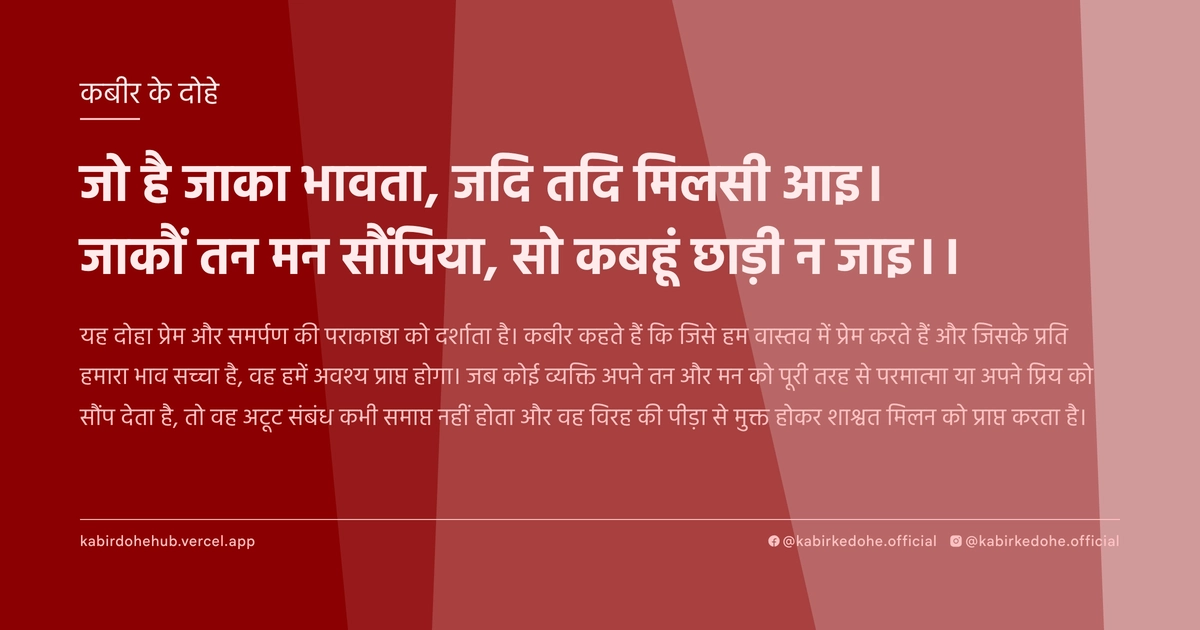
जो है जाका भावता, जदि तदि मिलसी आइ।
जाकौं तन मन सौंपिया, सो कबहूं छाड़ी न जाइ।।
Jo hai jaka bhavta, jadi tadi milasi aai. Jakon tan man saunpiya, so kabahun chhadi na jaai.
इस पृष्ठ पर इस कबीर दोहे का अर्थ (meaning), हिंदी व्याख्या और अंग्रेज़ी अनुवाद, दार्शनिक विश्लेषण और व्यावहारिक जीवन सीख दी गई है। यह दोहा भक्ति (Bhakti) विषय से जुड़ा है — Kabir doha meaning and explanation in Hindi and English.
अर्थ (Meaning):
यह दोहा प्रेम और समर्पण की पराकाष्ठा को दर्शाता है। कबीर कहते हैं कि जिसे हम वास्तव में प्रेम करते हैं और जिसके प्रति हमारा भाव सच्चा है, वह हमें अवश्य प्राप्त होगा। जब कोई व्यक्ति अपने तन और मन को पूरी तरह से परमात्मा या अपने प्रिय को सौंप देता है, तो वह अटूट संबंध कभी समाप्त नहीं होता और वह विरह की पीड़ा से मुक्त होकर शाश्वत मिलन को प्राप्त करता है।
This couplet illustrates the pinnacle of love and surrender. Kabir asserts that the one for whom we harbor true, heartfelt devotion will inevitably be attained. When a seeker completely surrenders both body and mind to the Divine or the Beloved, that bond becomes indissoluble, ensuring that the union, once achieved, can never be severed or lost.
व्याख्या (Interpretation):
शाब्दिक अर्थ है कि सच्ची इच्छा और समर्पण से मिलन संभव है। आध्यात्मिक स्तर पर, यह 'भाव' शब्द पर केंद्रित है, जो केवल भावना नहीं बल्कि एक गहन आध्यात्मिक आकर्षण है। यह निर्गुण भक्ति का सार है, जहाँ भक्त अपनी पृथकता (माया) को त्यागकर ब्रह्म में विलीन हो जाता है। यहाँ 'तन और मन सौंपने' का अर्थ अहंकार का पूर्ण विसर्जन है। जब 'मैं' मिट जाता है, तब केवल 'वह' बचता है, और यही अद्वैत वेदांत की स्थिति है। यह विरोधाभास है कि स्वयं को पूरी तरह खोकर ही व्यक्ति स्वयं को वास्तव में पाता है। यह मिलन भौतिक नहीं, बल्कि चेतना का मिलन है।
Literally, it suggests that sincere longing and surrender lead to union. Spiritually, it centers on 'Bhav,' which is not mere emotion but a profound spiritual magnetism. This is the essence of Nirgun Bhakti, where the devotee transcends the illusion of separation (Maya) to merge with the Formless Brahman. 'Surrendering body and mind' signifies the total annihilation of the ego. When the 'I' vanishes, only the 'Divine' remains, mirroring the non-duality of Advaita Vedanta. It presents the central paradox: only by completely losing oneself does one truly find oneself. This union is not physical, but a convergence of consciousness.
दार्शनिक विश्लेषण (Philosophical Analysis):
कबीर का यह विचार तत्कालीन समाज में व्याप्त कर्मकांडीय धर्म के विरुद्ध एक सशक्त प्रहार था। जहाँ उस समय धर्म को बाहरी अनुष्ठानों, तीर्थों और मूर्तियों में खोजा जा रहा था, कबीर ने 'भाव' और 'आंतरिक समर्पण' को प्राथमिकता दी। यह दृष्टिकोण सूफी मत के 'इश्क-ए-हकीकी' (ईश्वरीय प्रेम) से गहराई से मेल खाता है, जहाँ प्रेमी और प्रियतम के बीच का अंतर मिट जाता है।
दार्शनिक रूप से, यह दोहा अद्वैत वेदांत के उस सिद्धांत की पुष्टि करता है कि आत्मा और परमात्मा मूलतः एक ही हैं। विरह की स्थिति केवल अज्ञान (Avidya) के कारण है। जब साधक अपने अस्तित्व के हर अंश को समर्पित कर देता है, तो वह द्वैत (duality) को समाप्त कर देता है। यह समर्पण कोई बाहरी क्रिया नहीं, बल्कि एक मनोवैज्ञानिक रूपांतरण है।
कबीर जाति और वर्ग के भेदों को नकारते हुए यह संदेश देते हैं कि ईश्वर की प्राप्ति के लिए किसी विशेष कुल या शास्त्र के ज्ञान की आवश्यकता नहीं है, बल्कि केवल एक शुद्ध हृदय और पूर्ण समर्पण की आवश्यकता है। यह 'प्रेम मार्ग' है, जो ज्ञान मार्ग से अधिक तीव्र और भावनात्मक है।
यहाँ 'छोड़ न जाइ' का अर्थ है कि एक बार जब आत्मा परमात्मा के साथ एकाकार हो जाती है, तो वह पुनरावृत्ति के चक्र से मुक्त हो जाती है। यह मोक्ष की वह अवस्था है जहाँ भक्त और भगवान के बीच की दूरी शून्य हो जाती है।
अंततः, यह विश्लेषण हमें सिखाता है कि आध्यात्मिक प्रगति का पैमाना यह नहीं है कि हमने कितना पढ़ा है, बल्कि यह है कि हमने अपने अहंकार को कितना विसर्जित किया है। समर्पण ही वह कुंजी है जो वास्तविकता के द्वार खोलती है।
Kabir's perspective serves as a potent critique of the ritualistic religion prevalent in his era. While spirituality was then sought through external rites, pilgrimages, and idols, Kabir prioritized 'Bhav' (inner disposition) and 'absolute surrender.' This approach aligns deeply with the Sufi concept of 'Ishq-e-Haqiqi' (Divine Love), where the distinction between the lover and the Beloved dissolves.
Philosophically, this couplet affirms the Advaita Vedanta principle that the Atman and Brahman are fundamentally one. The state of longing or separation is merely a result of ignorance (Avidya). When the seeker surrenders every fragment of their existence, they annihilate duality. This surrender is not an external act but a profound psychological transformation.
By rejecting caste and class distinctions, Kabir messages that attaining the Divine requires neither a specific lineage nor scholarly knowledge of scriptures, but only a pure heart and total surrender. This is the 'Path of Love,' which is more visceral and immediate than the 'Path of Knowledge.'
The phrase 'never be left' implies that once the soul merges with the Divine, it is liberated from the cycle of recurrence. This is the state of Moksha where the distance between the devotee and the Deity becomes zero.
Ultimately, this analysis teaches us that the metric of spiritual progress is not how much one has studied, but how much of the ego has been relinquished. Surrender is the only key that unlocks the doors of ultimate reality.
मूल संदेश (Core Message):
- अहंकार की दीवार ही ईश्वर और आत्मा के बीच की एकमात्र बाधा है।
- सच्चा प्रेम पाने की इच्छा नहीं, बल्कि स्वयं को समर्पित करने का साहस है।
- जब 'मैं' का विसर्जन होता है, तब 'अनंत' का उदय होता है।
- बाहरी अनुष्ठान व्यर्थ हैं यदि हृदय में समर्पण का भाव नहीं है।
- पूर्ण समर्पण ही वह द्वार है जहाँ विरह समाप्त और मिलन प्रारंभ होता है।
- The wall of ego is the only barrier between the Divine and the Soul.
- True love is not the desire to possess, but the courage to surrender.
- When the 'I' is dissolved, the 'Infinite' emerges.
- External rituals are futile if the heart lacks the spirit of surrender.
- Total surrender is the gateway where longing ends and union begins.
व्यावहारिक उदाहरण (Practical Example):
एक समय की बात है, वाराणसी के घाटों पर माधव नाम का एक वृद्ध बुनकर रहता था। माधव का जीवन सादगी से भरा था, लेकिन उसका मन हमेशा एक गहरी बेचैनी में रहता था। वह घंटों मंदिर जाता, मंत्र पढ़ता और दान करता, फिर भी उसे वह शांति नहीं मिली जिसकी उसे तलाश थी। उसे लगता था कि वह ईश्वर को 'पाने' की कोशिश कर रहा है, जैसे कोई वस्तु बाजार से खरीदी जाती है।
एक दिन उसकी मुलाकात एक घुमक्कड़ फकीर से हुई। फकीर ने माधव की बेचैनी को देखा और उससे पूछा, "तुम क्या खोज रहे हो?"
माधव ने कहा, "मैं परमात्मा का साक्षात्कार करना चाहता हूँ, लेकिन मेरी साधना पूरी नहीं हो रही।"
फकीर हँसा और बोला, "तुम उसे पकड़ने की कोशिश कर रहे हो, जबकि तुम्हें खुद को उसके हवाले करना चाहिए। जब तक तुम 'मैं' खोज रहा हूँ, तब तक वह 'तुम' से दूर रहेगा। जिस दिन तुम कहोगे कि 'मैं अब मेरा नहीं रहा', उसी क्षण वह तुम्हें मिल जाएगा।"
माधव को यह बात समझ नहीं आई, लेकिन उसने एक प्रयोग करने का निर्णय लिया। उसने तय किया कि वह अब अपनी हर सांस, अपना हर काम, और यहाँ तक कि अपनी असफलताओं को भी परमात्मा को समर्पित कर देगा। उसने अपनी बुनकरी के करघे पर धागे पिरोते समय यह सोचना शुरू किया कि यह धागा उसका नहीं, बल्कि उस परमात्मा का है।
धीरे-धीरे, माधव के भीतर का 'कर्ता' (doer) समाप्त होने लगा। उसने महसूस किया कि वह अब केवल एक माध्यम है। जब वह कपड़े बुनता, तो उसे लगता कि कोई और उसके हाथों से काम करवा रहा है। उसने अपनी संपत्ति, अपने मान-सम्मान और अपनी पहचान के प्रति आसक्ति छोड़ दी।
एक रात, जब वह गहरी शांति में बैठा था, उसे अचानक एक ऐसा अनुभव हुआ जैसे वह स्वयं एक विशाल समुद्र की एक बूंद बन गया है जो समुद्र में मिल गई हो। उसे अब किसी मंदिर जाने की या किसी मंत्र की आवश्यकता नहीं थी।
उसने महसूस किया कि जब उसने अपना 'तन और मन' पूरी तरह सौंप दिया, तो वह अलगाव खत्म हो गया। वह अब अकेला नहीं था; वह संपूर्णता का हिस्सा था।
माधव का व्यवहार बदल गया। वह अब दूसरों की मदद बिना किसी अपेक्षा के करने लगा। उसकी आँखों में एक ऐसी करुणा थी जो केवल उसी व्यक्ति में हो सकती है जिसने स्वयं को खोकर सत्य को पाया हो।
गाँव के लोग हैरान थे कि माधव अब पहले से कहीं अधिक खुश और शांत था, जबकि उसके पास भौतिक रूप से कुछ नहीं बदला था। यह 'कबीर ट्विस्ट' था—पाने की इच्छा का मरना ही वास्तव में सब कुछ पा लेना था।
Once, on the ghats of Varanasi, lived an elderly weaver named Madhav. Madhav's life was simple, yet his mind was plagued by a deep restlessness. He spent hours in temples, chanting mantras and giving alms, yet he never found the peace he sought. He felt he was trying to 'acquire' God, as if God were a commodity to be bought from a market.
One day, he encountered a wandering fakir. Seeing Madhav's distress, the fakir asked, "What is it that you seek?"
Madhav replied, "I wish to realize the Divine, but my spiritual practices are not yielding results."
The fakir laughed and said, "You are trying to catch Him, whereas you should be handing yourself over to Him. As long as you say 'I am searching,' He will remain distant from 'you.' The moment you say 'I no longer belong to myself,' He will be found."
Madhav didn't fully grasp this, but he decided to experiment. He resolved to surrender every breath, every action, and even his failures to the Divine. As he threaded his loom, he began to think that the thread did not belong to him, but to the Eternal.
Gradually, the 'doer' within Madhav began to dissolve. He felt he was merely a medium. When he wove cloth, he felt as if someone else was guiding his hands. He let go of attachment to his wealth, his reputation, and his identity.
One night, sitting in profound silence, he suddenly experienced a sensation as if he were a single drop of water merging into a vast ocean. He no longer felt the need for temples or mantras.
He realized that once he had surrendered his 'body and mind' completely, the separation vanished. He was no longer alone; he was part of the Totality.
Madhav's behavior transformed. He began helping others without any expectation. His eyes held a compassion that only exists in one who has found Truth by losing themselves.
The villagers were amazed that Madhav was happier and more peaceful than ever, despite no physical change in his circumstances. This was the 'Kabir Twist'—the death of the desire to possess was, in reality, the attainment of everything.
अभ्यास मार्गदर्शन (Practice Guidance):
- प्रतिदिन 20 मिनट का 'समर्पण ध्यान' करें: अपनी आँखें बंद करें और कल्पना करें कि आपका अहंकार एक पुराने वस्त्र की तरह उतर रहा है और आप स्वयं को ब्रह्मांडीय चेतना को सौंप रहे हैं।
- स्व-पूछताछ जर्नल: प्रतिदिन लिखें कि आज किस क्षण में मेरा 'अहंकार' (Ego) हावी हुआ और मैंने उसे कैसे विसर्जित किया।
- कर्म योग का अभ्यास: दिन में कम से कम एक कार्य ऐसा करें जिसमें आप यह भूल जाएं कि आप उसे कर रहे हैं, और यह महसूस करें कि कार्य स्वयं हो रहा है।
- निदान चेकलिस्ट: क्या मैं अभी भी परिणामों से चिपका हुआ हूँ? क्या मैं अपनी पहचान को अपनी उपलब्धियों से जोड़ रहा हूँ? यदि हाँ, तो समर्पण अभी अधूरा है।
- Practice 20 minutes of 'Surrender Meditation' daily: Close your eyes and visualize your ego shedding like an old garment, offering your entire being to the cosmic consciousness.
- Self-Inquiry Journaling: Write daily about the moments where your 'Ego' dominated and how you consciously relinquished it.
- Practice Karma Yoga: Perform at least one task a day where you forget you are the 'doer' and feel that the action is happening through you.
- Diagnostic Checklist: Am I still clinging to results? Am I tying my identity to my achievements? If yes, the surrender is still incomplete.
चिंतन प्रश्न (Reflection Questions):
- मेरे जीवन में वह कौन सी चीज़ है जिसे मैं 'मेरा' कहता हूँ और उसे छोड़ने से मुझे सबसे अधिक डर लगता है?
- क्या मेरा आध्यात्मिक अभ्यास वास्तव में समर्पण है, या यह ईश्वर के साथ एक सौदा (Deal) है?
- मेरी सार्वजनिक छवि (Public Image) और मेरे आंतरिक शून्य के बीच कितना अंतर है?
- यदि आज मेरी सारी पहचान (नाम, पद, रिश्ता) छीन ली जाए, तो क्या मैं फिर भी पूर्ण महसूस करूँगा?
- क्या मैं वास्तव में प्रेम करता हूँ, या मैं केवल प्रेम किए जाने की इच्छा रखता हूँ?
- मेरे भीतर का वह कौन सा हिस्सा है जो अभी भी नियंत्रण (Control) चाहता है?
- What is the one thing in my life that I call 'mine' and fear losing the most?
- Is my spiritual practice truly surrender, or is it a subconscious deal with the Divine?
- How wide is the gap between my public persona and my internal void?
- If all my identities (name, title, relationships) were stripped away today, would I still feel whole?
- Do I truly love, or do I merely desire to be loved?
- Which part of me is still desperately clinging to the need for control?