
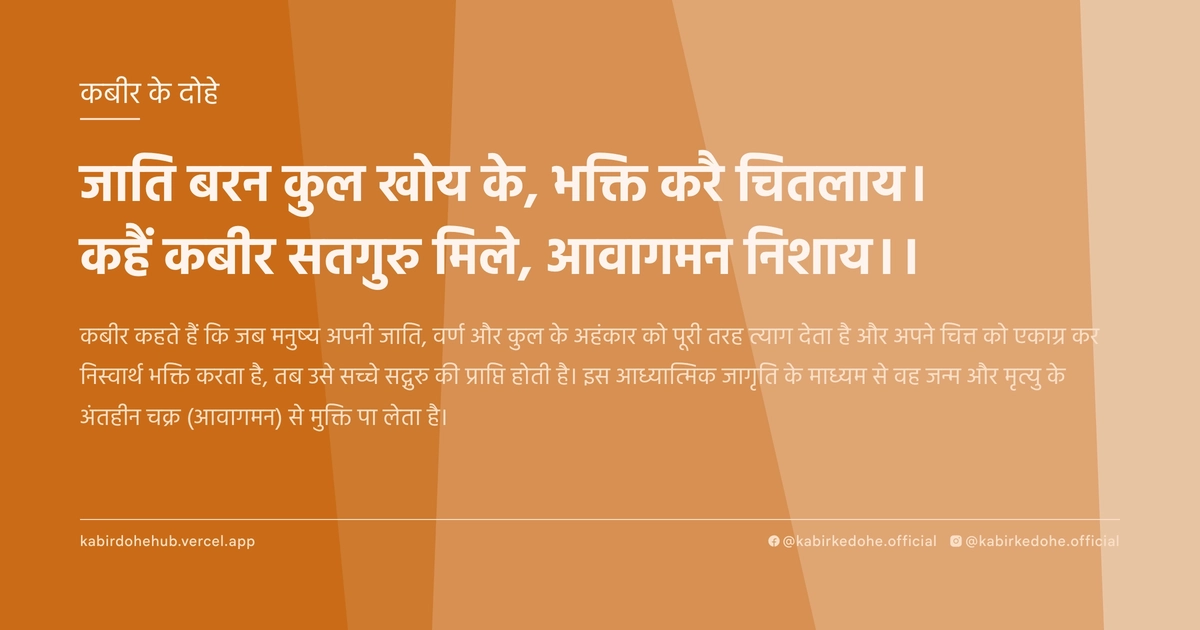
जाति बरन कुल खोय के, भक्ति करै चितलाय।
कहैं कबीर सतगुरु मिले, आवागमन निशाय।।
Jati baran kul khoy ke, bhakti karai chitlay. Kahein kabir satguru mile, aavagaman nishay.
इस पृष्ठ पर इस कबीर दोहे का अर्थ (meaning), हिंदी व्याख्या और अंग्रेज़ी अनुवाद, दार्शनिक विश्लेषण और व्यावहारिक जीवन सीख दी गई है। यह दोहा जाति विरोध (Anti-casteism) विषय से जुड़ा है — Kabir doha meaning and explanation in Hindi and English.
अर्थ (Meaning):
कबीर कहते हैं कि जब मनुष्य अपनी जाति, वर्ण और कुल के अहंकार को पूरी तरह त्याग देता है और अपने चित्त को एकाग्र कर निस्वार्थ भक्ति करता है, तब उसे सच्चे सद्गुरु की प्राप्ति होती है। इस आध्यात्मिक जागृति के माध्यम से वह जन्म और मृत्यु के अंतहीन चक्र (आवागमन) से मुक्ति पा लेता है।
Kabir asserts that when a seeker completely renounces the ego associated with caste, color, and lineage, and engages in devotion with a focused and surrendered heart, they encounter the True Guru. Through this divine guidance, the cycle of birth and death—the endless transmigration of the soul—is finally extinguished.
व्याख्या (Interpretation):
शाब्दिक अर्थ है सामाजिक पहचान का त्याग। रूपकात्मक रूप से, 'जाति-कुल' केवल सामाजिक श्रेणियां नहीं हैं, बल्कि वे मानसिक सीमाएं हैं जो हमें 'मैं' और 'तुम' में बांटती हैं। यह निर्गुण भक्ति का सार है जहाँ ईश्वर किसी विशेष कुल का नहीं, बल्कि सर्वव्यापी है। जब साधक अपनी पहचान के इन कृत्रिम आवरणों को हटाता है, तो वह माया के भ्रम को भेद देता है। यह अद्वैत वेदांत की उस स्थिति है जहाँ आत्मा और ब्रह्म की एकता का अनुभव होता है। यहाँ 'चितलाय' का अर्थ है मन का पूरी तरह विलीन हो जाना। अंततः, सद्गुरु वह प्रकाश है जो अज्ञान के अंधकार को मिटाकर मोक्ष का मार्ग प्रशस्त करता है।
Literally, this refers to the abandonment of social identity. Metaphorically, 'caste and lineage' are not merely social categories but mental constructs that create the illusion of separation between 'I' and 'Other.' This is the essence of Nirgun Bhakti, where the Divine is formless and transcends all sectarian boundaries. When the seeker strips away these artificial layers of identity, they pierce through the veil of Maya. This aligns with Advaita Vedanta, where the duality of the self and the Absolute dissolves into non-duality. 'Chitlaay' signifies the total absorption of the mind into the Divine. Ultimately, the Satguru is the catalyst who annihilates the ignorance of the ego, ending the cycle of Samsara.
दार्शनिक विश्लेषण (Philosophical Analysis):
कबीर का यह दोहा 15वीं शताब्दी के सामाजिक और धार्मिक संघर्षों की उपज है, जहाँ कर्मकांड और जातिगत श्रेष्ठता चरम पर थी। कबीर ने पुरजोर तरीके से उस व्यवस्था को चुनौती दी जो ईश्वर तक पहुँचने के लिए जन्म आधारित पात्रता को अनिवार्य मानती थी। उनका दर्शन 'सहज मार्ग' पर आधारित है, जो बाहरी आडंबरों के बजाय आंतरिक शुद्धि पर बल देता है।
दार्शनिक रूप से, यह सूफीवाद के 'फना' (अहंकार का विनाश) और वेदांत के 'अहं ब्रह्मास्मि' का संगम है। कबीर तर्क देते हैं कि जब तक व्यक्ति खुद को एक विशिष्ट समूह (कुल या जाति) से जोड़कर देखता है, वह सत्य के पूर्ण स्वरूप को नहीं देख सकता क्योंकि वह एक सीमित दृष्टिकोण से देख रहा होता है। अहंकार का यह सूक्ष्म रूप ही बंधन का कारण है।
यहाँ 'आवागमन' का उल्लेख पुनर्जन्म के सिद्धांत को दर्शाता है। कबीर के अनुसार, अज्ञानता और अहंकार ही वह गोंद हैं जो आत्मा को भौतिक संसार से चिपकाए रखते हैं। जब व्यक्ति अपनी सामाजिक पहचान को 'खो' देता है, तो वह वास्तव में अपनी सीमित पहचान को व्यापक ब्रह्मांडीय चेतना में विलीन कर रहा होता है।
यह विश्लेषण स्पष्ट करता है कि कबीर केवल सामाजिक सुधारक नहीं थे, बल्कि एक गहन मनोवैज्ञानिक चिकित्सक थे। वे जानते थे कि सामाजिक पहचान व्यक्ति के अहंकार को पोषण देती है, और जब तक यह अहंकार जीवित है, आध्यात्मिक प्रगति असंभव है। वे ritualism (कर्मकांड) को एक बाधा मानते थे क्योंकि वह अक्सर श्रेष्ठता की भावना को जन्म देता है।
अंततः, यह दोहा इस सत्य को स्थापित करता है कि मुक्ति किसी विशेष कुल या धर्म के लिए आरक्षित नहीं है। यह केवल उस व्यक्ति के लिए उपलब्ध है जो अपनी पहचान के सभी मुखौटों को उतारने का साहस रखता है। यह एक क्रांतिकारी आह्वान है जो मनुष्य को उसकी जैविक और सामाजिक सीमाओं से ऊपर उठाकर उसे एक 'दिव्य इकाई' के रूप में देखने के लिए प्रेरित करता है।
This couplet is a product of the 15th-century socio-religious turmoil, where ritualism and caste superiority were pervasive. Kabir vehemently challenged the systemic belief that spiritual eligibility was determined by birth. His philosophy centers on the 'Sahaj Marg' (the Natural Path), emphasizing internal purification over external ostentation.
Philosophically, this is a confluence of the Sufi concept of 'Fana' (annihilation of the self) and the Vedantic realization of 'Aham Brahmasmi' (I am Brahman). Kabir argues that as long as an individual identifies with a specific group—be it caste or lineage—they perceive the Truth through a filtered, limited lens. This subtle attachment to identity is the primary shackle of the soul.
The mention of 'Aavagaman' refers to the cycle of transmigration. According to Kabir, ignorance and ego are the adhesives that bind the soul to the material world. By 'losing' one's social identity, the seeker is not merely performing a social act but is dissolving the limited ego into the vast cosmic consciousness.
This analysis reveals Kabir not just as a social reformer, but as a profound psychological guide. He understood that social identity feeds the ego, and as long as the ego persists, spiritual liberation remains an impossibility. He viewed ritualism as a barrier because it often reinforces a sense of spiritual hierarchy and superiority.
Ultimately, the doha establishes that liberation is not the preserve of any specific caste or creed. It is accessible only to those who possess the courage to strip away all masks of identity. It is a revolutionary call to transcend biological and social boundaries, recognizing the human being as a divine entity rather than a social product.
मूल संदेश (Core Message):
- सामाजिक पहचान एक मानसिक कारागार है।
- अहंकार का त्याग ही वास्तविक ज्ञान की पहली सीढ़ी है।
- ईश्वर किसी कुल का नहीं, बल्कि शुद्ध चेतना का है।
- सच्चा गुरु तभी मिलता है जब 'मैं' मिट जाता है।
- मुक्ति बाहरी कर्मकांडों में नहीं, आंतरिक विसर्जन में है।
- Social identity is a mental prison.
- Renouncing the ego is the first step toward true knowledge.
- The Divine belongs to pure consciousness, not to any lineage.
- The True Guru appears only when the 'I' vanishes.
- Liberation lies in internal dissolution, not external rituals.
व्यावहारिक उदाहरण (Practical Example):
वाराणसी के एक पुराने घाट पर रहने वाले माधव नाम के एक वृद्ध बुनकर थे। माधव अपने परिवार की परंपरा और अपनी जाति के गौरव में बहुत डूबे हुए थे। वे मानते थे कि उनकी कला और उनका कुल उन्हें दूसरों से श्रेष्ठ बनाता है। वे अक्सर अन्य समुदायों के लोगों को तुच्छ समझते थे और केवल अपने समूह के लोगों के साथ ही आध्यात्मिक चर्चा करते थे।
एक दिन, उनके शहर में एक घुमक्कड़ फकीर आया, जिसने माधव के अहंकार को एक सरल प्रश्न से चुनौती दी। फकीर ने पूछा, 'जब तुम धागा बुनते हो, तो क्या धागा पूछता है कि वह किस कुल का है, या वह केवल कपड़े का हिस्सा बन जाता है?' माधव को यह बात चुभी, लेकिन उन्होंने उसे नजरअंदाज कर दिया।
कुछ समय बाद, माधव एक गंभीर बीमारी की चपेट में आ गए। उनकी अपनी जाति के जिन लोगों पर उन्हें गर्व था, उनमें से कोई भी उनकी देखभाल के लिए नहीं आया, क्योंकि वे अब 'उपयोगी' नहीं रहे थे। उनकी सेवा एक ऐसे व्यक्ति ने की जिसे माधव ने हमेशा नीची नजर से देखा था—एक साधारण सफाई कर्मचारी, जिसका नाम करीम था।
करीम ने बिना किसी भेदभाव के, दिन-रात माधव की सेवा की। वह उन्हें भोजन कराता, उनके घावों को साफ करता और उनके अकेलेपन में उनके साथ बातें करता। माधव ने देखा कि जिस व्यक्ति को उन्होंने अपनी 'जाति और कुल' के अहंकार में अछूत माना था, उसी के हृदय में सच्ची करुणा और ईश्वर का वास था।
एक रात, जब माधव की चेतना धीरे-धीरे लौट रही थी, उन्हें कबीर का यह दोहा याद आया। उन्हें एहसास हुआ कि उनका 'कुल' और 'जाति' केवल एक मानसिक दीवार थी जिसने उन्हें वास्तविक प्रेम और मानवता से दूर रखा था। उन्होंने महसूस किया कि वे जिस श्रेष्ठता का ढोंग कर रहे थे, वह वास्तव में उनकी सबसे बड़ी कमजोरी थी।
माधव ने अपनी आँखें खोलीं और करीम का हाथ पकड़कर पहली बार उसे एक इंसान के रूप में देखा, न कि एक सामाजिक श्रेणी के रूप में। उन्होंने अपने भीतर के उस 'अहंकारी बुनकर' को मरने दिया और एक 'साधारण मनुष्य' के रूप में पुनर्जन्म लिया।
इस परिवर्तन के बाद, माधव ने अपनी पूरी संपत्ति और अपनी कला का उपयोग उन बच्चों को सिखाने में किया जो समाज द्वारा बहिष्कृत थे। उन्होंने जातिगत दीवारों को ढहा दिया और अपने घर को एक ऐसे केंद्र में बदल दिया जहाँ केवल 'प्रेम' की भाषा बोली जाती थी।
माधव का जीवन अब एक प्रदर्शन नहीं, बल्कि एक प्रार्थना बन गया था। उन्होंने पाया कि जब उन्होंने अपनी पहचान का बोझ उतारा, तो उनका मन हल्का हो गया और उन्हें वह शांति मिली जो उन्हें वर्षों के कर्मकांडों और कुल-गौरव में नहीं मिली थी। यह उनका 'आवागमन' का अंत था—अहंकार की मृत्यु और आत्मा का उदय।
In the ancient ghats of Varanasi lived an elderly weaver named Madhav. Madhav was deeply immersed in the pride of his family tradition and caste. He believed that his ancestral craft and lineage made him superior to others. He often looked down upon other communities and restricted his spiritual discourses only to those within his own social circle.
One day, a wandering fakir arrived in the city and challenged Madhav's ego with a simple question: 'When you weave a thread, does the thread ask which lineage it belongs to, or does it simply become part of the fabric?' Madhav felt stung by the remark but chose to ignore it.
Some time later, Madhav fell gravely ill. The very people of his caste, in whom he had placed such pride, vanished when he was no longer 'useful' to them. His care was instead provided by a man whom Madhav had always viewed with contempt—a simple sanitation worker named Karim.
Karim served Madhav day and night without a shred of prejudice. He fed him, cleaned his wounds, and kept him company in his profound loneliness. Madhav realized that the person he had deemed 'untouchable' due to his caste ego possessed the truest form of compassion and divine love.
One night, as Madhav's consciousness flickered, Kabir's doha echoed in his mind. He realized that his 'caste' and 'lineage' were merely mental walls that had separated him from genuine love and humanity. He understood that the superiority he had flaunted was, in reality, his greatest weakness.
Madhav opened his eyes and held Karim's hand, seeing him for the first time as a human being rather than a social category. He allowed the 'arrogant weaver' within him to die and was reborn as a 'simple human.'
Following this transformation, Madhav dedicated his wealth and his craft to teaching children who were outcasts of society. He tore down the caste walls and turned his home into a sanctuary where only the language of love was spoken.
Madhav's life ceased to be a performance and became a prayer. He discovered that once he shed the burden of identity, his mind became light, and he found a peace that years of ritualism and ancestral pride had never provided. This was his end of 'Aavagaman'—the death of the ego and the awakening of the soul.
अभ्यास मार्गदर्शन (Practice Guidance):
- दैनिक आत्म-निरीक्षण: प्रतिदिन 15 मिनट मौन बैठें और उन क्षणों को पहचानें जब आप किसी को उसकी सामाजिक, आर्थिक या शैक्षिक पहचान के आधार पर आंकते हैं।
- पहचान का विसर्जन: एक डायरी लिखें जिसमें आप अपनी उन सभी 'पहचानों' (जैसे पद, उपाधि, जाति) की सूची बनाएं जिनसे आप सबसे अधिक जुड़े हैं, और फिर विचार करें कि यदि ये सब छीन लिए जाएं, तो आप वास्तव में कौन हैं।
- सेवा अभ्यास: महीने में एक बार ऐसे व्यक्ति की निस्वार्थ सेवा करें जिससे आप वैचारिक या सामाजिक रूप से पूरी तरह असहमत हों।
- निदान चेकलिस्ट: क्या आप अभी भी दूसरों को 'उन जैसा' या 'हमारे जैसा' कहते हैं? क्या आप अपनी उपलब्धियों का श्रेय अपने कुल या पृष्ठभूमि को देते हैं? यदि हाँ, तो आपका अहंकार अभी भी सक्रिय है।
- Daily Self-Observation: Spend 15 minutes in silence daily, identifying moments where you judge someone based on their social, economic, or educational identity.
- Dissolution of Identity: Keep a journal listing all the 'identities' (titles, caste, status) you cling to most. Then, contemplate: If all these were stripped away, who would you actually be?
- Service Practice: Once a month, perform an act of selfless service for someone with whom you are ideologically or socially completely opposed.
- Diagnostic Checklist: Do you still categorize people as 'those people' or 'our people'? Do you attribute your successes to your lineage or background? If yes, your ego is still operational.
चिंतन प्रश्न (Reflection Questions):
- यदि आपकी सारी डिग्रियां, पद और पारिवारिक प्रतिष्ठा छीन ली जाए, तो आपके पास क्या बचेगा?
- आपकी कौन सी छिपी हुई पूर्वाग्रह (biases) हैं जो आपको दूसरों के साथ समान व्यवहार करने से रोकती हैं?
- क्या आपका 'आध्यात्मिक गर्व' वास्तव में आपकी विनम्रता को ढकने का एक तरीका है?
- आप अपनी डिजिटल पहचान (सोशल मीडिया) को अपनी वास्तविक पहचान से अधिक महत्व क्यों देते हैं?
- क्या आप वास्तव में समानता में विश्वास करते हैं, या आप केवल अपनी श्रेष्ठता को स्वीकार करने की उम्मीद करते हैं?
- If all your degrees, titles, and family prestige were stripped away, what would remain of you?
- What hidden biases prevent you from treating others with absolute equality?
- Is your 'spiritual pride' actually a mask to hide your lack of genuine humility?
- Why do you value your digital persona (social media) more than your authentic internal self?
- Do you truly believe in equality, or do you simply expect others to acknowledge your superiority?