
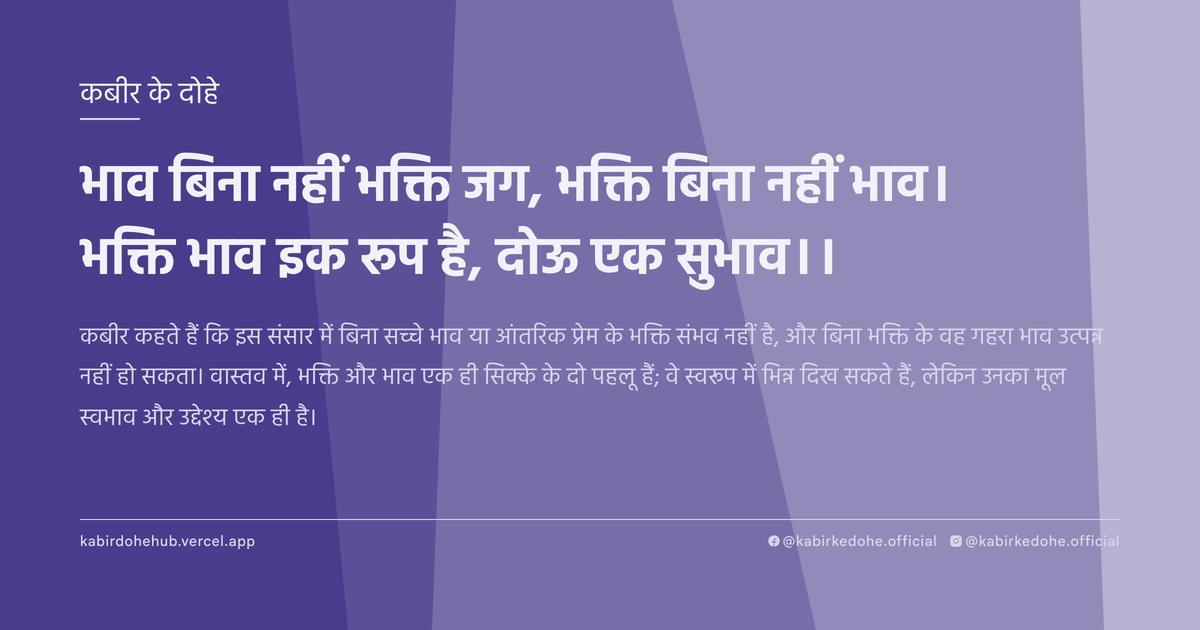
भाव बिना नहीं भक्ति जग, भक्ति बिना नहीं भाव।
भक्ति भाव इक रूप है, दोऊ एक सुभाव।।
Bhav bina nahi bhakti jag, bhakti bina nahi bhav. Bhakti bhav ik roop hai, dou ek subhav.
इस पृष्ठ पर इस कबीर दोहे का अर्थ (meaning), हिंदी व्याख्या और अंग्रेज़ी अनुवाद, दार्शनिक विश्लेषण और व्यावहारिक जीवन सीख दी गई है। यह दोहा भक्ति (Bhakti) विषय से जुड़ा है — Kabir doha meaning and explanation in Hindi and English.
अर्थ (Meaning):
कबीर कहते हैं कि इस संसार में बिना सच्चे भाव या आंतरिक प्रेम के भक्ति संभव नहीं है, और बिना भक्ति के वह गहरा भाव उत्पन्न नहीं हो सकता। वास्तव में, भक्ति और भाव एक ही सिक्के के दो पहलू हैं; वे स्वरूप में भिन्न दिख सकते हैं, लेकिन उनका मूल स्वभाव और उद्देश्य एक ही है।
Kabir asserts that in this world, devotion (Bhakti) is impossible without genuine emotion or inner longing (Bhav), and conversely, such profound longing cannot exist without the seed of devotion. In essence, Bhakti and Bhav are a single entity in two forms; though they appear distinct, their fundamental nature and essence are identical.
व्याख्या (Interpretation):
इस दोहे का शाब्दिक अर्थ है कि प्रेम और उपासना परस्पर निर्भर हैं। रूपकात्मक स्तर पर, 'भाव' वह आंतरिक बीज है और 'भक्ति' वह विकसित वृक्ष। निर्गुण भक्ति के संदर्भ में, यह दर्शाता है कि ईश्वर किसी बाहरी कर्मकांड से नहीं, बल्कि हृदय की तड़प से प्राप्त होते हैं। माया हमें यह विश्वास दिलाती है कि पूजा के बाहरी तरीके महत्वपूर्ण हैं, लेकिन कबीर यहाँ अद्वैत वेदांत की ओर इशारा कर रहे हैं जहाँ भक्त और भगवान का भेद मिट जाता है। जब भाव चरम पर होता है, तो वह भक्ति बन जाता है, और जब भक्ति गहरी होती है, तो वह शुद्ध भाव में विलीन हो जाती है। यह विरोधाभास यह समझाता है कि आध्यात्मिक यात्रा बाहरी यात्रा नहीं, बल्कि आंतरिक चेतना का रूपांतरण है। अंततः, यह आत्मा और परमात्मा के मिलन की एक ही प्रक्रिया है।
Literally, the couplet suggests that love and worship are interdependent. Metaphorically, 'Bhav' is the internal seed, and 'Bhakti' is the fully grown tree. In the context of Nirgun Bhakti, this indicates that the Divine is not attained through external rituals but through the intense longing of the heart. Maya creates the illusion that outward forms of worship are paramount, but Kabir points toward Advaita Vedanta, where the distinction between the devotee and the Divine dissolves. When emotion reaches its peak, it becomes devotion, and when devotion deepens, it merges back into pure emotion. This paradox explains that the spiritual journey is not an external pilgrimage but a transformation of inner consciousness. Ultimately, it is a single process of the Atman merging with Brahman.
दार्शनिक विश्लेषण (Philosophical Analysis):
कबीर का यह दर्शन उस समय के सामाजिक और धार्मिक परिवेश की प्रतिक्रिया था, जहाँ धर्म केवल कर्मकांडों, मूर्तियों और जातिगत श्रेष्ठता में सिमट गया था। उन्होंने 'भाव' पर जोर देकर धर्म को मंदिर और मस्जिद से निकालकर मनुष्य के हृदय में स्थापित किया। यह दृष्टिकोण सूफी मत के 'इश्क-ए-हकीकी' (ईश्वरीय प्रेम) से गहराई से मेल खाता है, जहाँ प्रेमी और प्रियतम के बीच का अंतर समाप्त हो जाता है।
अद्वैत वेदांत के नजरिए से, कबीर यहाँ यह समझा रहे हैं कि द्वैत (दो होने का भाव) केवल अज्ञानता के कारण है। जब हम कहते हैं कि 'मैं' भक्ति कर रहा हूँ, तो वहाँ अहंकार मौजूद है। लेकिन जब 'भाव' इतना प्रबल हो जाता है कि 'मैं' मिट जाता है, तब केवल भक्ति शेष रहती है। यह अहंकार का विसर्जन ही वास्तविक मोक्ष है।
कबीर ने ritualism (कर्मकांड) का विरोध किया क्योंकि वे जानते थे कि बिना भाव के किया गया जप केवल एक यांत्रिक क्रिया है। एक पंडित जो मंत्र पढ़ता है लेकिन उसके हृदय में करुणा नहीं है, वह उस अनपढ़ व्यक्ति से पीछे है जो ईश्वर को प्रेम करता है। यह सामाजिक समानता का एक आध्यात्मिक आधार प्रदान करता है, जहाँ पात्रता का पैमाना जाति नहीं, बल्कि हृदय की पवित्रता है।
मनोवैज्ञानिक स्तर पर, यह दोहा भावनात्मक बुद्धिमत्ता और आध्यात्मिक समर्पण के एकीकरण की बात करता है। जब मनुष्य अपनी भावनाओं को दबाने के बजाय उन्हें ईश्वरीय ऊर्जा में बदल देता है, तो वह मानसिक क्लेशों से मुक्त हो जाता है। यह 'भाव' ही है जो एक साधारण मनुष्य को संत बना देता है।
निष्कर्षतः, कबीर यह स्थापित करते हैं कि भक्ति कोई बाहरी आवरण नहीं है जिसे ओढ़ा जा सके, बल्कि यह एक आंतरिक अवस्था है। जो व्यक्ति अपने भीतर के प्रेम को पहचान लेता है, वह स्वतः ही उस निराकार ब्रह्म से जुड़ जाता है, क्योंकि प्रेम ही वह एकमात्र सेतु है जो सीमित मानव को असीमित परमात्मा से जोड़ता है।
Kabir's philosophy was a direct response to the socio-religious climate of his era, where religion had shrunk into mere rituals, idol worship, and caste superiority. By emphasizing 'Bhav' (inner emotion), he shifted the locus of spirituality from temples and mosques to the human heart. This perspective aligns deeply with the Sufi concept of 'Ishq-e-Haqiqi' (Divine Love), where the boundary between the lover and the Beloved vanishes.
From the lens of Advaita Vedanta, Kabir explains that duality exists only due to ignorance. When we claim 'I am practicing devotion,' the ego is still present. However, when 'Bhav' becomes so intense that the 'I' dissolves, only Bhakti remains. This annihilation of the ego is the true path to liberation (Moksha).
Kabir rejected ritualism because he recognized that chanting without emotion is merely a mechanical act. A scholar who recites mantras without compassion in the heart is inferior to an illiterate person who loves the Divine. This provides a spiritual foundation for social equality, where the criterion for eligibility is not caste, but the purity of the heart.
On a psychological level, this doha speaks to the integration of emotional intelligence and spiritual surrender. When a human transforms their raw emotions into divine energy instead of suppressing them, they are freed from mental turmoil. It is this 'Bhav' that transforms an ordinary person into a saint.
In conclusion, Kabir establishes that Bhakti is not an external garment to be worn, but an internal state of being. One who recognizes the love within themselves automatically connects with the formless Brahman, for love is the only bridge connecting the limited human to the limitless Divine.
मूल संदेश (Core Message):
- बाहरी आडंबर केवल भ्रम हैं, आंतरिक प्रेम ही सत्य है।
- बिना हृदय की तड़प के किया गया जप व्यर्थ है।
- भक्ति और भाव एक ही सत्य के दो अलग नाम हैं।
- अहंकार का विसर्जन ही वास्तविक उपासना की शुरुआत है।
- ईश्वर विधि में नहीं, बल्कि भक्त की भावना में बसते हैं।
- External rituals are mere illusions; inner love is the only truth.
- Chanting without the longing of the heart is futile.
- Bhakti and Bhav are two different names for the same truth.
- The dissolution of ego is the beginning of true worship.
- The Divine resides not in the method, but in the emotion of the devotee.
व्यावहारिक उदाहरण (Practical Example):
वाराणसी के घाटों पर रहने वाली एक वृद्ध विधवा, जानकी, का जीवन अत्यंत कठिन था। वह दूसरों के घरों में छोटे-मोटे काम करती और शाम को गंगा किनारे बैठकर घंटों मौन रहती। शहर के बड़े पंडित उसे अक्सर उपहास करते थे क्योंकि वह न तो कठिन मंत्र जानती थी और न ही महंगे अनुष्ठान कर सकती थी।
जानकी के पास देने के लिए कुछ नहीं था, सिवाय एक गहरे, अनकहे दर्द और उस दर्द से उपजे एक असीम प्रेम के। वह जब गंगा की लहरों को देखती, तो उसे उसमें अपना खोया हुआ सब कुछ और पूरा ब्रह्मांड नजर आता। उसकी प्रार्थनाओं में शब्द नहीं थे, केवल आँसू थे।
एक दिन, शहर का एक अहंकारी विद्वान, जो शास्त्रों का ज्ञाता था, जानकी के पास आया। उसने देखा कि जानकी की आँखों में एक ऐसी शांति और चमक थी जो उसने बड़े-बड़े तपस्वियों में भी नहीं देखी थी। उसने पूछा, 'तुम कौन से गुप्त मंत्र का जाप करती हो कि तुम्हें यह शांति प्राप्त है?'
जानकी ने सरलता से उत्तर दिया, 'बेटा, मैं मंत्र नहीं जानती। मैं बस उस निराकार को याद करती हूँ जैसे एक बच्चा अपनी माँ को याद करता है। मेरे पास कोई विधि नहीं है, बस एक तड़प है।'
विद्वान ने उसे चुनौती दी कि बिना विधि के भक्ति संभव नहीं है। उसने उसे शास्त्र सुनाए, नियमों की सूची दी और बताया कि कैसे सही तरीके से पूजा की जाती है। लेकिन जानकी बस मुस्कुराती रही।
कुछ समय बाद, उस विद्वान के जीवन में एक बड़ा संकट आया। उसकी सारी उपलब्धियाँ, उसका पद और उसका अहंकार एक झटके में बिखर गया। वह गहरे अवसाद में चला गया और उसके रटे-रटाए मंत्र उसे शांति देने में विफल रहे।
वह टूटकर जानकी के पास आया। उसने देखा कि जानकी अभी भी उसी सहजता से मुस्कुरा रही थी। उसने महसूस किया कि उसकी अपनी 'भक्ति' केवल एक बौद्धिक व्यायाम थी, जबकि जानकी की 'भक्ति' उसके 'भाव' का विस्तार थी।
जानकी ने उसका हाथ थामा और कहा, 'जब तक तुम यह सोचोगे कि तुम पूजा कर रहे हो, तब तक तुम दूर रहोगे। जिस दिन तुम यह भूल जाओगे कि तुम कौन हो और केवल प्रेम बचेगा, उस दिन तुम उसे पा लोगे।'
उस क्षण विद्वान का अहंकार टूट गया। उसने पहली बार महसूस किया कि वह अब तक केवल शब्दों की पूजा कर रहा था, भाव की नहीं। उसने अपनी किताबों को किनारे रखा और जानकी के मौन में डूब गया।
यह 'कबीर ट्विस्ट' था—जहाँ एक शास्त्र-ज्ञानी ने जाना कि ज्ञान तब तक बोझ है जब तक वह प्रेम में परिवर्तित न हो जाए। विद्वान ने अपना जीवन दूसरों की सेवा में लगा दिया, और उसकी भक्ति अब यांत्रिक नहीं, बल्कि भावपूर्ण हो गई।
Janki, an elderly widow living on the ghats of Varanasi, led a life of extreme hardship. She did odd jobs in various households and spent her evenings in profound silence by the Ganges. The city's prominent priests often mocked her because she knew neither complex mantras nor could she afford expensive rituals.
Janki had nothing to offer except a deep, unspoken pain and an infinite love born from that very suffering. When she looked at the ripples of the Ganges, she saw within them everything she had lost and the entire universe. Her prayers contained no words, only tears.
One day, an arrogant scholar, a master of the scriptures, approached Janki. He noticed a peace and radiance in her eyes that he had never seen even in the most renowned ascetics. He asked, 'Which secret mantra do you chant to achieve such tranquility?'
Janki replied simply, 'Son, I know no mantras. I simply remember the Formless One as a child remembers its mother. I have no method, only a longing.'
The scholar challenged her, claiming that devotion without method is impossible. He recited scriptures, gave her lists of rules, and explained the 'correct' way to worship. Janki only smiled.
After some time, a great crisis struck the scholar's life. His achievements, his status, and his ego shattered in an instant. He fell into a deep depression, and his rote-memorized mantras failed to bring him peace.
Broken, he returned to Janki. He saw that she was still smiling with the same effortless grace. He realized that his own 'devotion' had been merely an intellectual exercise, while Janki's 'devotion' was an extension of her 'Bhav' (emotion).
Janki took his hand and said, 'As long as you think that *you* are worshipping, you will remain distant. The day you forget who you are and only love remains, that day you will find Him.'
In that moment, the scholar's ego collapsed. He realized he had been worshipping words, not the essence. He set aside his books and immersed himself in Janki's silence.
This was the 'Kabir Twist'—where a master of scriptures realized that knowledge is a burden until it is transformed into love. The scholar dedicated his life to serving others, and his devotion ceased to be mechanical and became heartfelt.
अभ्यास मार्गदर्शन (Practice Guidance):
- दैनिक चिंतन: प्रतिदिन 15 मिनट मौन बैठें और अपने भीतर उठने वाले प्रेम, करुणा या विरह के भावों को बिना किसी निर्णय के केवल महसूस करें।
- आत्म-पूछताछ जर्नल: लिखें कि आपकी प्रार्थनाएँ या कार्य केवल सामाजिक दिखावा (Ritual) हैं या उनके पीछे वास्तव में कोई गहरा भावनात्मक जुड़ाव (Bhav) है।
- व्यवहारिक परिवर्तन: किसी ऐसे व्यक्ति की निस्वार्थ मदद करें जिससे आपका कोई संबंध न हो, और देखें कि क्या आप इसे 'पुण्य' कमाने के लिए कर रहे हैं या शुद्ध प्रेम के भाव से।
- निदान चेकलिस्ट: यदि आप पूजा के बाद भी क्रोधित महसूस करते हैं या दूसरों को छोटा समझते हैं, तो आपकी भक्ति केवल 'विधि' है, 'भाव' नहीं। यदि शांति और विनम्रता बढ़ रही है, तो आप सही मार्ग पर हैं।
- Daily Contemplation: Sit in silence for 15 minutes daily and simply feel the emotions of love, compassion, or longing arising within you without any judgment.
- Self-Inquiry Journal: Write down whether your prayers or spiritual acts are merely social performances (Rituals) or if there is a genuine emotional connection (Bhav) behind them.
- Behavioral Change: Help someone selflessly who has no connection to you, and observe whether you are doing it to earn 'merit' or out of pure love.
- Diagnostic Checklist: If you still feel anger or a sense of superiority over others after your prayers, your devotion is merely 'Method,' not 'Bhav.' If peace and humility are increasing, you are on the right path.
चिंतन प्रश्न (Reflection Questions):
- क्या मेरी धार्मिक पहचान मेरे वास्तविक प्रेम से बड़ी हो गई है?
- यदि मुझसे मेरे सभी धार्मिक प्रतीक (माला, तिलक, मंदिर) छीन लिए जाएं, तो क्या मेरा ईश्वर से संबंध बचेगा?
- मैं दूसरों के सामने जो 'भक्त' दिखता हूँ, क्या वह मेरी आंतरिक सच्चाई है या एक निर्मित छवि?
- क्या मैं ईश्वर को पाने की कोशिश कर रहा हूँ, या मैं वास्तव में ईश्वर बनने (प्रेममय होने) का प्रयास कर रहा हूँ?
- मेरे जीवन का कौन सा दुख मुझे सबसे अधिक विनम्र बनाता है, और क्या मैं उस दुख को 'भाव' में बदल सकता हूँ?
- Has my religious identity become larger than my actual capacity to love?
- If all my religious symbols (beads, marks, temples) were taken away, would my connection to the Divine remain?
- The 'devotee' I present to the world—is that my internal truth or a constructed image?
- Am I trying to 'attain' God, or am I actually attempting to 'become' God (to become Love)?
- Which sorrow in my life makes me the most humble, and can I transform that pain into 'Bhav'?