
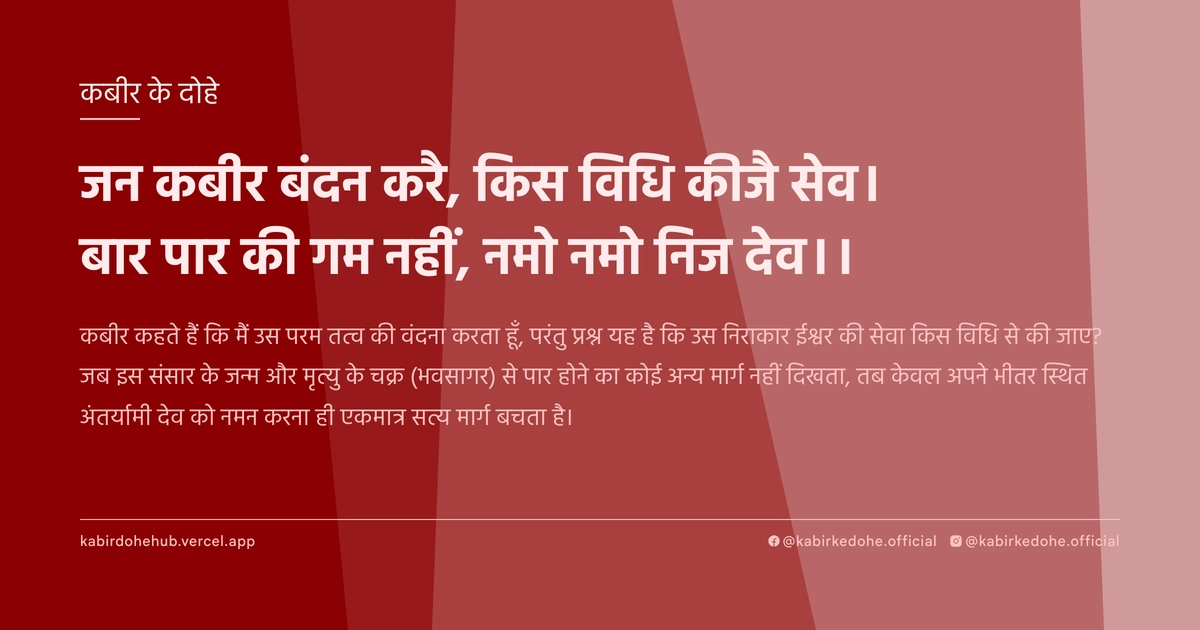
जन कबीर बंदन करै, किस विधि कीजै सेव।
बार पार की गम नहीं, नमो नमो निज देव।।
Jan Kabir bandan karai, kis vidhi keejai sev. Baar paar ki gam nahi, namo namo nij dev.
इस पृष्ठ पर इस कबीर दोहे का अर्थ (meaning), हिंदी व्याख्या और अंग्रेज़ी अनुवाद, दार्शनिक विश्लेषण और व्यावहारिक जीवन सीख दी गई है। यह दोहा अंतर ज्योति (The Inner Light) विषय से जुड़ा है — Kabir doha meaning and explanation in Hindi and English.
अर्थ (Meaning):
कबीर कहते हैं कि मैं उस परम तत्व की वंदना करता हूँ, परंतु प्रश्न यह है कि उस निराकार ईश्वर की सेवा किस विधि से की जाए? जब इस संसार के जन्म और मृत्यु के चक्र (भवसागर) से पार होने का कोई अन्य मार्ग नहीं दिखता, तब केवल अपने भीतर स्थित अंतर्यामी देव को नमन करना ही एकमात्र सत्य मार्ग बचता है।
Kabir expresses his deep reverence for the Divine, yet questions the method of serving a formless entity. He realizes that since there is no other way to cross the turbulent ocean of worldly existence and repetitive births, the only true sanctuary is to bow before the Divine Presence residing within one's own soul.
व्याख्या (Interpretation):
यह दोहा बाहरी कर्मकांडों और मूर्ति पूजा की निरर्थकता को दर्शाता है। कबीर पहले एक विरोधाभास प्रस्तुत करते हैं—'किस विधि कीजै सेव'—क्योंकि जिसे देखा नहीं जा सकता, उसकी सेवा पारंपरिक तरीकों से संभव नहीं है। यहाँ 'बार पार' का अर्थ संसार के दुखों और पुनर्जन्म के चक्र से है। जब साधक यह समझ जाता है कि बाहरी तीर्थ या अनुष्ठान उसे मुक्ति नहीं दिला सकते, तब वह 'निज देव' यानी अपने भीतर के आत्म-तत्व की ओर मुड़ता है। यह निर्गुण भक्ति का सार है जहाँ भक्त और भगवान के बीच का द्वैत समाप्त हो जाता है। यह अद्वैत वेदांत के उस सत्य की पुष्टि करता है जहाँ आत्मा और ब्रह्म एक ही हैं। माया के पर्दे हटने पर केवल आंतरिक समर्पण ही शेष रहता है।
This couplet highlights the futility of external rituals and idol worship. Kabir presents a paradox—'by what method shall I serve'—because a formless entity cannot be served through traditional, physical means. 'Baar paar' refers to the cycle of birth, death, and the suffering of the material world. Once the seeker realizes that external pilgrimages or rites cannot grant liberation, they turn toward the 'Nij Dev' or the Inner Deity. This is the essence of Nirgun Bhakti, where the duality between the devotee and the Divine dissolves. It affirms the Advaita Vedanta truth that Atman and Brahman are one. When the veil of Maya is lifted, only internal surrender remains as the ultimate truth.
दार्शनिक विश्लेषण (Philosophical Analysis):
कबीर का यह दृष्टिकोण उनके युग के सामाजिक और धार्मिक पाखंडों के विरुद्ध एक सशक्त प्रहार था। उस समय धर्म केवल बाहरी दिखावे, जातिगत श्रेष्ठता और जटिल अनुष्ठानों तक सीमित हो गया था। कबीर ने इस व्यवस्था को चुनौती देते हुए यह प्रतिपादित किया कि ईश्वर किसी मंदिर, मस्जिद या विशेष विधि में नहीं, बल्कि मनुष्य के अपने हृदय में स्थित है। यह विचार सूफी मत के 'वहदत-अल-वजूद' (अस्तित्व की एकता) से मेल खाता है, जहाँ खुदा को इंसान के भीतर खोजा जाता है।
दार्शनिक स्तर पर, यह दोहा 'अहंकार' के विसर्जन की बात करता है। जब कबीर 'किस विधि' पूछते हैं, तो वे वास्तव में उस बौद्धिक अहंकार को चुनौती दे रहे होते हैं जो सोचता है कि वह ईश्वर को किसी तकनीक या नियम से नियंत्रित या प्राप्त कर सकता है। यह एक मनोवैज्ञानिक रूपांतरण है जहाँ साधक 'कर्ता' होने का भ्रम त्याग कर केवल 'साक्षी' बन जाता है।
अद्वैत वेदांत के अनुसार, अज्ञान (अविद्या) ही वह पर्दा है जो हमें हमारे वास्तविक स्वरूप से अलग करता है। कबीर यहाँ उस अविद्या को नष्ट करने का आह्वान कर रहे हैं। वे कहते हैं कि जब तक आप बाहर खोजेंगे, आप केवल भ्रम पाएंगे। मुक्ति का मार्ग 'बाहर' से 'भीतर' की यात्रा है।
यह दोहा कर्मकांडीय धर्म (Ritualistic Religion) और आध्यात्मिक अनुभव (Spiritual Experience) के बीच के अंतर को स्पष्ट करता है। सेवा का अर्थ यहाँ शारीरिक सेवा नहीं, बल्कि चेतना का शुद्धिकरण है। जब मन शांत और अहंकार शून्य होता है, तब 'निज देव' का साक्षात्कार स्वतः हो जाता है।
अंततः, कबीर यह संदेश देते हैं कि ईश्वर कोई बाहरी वस्तु नहीं जिसे प्राप्त किया जाए, बल्कि वह हमारी मूल प्रकृति है। इस सत्य को स्वीकार करना ही सबसे बड़ी वंदना है। यह मनुष्य को जाति, धर्म और संप्रदाय की संकीर्ण सीमाओं से मुक्त कर उसे सार्वभौमिक चेतना से जोड़ता है।
Kabir's perspective was a powerful strike against the social and religious hypocrisies of his era. At that time, religion had become confined to external displays, caste superiority, and complex rituals. Challenging this system, Kabir postulated that God does not reside in a temple, mosque, or specific ritual, but within the human heart. This idea aligns with the Sufi concept of 'Wahdat-al-Wujud' (Unity of Existence), where the Divine is sought within the self.
On a philosophical level, this doha speaks of the dissolution of the 'Ego'. When Kabir asks 'by what method', he is actually challenging the intellectual arrogance that believes God can be controlled or attained through a specific technique or rule. This is a psychological transformation where the seeker ceases to be the 'doer' and becomes the 'witness'.
According to Advaita Vedanta, ignorance (Avidya) is the veil that separates us from our true nature. Kabir calls for the destruction of this ignorance. He suggests that as long as one searches externally, they will find only illusions. The path to liberation is the journey from the 'outside' to the 'inside'.
This couplet clarifies the distinction between ritualistic religion and spiritual experience. 'Service' here does not mean physical labor, but the purification of consciousness. When the mind is still and the ego is void, the realization of the 'Inner Deity' happens spontaneously.
Ultimately, Kabir conveys that God is not an external object to be acquired, but our fundamental nature. Accepting this truth is the highest form of worship. This liberates humans from the narrow confines of caste, religion, and sect, connecting them to the universal consciousness.
मूल संदेश (Core Message):
- बाहरी कर्मकांड केवल मन का भ्रम हैं, सत्य भीतर है।
- ईश्वर की खोज बाहर नहीं, आत्म-साक्षात्कार में है।
- अहंकार का विसर्जन ही वास्तविक वंदना है।
- संसार से पार होने का मार्ग आंतरिक मौन है।
- आत्मा और परमात्मा का अद्वैत ही अंतिम सत्य है।
- External rituals are mere illusions of the mind; truth lies within.
- The search for God is not outward, but in self-realization.
- The dissolution of ego is the only true worship.
- The path to crossing the worldly ocean is internal silence.
- The non-duality of Atman and Brahman is the ultimate truth.
व्यावहारिक उदाहरण (Practical Example):
एक समय की बात है, वाराणसी के घाटों पर माधव नाम का एक वृद्ध बुनकर रहता था। माधव जीवन भर बहुत धार्मिक था; वह हर दिन घंटों पूजा करता, कठिन व्रत रखता और शहर के सबसे बड़े पंडितों से सलाह लेता था कि मोक्ष कैसे प्राप्त किया जाए। वह अपनी पूरी संपत्ति दान कर चुका था और अब केवल इस उम्मीद में जी रहा था कि उसकी बाहरी भक्ति उसे जन्म-मृत्यु के चक्र से पार ले जाएगी।
एक दिन माधव की मुलाकात एक फकीर से हुई जो घाट की सीढ़ियों पर चुपचाप बैठा था। माधव ने गर्व से अपनी लंबी तपस्या और अनुष्ठानों की सूची सुनाई और पूछा, "महात्मन, क्या मैं अब मुक्ति के करीब हूँ?" फकीर ने मुस्कुराते हुए पूछा, "तुमने जिस ईश्वर की सेवा की, क्या तुमने कभी उसे अपने भीतर देखा, या केवल पत्थरों और किताबों में खोजा?"
माधव हतप्रभ रह गया। उसने कभी इस तरह नहीं सोचा था। उसने हमेशा माना था कि ईश्वर ऊपर कहीं है और उसे प्रसन्न करने के लिए विशेष विधियों की आवश्यकता है। फकीर ने उसे अपनी आँखें बंद करने और केवल अपनी सांसों के प्रति जागरूक होने को कहा।
शुरुआत में माधव को बहुत बेचैनी हुई। उसे लगा कि वह समय बर्बाद कर रहा है। लेकिन जैसे-जैसे वह शांत हुआ, उसे महसूस हुआ कि उसके भीतर एक गहरा सन्नाटा है, और उस सन्नाटे में एक ऐसी शांति थी जो उसने किसी मंदिर की आरती में नहीं पाई थी।
उसे अचानक एहसास हुआ कि वह जिस 'देव' को बाहर ढूंढ रहा था, वह वास्तव में उसके अपने अस्तित्व का सबसे शुद्ध हिस्सा था। वह जिसे 'सेवा' समझ रहा था, वह वास्तव में उसकी अपनी पहचान को बाहरी नियमों में कैद करने का प्रयास था।
इस बोध ने माधव के जीवन को बदल दिया। उसने कठिन व्रतों और दिखावे की पूजा को त्याग दिया। अब वह अपना काम (बुनाई) पूरी जागरूकता के साथ करता था, जैसे कि वह ईश्वर के लिए कपड़ा बुन रहा हो।
उसका व्यवहार बदल गया। वह अब दूसरों को उनके धर्म के आधार पर नहीं, बल्कि उनके भीतर की दिव्यता के आधार पर देखने लगा। उसकी शांति अब उसके चेहरे पर झलकती थी, जो किसी भी बाहरी अनुष्ठान से अधिक प्रभावशाली थी।
माधव ने समझ लिया कि 'बार पार' होने का अर्थ कहीं और जाना नहीं, बल्कि यहीं रहकर अपने वास्तविक स्वरूप को पहचान लेना है। उसने अपनी वंदना को बाहरी शोर से हटाकर आंतरिक मौन में बदल दिया।
Once, in the ghats of Varanasi, lived an elderly weaver named Madhav. Madhav had been deeply religious all his life; he spent hours in prayer, observed rigorous fasts, and consulted the city's greatest pundits on how to attain Moksha. He had donated most of his wealth and lived in the hope that his external devotion would carry him across the cycle of birth and death.
One day, Madhav met a fakir sitting silently on the steps of the ghat. Madhav proudly listed his long penances and rituals and asked, "O Great Soul, am I now close to liberation?" The fakir smiled and asked, "The God you served, did you ever see Him within yourself, or did you only search for Him in stones and books?"
Madhav was stunned. He had never thought of it this way. He had always believed that God was somewhere above and required specific methods to be pleased. The fakir asked him to close his eyes and simply become aware of his breath.
Initially, Madhav felt restless. He felt he was wasting time. But as he grew still, he felt a profound silence within him, and in that silence was a peace he had never found in any temple's aarti.
He suddenly realized that the 'Deity' he was searching for outside was actually the purest part of his own existence. What he had mistaken for 'service' was actually an attempt to imprison his identity within external rules.
This realization transformed Madhav's life. He abandoned the rigorous fasts and ostentatious worship. He now performed his work (weaving) with total awareness, as if he were weaving cloth for the Divine.
His behavior changed. He no longer saw others based on their religion, but based on the divinity within them. His peace now radiated from his face, more powerful than any external ritual.
Madhav understood that 'crossing over' did not mean going somewhere else, but recognizing one's true nature right here. He shifted his worship from external noise to internal silence.
अभ्यास मार्गदर्शन (Practice Guidance):
- प्रतिदिन 20 मिनट 'साक्षी भाव' का अभ्यास करें: अपनी सांसों और विचारों को बिना किसी निर्णय के केवल देखें, यह महसूस करते हुए कि आप शरीर या मन नहीं, बल्कि वह चेतना हैं जो इन्हें देख रही है।
- आत्म-पूछताछ जर्नल: प्रतिदिन एक प्रश्न लिखें—"आज मैंने किस बाहरी पहचान (पद, धर्म, अहंकार) को सत्य मान लिया?" और फिर विश्लेषण करें कि वह पहचान आपके वास्तविक स्वरूप से कितनी अलग है।
- व्यवहारिक परिवर्तन: जब भी आप किसी दूसरे व्यक्ति की सेवा करें, तो यह भाव रखें कि आप अपने ही भीतर के 'निज देव' की सेवा कर रहे हैं। इससे सेवा में अहंकार समाप्त होगा और करुणा बढ़ेगी।
- डायग्नोस्टिक चेकलिस्ट: यदि आप अभी भी दूसरों के साथ तुलना कर रहे हैं, बाहरी प्रशंसा के भूखे हैं, या ईश्वर को केवल डर या लालच के माध्यम से पा रहे हैं, तो आप अभी भी 'बाहरी विधि' में फंसे हैं। यदि आप मौन में सहज हैं, तो आप सही दिशा में हैं।
- Practice 'Witness Consciousness' for 20 minutes daily: Observe your breath and thoughts without judgment, realizing that you are not the body or mind, but the consciousness observing them.
- Self-Inquiry Journal: Write one question daily—"Which external identity (status, religion, ego) did I mistake for truth today?" and analyze how that identity differs from your true nature.
- Behavioral Shift: Whenever you serve another person, hold the intention that you are serving the 'Inner Deity' within them. This removes ego from service and increases genuine compassion.
- Diagnostic Checklist: If you are still comparing yourself to others, craving external validation, or seeking God through fear or greed, you are still trapped in 'external methods'. If you are comfortable in silence, you are moving in the right direction.
चिंतन प्रश्न (Reflection Questions):
- यदि आपके पास आपका नाम, धर्म और सामाजिक पद न हो, तो आप वास्तव में कौन हैं?
- क्या आपकी आध्यात्मिक साधना आपको विनम्र बना रही है, या यह आपके अहंकार को एक 'धार्मिक' मुखौटा दे रही है?
- आप जिस 'परमात्मा' की कल्पना करते हैं, क्या वह आपकी अपनी इच्छाओं का प्रतिबिंब है या एक शुद्ध सत्य?
- आपकी डिजिटल पहचान (Social Media Ego) आपके वास्तविक आंतरिक स्वरूप को कितना ढक चुकी है?
- क्या आप वास्तव में ईश्वर की सेवा करना चाहते हैं, या आप केवल अपनी समस्याओं का समाधान चाहते हैं?
- मौन में रहने पर आपको जो डर महसूस होता है, वह वास्तव में किसका डर है—ईश्वर का या अपने स्वयं के खालीपन का?
- If you had no name, religion, or social status, who would you actually be?
- Is your spiritual practice making you humble, or is it giving your ego a 'religious' mask?
- Is the 'Divine' you imagine a reflection of your own desires or a pure truth?
- How much has your digital identity (Social Media Ego) obscured your true internal nature?
- Do you truly wish to serve the Divine, or are you merely seeking solutions to your own problems?
- The fear you feel when in total silence—whose fear is it actually: God's or your own emptiness?