
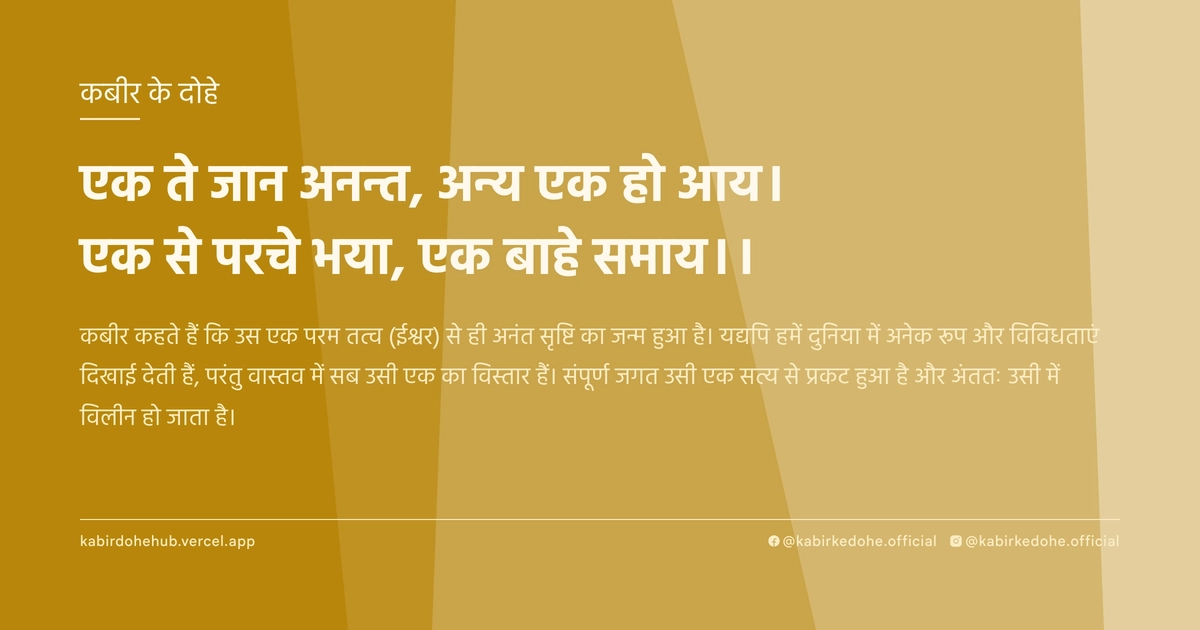
एक ते जान अनन्त, अन्य एक हो आय।
एक से परचे भया, एक बाहे समाय।।
Ek te jaan anant, anya ek ho aaye. Ek se parche bhaya, ek baahe samaye.
इस पृष्ठ पर इस कबीर दोहे का अर्थ (meaning), हिंदी व्याख्या और अंग्रेज़ी अनुवाद, दार्शनिक विश्लेषण और व्यावहारिक जीवन सीख दी गई है। यह दोहा निर्गुण ब्रह्म (Nirguna Brahman) विषय से जुड़ा है — Kabir doha meaning and explanation in Hindi and English.
अर्थ (Meaning):
कबीर कहते हैं कि उस एक परम तत्व (ईश्वर) से ही अनंत सृष्टि का जन्म हुआ है। यद्यपि हमें दुनिया में अनेक रूप और विविधताएं दिखाई देती हैं, परंतु वास्तव में सब उसी एक का विस्तार हैं। संपूर्ण जगत उसी एक सत्य से प्रकट हुआ है और अंततः उसी में विलीन हो जाता है।
Kabir asserts that from the One Absolute Truth, the infinite universe has emerged. Though we perceive a multitude of forms and diversities in the world, they are merely extensions of that single Essence. Everything manifests from the One and eventually merges back into that same singular Reality.
व्याख्या (Interpretation):
इस दोहे का शाब्दिक अर्थ है कि एक से अनंत की उत्पत्ति हुई। आध्यात्मिक स्तर पर, यह 'अद्वैत' की स्थिति है जहाँ केवल एक ही चेतना विद्यमान है। 'परचे' का अर्थ है प्रकटीकरण; जैसे सोने से बने विभिन्न आभूषण अंततः सोना ही होते हैं, वैसे ही यह संसार उस निराकार ब्रह्म का साकार खेल है। माया हमें विविधता दिखाती है, जिससे हम स्वयं को अलग महसूस करते हैं, लेकिन यह अलगाव एक भ्रम है। जब साधक अपनी सीमित पहचान (अहंकार) को मिटाता है, तो वह अनुभव करता है कि वह और ब्रह्मांड अलग नहीं हैं। यह विरोधाभास है कि जो एक है, वही अनेक बनकर फिर से एक में समा जाता है।
Literally, the verse speaks of the infinite arising from the One. Spiritually, this describes the state of 'Advaita' or non-duality, where only one consciousness exists. The term 'parche' refers to manifestation; just as various ornaments made of gold are fundamentally gold, the universe is the tangible play of the formless Brahman. Maya creates the illusion of diversity, making us feel separate, but this separation is a veil. When a seeker dissolves their limited identity (ego), they realize that they and the cosmos are not distinct. It is the ultimate paradox: the One becomes many, only to eventually merge back into the One.
दार्शनिक विश्लेषण (Philosophical Analysis):
कबीर का यह दर्शन निर्गुण भक्ति और सूफीवाद के 'वहदत-अल-वजूद' (अस्तित्व की एकता) का संगम है। उन्होंने अपने समय के धार्मिक कट्टरवाद और कर्मकांडों को चुनौती दी, जहाँ ईश्वर को केवल मंदिर या मस्जिद में सीमित माना जाता था। कबीर के लिए, ईश्वर किसी विशेष धर्म या मूर्ति में नहीं, बल्कि अस्तित्व के कण-कण में व्याप्त है।
यह विचार अद्वैत वेदांत के करीब है, जो कहता है कि 'ब्रह्म सत्यं जगन्मिथ्या'—केवल ब्रह्म सत्य है और जगत माया है। यहाँ 'माया' का अर्थ यह नहीं कि दुनिया अस्तित्वहीन है, बल्कि यह कि दुनिया वैसी नहीं है जैसी वह दिखती है। हम रूपों को देखते हैं, सत्य को नहीं।
सूफी मत के प्रभाव में, कबीर प्रेम और विरह के माध्यम से इस एकता तक पहुँचने की बात करते हैं। उनके अनुसार, आत्मा का परमात्मा से अलग होना एक त्रासदी है, और इस अलगाव को मिटाना ही जीवन का उद्देश्य है।
मनोवैज्ञानिक स्तर पर, यह दोहा अहंकार के विसर्जन की बात करता है। जब तक 'मैं' और 'तू' का भेद रहता है, तब तक द्वंद्व और संघर्ष बना रहता है। जैसे ही यह भेद मिटता है, करुणा और सार्वभौमिक प्रेम का जन्म होता है।
कबीर इस सत्य को सरल भाषा में समझाकर यह संदेश देते हैं कि मोक्ष किसी कठिन अनुष्ठान में नहीं, बल्कि इस बोध में है कि हम सब एक ही स्रोत की धाराएं हैं। यह ज्ञान व्यक्ति को जाति, वर्ण और संप्रदाय के संकीर्ण बंधनों से मुक्त करता है।
Kabir's philosophy here is a confluence of Nirgun Bhakti and the Sufi concept of 'Wahdat-al-Wujud' (the Unity of Existence). He challenged the religious orthodoxy of his era, which confined the Divine to temples or mosques. For Kabir, God is not found in a specific religion or idol but permeates every atom of existence.
This perspective aligns closely with Advaita Vedanta, which posits 'Brahman Satyam Jagan Mithya'—Brahman is the only truth, and the world is an illusion. Here, 'Maya' does not imply that the world is non-existent, but rather that it is not as it appears. We perceive the forms, not the underlying Truth.
Influenced by Sufism, Kabir speaks of reaching this unity through love and longing. According to him, the separation of the soul from the Divine is a tragedy, and the purpose of life is to bridge this gap.
On a psychological level, this verse addresses the dissolution of the ego. As long as the distinction between 'I' and 'Thou' persists, conflict and duality remain. Once this boundary vanishes, universal compassion and love are born.
By explaining this truth in simple language, Kabir suggests that liberation is not found in complex rituals but in the realization that we are all streams from the same source. This insight frees the individual from the narrow shackles of caste, creed, and sect.
मूल संदेश (Core Message):
- विविधता केवल एक बाहरी आवरण है, सत्य केवल एकता है।
- अहंकार वह पर्दा है जो हमें एक-दूसरे से अलग करता है।
- सृष्टि का हर कण उसी एक अनंत चेतना का प्रतिबिंब है।
- द्वैत का त्याग ही वास्तविक आध्यात्मिक जागृति है।
- जब 'मैं' मिटता है, तब केवल 'वह' शेष रहता है।
- Diversity is but an outer shell; Truth is only Unity.
- The ego is the veil that separates us from one another.
- Every particle of creation is a reflection of that one infinite consciousness.
- Renouncing duality is the essence of true spiritual awakening.
- When the 'I' dissolves, only the 'One' remains.
व्यावहारिक उदाहरण (Practical Example):
वाराणसी के एक पुराने घाट पर माधव नाम का एक वृद्ध बुनकर रहता था। वह अपनी पूरी जिंदगी रेशमी साड़ियों के धागों को अलग-अलग रंगों में रंगने और उन्हें जोड़ने में बिता चुका था। माधव स्वभाव से बहुत क्रोधी था और अपने पड़ोसियों को तुच्छ समझता था, क्योंकि वह खुद को एक कुशल कलाकार मानता था।
एक दिन, वह घाट पर बैठा एक छोटे बच्चे को मिट्टी के घरौंदे बनाते देख रहा था। बच्चा अलग-अलग रंगों की मिट्टी से घर बना रहा था, लेकिन जैसे ही बारिश हुई, सारी आकृतियाँ मिट गईं और केवल एक भूरा कीचड़ रह गया।
माधव ने देखा कि जिस मिट्टी से सुंदर महल बना था और जिस मिट्टी से गंदी नाली बनी थी, अंत में दोनों एक ही रंग और रूप में मिल गए। उसे अचानक कबीर का यह दोहा याद आया कि सब कुछ एक ही स्रोत से आया है और उसी में समा जाना है।
उसे महसूस हुआ कि उसकी रेशमी साड़ियों के अलग-अलग रंग केवल बाहरी दिखावा हैं; धागा तो वही एक है। उसने सोचा कि यदि मिट्टी अंत में एक हो जाती है, तो वह अपने पड़ोसियों से नफरत क्यों करता है? क्या वे सब उसी एक चेतना के अलग-अलग रंग नहीं हैं?
उस रात माधव की नींद उड़ गई। उसने अपनी पूरी जिंदगी की उपलब्धियों को देखा और पाया कि उसका 'अहंकार' ही वह पर्दा था जिसने उसे दूसरों से अलग किया था। उसने महसूस किया कि वह जिसे 'दूसरा' समझ रहा था, वह वास्तव में उसका ही एक विस्तार था।
अगली सुबह, माधव ने अपने उस पड़ोसी की मदद की जिससे उसकी सालों से बात नहीं हुई थी। उसने अपनी सबसे महंगी साड़ी उस पड़ोसी की बेटी की शादी के लिए भेंट कर दी, जिसे वह अब तक अपना प्रतिद्वंद्वी मानता था।
उसके चेहरे पर एक ऐसी शांति थी जो उसने कभी नहीं अनुभव की थी। उसने पाया कि जब उसने 'मैं' और 'वह' का भेद मिटाया, तो उसका आंतरिक संघर्ष समाप्त हो गया।
माधव अब केवल कपड़े नहीं बुनता था, बल्कि वह लोगों के दिलों को जोड़ने का प्रयास करता था। वह समझ गया था कि विविधता केवल एक खेल है, और सत्य केवल एकता है।
On an ancient ghat in Varanasi lived an elderly weaver named Madhav. He had spent his entire life dyeing silk threads in various colors and weaving them together. Madhav was naturally irritable and looked down upon his neighbors, believing his skill as an artist made him superior.
One day, while sitting by the river, he watched a small child building houses out of mud. The child used different colored clays to create elaborate structures, but as soon as the rain fell, all the shapes vanished, leaving behind only a single, brown sludge.
Madhav noticed that the mud used to build the beautiful palace and the mud that formed the dirty drain had eventually merged into the same color and form. Suddenly, Kabir's verse resonated in his mind: everything originates from One and merges back into One.
He realized that the different colors of his silk sarees were merely outward appearances; the thread remained the same. He wondered why he hated his neighbors if all of existence was just different colors of the same consciousness.
That night, Madhav could not sleep. He reviewed his life's achievements and realized that his 'ego' was the veil that had separated him from others. He understood that those he considered 'others' were actually extensions of himself.
The next morning, Madhav helped the neighbor with whom he hadn't spoken for years. He gifted his most expensive saree for the wedding of that neighbor's daughter, whom he had previously viewed as a rival.
A peace settled over him that he had never experienced before. He discovered that once the distinction between 'I' and 'Thou' vanished, his internal conflict ceased.
Madhav no longer just wove fabric; he sought to weave hearts together. He understood that diversity is but a play, and the only truth is unity.
अभ्यास मार्गदर्शन (Practice Guidance):
- प्रतिदिन 20 मिनट मौन ध्यान करें, जहाँ आप अपने विचारों को केवल 'एक' ऊर्जा के प्रवाह के रूप में देखें, बिना किसी निर्णय के।
- एक डायरी लिखें जिसमें उन लोगों की सूची बनाएं जिनसे आप घृणा करते हैं, और फिर उनके भीतर उसी दैवीय अंश को खोजने का प्रयास करें जो आपके भीतर है।
- व्यवहार परिवर्तन: जब भी किसी अजनबी से मिलें, मन में यह भाव लाएं कि 'यह मेरा ही एक रूप है'।
- निदान चेकलिस्ट: क्या मैं अभी भी लोगों को उनकी जाति, धर्म या पद से पहचान रहा हूँ? क्या मैं अपनी सफलता का श्रेय केवल स्वयं को दे रहा हूँ? यदि हाँ, तो मैं अभी भी 'अनेक' के भ्रम में हूँ।
- Practice 20 minutes of silent meditation daily, observing your thoughts simply as a flow of 'one' energy, without judgment.
- Keep a journal listing people you feel resentment toward, and consciously attempt to find the same divine spark in them that exists within you.
- Behavioral Shift: Whenever you meet a stranger, internally affirm, 'This is another form of myself.'
- Diagnostic Checklist: Am I still identifying people by their caste, religion, or status? Do I attribute my success solely to my own effort? If yes, I am still trapped in the illusion of 'many'.
चिंतन प्रश्न (Reflection Questions):
- मेरी वह कौन सी पहचान है (पद, धर्म, नाम) जिसे मैं सबसे अधिक पकड़ कर रखता हूँ, और यदि वह छिन जाए तो क्या मैं शून्य महसूस करूँगा?
- मैं जिन लोगों को अपना शत्रु मानता हूँ, क्या मैं उनके दुखों में अपनी ही पीड़ा देख पा रहा हूँ?
- क्या मेरा 'परोपकार' वास्तव में दूसरों की मदद है, या यह मेरे अहंकार को संतुष्ट करने का एक तरीका है?
- डिजिटल युग में, मैं अपनी छवि (Image) को सत्य मान रहा हूँ या अपने आंतरिक मौन को?
- यदि पूरा ब्रह्मांड एक ही चेतना है, तो मैं अपनी व्यक्तिगत समस्याओं को इतना बड़ा क्यों मानता हूँ?
- Which identity (status, religion, name) do I cling to most, and if it were stripped away, would I feel like a void?
- In those I perceive as enemies, can I see my own suffering reflected in theirs?
- Is my 'philanthropy' truly helping others, or is it a method to satisfy my own ego?
- In the digital age, am I mistaking my curated image for my true self, or am I attuned to my inner silence?
- If the entire universe is one consciousness, why do I perceive my personal problems as so monumental?