
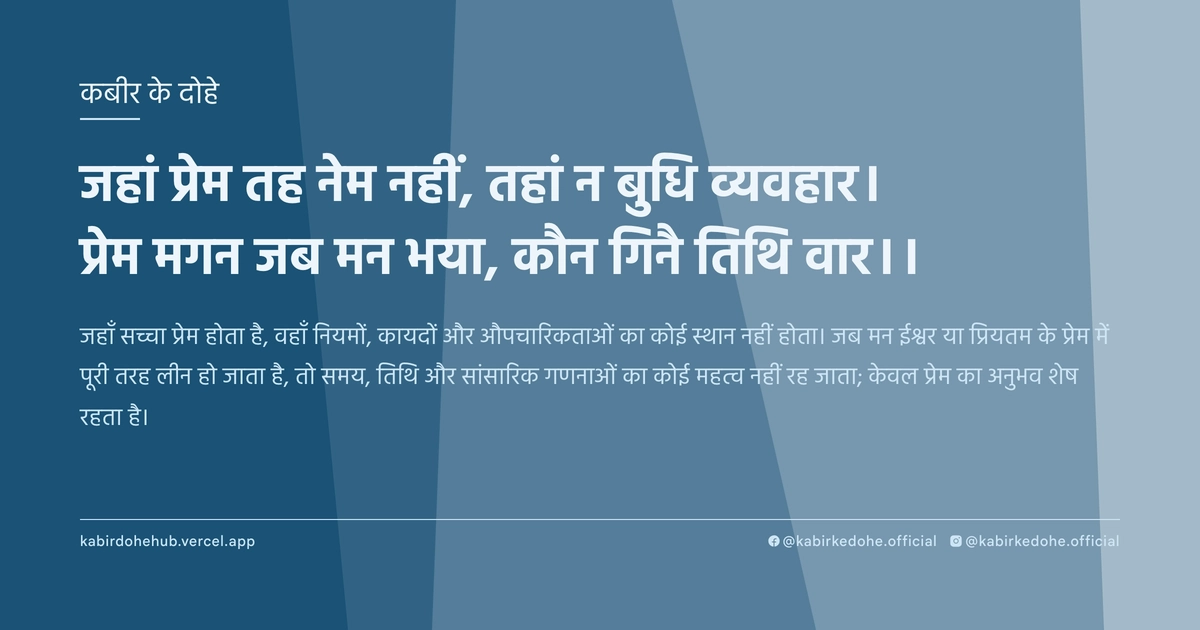
जहां प्रेम तह नेम नहीं, तहां न बुधि व्यवहार।
प्रेम मगन जब मन भया, कौन गिनै तिथि वार।।
Jahaan prem tah nem nahin, tahaan na budhi vyavhaar. Prem magan jab man bhaya, kaun ginaye tithi vaar.
इस पृष्ठ पर इस कबीर दोहे का अर्थ (meaning), हिंदी व्याख्या और अंग्रेज़ी अनुवाद, दार्शनिक विश्लेषण और व्यावहारिक जीवन सीख दी गई है। यह दोहा भक्ति (Bhakti) विषय से जुड़ा है — Kabir doha meaning and explanation in Hindi and English.
अर्थ (Meaning):
जहाँ सच्चा प्रेम होता है, वहाँ नियमों, कायदों और औपचारिकताओं का कोई स्थान नहीं होता। जब मन ईश्वर या प्रियतम के प्रेम में पूरी तरह लीन हो जाता है, तो समय, तिथि और सांसारिक गणनाओं का कोई महत्व नहीं रह जाता; केवल प्रेम का अनुभव शेष रहता है।
Where true love resides, there is no room for rigid rules, social protocols, or calculated behaviors. When the heart is completely immersed in the ecstasy of divine love, the constraints of time, dates, and worldly schedules vanish, leaving only the pure experience of union.
व्याख्या (Interpretation):
यह दोहा प्रेम की उस पराकाष्ठा को दर्शाता है जहाँ प्रेमी और प्रियतम के बीच का द्वैत समाप्त हो जाता है। 'नेम' यहाँ उन सामाजिक और धार्मिक बंधनों का प्रतीक है जो मनुष्य को उसकी सहजता से दूर करते हैं। कबीर समझाते हैं कि बुद्धि और व्यवहार जब तक गणनाओं (calculation) पर आधारित हैं, वे प्रेम के मार्ग में बाधा हैं। जब आत्मा 'निर्गुण' ब्रह्म के प्रेम में मग्न होती है, तो वह काल (time) की सीमा से ऊपर उठ जाती है। यह अवस्था 'अद्वैत' की है, जहाँ ज्ञाता और ज्ञेय एक हो जाते हैं। यहाँ प्रेम कोई भावना नहीं, बल्कि एक आध्यात्मिक स्थिति है जो अहंकार को मिटा देती है। अंततः, यह दोहा हमें सिखाता है कि प्रेम ही सर्वोच्च धर्म है, जो सभी औपचारिकताओं को निगल जाता है।
This couplet depicts the pinnacle of love where the duality between the lover and the beloved dissolves. 'Nem' (rules) symbolizes the social and religious constraints that alienate a human from their innate spontaneity. Kabir explains that as long as intellect and behavior are based on calculation, they act as barriers to true love. When the soul is immersed in the love of the 'Nirgun' (formless) Brahman, it transcends the limitations of time. This is the state of 'Advaita' (non-duality), where the knower and the known become one. Here, love is not merely an emotion but a spiritual state that annihilates the ego. Ultimately, the verse teaches that love is the supreme religion, consuming all formalities in its fire.
दार्शनिक विश्लेषण (Philosophical Analysis):
कबीर का यह दर्शन उस समय के कट्टरपंथी धार्मिक वातावरण के विरुद्ध एक सशक्त प्रतिक्रिया था, जहाँ धर्म केवल कर्मकांडों और नियमों (नेम) का संग्रह बन गया था। कबीर ने 'सहज मार्ग' का समर्थन किया, जो बाहरी आडंबरों के बजाय आंतरिक अनुभव पर बल देता है। यह दृष्टिकोण सूफी मत के 'इश्क-ए-हकीकी' (दिव्य प्रेम) से गहराई से मेल खाता है, जहाँ प्रेमी अपने अस्तित्व को मिटाकर प्रियतम में विलीन हो जाता है।
अद्वैत वेदांत के संदर्भ में, यह दोहा माया के भ्रम को तोड़ने की बात करता है। समय (तिथि-वार) और सामाजिक नियम माया के उपकरण हैं जो हमें यह विश्वास दिलाते हैं कि हम अलग-अलग इकाइयाँ हैं। जब प्रेम जागता है, तो यह भ्रम टूट जाता है और व्यक्ति को अपनी वास्तविक प्रकृति—शुद्ध चेतना—का अनुभव होता है।
कबीर यहाँ 'बुद्धि' और 'प्रेम' के बीच एक स्पष्ट विभाजन करते हैं। बुद्धि विश्लेषण करती है, तुलना करती है और सीमाएँ बनाती है, जबकि प्रेम स्वीकार करता है और विस्तार करता है। आध्यात्मिक प्रगति के लिए बुद्धि का समर्पण आवश्यक है, क्योंकि बुद्धि कभी भी उस अनंत को नहीं पा सकती जिसे केवल समर्पण से प्राप्त किया जा सकता है।
जाति और वर्ण व्यवस्था के प्रति कबीर का विरोध भी इसी दर्शन से उपजा है। यदि प्रेम सर्वोच्च है, तो जन्म या कुल के नियम निरर्थक हैं। यह सामाजिक समानता का एक आध्यात्मिक आधार प्रदान करता है, जहाँ केवल हृदय की पवित्रता मायने रखती है।
मनोवैज्ञानिक स्तर पर, यह 'फ्लो' (flow) की स्थिति है, जहाँ व्यक्ति वर्तमान क्षण में इतना डूब जाता है कि समय का बोध समाप्त हो जाता है। यह अहंकार का विसर्जन है, क्योंकि अहंकार ही वह तत्व है जो समय और नियमों के माध्यम से अपनी पहचान बनाए रखने की कोशिश करता है। जब 'मैं' मिटता है, तो केवल 'प्रेम' बचता है।
Kabir's philosophy serves as a powerful reaction against the dogmatic religious atmosphere of his era, where religion had become a mere collection of rituals and rigid rules (nem). He advocated for the 'Sahaj Marg' (the natural path), emphasizing internal experience over external ostentation. This perspective aligns deeply with the Sufi concept of 'Ishq-e-Haqiqi' (divine love), where the lover annihilates their existence to merge with the Beloved.
In the context of Advaita Vedanta, this verse speaks of breaking the illusion of Maya. Time (dates and days) and social protocols are tools of Maya that reinforce the belief in separate identities. When love awakens, this illusion shatters, and the individual experiences their true nature—pure consciousness.
Kabir draws a sharp distinction between 'intellect' (budhi) and 'love'. The intellect analyzes, compares, and creates boundaries, whereas love accepts and expands. For spiritual evolution, the surrender of the intellect is necessary, as the mind can never grasp the Infinite, which is accessible only through total surrender.
Kabir's rejection of the caste system also stems from this philosophy. If love is supreme, then rules of birth or lineage become irrelevant. This provides a spiritual foundation for social equality, where only the purity of the heart matters.
Psychologically, this describes a state of 'flow,' where a person is so immersed in the present moment that the perception of time vanishes. It is the dissolution of the ego, for the ego is the very element that attempts to maintain its identity through the measurement of time and adherence to rules. When the 'I' vanishes, only 'Love' remains.
मूल संदेश (Core Message):
- नियम केवल मार्ग हैं, गंतव्य नहीं; प्रेम ही अंतिम सत्य है।
- जब हृदय जागता है, तो बुद्धि की गणनाएँ अर्थहीन हो जाती हैं।
- ईश्वर मंदिर के कायदों में नहीं, बल्कि निस्वार्थ करुणा में बसता है।
- समय और स्थान की सीमाएं केवल अहंकार के लिए हैं, आत्मा के लिए नहीं।
- सच्ची भक्ति वह है जो मनुष्य को मनुष्य से जोड़ दे, न कि अलग करे।
- अहंकार का विसर्जन ही प्रेम की पहली शर्त है।
- Rules are merely paths, not the destination; Love is the ultimate truth.
- When the heart awakens, the calculations of the intellect become meaningless.
- God dwells not in the protocols of temples, but in selfless compassion.
- Limits of time and space exist only for the ego, not for the soul.
- True devotion is that which unites human with human, rather than dividing them.
- The dissolution of the ego is the primary condition for love.
व्यावहारिक उदाहरण (Practical Example):
एक समय की बात है, वाराणसी के घाटों पर रहने वाला एक वृद्ध विधवा, जिन्हें लोग 'काकी' कहते थे, अपनी पूरी जिंदगी धर्म के कठोर नियमों का पालन करते हुए बिता चुकी थीं। उनका पूरा दिन पूजा-पाठ, समय पर स्नान और शुद्धता के नियमों में बीता था। उनके लिए धर्म का अर्थ था—सही समय पर सही मंत्र पढ़ना और अशुद्ध चीजों से दूर रहना।
एक दिन, घाट की सीढ़ियों पर एक छोटा बच्चा, जो शायद किसी गरीब परिवार का था, भूख से बेहाल होकर रो रहा था। वह बच्चा अछूत समुदाय से था, और काकी के नियमों के अनुसार, उसे छूना या उसकी मदद करना उनकी 'शुद्धता' को भंग कर सकता था। काकी ने पहले अपनी बुद्धि से सोचा—'यह बच्चा अछूत है, अगर मैं इसे छुऊंगी तो मुझे दोबारा स्नान करना होगा, मेरी पूजा खंडित हो जाएगी।'
लेकिन तभी, उस बच्चे की आँखों में एक ऐसी तड़प दिखी जिसने काकी के भीतर के वर्षों पुराने नियमों के बांध को तोड़ दिया। अचानक, उन्हें याद आया कि वे जिस ईश्वर की पूजा करती हैं, वह तो कण-कण में है। उनके भीतर एक तीव्र करुणा जागी, जो किसी भी नियम से बड़ी थी।
काकी ने बिना सोचे-समझे अपना हाथ बढ़ाया, बच्चे को गले लगाया और अपने पास रखा हुआ भोजन उसे खिला दिया। उस क्षण, उन्हें इस बात की कोई परवाह नहीं थी कि वे किस समय पर हैं, क्या उन्होंने स्नान किया है, या समाज क्या कहेगा। वे उस बच्चे की मुस्कान में ईश्वर को देख रही थीं।
जैसे ही बच्चे ने भोजन किया और शांत हुआ, काकी को एक ऐसी शांति का अनुभव हुआ जो उन्होंने जीवन भर की हज़ारों पूजाओं में कभी नहीं पाया था। उन्हें महसूस हुआ कि वे अब तक केवल 'नेम' (नियमों) की पूजा कर रही थीं, 'प्रेम' की नहीं।
उस दिन के बाद, काकी का जीवन बदल गया। उन्होंने पूजा करना नहीं छोड़ा, लेकिन अब उनकी पूजा का केंद्र मंदिर की मूर्ति नहीं, बल्कि हर दुखी इंसान की सेवा बन गई। उन्होंने नियमों को पूरी तरह नहीं त्यागा, लेकिन उन्हें प्रेम के अधीन कर दिया।
गाँव के लोग हैरान थे कि जो काकी कभी शुद्धता के लिए दूसरों को दूर रखती थीं, वे अब सबके साथ मिल-बैठकर बातें करती थीं। जब किसी ने उनसे पूछा कि क्या वे अपने धर्म के नियमों को भूल गई हैं, तो उन्होंने मुस्कुराकर कहा, 'मैंने नियमों को नहीं छोड़ा, मैंने बस उस ईश्वर को पा लिया है जो नियमों से परे है।'
यह 'कबीर ट्विस्ट' था—जब नियम प्रेम के मार्ग में बाधा बने, तो प्रेम ने नियमों को जला दिया। काकी ने सीखा कि सच्ची भक्ति मंदिर की दीवारों में नहीं, बल्कि एक भूखे बच्चे की तृप्ति में है। उनका अहंकार, जो 'शुद्धता' के गर्व से भरा था, पूरी तरह मिट गया और वे वास्तव में मुक्त हो गईं।
Once, on the ghats of Varanasi, lived an elderly widow known as 'Kaki,' who had spent her entire life adhering to the strictest religious codes. Her days were governed by precise timings for prayer, bathing, and maintaining ritual purity. For her, religion meant reciting the right mantras at the right time and avoiding anything 'impure.'
One day, a small child from a marginalized community, trembling with hunger, was crying on the stone steps of the ghat. According to Kaki's rigid rules, touching or helping this child would violate her ritual purity and invalidate her prayers.
Initially, her intellect intervened: 'This child is untouchable; if I touch him, I will have to bathe again, and my worship will be disrupted.' But then, she saw a desperation in the child's eyes that shattered the dams of rules she had built over decades.
Suddenly, she remembered that the God she worshipped resided in every atom. A surge of compassion arose within her, far more powerful than any scripture. Without a second thought, she reached out, embraced the child, and fed him the food she had kept for herself.
In that moment, she forgot the time, forgot her ritual status, and forgot the judgmental eyes of society. She saw the Divine in the child's smile. As the child calmed down, Kaki experienced a profound peace that she had never found in thousands of ritualistic prayers.
She realized that until then, she had been worshipping 'Nem' (rules), not 'Prem' (love). From that day forward, Kaki's life transformed. She didn't stop praying, but the center of her worship shifted from the temple idol to the service of suffering humanity.
Villagers were astonished that the woman who once shunned others for purity now sat with everyone. When asked if she had forgotten her religious duties, she smiled and replied, 'I haven't forgotten the rules; I have simply found the God who exists beyond them.'
This was the 'Kabir Twist'—when rules became barriers to love, love incinerated the rules. Kaki learned that true devotion is not found within temple walls but in the satisfaction of a hungry child. Her ego, once inflated by the pride of 'purity,' vanished, and she became truly free.
अभ्यास मार्गदर्शन (Practice Guidance):
- दैनिक अभ्यास: प्रतिदिन 15 मिनट मौन बैठें और विचार करें कि आपके जीवन में कौन से 'नियम' या 'अपेक्षाएं' आपको दूसरों से प्रेम करने से रोक रही हैं।
- आत्म-पूछताछ जर्नल: लिखें—'यदि मैं समाज के डर और अपनी छवि की चिंता छोड़ दूँ, तो मैं आज किसकी मदद करूँगा/करूँगी और कैसे?'
- व्यवहार परिवर्तन: दिन में कम से कम एक बार ऐसा कार्य करें जो आपकी 'तार्किक बुद्धि' के विपरीत हो लेकिन 'करुणा' से प्रेरित हो (जैसे किसी अजनबी की बिना कारण मदद करना)।
- डायग्नोस्टिक चेकलिस्ट: यदि आप किसी की मदद करते समय यह सोच रहे हैं कि 'लोग क्या कहेंगे' या 'क्या यह सही समय है', तो आप अभी भी 'नेम' (नियमों) में हैं। यदि आप केवल सामने वाले के दुख को महसूस कर रहे हैं, तो आप 'प्रेम' में हैं।
- Daily Practice: Sit in silence for 15 minutes daily and contemplate which 'rules' or 'expectations' in your life are preventing you from loving others unconditionally.
- Self-Inquiry Journal: Write—'If I were to let go of social fear and the concern for my image, whom would I help today, and how?'
- Behavioral Shift: At least once a day, perform an act that contradicts your 'logical intellect' but is driven by 'compassion' (e.g., helping a stranger without a calculated reason).
- Diagnostic Checklist: If, while helping someone, you are thinking 'what will people say' or 'is this the right time,' you are still operating within 'Nem' (rules). If you feel only the other's suffering, you are in 'Prem' (love).
चिंतन प्रश्न (Reflection Questions):
- क्या मेरी 'नैतिकता' वास्तव में करुणा पर आधारित है, या यह केवल समाज द्वारा थोपे गए नियमों का पालन है?
- मैं अपनी सार्वजनिक छवि (Public Image) को बनाए रखने के लिए कितनी बार अपने आंतरिक प्रेम की आवाज को दबाता हूँ?
- मेरे जीवन में ऐसा कौन सा 'नियम' है जिसे तोड़ने पर मुझे डर लगता है, लेकिन वह नियम किसी की मदद में बाधा है?
- क्या मैं ईश्वर को एक 'पुरस्कार देने वाले' या 'दंड देने वाले' न्यायाधीश के रूप में देखता हूँ, या एक अनंत प्रेम के रूप में?
- मेरी डिजिटल पहचान (Social Media Ego) मुझे वास्तविक मानवीय संबंधों से कितना दूर ले जा रही है?
- यदि कल सारे सामाजिक नियम समाप्त हो जाएं, तो क्या मेरे भीतर दूसरों के लिए प्रेम बचेगा?
- Is my 'morality' truly based on compassion, or is it merely adherence to rules imposed by society?
- How often do I suppress the voice of my inner love to maintain my public image?
- Which 'rule' in my life do I fear breaking, even though it hinders me from helping someone?
- Do I perceive God as a judge who rewards or punishes, or as an infinite ocean of love?
- To what extent is my digital identity (Social Media Ego) distancing me from authentic human connections?
- If all social rules vanished tomorrow, would there be any love left within me for others?