
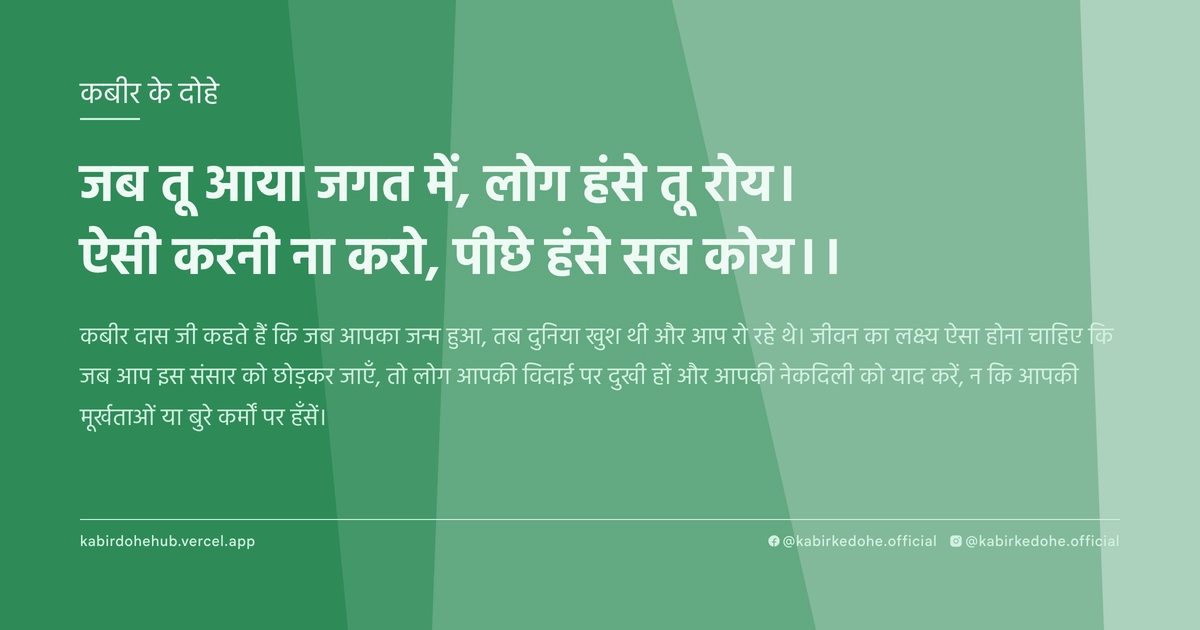
जब तू आया जगत में, लोग हंसे तू रोय।
ऐसी करनी ना करो, पीछे हंसे सब कोय।।
Jab tu aaya jagat mein, log hanse tu roy. Aisi karni na karo, peeche hanse sab koy.
इस पृष्ठ पर इस कबीर दोहे का अर्थ (meaning), हिंदी व्याख्या और अंग्रेज़ी अनुवाद, दार्शनिक विश्लेषण और व्यावहारिक जीवन सीख दी गई है। यह दोहा कर्म (Karma) विषय से जुड़ा है — Kabir doha meaning and explanation in Hindi and English.
अर्थ (Meaning):
कबीर दास जी कहते हैं कि जब आपका जन्म हुआ, तब दुनिया खुश थी और आप रो रहे थे। जीवन का लक्ष्य ऐसा होना चाहिए कि जब आप इस संसार को छोड़कर जाएँ, तो लोग आपकी विदाई पर दुखी हों और आपकी नेकदिली को याद करें, न कि आपकी मूर्खताओं या बुरे कर्मों पर हँसें।
Kabir observes the irony of birth: when you entered this world, others laughed with joy while you cried. He urges us to live such a virtuous life that upon our departure, the world mourns our loss with respect rather than mocking the legacy of our foolishness or cruelty.
व्याख्या (Interpretation):
यह दोहा जीवन के चक्र और मानवीय अहंकार के विरोधाभास को दर्शाता है। शाब्दिक अर्थ में यह जन्म और मृत्यु की स्थिति की तुलना है, लेकिन आध्यात्मिक स्तर पर यह 'माया' के प्रभाव और 'कर्म' के सिद्धांत की व्याख्या है। यहाँ रोना अज्ञानता और भौतिक बंधन में प्रवेश का प्रतीक है। कबीर निरगुण भक्ति के माध्यम से समझाते हैं कि मनुष्य अक्सर बाहरी दिखावे और अहंकार में इतना खो जाता है कि वह अपने वास्तविक स्वरूप (आत्मा) को भूल जाता है। यदि जीवन केवल इंद्रिय सुखों और अहंकार की तुष्टि में व्यतीत हो, तो मृत्यु के पश्चात व्यक्ति का अस्तित्व केवल एक उपहास बनकर रह जाता है। यह द्वैतवाद से अद्वैत की ओर बढ़ने का संकेत है, जहाँ व्यक्ति स्वयं को शरीर नहीं, बल्कि उस शाश्वत सत्य का हिस्सा मानता है जो करुणा और प्रेम से संचालित है।
This couplet highlights the paradox of human existence and the illusion of the ego. Literally, it compares the circumstances of birth and death, but metaphorically, it delves into the mechanics of Maya and the law of Karma. The infant's cry symbolizes the soul's distress upon entering the bondage of material existence. Through the lens of Nirgun Bhakti, Kabir suggests that most humans spend their lives chasing transient shadows, forgetting their essence as the formless Atman. When a life is lived solely for the gratification of the ego, the legacy left behind is hollow, inviting ridicule rather than reverence. It is a call to shift from the duality of 'I' and 'Mine' toward the non-dual realization of Brahman, where the only lasting imprint is one of selfless love and spiritual integrity.
दार्शनिक विश्लेषण (Philosophical Analysis):
कबीर का यह दोहा उस सामाजिक और धार्मिक पाखंड पर प्रहार है जहाँ लोग बाहरी कर्मकांडों को मोक्ष का मार्ग मानते हैं। उनके समय में, जाति और धर्म के नाम पर श्रेष्ठता का दावा करना आम था, लेकिन कबीर ने स्पष्ट किया कि ईश्वर की दृष्टि में केवल 'करनी' (कर्म) का मूल्य है। यह विचार अद्वैत वेदांत के करीब है, जहाँ यह माना जाता है कि आत्मा और परमात्मा एक ही हैं, और अहंकार ही वह पर्दा है जो हमें इस सत्य से दूर रखता है।
सूफीवाद के प्रभाव में, कबीर यहाँ 'फना' (अहंकार का विनाश) की बात कर रहे हैं। जब तक मनुष्य अपनी पहचान को पद, प्रतिष्ठा या धन से जोड़ता है, वह वास्तव में एक भ्रम में जी रहा होता है। वह 'हँसी' जो मृत्यु के बाद आती है, वह वास्तव में उस व्यक्ति की आध्यात्मिक विफलता का प्रतीक है जिसने जीवन भर केवल बाहरी आवरण को सजाया, लेकिन आंतरिक शुद्धि की उपेक्षा की।
मनोवैज्ञानिक स्तर पर, यह दोहा हमें हमारी 'मृत्यु दर' (mortality) की याद दिलाता है। यह एक 'मेमेंटो मोरी' (मृत्यु को याद रखो) है जो हमें वर्तमान क्षण में सचेत करता है। कबीर तर्क देते हैं कि यदि हम अपनी मृत्यु के बाद की छवि के बारे में सोचें, तो हम वर्तमान में अधिक विनम्र और दयालु बनेंगे।
यह संदेश केवल नैतिक उपदेश नहीं है, बल्कि एक क्रांतिकारी बदलाव की मांग है। यह हमें सिखाता है कि वास्तविक सम्मान वह नहीं है जो जीवित रहते हुए चापलूसी से मिलता है, बल्कि वह है जो हमारे जाने के बाद हमारी अनुपस्थिति में हमारी सच्चाई के लिए महसूस किया जाता है।
अंततः, कबीर का दर्शन यह है कि जीवन एक अवसर है अपनी चेतना को ऊपर उठाने का। यदि हम केवल भौतिक इच्छाओं के पीछे भागते हैं, तो हम उस चक्र में फंसे रहते हैं जहाँ जन्म और मृत्यु केवल दुख और उपहास के बिंदु बन जाते हैं। मुक्ति केवल उन्हीं को मिलती है जो 'स्व' का त्याग कर 'सर्व' में विलीन हो जाते हैं।
Kabir’s verse is a sharp critique of the social and religious hypocrisy of his era, where ritualism was often mistaken for spiritual liberation. In a society fractured by caste and creed, Kabir asserts that the only currency of value in the eyes of the Divine is 'Karni' (action/conduct). This aligns closely with Advaita Vedanta, which posits that the Atman and Brahman are one, and the ego is the sole veil obscuring this primordial truth.
Drawing from Sufi influences, Kabir emphasizes the concept of 'Fana'—the annihilation of the false self. When an individual anchors their identity to transient markers like status, wealth, or lineage, they exist within a state of spiritual delusion. The 'laughter' that follows such a death is not mere mockery, but a symbolic representation of the absurdity of a life spent polishing a mirror that reflects nothing but a void.
Psychologically, this doha serves as a 'Memento Mori,' forcing the practitioner to confront their mortality. By projecting oneself into the future state of being remembered, Kabir triggers a cognitive shift toward humility. He suggests that the fear of being a cosmic joke after death should drive the individual toward a life of authentic virtue and compassion.
This is not a mere moralistic plea but a call for a radical ontological shift. Kabir distinguishes between the 'social mask' we wear to gain applause in life and the 'spiritual essence' that remains after the mask is stripped away. True honor is not the applause of the living, but the silent reverence of those who recognize a soul that lived in truth.
Ultimately, Kabir’s philosophy posits that life is a singular opportunity to elevate consciousness. To chase material desires is to remain trapped in a cycle where birth and death are merely points of sorrow and ridicule. Liberation is reserved for those who transcend the 'I' to merge with the 'All,' transforming their existence into a bridge of light for others.
मूल संदेश (Core Message):
- जन्म का रोना अज्ञानता है, मृत्यु का उपहास अहंकार का परिणाम है।
- बाहरी दिखावे को छोड़कर आंतरिक चरित्र के निर्माण पर ध्यान दें।
- सच्ची विरासत धन या पद नहीं, बल्कि दूसरों के दिलों में छोड़ी गई करुणा है।
- अहंकार वह पर्दा है जो हमें परमात्मा और मानवता से अलग करता है।
- जीवन का उद्देश्य स्वयं को मिटाकर सर्वव्यापी सत्य में विलीन होना है।
- The cry of birth is ignorance; the laughter at death is the fruit of ego.
- Shift focus from the external facade to the cultivation of internal character.
- A true legacy is not wealth or status, but the compassion left in others' hearts.
- The ego is the veil that separates the individual from the Universal Truth.
- The purpose of life is to dissolve the 'I' and merge into the Infinite.
व्यावहारिक उदाहरण (Practical Example):
एक समय की बात है, वाराणसी के घाटों पर माधव नाम का एक वृद्ध बुनकर रहता था। माधव अपने काम में निपुण था, लेकिन उसका स्वभाव अत्यंत अहंकारी था। वह मानता था कि उसके द्वारा बुने गए रेशमी वस्त्र केवल राजघरानों के लिए हैं और वह साधारण लोगों को तुच्छ समझता था। वह अक्सर अपनी श्रेष्ठता का बखान करता और दूसरों को नीचा दिखाता था।
एक दिन, माधव की मुलाकात एक फकीर से हुई जिसने उसे कबीर का यह दोहा सुनाया। फकीर ने माधव से कहा, 'माधव, तुम इन वस्त्रों की चमक पर गर्व कर रहे हो, लेकिन क्या तुमने सोचा है कि जब तुम इस शरीर का वस्त्र उतारोगे, तब दुनिया तुम्हारी कला को याद रखेगी या तुम्हारे अहंकार को?'
माधव को पहले तो यह बात चुभी, लेकिन उस रात उसे एक सपना आया। उसने देखा कि वह अपनी मृत्यु के बाद खड़ा है और लोग उसके शानदार वस्त्रों को देख रहे हैं, लेकिन वे उसकी कला की प्रशंसा नहीं कर रहे, बल्कि उसकी कड़वाहट और घमंड पर हँस रहे हैं। वे कह रहे थे, 'देखो, इस आदमी ने दुनिया भर के कपड़े तो रंगे, लेकिन अपनी आत्मा को सफेद रखना भूल गया।'
जागने के बाद माधव की आँखों में आँसू थे। उसे अहसास हुआ कि उसने जीवन भर केवल बाहरी आवरण को संवारा था, जबकि उसका आंतरिक व्यक्तित्व मैला हो चुका था। उसने तय किया कि वह अब केवल धन के लिए नहीं, बल्कि सेवा के लिए बुनेगा।
उसने अपने हुनर का उपयोग गरीब बच्चों के लिए गर्म कपड़े बनाने में करना शुरू किया। वह अब घाटों पर आने वाले हर व्यक्ति से विनम्रता से बात करता था। उसका अहंकार धीरे-धीरे करुणा में बदलने लगा।
वर्षों बाद, जब माधव का समय आया, तो पूरा शहर उसके अंतिम संस्कार में उमड़ पड़ा। कोई उसकी संपत्ति के लिए नहीं, बल्कि उस निस्वार्थ प्रेम के लिए रो रहा था जो उसने अंतिम वर्षों में सबको दिया था।
उसकी मृत्यु पर कोई हँसा नहीं; बल्कि हर आँख नम थी। माधव ने कबीर की उस चेतावनी को सच कर दिखाया था कि 'ऐसी करनी' की जाए कि पीछे दुनिया रोए, हँसे नहीं।
उसकी कहानी आज भी वाराणसी की गलियों में सुनाई जाती है, जो यह सिखाती है कि इंसान की असली पहचान उसके काम की गुणवत्ता से नहीं, बल्कि उसके व्यवहार की पवित्रता से होती है।
माधव का परिवर्तन यह दर्शाता है कि जब हम अपनी मृत्यु को एक दर्पण की तरह उपयोग करते हैं, तो हम वर्तमान में अधिक मानवीय बन जाते हैं।
Once, on the ghats of Varanasi, lived an elderly weaver named Madhav. Madhav was a master of his craft, but his heart was consumed by arrogance. He believed his exquisite silk weaves were fit only for royalty, and he looked down upon the common folk with utter disdain, often mocking their simplicity.
One evening, Madhav encountered a wandering Sufi dervish who recited Kabir’s doha to him. The dervish looked into Madhav's eyes and asked, 'Madhav, you pride yourself on the luster of your fabrics, but have you considered what will remain when you shed the garment of this body? Will the world remember your art, or your arrogance?'
Initially, Madhav was offended, but that night, he was visited by a vivid dream. He saw himself standing after his death, watching a crowd gather. They were looking at his fine clothes, but they weren't praising his skill; they were laughing at his bitterness. They whispered, 'Look at this man; he dyed the world in colors, but forgot to keep his own soul pure.'
Waking up in a cold sweat, Madhav felt a profound sense of emptiness. He realized he had spent his entire life polishing an external shell while allowing his inner self to decay into malice. He decided that from that day forward, he would weave not for gold, but for grace.
He began using his skill to create warm blankets and clothes for orphaned children and the destitute of the city. The man who once sneered at the poor now spent his mornings listening to their sorrows and his evenings serving them.
His arrogance gradually dissolved into a deep, resonant compassion. He no longer sought the applause of the elite but found peace in the silent gratitude of the forgotten.
Years later, when Madhav’s time finally came, the entire city gathered for his farewell. There was no laughter, only a heavy, collective grief. People wept not for the loss of a weaver, but for the loss of a soul who had become a sanctuary for others.
Madhav had transformed his legacy. He had ensured that his 'Karni' (actions) were such that the world mourned his departure with genuine love, fulfilling Kabir's spiritual injunction.
His story is still whispered in the alleys of Varanasi, serving as a reminder that a human's true identity is not defined by the quality of their work, but by the purity of their conduct.
Madhav's transformation illustrates that when we use the reality of death as a mirror, we are forced to live more humanely in the present.
अभ्यास मार्गदर्शन (Practice Guidance):
- दैनिक आत्म-निरीक्षण: प्रतिदिन रात को सोने से पहले 10 मिनट यह सोचें कि यदि आज मेरा अंतिम दिन होता, तो लोग मेरे बारे में क्या कहेंगे? क्या वे मेरी दयालुता को याद करेंगे या मेरे क्रोध को?
- अहंकार का विसर्जन: दिन में कम से कम एक बार ऐसा कार्य करें जिसमें आप अपनी पहचान या पद को पूरी तरह भूलकर किसी की निस्वार्थ सेवा करें।
- जर्नलिंग प्रॉम्प्ट: 'मेरे जीवन का वह कौन सा हिस्सा है जिसे मैं दुनिया से छिपाता हूँ क्योंकि मुझे डर है कि लोग उस पर हँसेंगे?' इस पर गहराई से लिखें और उसे स्वीकार करें।
- डायग्नोस्टिक चेकलिस्ट: क्या मैं दूसरों की सफलता पर ईर्ष्या करता हूँ? क्या मैं अपनी उपलब्धियों का ढिंढोरा पीटता हूँ? क्या मैं केवल उन्हीं की मदद करता हूँ जिनसे मुझे लाभ मिल सकता है? यदि हाँ, तो आप अभी भी 'माया' के प्रभाव में हैं।
- Daily Self-Audit: Spend 10 minutes before sleep contemplating: 'If today were my final day, what would be the narrative of my life? Would people remember my kindness or my cruelty?'
- Ego Dissolution: Perform at least one act of selfless service daily where you completely strip away your social identity, title, or status to help another.
- Journaling Prompt: 'Which part of my life do I hide from the world because I fear people will laugh at it?' Write about this shadow and integrate it with compassion.
- Diagnostic Checklist: Do I feel envy at others' success? Do I constantly broadcast my achievements? Do I only help those who can reciprocate? If yes, you are still operating under the illusion of the ego.
चिंतन प्रश्न (Reflection Questions):
- क्या मेरी सार्वजनिक छवि (Public Image) मेरी वास्तविक आंतरिक स्थिति से मेल खाती है, या मैं केवल एक मुखौटा पहनकर जी रहा हूँ?
- मैं अपनी सफलता का श्रेय किसे देता हूँ—अपने कौशल को या उस ब्रह्मांडीय कृपा को जिसने मुझे अवसर दिए?
- यदि मेरी सारी उपलब्धियाँ और पद छीन लिए जाएँ, तो मेरे पास ऐसा क्या बचेगा जिसे दुनिया सम्मान दे सके?
- मेरे जीवन के वे कौन से गुप्त पूर्वाग्रह हैं जो मुझे दूसरों को वास्तव में 'देखने' से रोकते हैं?
- क्या मैं प्रेम करता हूँ, या मैं केवल उस प्रेम को चाहता हूँ जो मुझे दूसरों से मिले?
- Does my public image align with my internal reality, or am I merely living behind a carefully constructed mask?
- To whom do I attribute my success—to my own skill, or to the cosmic grace that provided the opportunity?
- If all my achievements and titles were stripped away, what would remain of me that the world could truly respect?
- What are the hidden biases in my heart that prevent me from seeing others as a reflection of the same Divine Soul?
- Do I actually love others, or am I merely in love with the feeling of being loved by them?