
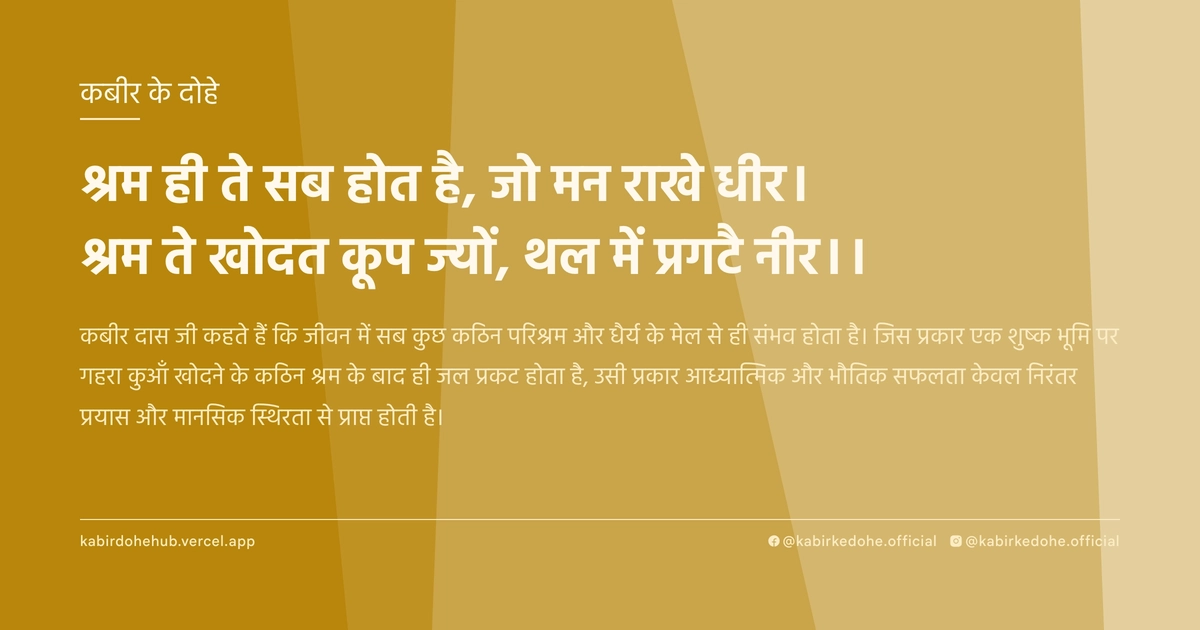
श्रम ही ते सब होत है, जो मन राखे धीर।
श्रम ते खोदत कूप ज्यों, थल में प्रगटै नीर।।
Shram hi te sab hot hai, jo man rakhe dheer. Shram te khodat koop jyon, thal mein pragtai neer.
इस पृष्ठ पर इस कबीर दोहे का अर्थ (meaning), हिंदी व्याख्या और अंग्रेज़ी अनुवाद, दार्शनिक विश्लेषण और व्यावहारिक जीवन सीख दी गई है। यह दोहा धैर्य (Patience) विषय से जुड़ा है — Kabir doha meaning and explanation in Hindi and English.
अर्थ (Meaning):
कबीर दास जी कहते हैं कि जीवन में सब कुछ कठिन परिश्रम और धैर्य के मेल से ही संभव होता है। जिस प्रकार एक शुष्क भूमि पर गहरा कुआँ खोदने के कठिन श्रम के बाद ही जल प्रकट होता है, उसी प्रकार आध्यात्मिक और भौतिक सफलता केवल निरंतर प्रयास और मानसिक स्थिरता से प्राप्त होती है।
Kabir asserts that all achievements in life are the result of diligent effort coupled with unwavering patience. Just as water emerges from a parched land only after the arduous labor of digging a deep well, spiritual and material fulfillment manifests only through persistent striving and a steady, composed mind.
व्याख्या (Interpretation):
यह दोहा भौतिक श्रम और आंतरिक साधना के बीच के सेतु को दर्शाता है। शाब्दिक अर्थ में यह मेहनत की बात करता है, परंतु आध्यात्मिक स्तर पर 'श्रम' का अर्थ है 'साधना' और 'धीर' का अर्थ है 'समत्व'। निर्गुण भक्ति में, ईश्वर बाहर नहीं बल्कि भीतर है, लेकिन उसे पाने के लिए अहंकार की परतों को खोदना पड़ता है। माया का पर्दा एक शुष्क रेगिस्तान की तरह है; जब तक साधक धैर्यपूर्वक अपनी वासनाओं और अज्ञान को खोदकर निकाल नहीं देता, तब तक आत्म-साक्षात्कार का अमृत रूपी जल प्रकट नहीं होता। यह अद्वैत वेदांत के उस सत्य को पुष्ट करता है कि ब्रह्म सर्वत्र है, परंतु हमारी दृष्टि उसे देखने में असमर्थ है जब तक कि हम अनुशासन और तपस्या का मार्ग न अपनाएं।
This couplet illustrates the bridge between physical labor and internal spiritual discipline. While literally advocating for hard work, on a metaphysical level, 'shram' signifies 'Sadhana' (disciplined practice) and 'dheer' signifies 'equanimity'. In Nirgun Bhakti, the Divine is not external but internal, yet reaching this truth requires digging through layers of ego. The veil of Maya is like a parched desert; until the seeker patiently excavates their desires and ignorance, the water of self-realization does not emerge. This reinforces the Advaita Vedanta principle that Brahman is omnipresent, yet invisible to the seeker until the rigorous process of austerity and discipline clears the internal debris.
दार्शनिक विश्लेषण (Philosophical Analysis):
कबीर का यह दर्शन उस समय के समाज के लिए एक क्रांतिकारी आह्वान था, जहाँ धर्म केवल कर्मकांडों और बाहरी दिखावे तक सीमित हो गया था। उन्होंने यह स्पष्ट किया कि मोक्ष किसी मंदिर, मस्जिद या केवल मंत्रोच्चार से नहीं, बल्कि 'श्रम' यानी वास्तविक आंतरिक संघर्ष और कर्म से मिलता है। यह दृष्टिकोण सूफीवाद के 'मुजाहदा' (आंतरिक संघर्ष) के समान है, जहाँ साधक अपनी नफ्स (अहंकार) से लड़ता है।
यहाँ 'श्रम' केवल शारीरिक कार्य नहीं है, बल्कि यह मानसिक रूपांतरण की प्रक्रिया है। कबीर जाति व्यवस्था और ऊंच-नीच के भेदभाव को नकारते हुए कहते हैं कि सत्य का मार्ग सबके लिए समान है, बशर्ते वे धैर्य रखें। यह अद्वैत वेदांत के उस विचार से जुड़ता है जहाँ जीव और ब्रह्म की एकता को पहचानने के लिए अविद्या का विनाश आवश्यक है।
अक्सर लोग इस दोहे को केवल सांसारिक सफलता से जोड़कर देखते हैं, जो एक बड़ी भूल है। कबीर यहाँ 'श्रम' को 'तप' के रूप में प्रस्तुत कर रहे हैं। जैसे कुआँ खोदते समय मिट्टी हटानी पड़ती है, वैसे ही आध्यात्मिक यात्रा में क्रोध, लोभ और मोह की मिट्टी हटानी पड़ती है।
यह दर्शन सिखाता है कि धैर्य (धीर) के बिना श्रम व्यर्थ है और श्रम के बिना धैर्य केवल आलस्य है। इन दोनों का संतुलन ही साधक को शून्य से पूर्ण की ओर ले जाता है। यह अहंकार के विसर्जन की प्रक्रिया है, जहाँ व्यक्ति यह समझता है कि वह कर्ता नहीं, बल्कि केवल एक माध्यम है।
अंततः, कबीर यह स्थापित करते हैं कि सत्य 'प्रकट' होता है, वह 'बनाया' नहीं जाता। जल पहले से ही जमीन के नीचे था, बस उसे खोजने का श्रम करना था। इसी प्रकार, परमात्मा पहले से ही हमारे भीतर है, बस उसे अनुभव करने का श्रम करना आवश्यक है।
Kabir's philosophy served as a revolutionary call to a society where religion had become confined to rituals and outward displays. He clarified that liberation is not achieved through temples, mosques, or mere chanting, but through 'shram'—actual internal struggle and righteous action. This perspective mirrors the Sufi concept of 'Mujahada' (spiritual struggle), where the seeker battles the 'nafs' (ego).
In this context, 'shram' is not merely physical labor but a process of psychological transformation. By rejecting caste hierarchies, Kabir asserts that the path to truth is open to all, provided they possess patience. This aligns with Advaita Vedanta, where the removal of 'Avidya' (ignorance) is essential to realize the non-duality of the Atman and Brahman.
Common literalist interpretations often mistake this for a simple exhortation to work hard for worldly success. However, Kabir presents 'shram' as 'Tapas' (austerity). Just as earth must be removed to find water, the debris of anger, greed, and attachment must be excavated from the soul.
The philosophy posits that patience without effort is mere lethargy, and effort without patience is futile. The balance of these two leads the seeker from the void to the absolute. It is a process of ego-annihilation, where the individual realizes they are not the 'doer' but a medium.
Ultimately, Kabir establishes that Truth is 'revealed,' not 'created.' The water was always beneath the earth; the labor was simply to uncover it. Similarly, the Divine is already within us; the effort lies in uncovering that inherent presence.
मूल संदेश (Core Message):
- अधीरता आध्यात्मिक प्रगति की सबसे बड़ी बाधा है।
- सच्चा श्रम केवल शारीरिक नहीं, बल्कि मानसिक अनुशासन है।
- धैर्य वह खाद है जो कठिन परिश्रम को फल में बदलती है।
- सत्य बाहर खोजने की वस्तु नहीं, भीतर प्रकट करने की प्रक्रिया है।
- अहंकार का विसर्जन ही आत्म-साक्षात्कार का वास्तविक कुआँ है।
- Impatience is the greatest obstacle to spiritual evolution.
- True labor is not merely physical, but a form of mental discipline.
- Patience is the catalyst that transforms hard work into fruition.
- Truth is not an object to be found, but a process to be revealed.
- The dissolution of ego is the actual digging of the well to self-realization.
व्यावहारिक उदाहरण (Practical Example):
वाराणसी के एक पुराने मोहल्ले में माधव नाम का एक वृद्ध बुनकर रहता था। माधव अपनी कला में निपुण था, लेकिन उसके मन में एक गहरी टीस थी कि उसकी अगली पीढ़ी इस कला को बोझ मानकर छोड़ रही है। वह अक्सर देखता कि उसके बेटे और पोते केवल त्वरित लाभ और आसान रास्तों की तलाश में थे।
एक दिन माधव ने अपने पोते, आर्यन, को एक पुराना, उलझा हुआ रेशमी धागा दिया और कहा, 'इसे सुलझाओ और इससे एक ऐसा वस्त्र बनाओ जिसमें एक भी गांठ न हो।' आर्यन ने जोश में काम शुरू किया, लेकिन जल्द ही वह धागों की उलझन से परेशान हो गया। उसने कई बार कोशिश की, लेकिन हर बार धागा टूट जाता या गांठें और बढ़ जातीं।
तीन दिन बाद, आर्यन ने गुस्से में धागा फेंक दिया और कहा, 'यह असंभव है, यह धागा ही खराब है।' माधव मुस्कुराया और उसे अपने पास बिठाकर यह दोहा सुनाया। उसने समझाया कि जिस तरह इस धागे की गांठें समय और धैर्य के साथ एक-एक कर खुलेंगी, वैसे ही जीवन के सत्य और कौशल की प्राप्ति भी धीरे-धीरे होती है।
माधव ने आर्यन को सिखाया कि 'श्रम' केवल हाथ चलाना नहीं है, बल्कि उस समय अपनी उत्तेजना को शांत रखना है जब परिणाम नहीं दिख रहे होते। आर्यन ने फिर से प्रयास किया। इस बार उसने जल्दबाजी नहीं की। वह घंटों एक ही गांठ पर ध्यान केंद्रित करता, कभी विफल होता, तो कभी सफल।
जैसे-जैसे दिन बीते, आर्यन का स्वभाव बदलने लगा। वह अब केवल वस्त्र नहीं बुन रहा था, बल्कि अपने भीतर के क्रोध और अधीरता को भी सुलझा रहा था। उसने महसूस किया कि जिस शांति की वह तलाश कर रहा था, वह परिणाम में नहीं, बल्कि उस धैर्यपूर्ण प्रक्रिया में थी।
महीनों की मेहनत के बाद, एक ऐसा वस्त्र तैयार हुआ जिसकी सूक्ष्मता और चमक अद्भुत थी। वह वस्त्र केवल रेशम का नहीं था, बल्कि आर्यन के धैर्य और तप का प्रमाण था। उसने जाना कि बिना संघर्ष के मिली सफलता क्षणिक होती है, लेकिन श्रम से अर्जित ज्ञान स्थायी होता है।
आर्यन ने अब केवल बुनकरी नहीं सीखी, बल्कि उसने अपने जीवन के अन्य क्षेत्रों में भी इस सिद्धांत को लागू किया। उसने अपने पिता के साथ संबंधों को सुधारने के लिए भी वही धैर्य अपनाया, जिससे उनके घर का कलह समाप्त हो गया।
इस प्रकार, एक साधारण बुनकरी के कार्य ने आर्यन को एक आध्यात्मिक रूपांतरण दिया। उसने समझा कि जीवन का 'जल' (सफलता और शांति) उन्हीं को मिलता है जो मन की स्थिरता के साथ निरंतर खुदाई करने का साहस रखते हैं।
In an ancient neighborhood of Varanasi lived an elderly weaver named Madhav. Madhav was a master of his craft, but he carried a deep sorrow that the next generation viewed this art as a burden. He observed his son and grandson seeking only quick profits and effortless shortcuts.
One day, Madhav gave his grandson, Aryan, a piece of old, tangled silk thread and said, 'Untangle this and weave a cloth that has not a single knot.' Aryan began with enthusiasm, but soon became frustrated by the complexity of the tangles. He tried repeatedly, but the threads either snapped or became more knotted.
After three days, Aryan threw the thread in anger, claiming, 'This is impossible; the thread itself is defective.' Madhav smiled, sat him down, and recited this Doha. He explained that just as these knots would open one by one with time and patience, the truths of life and the mastery of skill are attained gradually.
Madhav taught Aryan that 'shram' is not just the movement of hands, but the ability to keep one's agitation calm when results are invisible. Aryan tried again. This time, he abandoned haste. He spent hours focusing on a single knot, sometimes failing, sometimes succeeding.
As days passed, Aryan's temperament began to change. He was no longer just weaving cloth; he was untangling the anger and impatience within himself. He realized that the peace he sought was not in the final product, but in the patient process itself.
After months of labor, a garment emerged whose delicacy and luster were breathtaking. That cloth was not merely made of silk, but was a testament to Aryan's patience and austerity. He learned that success gained without struggle is fleeting, but knowledge earned through labor is permanent.
Aryan now applied this principle to other areas of his life. He adopted the same patience to heal his strained relationship with his father, which eventually ended the conflicts in their home.
Thus, a simple act of weaving brought about a spiritual transformation in Aryan. He understood that the 'water' of life (success and peace) is granted only to those who possess the courage to dig continuously with a steady mind.
अभ्यास मार्गदर्शन (Practice Guidance):
- दैनिक चिंतन: प्रतिदिन 15 मिनट मौन बैठें और अपने जीवन के उस क्षेत्र की पहचान करें जहाँ आप जल्दबाजी कर रहे हैं। स्वयं से पूछें, 'क्या मैं परिणाम के मोह में प्रक्रिया का आनंद भूल गया हूँ?'
- आत्म-पूछताछ जर्नल: एक डायरी लिखें जिसमें आप अपनी उन असफलताओं को दर्ज करें जिन्हें आपने 'असंभव' मान लिया था। विश्लेषण करें कि क्या वहाँ धैर्य की कमी थी या प्रयास की।
- व्यवहार परिवर्तन: किसी ऐसे कार्य को चुनें जिसे आप नापसंद करते हैं या जिसमें आप कमजोर हैं। उसे अगले 30 दिनों तक बिना किसी शिकायत के, पूर्ण एकाग्रता और धैर्य के साथ करें।
- निदान चेकलिस्ट: यदि आप छोटी बाधाओं पर क्रोधित हो रहे हैं, बार-बार कार्य बदल रहे हैं, या केवल 'शॉर्टकट' खोज रहे हैं, तो समझ लें कि आप इस ज्ञान के विपरीत जी रहे हैं। यदि आप कठिन समय में भी शांत हैं और प्रयास जारी रखे हुए हैं, तो आप इस मार्ग पर हैं।
- Daily Contemplation: Sit in silence for 15 minutes daily and identify an area of your life where you are rushing. Ask yourself, 'Have I forgotten the joy of the process in my obsession with the result?'
- Self-Inquiry Journal: Maintain a diary recording failures you once labeled as 'impossible.' Analyze whether the failure was due to a lack of effort or a lack of patience.
- Behavioral Shift: Choose a task you dislike or struggle with. Commit to performing it for the next 30 days with total concentration and patience, without a single complaint.
- Diagnostic Checklist: If you find yourself reacting with anger to minor setbacks, frequently switching tasks, or obsessing over 'shortcuts,' you are living contrary to this wisdom. If you remain calm and persistent during hardships, you are embodying this path.
चिंतन प्रश्न (Reflection Questions):
- क्या मेरी मेहनत वास्तव में सत्य की खोज है, या मैं केवल अपनी सामाजिक छवि (Digital Ego) को बेहतर बनाने के लिए संघर्ष कर रहा हूँ?
- जब मैं कहता हूँ कि 'मैं बहुत प्रयास कर रहा हूँ', तो क्या उस प्रयास में मेरा अहंकार शामिल है या पूर्ण समर्पण?
- मेरे जीवन का वह 'शुष्क क्षेत्र' कौन सा है जिसे मैं खोदने से डर रहा हूँ क्योंकि वहाँ दर्द और सामना करना पड़ सकता है?
- क्या मैं वास्तव में धैर्यवान हूँ, या मैं केवल परिस्थितियों के आगे मजबूर होकर चुप हूँ?
- यदि परिणाम कभी न मिले, तो क्या मेरा 'श्रम' तब भी मेरे लिए मूल्यवान होगा?
- Is my hard work truly a search for truth, or am I struggling merely to polish my social image (Digital Ego)?
- When I claim 'I am trying very hard,' is my ego driving the effort or is it a state of total surrender?
- What is the 'parched area' of my life that I am afraid to excavate because it requires facing pain?
- Am I truly patient, or am I simply silent because I am forced by circumstances?
- If the desired result never manifests, would my 'labor' still hold value for me?