
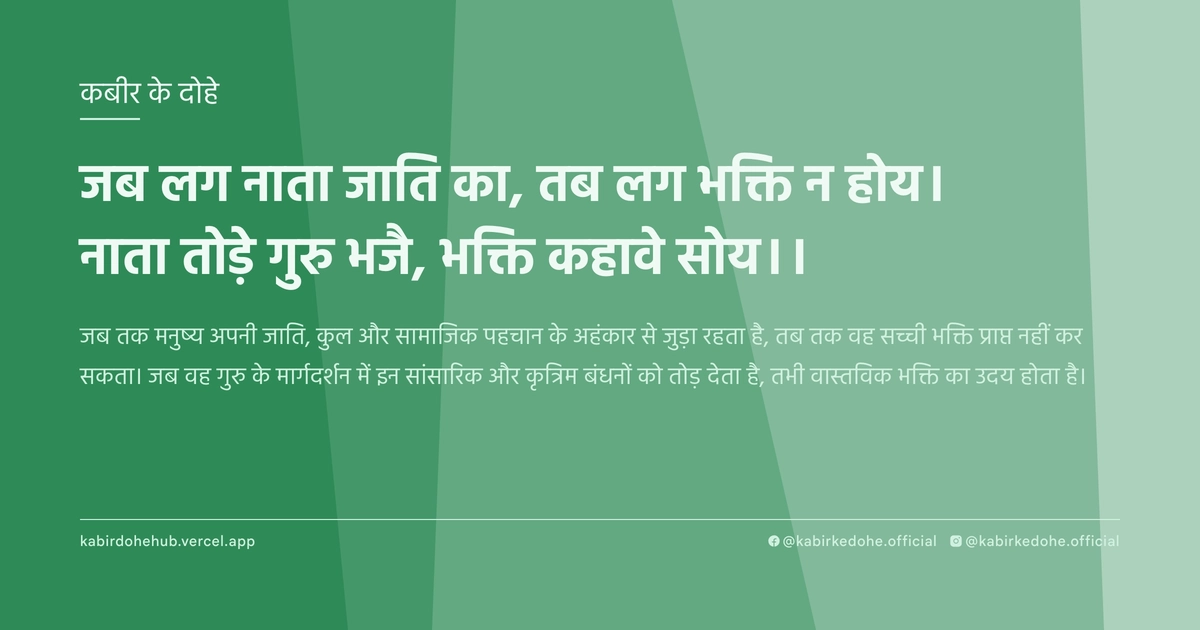
जब लग नाता जाति का, तब लग भक्ति न होय।
नाता तोड़े गुरु भजै, भक्ति कहावे सोय।।
Jab lag nata jati ka, tab lag bhakti na hoye. Nata tode guru bhajai, bhakti kahave soy.
इस पृष्ठ पर इस कबीर दोहे का अर्थ (meaning), हिंदी व्याख्या और अंग्रेज़ी अनुवाद, दार्शनिक विश्लेषण और व्यावहारिक जीवन सीख दी गई है। यह दोहा जाति विरोध (Anti-casteism) विषय से जुड़ा है — Kabir doha meaning and explanation in Hindi and English.
अर्थ (Meaning):
जब तक मनुष्य अपनी जाति, कुल और सामाजिक पहचान के अहंकार से जुड़ा रहता है, तब तक वह सच्ची भक्ति प्राप्त नहीं कर सकता। जब वह गुरु के मार्गदर्शन में इन सांसारिक और कृत्रिम बंधनों को तोड़ देता है, तभी वास्तविक भक्ति का उदय होता है।
As long as a person remains tethered to the ego of caste, lineage, and social identity, true devotion remains unattainable. Only when these artificial worldly bonds are severed through the guidance of a Guru does genuine spiritual devotion manifest.
व्याख्या (Interpretation):
इस दोहे का शाब्दिक अर्थ है कि जातिगत पहचान भक्ति के मार्ग में बाधा है। गहरे स्तर पर, 'जाति' केवल जन्म आधारित समूह नहीं, बल्कि उस 'अहंकार' का प्रतीक है जो हमें दूसरों से अलग करता है। यह द्वैत (duality) की स्थिति है जहाँ व्यक्ति स्वयं को एक सीमित पहचान में कैद कर लेता है। निर्गुण भक्ति के अनुसार, ईश्वर निराकार है और वह किसी सामाजिक श्रेणी में नहीं बँधा है। जब साधक गुरु की कृपा से इस मिथ्या पहचान (माया) को नष्ट करता है, तो वह अपनी आत्मा (Atman) का ब्रह्म (Brahman) के साथ मिलन महसूस करता है। यह प्रक्रिया 'अहं' के विसर्जन की है, जहाँ 'मैं' एक जाति का सदस्य होने के बजाय केवल एक चेतना बन जाता है।
Literally, the verse asserts that caste identity is an obstacle to devotion. Metaphorically, 'caste' represents the broader psychological construct of the ego—the fragmented identity that separates the self from the whole. This is the state of duality, where the individual is imprisoned by a limited, socially conditioned persona. In the realm of Nirgun Bhakti, the Divine is formless and transcends all social hierarchies. When a seeker, guided by a Guru, shatters this illusory identity (Maya), they realize the non-duality of Atman and Brahman. The process is one of ego-annihilation, where the 'I' ceases to be a member of a specific group and transforms into pure, universal consciousness.
दार्शनिक विश्लेषण (Philosophical Analysis):
कबीर का यह दोहा उस समय के कठोर सामाजिक ढांचे पर एक प्रहार है जहाँ धर्म को कर्मकांडों और जन्म आधारित श्रेष्ठता से जोड़ा गया था। कबीर ने स्पष्ट किया कि ईश्वर की प्राप्ति के लिए किसी विशेष कुल या जाति का होना आवश्यक नहीं है। यह विचार अद्वैत वेदांत के इस सिद्धांत से मेल खाता है कि आत्मा शुद्ध है और वह किसी भी सांसारिक लेबल से परे है।
सूफीवाद के प्रभाव में, कबीर 'फना' (अहंकार का विनाश) की बात करते हैं। उनके लिए भक्ति केवल माला जपना नहीं, बल्कि उस मानसिक दीवार को गिराना है जो हमें दूसरे मनुष्य से अलग करती है। जाति का नाता तोड़ना वास्तव में उस सामाजिक कंडीशनिंग को तोड़ना है जो हमें यह विश्वास दिलाती है कि हम दूसरों से श्रेष्ठ या निम्न हैं।
कबीर का विरोध केवल बाहरी जाति व्यवस्था से नहीं, बल्कि उस आंतरिक श्रेष्ठता बोध से था जो भक्ति के मार्ग में सबसे बड़ा अवरोध है। वे तर्क देते हैं कि जब तक व्यक्ति अपनी पहचान को एक समूह से जोड़कर देखता है, वह 'स्व' को नहीं जान सकता। यह मनोवैज्ञानिक रूपांतरण है जहाँ व्यक्ति अपनी सामाजिक पहचान को त्यागकर वैश्विक पहचान अपनाता है।
यहाँ 'गुरु' की भूमिका अत्यंत महत्वपूर्ण है। गुरु वह उत्प्रेरक है जो साधक को यह दिखाता है कि उसकी पहचान उसकी जाति नहीं, बल्कि उसकी चेतना है। बिना गुरु के, व्यक्ति अक्सर अपने अहंकार को ही 'भक्ति' समझ बैठता है। गुरु का कार्य उस दर्पण को साफ करना है जिसमें साधक अपनी वास्तविक, अद्वैत प्रकृति को देख सके।
अंततः, यह दोहा यह संदेश देता है कि सच्ची भक्ति केवल तभी संभव है जब हम अपनी संकीर्ण पहचानों का त्याग कर दें। यह एक क्रांतिकारी आह्वान है जो धर्म को मंदिर, मस्जिद और जातिगत सीमाओं से निकालकर हृदय की गहराई में स्थापित करता है, जहाँ केवल प्रेम और सत्य का वास होता है।
This couplet is a direct assault on the rigid social structures of Kabir's era, where spirituality was often conflated with ritualism and birth-based superiority. Kabir asserts that divine realization requires no specific lineage or caste. This aligns with the core tenet of Advaita Vedanta: the soul is pure and exists beyond all worldly labels and social constructs.
Influenced by Sufism, Kabir speaks of 'Fana'—the annihilation of the ego. For him, devotion is not the mechanical repetition of prayers but the dismantling of the mental walls that separate one human from another. Severing the 'bond of caste' is essentially breaking the social conditioning that convinces us of our inherent superiority or inferiority.
Kabir's critique extends beyond the external caste system to the internal sense of pride. He argues that as long as an individual defines themselves through a group identity, they cannot realize the 'Self'. This is a psychological transformation where the practitioner shifts from a narrow social identity to a universal consciousness.
The role of the 'Guru' is pivotal here. The Guru acts as the catalyst who reveals that the seeker's true identity is not their caste, but their consciousness. Without a guide, a seeker often mistakes their ego for spiritual attainment. The Guru cleanses the mirror, allowing the seeker to perceive their non-dual nature.
Ultimately, the verse teaches that genuine devotion is possible only after the shedding of restrictive identities. It is a revolutionary call to move religion out of temples, mosques, and caste boundaries and plant it deep within the heart, where only love and truth reside.
मूल संदेश (Core Message):
- सामाजिक पहचान एक मानसिक कारागार है जो आत्मा को सीमित करती है।
- सच्ची भक्ति के लिए अहंकार का पूर्ण विसर्जन अनिवार्य है।
- गुरु वह कुल्हाड़ी है जो जाति और वर्ग के मोह को काटती है।
- ईश्वर किसी कुल का नहीं, बल्कि शुद्ध चेतना का अनुभव है।
- मानवीय एकता ही आध्यात्मिक उत्थान का एकमात्र वास्तविक मार्ग है।
- Social identity is a mental prison that limits the expansion of the soul.
- The total dissolution of the ego is mandatory for genuine devotion.
- The Guru is the axe that severs the attachment to caste and class.
- The Divine is not a property of any lineage, but an experience of pure consciousness.
- Universal human unity is the only authentic path to spiritual elevation.
व्यावहारिक उदाहरण (Practical Example):
वाराणसी के घाटों पर रहने वाला एक वृद्ध विधवा, जानकी, अपनी पूरी जिंदगी इस विश्वास में बिता चुकी थी कि उसकी सामाजिक स्थिति और उसकी जाति की मर्यादाएं ही उसके जीवन का एकमात्र सत्य हैं। वह अन्य महिलाओं से दूरी बनाए रखती थी क्योंकि उसे सिखाया गया था कि उसकी शुद्धता उसके कुल के नियमों के पालन में है।
एक दिन उसकी मुलाकात एक घुमंतू साधु से हुई, जिसने उसे एक साधारण सा प्रश्न पूछा: 'जब तुम सोती हो, तो क्या तुम्हारी जाति भी तुम्हारे साथ सोती है, या केवल तुम्हारी आत्मा?' जानकी इस प्रश्न से विचलित हो गई। उसने महसूस किया कि उसकी पूरी पहचान केवल दूसरों की नजरों में बनी एक छवि थी।
उसने देखा कि उसके पड़ोस में एक अछूत मानी जाने वाली महिला रहती थी, जो अत्यंत दयालु थी और सबकी मदद करती थी। जानकी के मन में द्वंद्व था—एक तरफ उसके कुल की मर्यादा थी और दूसरी तरफ वह मानवीय प्रेम जो वह उस महिला में देख रही थी।
साधु ने उसे समझाया कि जब तक वह खुद को 'उच्च कुल' की महिला मानती रहेगी, वह ईश्वर के उस प्रेम को नहीं समझ पाएगी जो सबके लिए समान है। उसने कहा, 'यह जाति का नाता एक जंजीर है, जिसे तोड़कर ही तुम मुक्त हो सकती हो।'
जानकी ने धीरे-धीरे अपने मन के पूर्वाग्रहों को चुनौती देना शुरू किया। उसने पहली बार उस महिला का हाथ थामा और उसके साथ बैठकर भोजन किया। उस क्षण, उसे एक ऐसी शांति महसूस हुई जो उसने वर्षों के कठोर अनुष्ठानों में कभी नहीं पाई थी।
उसने महसूस किया कि उसकी 'शुद्धता' बाहरी नियमों में नहीं, बल्कि इस अहसास में थी कि वह और वह दूसरी महिला एक ही ईश्वरीय प्रकाश के अंश हैं। उसका अहंकार, जो उसकी जाति की श्रेष्ठता पर टिका था, पूरी तरह ढह गया।
अब जानकी घाटों पर केवल अपनी जाति की महिलाओं के साथ नहीं, बल्कि हर उस व्यक्ति के साथ बैठती थी जो सत्य की खोज में था। उसने अपनी सामाजिक पहचान को त्याग कर एक 'मानवीय पहचान' अपना ली थी।
यह 'कबीर ट्विस्ट' था—एक साधारण प्रश्न ने उसकी सदियों पुरानी मानसिक बेड़ियों को तोड़ दिया। उसकी भक्ति अब दिखावे और नियमों से मुक्त होकर एक सहज, प्रेमपूर्ण समर्पण में बदल गई थी।
Janaki, an elderly widow living on the ghats of Varanasi, had spent her entire life believing that her social standing and the restrictions of her caste were the only truths of her existence. She maintained a distance from other women, taught that her purity lay in adhering to the strict codes of her lineage.
One day, she encountered a wandering ascetic who asked her a simple yet piercing question: 'When you sleep, does your caste sleep with you, or is it only your soul that rests?' Janaki was shaken. She realized that her entire identity was merely an image constructed in the eyes of others.
She noticed a woman living nearby, regarded as 'untouchable' by society, who was profoundly compassionate and helped everyone. Janaki felt a conflict—on one side was the dignity of her lineage, and on the other was the raw human love she witnessed in that woman.
The ascetic explained that as long as she clung to the label of being from a 'high caste,' she would never understand the Divine love that is equal for all. He told her, 'This bond of caste is a chain; only by breaking it can you find liberation.'
Slowly, Janaki began to challenge her internal prejudices. For the first time, she reached out and held the hand of the other woman, sharing a meal with her. In that moment, she experienced a peace that years of rigid rituals had never provided.
She realized that her 'purity' did not reside in external rules, but in the realization that she and the other woman were sparks of the same divine light. Her ego, built on the foundation of caste superiority, completely collapsed.
Janaki no longer sat only with women of her own caste on the ghats; she sat with anyone seeking truth. She had discarded her social identity in favor of a universal human identity.
This was the 'Kabir Twist'—a single question shattered centuries of mental conditioning. Her devotion shifted from a performance of rules to a spontaneous, loving surrender.
अभ्यास मार्गदर्शन (Practice Guidance):
- प्रतिदिन 20 मिनट मौन ध्यान करें और विचार करें कि यदि आपकी सामाजिक पहचान (नाम, पद, जाति) छीन ली जाए, तो आप वास्तव में कौन हैं।
- एक 'अहंकार जर्नल' बनाएँ: उन क्षणों को लिखें जब आपने किसी को उसकी पृष्ठभूमि या पहचान के आधार पर आंका। विश्लेषण करें कि वह निर्णय आपके किस आंतरिक डर या श्रेष्ठता बोध से उपजा था।
- सचेत व्यवहार परिवर्तन: सप्ताह में एक बार ऐसे व्यक्ति के साथ समय बिताएं या उनकी मदद करें जिससे आप अपनी सामाजिक या वैचारिक मान्यताओं के कारण दूरी बनाते रहे हैं।
- डायग्नोस्टिक चेकलिस्ट: क्या मैं दूसरों की मदद करते समय यह सोचता हूँ कि मैं 'श्रेष्ठ' हूँ? क्या मेरी शांति इस बात पर निर्भर है कि लोग मुझे किस सम्मान से बुलाते हैं? यदि हाँ, तो जाति/अहंकार का नाता अभी भी मौजूद है।
- Practice 20 minutes of silent meditation daily, contemplating: 'If my social identity (name, title, caste) were stripped away, who would I truly be?'
- Maintain an 'Ego Journal': Record moments when you judged someone based on their background or identity. Analyze which internal fear or sense of superiority triggered that judgment.
- Conscious Behavioral Shift: Once a week, spend time with or help someone you have historically avoided due to social or ideological biases.
- Diagnostic Checklist: Do I feel 'superior' while helping others? Does my peace depend on the titles or respect others accord me? If yes, the 'bond of identity' still persists.
चिंतन प्रश्न (Reflection Questions):
- मेरी वह कौन सी 'अदृश्य जाति' या पहचान है (जैसे शिक्षित, अमीर, आधुनिक) जिसका उपयोग मैं दूसरों को छोटा महसूस कराने के लिए करता हूँ?
- यदि कल मेरी सारी सामाजिक प्रतिष्ठा समाप्त हो जाए, तो क्या मेरे भीतर कोई ऐसा मूल्य बचेगा जिसे मैं अपना कह सकूँ?
- क्या मेरी भक्ति वास्तव में ईश्वर के प्रति है, या मैं केवल अपनी धार्मिक पहचान के माध्यम से समाज में स्वीकृति चाहता हूँ?
- मेरे भीतर का वह कौन सा डर है जो मुझे अपनी पहचान के दायरे से बाहर निकलने से रोकता है?
- क्या मैं वास्तव में समानता में विश्वास करता हूँ, या मैं केवल उन लोगों के साथ समानता चाहता हूँ जो मेरे जैसे हैं?
- What is the 'invisible caste' or identity (e.g., educated, wealthy, modern) that I use to subtly make others feel inferior?
- If all my social prestige were stripped away tomorrow, would there be any value left within me that I could call my own?
- Is my devotion truly toward the Divine, or am I merely seeking social validation through my religious identity?
- What is the specific fear within me that prevents me from stepping outside the boundaries of my conditioned identity?
- Do I truly believe in equality, or do I only desire equality with those who are similar to me?