
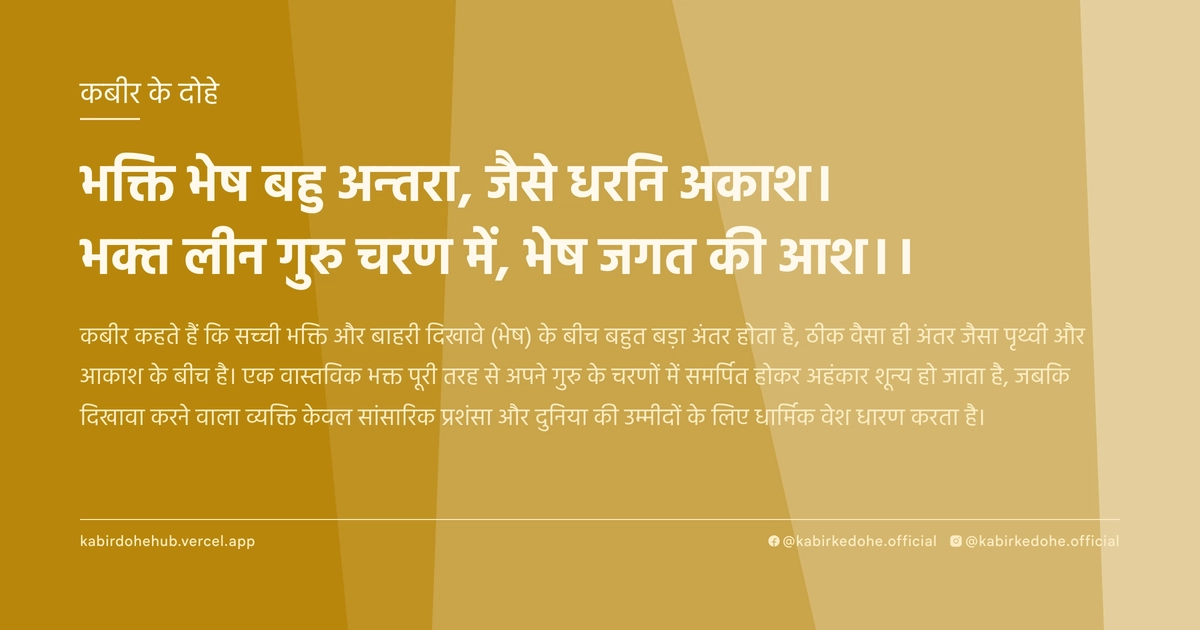
भक्ति भेष बहु अन्तरा, जैसे धरनि अकाश।
भक्त लीन गुरु चरण में, भेष जगत की आश।।
Bhakti bhesh bahu antara, jaise dharni akash. Bhakt leen guru charan mein, bhesh jagat ki aash.
इस पृष्ठ पर इस कबीर दोहे का अर्थ (meaning), हिंदी व्याख्या और अंग्रेज़ी अनुवाद, दार्शनिक विश्लेषण और व्यावहारिक जीवन सीख दी गई है। यह दोहा भक्ति (Bhakti) विषय से जुड़ा है — Kabir doha meaning and explanation in Hindi and English.
अर्थ (Meaning):
कबीर कहते हैं कि सच्ची भक्ति और बाहरी दिखावे (भेष) के बीच बहुत बड़ा अंतर होता है, ठीक वैसा ही अंतर जैसा पृथ्वी और आकाश के बीच है। एक वास्तविक भक्त पूरी तरह से अपने गुरु के चरणों में समर्पित होकर अहंकार शून्य हो जाता है, जबकि दिखावा करने वाला व्यक्ति केवल सांसारिक प्रशंसा और दुनिया की उम्मीदों के लिए धार्मिक वेश धारण करता है।
Kabir asserts that there is a profound chasm between genuine devotion and outward religious appearance, as vast as the distance between the earth and the sky. A true devotee is completely absorbed in the guidance of the Guru, dissolving the ego, whereas one who merely adopts a spiritual guise does so only to seek validation and expectations from the worldly society.
व्याख्या (Interpretation):
इस दोहे का शाब्दिक अर्थ बाहरी आडंबर और आंतरिक सत्य के विरोधाभास को दर्शाता है। 'धरनि अकाश' का रूपक यह बताता है कि दिखावा और वास्तविकता दो विपरीत ध्रुव हैं। यहाँ 'भेष' माया का प्रतीक है, जो मनुष्य को यह भ्रम देता है कि वह पवित्र है, जबकि उसका मन अभी भी वासनाओं में लिप्त है। निर्गुण भक्ति के संदर्भ में, ईश्वर किसी विशेष वस्त्र या तिलक में नहीं, बल्कि हृदय की शुद्धि में बसता है। जब भक्त 'गुरु चरण' में लीन होता है, तो वह द्वैत (Duality) को समाप्त कर अद्वैत (Non-duality) की स्थिति में पहुँचता है। यह समर्पण केवल शारीरिक नहीं, बल्कि मानसिक अहंकार का विसर्जन है। अंततः, यह दोहा हमें चेतावनी देता है कि धर्म को सामाजिक प्रतिष्ठा का साधन बनाने से आध्यात्मिक प्रगति रुक जाती है।
The literal meaning of this couplet highlights the paradox between external ostentation and internal truth. The metaphor of 'earth and sky' illustrates that appearance and reality are polar opposites. Here, 'bhesh' (guise) symbolizes Maya, the cosmic illusion that tricks a person into believing they are holy while their mind remains tethered to worldly desires. In the context of Nirgun Bhakti, the Divine does not reside in specific garments or ritualistic marks, but in the purity of the heart. When a devotee is 'absorbed in the Guru's feet,' they transcend duality to reach the state of Advaita (Non-duality). This surrender is not merely physical but a total dissolution of the ego. Ultimately, the verse warns that treating religion as a tool for social prestige halts spiritual evolution.
दार्शनिक विश्लेषण (Philosophical Analysis):
कबीर का यह विचार उनके युग के धार्मिक पाखंड के विरुद्ध एक सशक्त प्रहार है। 15वीं शताब्दी में, धर्म अक्सर बाहरी प्रतीकों—जैसे माला, भस्म और विशेष वस्त्रों—तक सीमित हो गया था। कबीर ने इस 'संस्थागत धर्म' को चुनौती दी और 'सहज मार्ग' का समर्थन किया। उनका दर्शन अद्वैत वेदांत से प्रेरित है, जहाँ आत्मा और परमात्मा को एक माना गया है। उनके अनुसार, जब तक 'मैं' (अहंकार) जीवित है, तब तक ईश्वर का अनुभव असंभव है।
सूफी मत के 'फना' (अहंकार का विनाश) के सिद्धांत के समान, कबीर यहाँ गुरु के चरणों में लीन होने की बात करते हैं। यह लीनता कोई अंधभक्ति नहीं, बल्कि विवेक का जागरण है। वे स्पष्ट करते हैं कि जो व्यक्ति दुनिया की 'आश' (उम्मीद) में जीता है, वह वास्तव में अपनी ही छवि की पूजा कर रहा है। यह मनोवैज्ञानिक बंधन व्यक्ति को सत्य से दूर ले जाता है क्योंकि वह अपनी पहचान बाहरी प्रशंसा में खोजता है।
कबीर का विरोध केवल ब्राह्मणवादी या मौलवी परंपराओं से नहीं था, बल्कि उस मानवीय प्रवृत्ति से था जो सत्य को ढकने के लिए मुखौटों का उपयोग करती है। वे तर्क देते हैं कि यदि भक्ति केवल बाहरी है, तो वह एक बोझ है। वास्तविक भक्ति वह है जो व्यक्ति को विनम्र बनाए और उसे जाति, धर्म और वर्ग के भेदों से ऊपर उठाए।
यहाँ 'गुरु' केवल एक व्यक्ति नहीं, बल्कि वह प्रकाश है जो शिष्य के भीतर के अंधकार को मिटाता है। गुरु का कार्य शिष्य को यह दिखाना है कि वह जिसे बाहर खोज रहा है, वह उसके भीतर ही है। जब यह बोध होता है, तो बाहरी भेष की आवश्यकता समाप्त हो जाती है।
अंततः, यह विश्लेषण हमें सिखाता है कि आध्यात्मिक यात्रा 'पाने' की नहीं, बल्कि 'खोने' की प्रक्रिया है। अपनी सामाजिक पहचान, अपनी प्रतिष्ठा और अपने अहंकार को खोकर ही वह पाया जा सकता है जो शाश्वत है। दिखावा एक मानसिक कारागार है, जबकि समर्पण मुक्ति का द्वार है।
Kabir's thought here is a powerful strike against the religious hypocrisy of his era. In the 15th century, religion had largely become confined to external symbols—such as beads, ash, and specific attire. Kabir challenged this 'institutionalized religion' and advocated for the 'Sahaj Marg' (the Natural Path). His philosophy is deeply influenced by Advaita Vedanta, where the Atman (soul) and Brahman (universal consciousness) are seen as one.
Parallel to the Sufi concept of 'Fana' (the annihilation of the self), Kabir speaks of being absorbed in the Guru's feet. This absorption is not blind faith but the awakening of discernment (Viveka). He clarifies that a person living in 'aash' (expectation) of the world is essentially worshipping their own image. This psychological bondage distances the individual from the Truth because they seek identity in external validation.
Kabir's opposition was not merely against Brahminical or Mullah traditions, but against the human tendency to use masks to conceal the Truth. He argues that if devotion is purely external, it becomes a burden. True devotion is that which renders a person humble and elevates them above the divisions of caste, creed, and class.
In this context, the 'Guru' is not just a person, but the light that dispels the darkness within the disciple. The Guru's role is to show the disciple that what they seek externally is already within. Once this realization dawns, the need for an external guise vanishes.
Ultimately, this analysis teaches us that the spiritual journey is not a process of 'acquiring,' but of 'losing.' Only by shedding social identity, prestige, and ego can one find that which is eternal. Ostentation is a mental prison, while surrender is the gateway to liberation.
मूल संदेश (Core Message):
- बाहरी दिखावा आध्यात्मिक प्रगति का सबसे बड़ा अवरोध है।
- सच्ची भक्ति अहंकार के पूर्ण विसर्जन में निहित है।
- गुरु का अर्थ केवल व्यक्ति नहीं, बल्कि आंतरिक सत्य का बोध है।
- दुनिया की प्रशंसा की इच्छा आत्मा को बंधन में डालती है।
- सादगी और सत्यता ही ईश्वर तक पहुँचने का एकमात्र मार्ग हैं।
- External ostentation is the greatest obstacle to spiritual progress.
- True devotion lies in the total dissolution of the ego.
- The Guru is not merely a person, but the awakening of internal truth.
- The desire for worldly praise shackles the soul in illusion.
- Simplicity and authenticity are the only paths to the Divine.
व्यावहारिक उदाहरण (Practical Example):
वाराणसी के एक पुराने घाट पर रामदीन नाम का एक वृद्ध नाविक रहता था। रामदीन ने जीवन भर नाव चलाई थी, लेकिन वह खुद को बहुत धार्मिक मानता था। उसने एक बड़ा सा तिलक लगाया, गले में कई रुद्राक्ष की मालाएं पहनीं और हमेशा सफेद धोती पहनता था ताकि लोग उसे एक 'साधु' की तरह देखें। वह घाट पर आने वाले तीर्थयात्रियों को उपदेश देता था और अपनी धार्मिकता का प्रदर्शन करता था, जिससे उसे समाज में सम्मान और कुछ अतिरिक्त दान मिलता था।
उसी घाट के कोने में एक शांत व्यक्ति बैठता था, जिसे लोग केवल 'मौन बाबा' कहते थे। बाबा के पास न तो कोई विशेष वस्त्र थे और न ही कोई तिलक। वे फटे हुए सूती कपड़े पहनते थे और चुपचाप अपनी नाव की मरम्मत करते थे। रामदीन अक्सर उनका मजाक उड़ाता और कहता, 'देखो, भक्ति का कोई भेष नहीं है इनके पास, ये क्या साधु बनेंगे?'
एक दिन शहर में एक बहुत बड़ा विद्वान आया। रामदीन ने अपनी पूरी तैयारी की—नया तिलक, नई माला और सबसे शुद्ध वस्त्र। वह विद्वान के सामने गया और अपनी विद्वत्ता और भक्ति का प्रदर्शन करने लगा। लेकिन विद्वान ने उसकी बातों में केवल अहंकार देखा, श्रद्धा नहीं। विद्वान ने रामदीन की ओर देखा भी नहीं और सीधे उस मौन बाबा के पास गया जो चुपचाप किनारे पर बैठे थे।
विद्वान ने बाबा के चरणों में सिर झुकाया और कहा, 'इतने वर्षों बाद मुझे एक ऐसा व्यक्ति मिला जिसकी आँखों में शांति है और हृदय में कोई दिखावा नहीं।' रामदीन यह देखकर स्तब्ध रह गया। उसे समझ नहीं आया कि जिस व्यक्ति को वह 'भेषहीन' समझकर तुच्छ मानता था, वह वास्तव में इतना ऊंचा कैसे हो गया।
रामदीन ने बाबा से पूछा, 'आपने ऐसा क्या किया कि आप इतने पूजनीय बन गए? आपने तो कभी कोई व्रत नहीं किया, न ही कोई विशेष वस्त्र पहने।' बाबा ने मंद मुस्कान के साथ उत्तर दिया, 'बेटा, मैं वस्त्रों को नहीं, अपने भीतर के शोर को शांत करने का प्रयास करता रहा। तुम दुनिया को दिखाने के लिए साधु बने, मैं अपने भीतर के ईश्वर को खोजने के लिए शून्य बना।'
यह सुनकर रामदीन के भीतर कुछ टूट गया। उसे एहसास हुआ कि उसका तिलक और माला केवल एक मुखौटा थे, जिनके पीछे वह अपनी असुरक्षा और अहंकार को छिपा रहा था। वह दुनिया की 'आश' में जी रहा था, जबकि बाबा गुरु के ज्ञान में लीन थे।
अगले दिन, रामदीन ने अपनी भारी मालाएं उतार दीं और तिलक पोंछ लिया। उसने अब उपदेश देना बंद कर दिया और चुपचाप नाव चलाने लगा, लेकिन अब उसकी नाव में केवल यात्री नहीं, बल्कि करुणा और सेवा का भाव था।
उसने सीखा कि असली भक्ति वह नहीं जो दुनिया को दिखे, बल्कि वह है जो व्यक्ति को भीतर से बदल दे। उसका जीवन अब प्रदर्शन से हटकर समर्पण की ओर मुड़ गया था।
On an ancient ghat in Varanasi lived an elderly boatman named Ramdeen. Ramdeen had spent his life rowing boats, but he considered himself deeply religious. He wore a large tilak, multiple rudraksha beads around his neck, and always dressed in a pristine white dhoti so that people would perceive him as a 'sadhu.' He would preach to the pilgrims visiting the ghat, showcasing his piety to earn social respect and extra alms.
In a quiet corner of the same ghat sat a man known simply as 'Maun Baba' (Silent Father). Baba wore no special attire, no tilak, and no beads. He dressed in torn cotton clothes and spent his days silently repairing old boats. Ramdeen often mocked him, saying, 'Look at him, he has no guise of devotion; how can such a man be a seeker?'
One day, a renowned scholar visited the city. Ramdeen prepared himself meticulously—a fresh tilak, new beads, and his cleanest clothes. He approached the scholar and began demonstrating his knowledge and devotion. However, the scholar saw only ego in Ramdeen's words, not faith. The scholar ignored Ramdeen and walked straight to the silent Baba sitting by the shore.
The scholar bowed deeply at Baba's feet and said, 'After so many years, I have finally found a man whose eyes hold peace and whose heart holds no pretense.' Ramdeen was stunned. He could not comprehend how the man he dismissed as 'guise-less' could be so revered.
Ramdeen asked Baba, 'What did you do to become so venerable? You never observed strict fasts, nor did you wear sacred clothes.' Baba replied with a gentle smile, 'Son, I did not try to dress the body; I tried to silence the noise within. You became a sadhu to show the world; I became nothing to find the Divine within.'
Hearing this, something broke inside Ramdeen. He realized that his tilak and beads were merely masks hiding his insecurity and ego. He had been living for the 'expectations' of the world, while Baba was absorbed in the wisdom of the Guru.
The next day, Ramdeen removed his heavy beads and wiped away his tilak. He stopped preaching and returned to rowing his boat, but now his boat carried not just passengers, but a sense of compassion and service.
He learned that true devotion is not what is visible to the world, but that which transforms the individual from within. His life shifted from performance to surrender.
अभ्यास मार्गदर्शन (Practice Guidance):
- दैनिक आत्म-निरीक्षण: प्रतिदिन 15 मिनट मौन बैठें और स्वयं से पूछें—'आज मैंने जो भी कार्य किया, क्या वह मेरी आंतरिक खुशी के लिए था या दूसरों को प्रभावित करने के लिए?'
- अहंकार का विसर्जन: दिन में कम से कम एक ऐसा कार्य करें जिसमें आपकी प्रशंसा न हो, बल्कि आप पर्दे के पीछे रहकर किसी की मदद करें।
- सादा जीवन, उच्च विचार: अपने पहनावे या बाहरी प्रतीकों के बजाय अपने व्यवहार की विनम्रता पर ध्यान केंद्रित करें।
- डायरी लेखन: उन क्षणों को लिखें जब आपने 'धार्मिक' दिखने की कोशिश की लेकिन वास्तव में आप क्रोधित या ईर्ष्यालु महसूस कर रहे थे।
- निदान चेकलिस्ट: यदि आप किसी की आलोचना करते समय खुद को श्रेष्ठ महसूस करते हैं, तो समझ लें कि आप 'भेष' (अहंकार) में हैं, 'भक्ति' में नहीं।
- Daily Self-Inquiry: Sit in silence for 15 minutes daily and ask yourself—'Was the action I performed today for my internal peace or to impress others?'
- Dissolution of Ego: Perform at least one act of service daily where you remain anonymous and receive no praise.
- Simplicity over Symbolism: Focus on the humility of your behavior rather than the symbols of your attire or religious markers.
- Journaling: Record moments where you tried to appear 'spiritual' while internally feeling anger or jealousy.
- Diagnostic Checklist: If you feel a sense of superiority while criticizing others, recognize that you are operating from 'Bhesh' (ego/guise) rather than 'Bhakti' (devotion).
चिंतन प्रश्न (Reflection Questions):
- मेरे जीवन का वह कौन सा 'धार्मिक मुखौटा' है जिसे मैं समाज के सामने पहनता हूँ?
- क्या मेरी आध्यात्मिकता मुझे दूसरों के प्रति अधिक विनम्र बनाती है या अधिक निर्णयात्मक?
- यदि मुझसे मेरे सभी बाहरी धार्मिक प्रतीक छीन लिए जाएँ, तो क्या मेरी भक्ति जीवित रहेगी?
- मैं अपनी पहचान को अपनी उपलब्धियों और पद से अलग कैसे कर सकता हूँ?
- क्या मैं वास्तव में सत्य की खोज कर रहा हूँ, या केवल 'सत्य खोजने वाले' की छवि बना रहा हूँ?
- What is the 'religious mask' in my life that I wear for the sake of social acceptance?
- Does my spirituality make me more humble toward others, or more judgmental?
- If all my external religious symbols were stripped away, would my devotion still exist?
- How can I detach my identity from my achievements and social status?
- Am I truly seeking the Truth, or am I merely crafting the image of a 'truth-seeker'?