
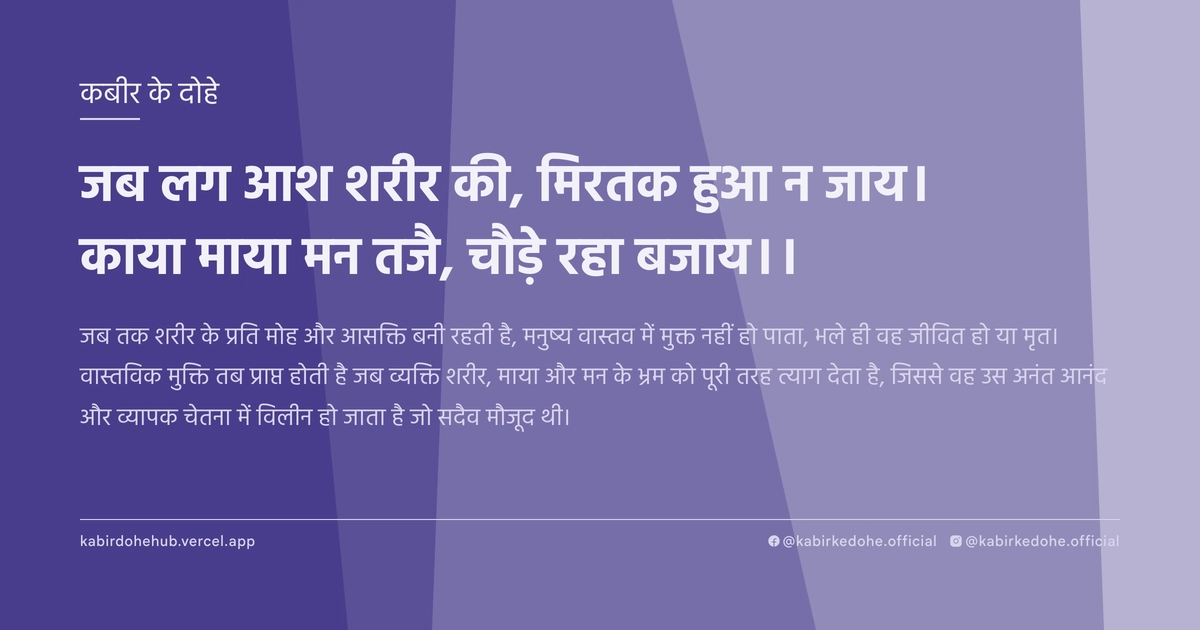
जब लग आश शरीर की, मिरतक हुआ न जाय।
काया माया मन तजै, चौडे़ रहा बजाय।।
Jab lag aash shareer ki, mirtak hua na jaaye. Kaya maya man tajai, chaude raha bajaye.
इस पृष्ठ पर इस कबीर दोहे का अर्थ (meaning), हिंदी व्याख्या और अंग्रेज़ी अनुवाद, दार्शनिक विश्लेषण और व्यावहारिक जीवन सीख दी गई है। यह दोहा मोह (Attachment) विषय से जुड़ा है — Kabir doha meaning and explanation in Hindi and English.
अर्थ (Meaning):
जब तक शरीर के प्रति मोह और आसक्ति बनी रहती है, मनुष्य वास्तव में मुक्त नहीं हो पाता, भले ही वह जीवित हो या मृत। वास्तविक मुक्ति तब प्राप्त होती है जब व्यक्ति शरीर, माया और मन के भ्रम को पूरी तरह त्याग देता है, जिससे वह उस अनंत आनंद और व्यापक चेतना में विलीन हो जाता है जो सदैव मौजूद थी।
As long as the attachment to the physical body persists, one cannot achieve true liberation, remaining trapped even in the face of death. Real freedom is attained only when one renounces the illusions of the body, the material world (Maya), and the flickering mind, thereby expanding into the vast, eternal resonance of the Absolute Truth.
व्याख्या (Interpretation):
यह दोहा शरीर की नश्वरता और आत्मा की अमरता के बीच के द्वंद्व को दर्शाता है। 'मिरतक' शब्द यहाँ केवल शारीरिक मृत्यु नहीं, बल्कि अहंकार की मृत्यु का संकेत है। जब तक हम स्वयं को केवल मांस और हड्डियों का ढांचा मानते हैं, हम माया के बंधन में जकड़े रहते हैं। निरगुण भक्ति के अनुसार, ईश्वर किसी मूर्ति में नहीं बल्कि इस शरीर के भीतर साक्षी रूप में है। जब मन और माया का पर्दा हटता है, तब 'चौडे़ रहा बजाय' का अर्थ है कि साधक उस विराट शून्यता और पूर्णता का अनुभव करता है जहाँ कोई सीमा नहीं रहती। यह अद्वैत वेदांत के उस सत्य की पुष्टि है जहाँ आत्मा और ब्रह्म एक हो जाते हैं, और व्यक्तिगत पहचान का विसर्जन वैश्विक चेतना में हो जाता है।
This couplet illustrates the conflict between the perishability of the body and the immortality of the soul. The term 'mirtak' (corpse) refers not merely to physical death, but to the essential death of the ego. As long as we identify solely with the flesh and bone, we remain shackled by Maya. In the tradition of Nirgun Bhakti, the Divine is not found in idols but as the Witness within. When the veil of mind and illusion is lifted, 'chaude raha bajaay' signifies the practitioner expanding into the vast emptiness and fullness of the Absolute, where all boundaries dissolve. This affirms the Advaita Vedanta truth of non-duality, where the Atman merges with Brahman, and the limited personal identity is subsumed by universal consciousness.
दार्शनिक विश्लेषण (Philosophical Analysis):
कबीर का यह दर्शन उनके समय के कर्मकांडीय आडंबरों और बाहरी दिखावे के विरुद्ध एक सशक्त प्रहार है। उन्होंने देखा कि लोग तीर्थयात्रा और पूजा-पाठ में लीन थे, लेकिन अपने भीतर के अहंकार को समाप्त करने का प्रयास नहीं कर रहे थे। कबीर यहाँ 'देह-अभिमान' को सबसे बड़ी बाधा मानते हैं। उनके अनुसार, शरीर एक वस्त्र की तरह है, जिसे आत्मा बदलती रहती है। जब तक हम इस वस्त्र को ही अपनी पहचान मानेंगे, हम जन्म-मृत्यु के चक्र में फंसे रहेंगे।
यह विचार सूफीवाद के 'फना' (अहंकार का विनाश) के करीब है, जहाँ प्रेमी अपने अस्तित्व को मिटाकर ईश्वर में समा जाता है। कबीर का मार्ग मध्यम मार्ग है—वे संसार छोड़ने को नहीं, बल्कि संसार में रहते हुए उसके प्रति अनासक्ति (detachment) विकसित करने को कहते हैं। यह मानसिक रूपांतरण की प्रक्रिया है जहाँ 'मैं' का विलोपन होता है और 'वह' का उदय होता है।
अद्वैत वेदांत के परिप्रेक्ष्य में, यह दोहा 'माया' के प्रभाव को स्पष्ट करता है। माया वह शक्ति है जो सत्य को छुपाती है और असत्य को सत्य दिखाती है। शरीर और मन इस माया के सबसे सूक्ष्म उपकरण हैं। जब साधक विवेक (discrimination) का उपयोग करता है, तो वह समझ पाता है कि वह शरीर नहीं, बल्कि वह चेतना है जो शरीर का अनुभव कर रही है।
कबीर जाति और धर्म के भेदों को इसलिए नकारते थे क्योंकि ये सभी 'माया' और 'मन' की उपज हैं। यदि शरीर ही मिथ्या है, तो शरीर पर आधारित जाति व्यवस्था और भी अधिक मिथ्या है। उनका दर्शन सामाजिक समानता का आधार इसी आध्यात्मिक सत्य में खोजता है कि हम सब एक ही निराकार तत्व के अंश हैं।
अंततः, यह दोहा मनोवैज्ञानिक मुक्ति की बात करता है। भय, ईर्ष्या और क्रोध केवल तभी तक जीवित रहते हैं जब तक 'मैं' (ego) जीवित है। जिस क्षण व्यक्ति यह अनुभव करता है कि वह शरीर से परे है, वह सभी मानसिक क्लेशों से मुक्त हो जाता है और एक ऐसी शांति प्राप्त करता है जो शब्दों से परे है।
Kabir's philosophy here is a potent strike against the ritualistic pomposity and outward displays of his era. He observed people immersed in pilgrimages and formal worship, yet failing to strive for the annihilation of their inner ego. Kabir identifies 'bodily pride' (deha-abhiman) as the primary obstacle to enlightenment. To him, the body is merely a garment that the soul changes periodically; as long as we mistake the garment for the wearer, we remain trapped in the cycle of Samsara.
This perspective closely aligns with the Sufi concept of 'Fana' (annihilation), where the lover erases their own existence to merge with the Beloved. Kabir proposes a middle path—not the physical abandonment of the world, but the cultivation of detachment while living within it. This is a process of psychological transmutation where the 'I' is dissolved to make way for the 'Thou'.
From the lens of Advaita Vedanta, this couplet elucidates the operation of 'Maya'. Maya is the cosmic illusion that conceals Truth and presents the ephemeral as eternal. The body and mind are the most subtle instruments of this illusion. When the seeker employs Viveka (spiritual discrimination), they realize they are not the body, but the consciousness experiencing the body.
Kabir rejected caste and religious divisions because he saw them as constructs of Maya and the conditioned mind. If the body itself is illusory, then the caste system based on birth is even more fraudulent. His philosophy finds the basis for social equality in the spiritual truth that all beings are fragments of the same formless Absolute.
Ultimately, this verse speaks of psychological liberation. Fear, jealousy, and anger survive only as long as the 'ego' is alive. The moment an individual experiences their existence beyond the physical form, they are liberated from all mental afflictions, attaining a peace that transcends all conceptual understanding.
मूल संदेश (Core Message):
- शरीर की पहचान ही सबसे बड़ा भ्रम है।
- अहंकार की मृत्यु ही वास्तविक जीवन का प्रारंभ है।
- माया का त्याग ही सत्य का साक्षात्कार है।
- मन के शोर को शांत कर अनंत का संगीत सुनें।
- स्वयं को सीमित न मानें, आप विराट चेतना हैं।
- Identification with the body is the ultimate illusion.
- The death of the ego is the true beginning of life.
- Renouncing Maya is the only path to realizing Truth.
- Silence the noise of the mind to hear the music of the Infinite.
- Cease viewing yourself as limited; you are universal consciousness.
व्यावहारिक उदाहरण (Practical Example):
वाराणसी के घाटों पर रहने वाले एक वृद्ध बुनकर थे, जिनका नाम माधव था। माधव ने अपना पूरा जीवन रेशमी साड़ियों की बुनाई में बिताया था। वे अपनी कला पर बहुत गर्व करते थे और मानते थे कि उनकी पहचान उनकी कुशलता और उनके द्वारा बनाए गए कपड़ों से है। वे अक्सर दूसरों को नीचा दिखाते थे जो उतनी बारीकी से काम नहीं कर पाते थे।
एक समय ऐसा आया जब माधव के हाथों में कंपन होने लगा और वे अब पहले की तरह बारीक बुनाई नहीं कर पाए। उनकी आर्थिक स्थिति बिगड़ने लगी और धीरे-धीरे उनके ग्राहक कम हो गए। माधव गहरे अवसाद में चले गए क्योंकि उनकी पूरी पहचान, उनका 'अहंकार', उनके काम से जुड़ा था। उन्हें लगा कि उनका अस्तित्व ही समाप्त हो गया है।
एक दिन उन्होंने एक फकीर को देखा जो घाट पर बैठा केवल मुस्कुरा रहा था, जबकि उसके पास पहनने को ठीक से कपड़े भी नहीं थे। माधव ने उससे पूछा, 'तुम्हारे पास कुछ नहीं है, फिर भी तुम इतने शांत कैसे हो?' फकीर ने मुस्कुराकर कहा, 'मैं वह नहीं हूँ जो मेरे पास है, और मैं वह भी नहीं हूँ जो मैं करता हूँ। मैं तो वह हूँ जो इन सबको देख रहा है।'
यह बात माधव के हृदय में गहरे तक उतर गई। उन्होंने महसूस किया कि उन्होंने जीवन भर केवल 'शरीर' और 'कौशल' की आसक्ति पाले रखी थी। उन्होंने सोचा कि यदि वे अपनी पहचान केवल एक बुनकर के रूप में रखेंगे, तो वे हमेशा दुखी रहेंगे क्योंकि शरीर और कौशल दोनों नश्वर हैं।
माधव ने धीरे-धीरे अपनी पहचान को अपने काम से अलग करना शुरू किया। उन्होंने यह स्वीकार किया कि वे एक आत्मा हैं, जिसका मूल्य किसी बाहरी उपलब्धि से नहीं है। उन्होंने अपने बचे हुए समय में गरीब बच्चों को बुनाई सिखाना शुरू किया, लेकिन अब वे प्रशंसा के लिए नहीं, बल्कि सेवा के लिए ऐसा कर रहे थे।
जब उन्होंने 'मैं सबसे श्रेष्ठ बुनकर हूँ' के विचार को त्याग दिया, तो उन्हें एक अद्भुत हल्कापन महसूस हुआ। उनका मानसिक तनाव गायब हो गया और वे अपनी वर्तमान स्थिति में संतुष्ट रहने लगे।
अब जब वे अपने कांपते हाथों को देखते, तो उन्हें दुख नहीं होता था, बल्कि वे मुस्कुराते थे कि यह शरीर तो केवल एक माध्यम था, और असली आनंद तो भीतर की शांति में है।
माधव की यह यात्रा 'काया और माया' के मोह से निकलकर 'विराट चेतना' में प्रवेश करने की यात्रा थी। उन्होंने जीवित रहते हुए ही उस 'मिरतक' (अहंकार की मृत्यु) का अनुभव किया, जिससे वे वास्तव में स्वतंत्र हो गए।
In the ghats of Varanasi lived an elderly weaver named Madhav. Madhav had spent his entire life weaving exquisite silk sarees. He took immense pride in his craft, believing his identity was defined by his skill and the fabrics he created. He often looked down upon others who could not weave with such precision.
Eventually, a time came when Madhav's hands began to tremble, and he could no longer perform the intricate weaves of his youth. His financial situation deteriorated, and his clientele dwindled. Madhav sank into a deep depression because his entire identity—his ego—was tied to his professional prowess. He felt as though his very existence had vanished.
One day, he noticed a wandering dervish sitting on the ghats, smiling serenely despite having barely any clothes to wear. Madhav asked him, 'You possess nothing, yet how are you so peaceful?' The dervish smiled and replied, 'I am not what I possess, nor am I what I do. I am the Witness who observes all these things.'
These words pierced Madhav's heart. He realized that he had spent his life clinging to the attachments of the 'body' and 'skill'. He understood that if he continued to identify himself solely as a weaver, he would remain eternally miserable, for both the body and skill are perishable.
Madhav slowly began to decouple his identity from his work. He accepted that he was a soul whose value was not contingent upon any external achievement. He started teaching weaving to poor children in the village, not for praise, but as an act of selfless service.
Once he abandoned the notion of 'I am the greatest weaver,' he felt an incredible lightness. His mental anguish vanished, and he found contentment in his present circumstances.
Now, when he looked at his trembling hands, he felt no sorrow; instead, he smiled, knowing that the body was merely a medium, and true bliss lay in the inner silence.
Madhav's journey was one of moving from the attachment of 'body and Maya' toward the 'universal consciousness'. While still alive, he experienced the 'death of the ego' (mirtak), which rendered him truly free.
अभ्यास मार्गदर्शन (Practice Guidance):
- साक्षी भाव का अभ्यास: दिन में तीन बार 10 मिनट के लिए शांत बैठें और अपने विचारों और शारीरिक संवेदनाओं को ऐसे देखें जैसे आप किसी और को देख रहे हों। स्वयं से कहें, 'मैं यह विचार नहीं हूँ, मैं यह शरीर नहीं हूँ, मैं केवल दृष्टा हूँ'।
- अनासक्ति जर्नलिंग: अपनी उन तीन पहचानों को लिखें जिनसे आप सबसे अधिक जुड़े हुए हैं (जैसे- पद, रिश्ता, संपत्ति)। फिर लिखें कि यदि ये कल छिन जाएं, तो आपके भीतर क्या बचेगा। उस 'बचे हुए' तत्व को पहचानने का प्रयास करें।
- सेवा के माध्यम से अहंकार विसर्जन: सप्ताह में एक बार ऐसा कार्य करें जिसमें आपकी कोई व्यक्तिगत प्रशंसा न हो और जिसे आप पूरी तरह गुमनामी में करें। यह 'मैं' के भाव को कम करने का व्यावहारिक तरीका है।
- डायग्नोस्टिक चेकलिस्ट: यदि आप छोटी बातों पर क्रोधित होते हैं, दूसरों की सफलता से ईर्ष्या करते हैं, या अपनी छवि (image) को लेकर अत्यधिक चिंतित रहते हैं, तो समझें कि आप अभी भी 'काया और माया' के बंधन में हैं। यदि आप विपरीत परिस्थितियों में भी तटस्थ रह पाते हैं, तो आप मुक्ति की ओर बढ़ रहे हैं।
- Practice of the Witness: Sit in silence for 10 minutes three times a day. Observe your thoughts and bodily sensations as if you are watching a stranger. Affirm to yourself: 'I am not this thought, I am not this body; I am the Witness.'
- Detachment Journaling: List three identities you are most attached to (e.g., professional title, family role, possessions). Then write what would remain of you if these were gone tomorrow. Try to identify that 'residual' essence.
- Ego-Dissolution through Service: Once a week, perform an act of service where you receive no personal credit and remain completely anonymous. This is a practical method to diminish the sense of 'I'.
- Diagnostic Checklist: If you react with anger to trivialities, feel envy toward others' success, or are overly anxious about your public image, recognize that you are still bound by 'Kaya and Maya'. If you can remain equanimous in adversity, you are moving toward liberation.
चिंतन प्रश्न (Reflection Questions):
- यदि आपकी सारी सामाजिक उपलब्धियां और भौतिक संपत्ति छीन ली जाए, तो आप स्वयं को कैसे परिभाषित करेंगे?
- आपकी 'डिजिटल पहचान' (सोशल मीडिया इमेज) आपके वास्तविक स्वरूप को कितना ढक रही है?
- क्या आप वास्तव में दूसरों की मदद करते हैं, या आप उस मदद के माध्यम से अपनी 'परोपकारी' छवि को पुष्ट कर रहे होते हैं?
- वह कौन सा डर है जो आपको यह मानने से रोकता है कि आप इस शरीर से परे कुछ और हैं?
- क्या आप अपनी मृत्यु के विचार से डरते हैं, या आप उस मुक्ति के विचार से डरते हैं जहाँ 'आप' नहीं रहेंगे?
- If all your social achievements and material possessions were stripped away, how would you define yourself?
- To what extent does your 'digital identity' (social media image) obscure your authentic self?
- Do you truly help others, or are you merely reinforcing your image as a 'philanthropist' through that help?
- What is the specific fear that prevents you from believing you are something beyond this body?
- Do you fear the thought of death, or do you fear the prospect of liberation where the 'I' no longer exists?