
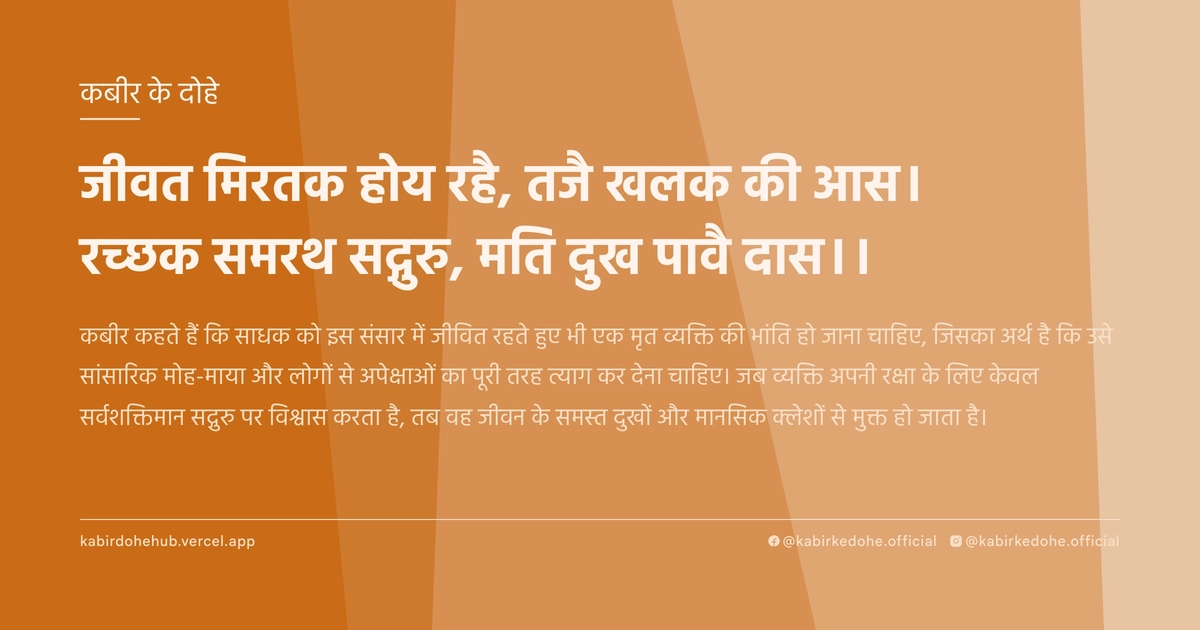
जीवत मिरतक होय रहै, तजै खलक की आस।
रच्छक समरथ सद्गुरु, मति दुख पावै दास।।
Jeevat mirtak hoye rahai, tajai khalak ki aas. Racchak samrath sadguru, mati dukh pavai das.
इस पृष्ठ पर इस कबीर दोहे का अर्थ (meaning), हिंदी व्याख्या और अंग्रेज़ी अनुवाद, दार्शनिक विश्लेषण और व्यावहारिक जीवन सीख दी गई है। यह दोहा गुरु महत्व (The Guru's Importance) विषय से जुड़ा है — Kabir doha meaning and explanation in Hindi and English.
अर्थ (Meaning):
कबीर कहते हैं कि साधक को इस संसार में जीवित रहते हुए भी एक मृत व्यक्ति की भांति हो जाना चाहिए, जिसका अर्थ है कि उसे सांसारिक मोह-माया और लोगों से अपेक्षाओं का पूरी तरह त्याग कर देना चाहिए। जब व्यक्ति अपनी रक्षा के लिए केवल सर्वशक्तिमान सद्गुरु पर विश्वास करता है, तब वह जीवन के समस्त दुखों और मानसिक क्लेशों से मुक्त हो जाता है।
Kabir suggests that a seeker should remain like a dead person while still alive, meaning one must completely renounce expectations from the world and other people. When a devotee places absolute trust in the omnipotent Sadguru as their sole protector, they are liberated from all worldly sorrows and mental anguish.
व्याख्या (Interpretation):
यहाँ 'मिरतक' या मृत होने का अर्थ शारीरिक मृत्यु नहीं, बल्कि 'अहंकार की मृत्यु' है। यह निर्गुण भक्ति का वह शिखर है जहाँ साधक अपनी सामाजिक पहचान और इच्छाओं को शून्य कर देता है। जब हम दुनिया से उम्मीदें (आस) छोड़ते हैं, तो हम माया के जाल से मुक्त हो जाते हैं। यह अद्वैत वेदांत के उस सिद्धांत को दर्शाता है जहाँ आत्मा स्वयं को ब्रह्म में विलीन कर देती है। सद्गुरु यहाँ केवल एक व्यक्ति नहीं, बल्कि वह आंतरिक प्रकाश या चेतना है जो अज्ञानता के अंधकार को मिटाती है। इस विरोधाभास में ही मुक्ति है: स्वयं को मिटाकर ही पूर्णता प्राप्त होती है।
The term 'mirtak' or dead does not refer to physical demise, but to the 'death of the ego.' This represents the pinnacle of Nirgun Bhakti, where the seeker nullifies their social identity and desires. By abandoning expectations (aas) from the world, one breaks the shackles of Maya. This aligns with Advaita Vedanta, where the individual soul merges into the universal Brahman. The Sadguru here is not merely a human teacher, but the internal light or consciousness that eradicates ignorance. In this paradox lies liberation: only by erasing the self does one achieve wholeness.
दार्शनिक विश्लेषण (Philosophical Analysis):
कबीर का यह दोहा मध्यकालीन भारत के उस दौर का है जब धर्म केवल कर्मकांडों और बाहरी दिखावे तक सीमित था। कबीर ने इस दिखावे पर प्रहार करते हुए 'भीतरी मृत्यु' की बात की है। यह सूफी मत के 'फना' (Fana) के सिद्धांत के समान है, जहाँ प्रेमी अपने अस्तित्व को ईश्वर की इच्छा में मिटा देता है।
यहाँ ritualism का विरोध स्पष्ट है; कबीर कहते हैं कि मंदिर-मस्जिद जाने से अधिक महत्वपूर्ण है अपनी इच्छाओं का अंत करना। यह मनोवैज्ञानिक रूपांतरण की प्रक्रिया है। जब तक 'मैं' जीवित है, तब तक दुख है। जैसे ही 'मैं' मरता है, केवल 'वह' (परमात्मा) बचता है।
अद्वैत वेदांत के परिप्रेक्ष्य में, यह माया के पर्दे को हटाने की प्रक्रिया है। संसार एक स्वप्न है, और अपेक्षाएं उस स्वप्न को और गहरा करती हैं। सद्गुरु वह माध्यम है जो साधक को यह बोध कराता है कि वह शरीर नहीं, बल्कि अविनाशी आत्मा है।
सामाजिक स्तर पर, यह जाति और वर्ग के भेदों को मिटाने का आह्वान है। एक मृत व्यक्ति न तो ऊँचा होता है और न नीचा। जब साधक इस मानसिक स्थिति को प्राप्त करता है, तो वह सामाजिक भेदभाव से ऊपर उठकर सार्वभौमिक प्रेम में लीन हो जाता है।
अंततः, यह दोहा सिखाता है कि वास्तविक सुरक्षा बाहरी दुनिया में नहीं, बल्कि आंतरिक समर्पण में है। जब हम दुनिया को अपना रक्षक मानना बंद कर देते हैं, तब हम उस परम सत्ता के संरक्षण में आ जाते हैं जो जन्म और मृत्यु से परे है।
This couplet emerges from the medieval Indian era when religion was largely confined to rituals and outward displays. Kabir attacks this superficiality by advocating for an 'inner death.' This mirrors the Sufi concept of 'Fana,' where the lover annihilates their existence in the will of the Divine.
The rejection of ritualism is explicit; Kabir asserts that extinguishing one's desires is far more vital than visiting temples or mosques. This is a process of psychological transformation. As long as the 'I' (ego) exists, suffering persists. Once the 'I' dies, only the 'He' (the Absolute) remains.
From the lens of Advaita Vedanta, this is the process of lifting the veil of Maya. The world is a dream, and expectations deepen that illusion. The Sadguru is the catalyst who awakens the seeker to the truth that they are not the body, but the eternal Atman.
Socially, this is a call to erase the distinctions of caste and class. A dead person is neither high nor low. When a seeker attains this mental state, they transcend social hierarchies and merge into universal love.
Ultimately, the verse teaches that true security is not found in the external world but in internal surrender. By ceasing to view the world as a protector, one enters the sanctuary of the Supreme Power that exists beyond birth and death.
मूल संदेश (Core Message):
- अपेक्षा ही समस्त मानसिक दुखों का मूल कारण है।
- अहंकार की मृत्यु ही वास्तविक आध्यात्मिक जन्म है।
- बाहरी रक्षकों के बजाय आंतरिक चेतना पर भरोसा करें।
- संसार में रहें, परंतु संसार को स्वयं में न बसने दें।
- पूर्ण समर्पण ही परम शांति का एकमात्र मार्ग है।
- Expectation is the root cause of all mental suffering.
- The death of the ego is the true spiritual birth.
- Trust internal consciousness over external protectors.
- Live in the world, but do not let the world live in you.
- Total surrender is the only path to ultimate peace.
व्यावहारिक उदाहरण (Practical Example):
एक समय की बात है, वाराणसी के घाटों पर रहने वाला एक वृद्ध विधवा, जिसे लोग 'माई' कहते थे, अत्यंत दुखी जीवन जी रही थी। उसने अपना पूरा जीवन अपने पुत्र की आशा में बिताया, जो वर्षों पहले शहर गया था और फिर कभी नहीं लौटा। वह हर आने वाले यात्री में अपने बेटे की छवि ढूँढती और हर किसी से उम्मीद लगाती कि शायद कोई खबर लाए। इस उम्मीद ने उसे मानसिक रूप से तोड़ दिया था।
एक दिन वह कबीर के एक अनुयायी से मिली, जिसने उसे यह दोहा सुनाया। माई ने पूछा, 'मैं जीवित हूँ, फिर भी मृत कैसे हो जाऊँ?' अनुयायी ने समझाया, 'माई, तुम्हारी देह जीवित है, लेकिन तुम्हारी उम्मीदें तुम्हें तड़पा रही हैं। उस उम्मीद को मार दो, जो तुम्हें दूसरों का मोहताज बनाती है।'
माई ने गहराई से विचार किया। उसने महसूस किया कि उसकी पीड़ा पुत्र के न होने से नहीं, बल्कि पुत्र के 'होने की इच्छा' से थी। उसने धीरे-धीरे अपनी उस मानसिक आस को त्यागना शुरू किया। उसने यह स्वीकार कर लिया कि वह अब किसी इंसान की मोहताज नहीं है।
उसने अपना समय अन्य अनाथ बच्चों की सेवा में लगाना शुरू किया। उसने अपनी पहचान एक 'दुखी माँ' से बदलकर एक 'निस्वार्थ सेविका' की कर ली। वह अब लोगों से यह नहीं पूछती थी कि उसका बेटा कहाँ है, बल्कि यह देखती थी कि किसी भूखे को रोटी कैसे मिले।
जैसे-जैसे उसकी दुनिया से 'अपेक्षा' खत्म हुई, उसका मन शांत होने लगा। उसे महसूस हुआ कि वह अब अकेली नहीं है, बल्कि एक अदृश्य शक्ति (सद्गुरु) उसके साथ है जो उसे हर पल सहारा दे रही है।
एक दिन एक व्यक्ति आया जिसने उसके बेटे के बारे में बताया, लेकिन माई के चेहरे पर अब कोई व्याकुलता नहीं थी। उसने शांति से सुना और मुस्कुराकर कहा, 'वह जहाँ भी है, ठीक होगा।'
उसकी आँखों में अब आंसू नहीं, बल्कि एक गहरा ठहराव था। उसने वास्तव में 'मृत' होना सीख लिया था—अर्थात अपनी इच्छाओं का अंत कर लिया था।
अब वह घाटों पर सबसे शांत व्यक्ति मानी जाती थी। उसकी मुक्ति किसी बाहरी चमत्कार से नहीं, बल्कि अपनी आस के विसर्जन से आई थी।
Once, in the ghats of Varanasi, lived an elderly widow known as 'Mai.' Her life was consumed by a singular, agonizing hope: her son, who had left for the city years ago and never returned. She searched for his image in every passing traveler, clinging to the hope that someone would bring news of him. This expectation had shattered her spirit.
One day, she met a follower of Kabir who recited this doha to her. Mai asked, 'I am alive; how can I become dead?' The follower explained, 'Mai, your body is alive, but your expectations are torturing you. Kill the hope that makes you dependent on others.'
Mai contemplated this deeply. She realized her pain stemmed not from the absence of her son, but from the 'desire for his presence.' She gradually began to renounce that mental attachment.
She started spending her time serving orphaned children. She shifted her identity from a 'grieving mother' to a 'selfless caregiver.' She no longer asked strangers about her son; instead, she focused on how to feed a hungry child.
As expectations vanished from her world, her mind grew still. She felt that she was no longer alone, but supported by an invisible power (the Sadguru) guiding her every step.
One day, a man arrived with news of her son, but there was no longer any agitation on Mai's face. She listened calmly and smiled, saying, 'Wherever he is, he must be well.'
There were no more tears in her eyes, only a profound stillness. She had truly learned to be 'dead'—meaning she had ended her egoic desires.
She became known as the most peaceful soul on the ghats. Her liberation came not from an external miracle, but from the dissolution of her expectations.
अभ्यास मार्गदर्शन (Practice Guidance):
- प्रतिदिन 20 मिनट मौन ध्यान करें, जहाँ आप अपनी सभी सामाजिक भूमिकाओं (पिता, पुत्र, कर्मचारी) को मानसिक रूप से उतार दें और केवल एक 'साक्षी' बनें।
- एक 'अपेक्षा डायरी' लिखें। उन सभी लोगों और स्थितियों की सूची बनाएं जिनसे आप उम्मीद रखते हैं, और फिर सचेत रूप से लिखें कि आप इन उम्मीदों को सद्गुरु/ब्रह्म को समर्पित करते हैं।
- व्यवहार परिवर्तन: जब भी किसी व्यक्ति से निराशा हो, तो तुरंत स्वयं से कहें—'मेरी आस मृत है, केवल सत्य जीवित है।'
- निदान चेकलिस्ट: क्या आप दूसरों की प्रशंसा या आलोचना से विचलित होते हैं? यदि हाँ, तो आपका 'अहंकार' अभी जीवित है। यदि आप तटस्थ हैं, तो आप 'मिरतक' होने की राह पर हैं।
- Practice 20 minutes of silent meditation daily, mentally shedding all social roles (parent, child, employee) and becoming a mere 'witness.'
- Maintain an 'Expectation Journal.' List all people and situations you depend on for happiness, then consciously write that you surrender these expectations to the Sadguru/Brahman.
- Behavioral Shift: Whenever you feel disappointed by someone, immediately tell yourself—'My expectation is dead; only the Truth remains.'
- Diagnostic Checklist: Do you still feel disturbed by praise or criticism? If yes, your 'ego' is still alive. If you remain neutral, you are on the path to becoming 'mirtak'.
चिंतन प्रश्न (Reflection Questions):
- आपकी वह कौन सी 'सामाजिक पहचान' है जिसे खोने का डर आपको सबसे अधिक सताता है?
- यदि आज आपकी सभी उम्मीदें पूरी तरह समाप्त हो जाएं, तो क्या आप वास्तव में शांत होंगे या भयभीत?
- आप अपनी डिजिटल पहचान (Social Media) के माध्यम से दूसरों से किस प्रकार की 'आस' या मान्यता खोज रहे हैं?
- क्या आपका 'भक्ति' भाव वास्तव में समर्पण है, या यह ईश्वर से कुछ पाने का एक सूक्ष्म सौदा है?
- वह कौन सा आंतरिक हिस्सा है जिसे आप 'मारने' से सबसे अधिक डरते हैं?
- Which 'social identity' do you fear losing the most?
- If all your expectations vanished today, would you truly be peaceful or terrified?
- What kind of 'hope' or validation are you seeking from others through your digital identity (Social Media)?
- Is your 'devotion' truly surrender, or is it a subtle bargain to get something from God?
- Which part of your inner self are you most afraid to 'kill'?