
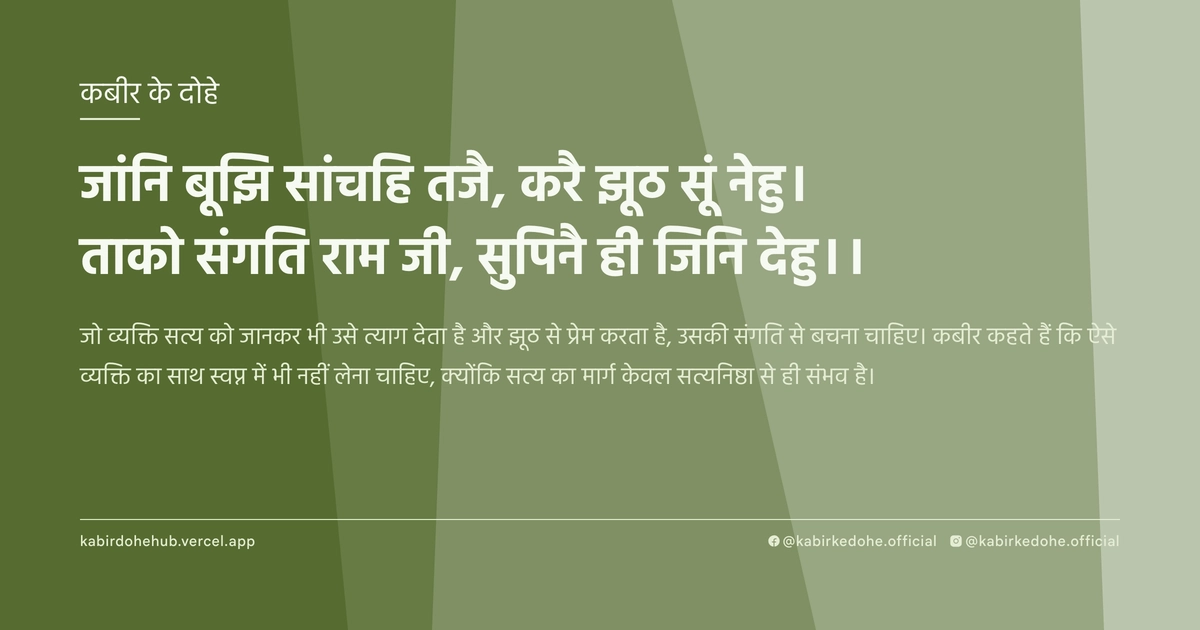
जांनि बूझि सांचहि तजै, करै झूठ सूं नेहु।
ताको संगति राम जी, सुपिनै ही जिनि देहु।।
Jaani boojhi saanchahi tajai, karai jhooth sun nehu. Taako sangati ram ji, supinai hi jini dehu.
इस पृष्ठ पर इस कबीर दोहे का अर्थ (meaning), हिंदी व्याख्या और अंग्रेज़ी अनुवाद, दार्शनिक विश्लेषण और व्यावहारिक जीवन सीख दी गई है। यह दोहा सत्य (Truth) विषय से जुड़ा है — Kabir doha meaning and explanation in Hindi and English.
अर्थ (Meaning):
जो व्यक्ति सत्य को जानकर भी उसे त्याग देता है और झूठ से प्रेम करता है, उसकी संगति से बचना चाहिए। कबीर कहते हैं कि ऐसे व्यक्ति का साथ स्वप्न में भी नहीं लेना चाहिए, क्योंकि सत्य का मार्ग केवल सत्यनिष्ठा से ही संभव है।
One who consciously rejects the truth after realizing it and instead develops an affection for falsehood is a dangerous companion. Kabir warns that such a person should be avoided entirely, even in one's dreams, as spiritual progress is impossible in the company of deceit.
व्याख्या (Interpretation):
शाब्दिक अर्थ यह है कि सत्य को जानने के बाद उसे नकारना एक गंभीर आध्यात्मिक अपराध है। यहाँ 'सत्य' केवल शब्दों की सच्चाई नहीं, बल्कि 'सत्यम्' यानी वह शाश्वत वास्तविकता है जो अपरिवर्तनीय है। जब मनुष्य माया के प्रभाव में आकर सत्य को त्यागता है, तो वह अपनी आत्मा (Atman) से विमुख हो जाता है। यह स्थिति अज्ञानता से अधिक घातक है क्योंकि यह 'जानबूझकर' किया गया चुनाव है। निर्गुण भक्ति में, सत्य ही ईश्वर है; अतः झूठ से प्रेम करना वास्तव में ईश्वर से विमुख होना है। यह द्वंद्व आत्मा और अहंकार के बीच का है, जहाँ अहंकार अपनी झूठी पहचान को बनाए रखने के लिए सत्य का दमन करता है।
Literally, the verse warns against those who consciously abandon truth. However, 'Truth' here refers to 'Satyam'—the eternal, unchanging reality of the Absolute. When a human rejects this realization in favor of falsehood, they are not merely lying but are actively severing their connection with the Atman. This is more perilous than simple ignorance because it is a conscious choice driven by Maya (illusion). In the tradition of Nirgun Bhakti, Truth is not a moral attribute but the very essence of the Divine. To love the lie is to embrace the ego's fabrication over the Brahman's reality. The central paradox is that the seeker cannot find the Truth while clinging to the comfort of a lie.
दार्शनिक विश्लेषण (Philosophical Analysis):
कबीर का यह दोहा उस सामाजिक और धार्मिक पाखंड पर प्रहार करता है जो उनके समय के कर्मकांडों में व्याप्त था। वे उन धर्मगुरुओं की आलोचना करते हैं जो शास्त्रों का ज्ञान रखते हुए भी अपने स्वार्थ के लिए झूठ का सहारा लेते हैं। यह दृष्टिकोण अद्वैत वेदांत के करीब है, जहाँ माया को सत्य का आवरण माना गया है। कबीर का तर्क है कि यदि कोई व्यक्ति सत्य को पहचान कर भी उसे त्यागता है, तो वह अपनी चेतना को गहरे अंधकार में धकेल रहा है।
सूफी मत के 'नफ्स' (अहंकार) के सिद्धांत के अनुसार, झूठ का मोह वास्तव में अहंकार की तुष्टि है। जब व्यक्ति सत्य को नकारता है, तो वह वास्तव में अपनी उस झूठी पहचान (False Ego) को बचा रहा होता है जिसे उसने दुनिया के सामने गढ़ा है। कबीर यहाँ 'संगति' की बात कर रहे हैं, क्योंकि आध्यात्मिक यात्रा में बाहरी वातावरण और साथ चलने वाले लोग हमारी मानसिक तरंगों को प्रभावित करते हैं।
यह दोहा केवल नैतिक उपदेश नहीं है, बल्कि एक मनोवैज्ञानिक चेतावनी है। झूठ से 'नेहु' यानी प्रेम करना एक मानसिक रोग है जहाँ व्यक्ति भ्रम को वास्तविकता समझने लगता है। यह स्थिति 'अविद्या' की पराकाष्ठा है। कबीर स्पष्ट करते हैं कि सत्य का मार्ग अत्यंत सूक्ष्म है और इसमें थोड़ी सी भी असत्यता पूरे आध्यात्मिक प्रयास को शून्य कर देती है।
ऐतिहासिक संदर्भ में, कबीर ने देखा कि कैसे जाति और धर्म के नाम पर लोगों को गुमराह किया गया। उन्होंने अनुभव किया कि जो लोग स्वयं को सत्य का ज्ञाता कहते हैं, वे ही अक्सर सबसे बड़े पाखंडी होते हैं। इसलिए, वे बाहरी प्रतीकों के बजाय आंतरिक ईमानदारी पर जोर देते हैं।
अंततः, यह विश्लेषण हमें यह सिखाता है कि सत्य की खोज केवल बौद्धिक नहीं, बल्कि अस्तित्वगत है। सत्य को जानना पर्याप्त नहीं है, उसे जीना अनिवार्य है। जो जान कर भी नहीं जीता, वह दूसरों के लिए भी विषैला बन जाता है, इसीलिए उसकी संगति का पूर्ण त्याग आवश्यक है।
Kabir's couplet is a scathing critique of the religious and social hypocrisy prevalent during his era. He targets the spiritual elites who possessed scriptural knowledge yet manipulated the truth for personal gain. This perspective aligns with Advaita Vedanta, where Maya is seen as the veil over the ultimate reality. Kabir argues that consciously rejecting the truth after realizing it is a catastrophic spiritual regression.
Drawing from the Sufi concept of 'Nafs' (the lower self/ego), the affection for falsehood is an attempt to nourish the ego. When a person rejects the truth, they are protecting a fabricated identity. Kabir emphasizes 'Sangat' (company) because the spiritual path is highly sensitive to the psychic vibrations of those around us; a companion who loves lies acts as a spiritual anchor, dragging the seeker back into illusion.
This is not merely a moral lesson but a psychological warning. To have 'Nehu' (affection) for a lie indicates a state of cognitive dissonance where the individual prefers a comfortable delusion over a harsh reality. In the framework of Bhakti, this is the peak of 'Avidya' (ignorance), where the ego creates a parallel reality to avoid the annihilation required for union with the Divine.
Historically, Kabir witnessed how caste and creed were used as tools of deception. He realized that those claiming to be the custodians of truth were often the architects of the greatest lies. Consequently, he shifted the focus from external rituals to internal integrity, asserting that ritualistic purity is meaningless without an honest heart.
Ultimately, this analysis reveals that the pursuit of truth is existential, not intellectual. Knowing the truth is insufficient; embodying it is the only way to liberation. One who knows but refuses to live the truth becomes a source of spiritual toxicity, justifying the absolute avoidance Kabir prescribes.
मूल संदेश (Core Message):
- अज्ञानता से अधिक खतरनाक है सत्य को जानकर भी उसे नकारना।
- झूठ का मोह आत्मा की आध्यात्मिक दृष्टि को अंधा कर देता है।
- पाखंडी की संगति आपके विवेक को नष्ट कर देती है।
- सत्य केवल शब्दों में नहीं, बल्कि आचरण की शुद्धता में है।
- अहंकार का विसर्जन ही सत्य के साक्षात्कार का एकमात्र मार्ग है।
- Rejecting the truth after realizing it is more perilous than simple ignorance.
- Affection for falsehood blinds the spiritual vision of the soul.
- The company of a hypocrite erodes one's own capacity for discernment.
- Truth resides not in spoken words, but in the purity of conduct.
- The annihilation of ego is the only gateway to realizing the Absolute Truth.
व्यावहारिक उदाहरण (Practical Example):
एक समय की बात है, बनारस के घाटों पर एक वृद्ध बुनकर रहता था जिसका नाम माधव था। माधव अपने काम में निपुण था और कबीर की वाणी का अनुयायी था। उसी बस्ती में एक धनी व्यापारी रहता था, जो अपनी उदारता का ढोंग करता था लेकिन वास्तव में अपने मजदूरों का शोषण करता था। वह व्यापारी अक्सर माधव के पास आकर धर्म और सत्य की बड़ी-बड़ी बातें करता था।
व्यापारी अक्सर कहता, "माधव, सत्य ही ईश्वर है, और मैं अपने जीवन में केवल सत्य का पालन करता हूँ।" लेकिन माधव ने देखा कि वह व्यापारी अपने कर्मचारियों के वेतन में कटौती करता था और फिर मंदिर में जाकर दान देता था ताकि लोग उसे 'सत्यवादी' समझें।
एक दिन व्यापारी ने माधव से एक गुप्त व्यापारिक सौदे में मदद मांगी, जिसमें उसे ग्राहकों को घटिया माल को उच्च गुणवत्ता वाला बताकर बेचना था। व्यापारी ने तर्क दिया, "यह केवल व्यापार की एक कला है, इसे झूठ नहीं कहते।"
माधव ने उसे चेतावनी दी, "भाई, तुम सत्य को जानते हो कि यह माल खराब है, फिर भी तुम झूठ से प्रेम कर रहे हो। यह तुम्हारी आत्मा को अंधा कर देगा।"
व्यापारी ने माधव का उपहास किया और उसे एक 'अज्ञानी बुनकर' कहकर पुकारा। उसने माधव को लालच दिया कि यदि वह उसकी मदद करे, तो वह उसे सोने की मोहरें देगा। माधव ने शांति से मना कर दिया।
कुछ समय बाद, व्यापारी का झूठ पकड़ा गया। उसके ग्राहकों ने उस पर मुकदमा किया और उसकी सारी संपत्ति जब्त हो गई। वह मानसिक रूप से टूट गया और मदद के लिए उन्हीं लोगों के पास गया जिन्हें उसने धोखा दिया था, लेकिन सबने उसे दुत्कार दिया।
अंत में, वह व्यापारी माधव के पास आया और रोते हुए अपनी गलती मानी। उसने पूछा, "तुमने मुझे पहले क्यों नहीं रोका?"
माधव ने उत्तर दिया, "मैंने रोका था, लेकिन तुम सत्य को जानते हुए भी झूठ से प्रेम कर रहे थे। जब तक तुम स्वयं झूठ को गले लगाते रहे, मेरी कोई भी बात तुम्हारे लिए केवल शोर थी।"
व्यापारी को समझ आया कि सत्य केवल बोलने की चीज़ नहीं, बल्कि जीने की चीज़ है। उसने अपना शेष जीवन ईमानदारी से जीने का संकल्प लिया और माधव के मार्गदर्शन में सादगी का जीवन अपनाया।
इस कहानी का 'कबीर ट्विस्ट' यह है कि माधव ने व्यापारी की मदद तब नहीं की जब वह उसे झूठ में शामिल होने के लिए कह रहा था, बल्कि उसकी मदद तब की जब व्यापारी का अहंकार पूरी तरह टूट गया और वह वास्तव में सत्य की खोज के लिए तैयार हुआ।
Once, on the ghats of Varanasi, lived an elderly weaver named Madhav. Madhav was a master of his craft and a devoted follower of Kabir's teachings. In the same neighborhood lived a wealthy merchant who projected an image of immense generosity but secretly exploited his laborers. The merchant often visited Madhav to discuss philosophy and the importance of truth.
The merchant would frequently proclaim, "Madhav, Truth is God, and I follow only the truth in my life." However, Madhav observed that the merchant would slash his workers' wages and then donate large sums to the temple solely to maintain his reputation as a 'truthful' man.
One day, the merchant asked Madhav to help him with a secret business deal. He wanted Madhav to vouch for the quality of some inferior cloth, claiming it was of the highest grade. The merchant argued, "This is simply the art of business; it is not a lie."
Madhav warned him, "Brother, you know the truth—that this cloth is flawed—yet you cherish the lie. This will blind your soul."
The merchant mocked Madhav, calling him an 'ignorant weaver,' and tempted him with gold coins if he would agree to the deception. Madhav calmly refused.
After some time, the merchant's deceit was exposed. His clients sued him, and his assets were seized. He was mentally shattered and sought help from those he had cheated, but they all turned him away.
Finally, the merchant came to Madhav, weeping and admitting his faults. He asked, "Why didn't you stop me before this happened?"
Madhav replied, "I did try, but you knew the truth and yet you loved the lie. As long as you embraced the falsehood, my words were merely noise to you."
The merchant realized that truth is not something to be spoken, but something to be lived. He vowed to spend the rest of his life in honesty and adopted a simple life under Madhav's guidance.
The 'Kabir Twist' here is that Madhav did not help the merchant when he was being offered wealth to lie; instead, he helped him only after the merchant's ego was completely demolished, making him truly ready to encounter the Truth.
अभ्यास मार्गदर्शन (Practice Guidance):
- दैनिक आत्म-निरीक्षण: हर रात सोने से पहले एक डायरी लिखें जिसमें उन क्षणों को दर्ज करें जब आपने अपनी सुविधा के लिए सत्य को बदला या अनदेखा किया।
- मौन साधना: प्रतिदिन 30 मिनट का मौन धारण करें। इस दौरान यह विचार करें कि आपका 'सामाजिक मुखौटा' (Public Persona) आपके वास्तविक स्वरूप से कितना अलग है।
- सत्य-संकल्प: एक छोटा लेकिन कठिन सत्य बोलने का संकल्प लें, भले ही उससे आपको तात्कालिक नुकसान या शर्मिंदगी महसूस हो।
- निदान चेकलिस्ट: क्या मैं दूसरों की प्रशंसा पाने के लिए अपनी उपलब्धियों को बढ़ा-चढ़ाकर बताता हूँ? क्या मैं अपनी गलतियों को सही ठहराने के लिए तर्क गढ़ता हूँ? यदि हाँ, तो आप 'झूठ से नेहु' की स्थिति में हैं।
- Daily Self-Audit: Keep a journal every night recording moments where you manipulated or ignored the truth for personal convenience or social gain.
- Silence Practice: Observe 30 minutes of absolute silence daily. Contemplate the gap between your 'Public Persona' and your authentic internal self.
- The Truth Vow: Commit to speaking one small but difficult truth daily, even if it results in immediate discomfort, loss, or embarrassment.
- Diagnostic Checklist: Do I exaggerate my achievements to gain admiration? Do I construct elaborate justifications to hide my mistakes? If yes, you are currently 'loving the lie'.
चिंतन प्रश्न (Reflection Questions):
- मेरे जीवन का वह कौन सा 'सुखद झूठ' है जिसे मैं सत्य के ऊपर प्राथमिकता देता हूँ?
- क्या मैं वास्तव में सत्य की खोज में हूँ, या मैं केवल ऐसे सत्य की तलाश में हूँ जो मेरी मान्यताओं की पुष्टि करे?
- जब मैं दूसरों के पाखंड की आलोचना करता हूँ, तो क्या मैं अपने भीतर छिपे उसी पाखंड को अनदेखा कर रहा होता हूँ?
- मेरी डिजिटल पहचान (Social Media) मेरे वास्तविक जीवन के सत्य से कितनी दूर है?
- क्या मैं उस सत्य को स्वीकार करने का साहस रखता हूँ जो मेरी पूरी पहचान को नष्ट कर दे?
- What is the 'comfortable lie' in my life that I prioritize over the uncomfortable truth?
- Am I truly seeking the Truth, or am I merely searching for a truth that confirms my existing biases?
- When I criticize the hypocrisy of others, am I ignoring the same hypocrisy residing within me?
- How far is my digital identity (Social Media) from the actual truth of my lived experience?
- Do I possess the courage to accept a truth that might completely dismantle my current identity?