
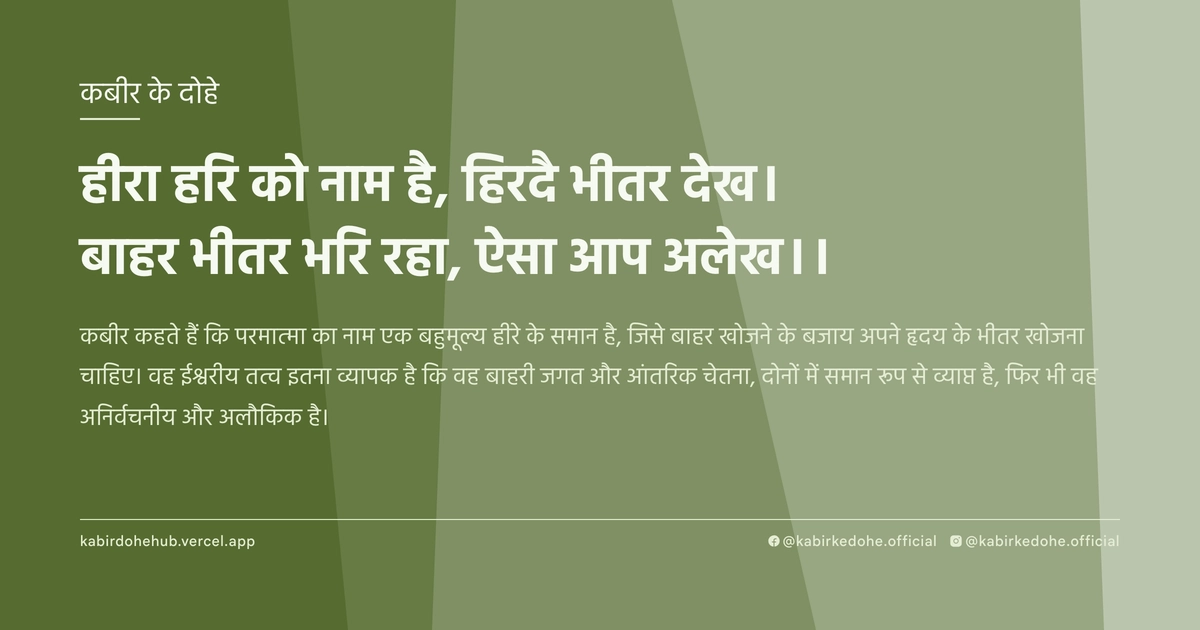
हीरा हरि को नाम है, हिरदै भीतर देख।
बाहर भीतर भरि रहा, ऐसा आप अलेख।।
Heera hari ko naam hai, hirdai bhitar dekh. Bahar bhitar bhari raha, aisa aap alekh.
इस पृष्ठ पर इस कबीर दोहे का अर्थ (meaning), हिंदी व्याख्या और अंग्रेज़ी अनुवाद, दार्शनिक विश्लेषण और व्यावहारिक जीवन सीख दी गई है। यह दोहा निर्गुण ब्रह्म (Nirguna Brahman) विषय से जुड़ा है — Kabir doha meaning and explanation in Hindi and English.
अर्थ (Meaning):
कबीर कहते हैं कि परमात्मा का नाम एक बहुमूल्य हीरे के समान है, जिसे बाहर खोजने के बजाय अपने हृदय के भीतर खोजना चाहिए। वह ईश्वरीय तत्व इतना व्यापक है कि वह बाहरी जगत और आंतरिक चेतना, दोनों में समान रूप से व्याप्त है, फिर भी वह अनिर्वचनीय और अलौकिक है।
Kabir asserts that the Divine Name is like a priceless diamond, which one must seek within the depths of one's own heart rather than in the external world. This spiritual essence is so pervasive that it fills both the outer universe and the inner consciousness, yet it remains indescribable and transcendental.
व्याख्या (Interpretation):
इस दोहे का शाब्दिक अर्थ है कि ईश्वर का नाम हीरा है जो हृदय में स्थित है। रूपक के स्तर पर, 'हीरा' शुद्ध चेतना और आत्मा की अमरता का प्रतीक है। कबीर यहाँ निर्गुण भक्ति का आह्वान करते हैं, जहाँ ईश्वर किसी मूर्ति या मंदिर में नहीं, बल्कि 'अलेख' (अलिखा) रूप में है, जिसे शब्दों में नहीं बांधा जा सकता। यह अद्वैत वेदांत के उस सिद्धांत को दर्शाता है जहाँ आत्मा और ब्रह्म एक ही हैं। माया हमें बाहरी आडंबरों में उलझाती है, जबकि सत्य हमारे भीतर ही सुप्त है। जब साधक अपनी आंतरिक यात्रा शुरू करता है, तो उसे बोध होता है कि वह जिसे बाहर खोज रहा था, वह वास्तव में उसका अपना ही स्वरूप है। यह विरोधाभास है कि जो सबसे करीब है, वही सबसे कठिन खोजने वाला है।
Literally, the verse suggests that the Divine Name is a diamond residing within the heart. Metaphorically, the 'diamond' symbolizes pure consciousness and the immortality of the soul. Kabir invokes Nirgun Bhakti, where the Divine is not found in idols or temples but as 'Alekh'—the unwritten, the indescribable. This aligns with Advaita Vedanta, asserting the non-duality of Atman and Brahman. Maya lures the seeker into external rituals, while the Truth remains dormant within. As the seeker embarks on an internal journey, they realize that the object of their search is their own essential nature. It is the central paradox of the human condition: that which is closest to us is often the hardest to perceive.
दार्शनिक विश्लेषण (Philosophical Analysis):
कबीर का यह दोहा उस युग की प्रतिक्रिया है जहाँ धर्म केवल कर्मकांडों और बाहरी प्रदर्शनों तक सीमित हो गया था। उन्होंने जाति, वर्ण और मंदिर-मस्जिद के भेद को नकारते हुए 'सहज मार्ग' पर जोर दिया। यहाँ 'हीरा' शब्द केवल मूल्य का नहीं, बल्कि कठोरता और शुद्धता का प्रतीक है, जो अज्ञानता के मैल को साफ करने की क्षमता रखता है।
दार्शनिक रूप से, यह सूफीवाद के 'वहदत-अल-वजूद' (अस्तित्व की एकता) और वेदांत के 'सर्वं खल्विदं ब्रह्म' के करीब है। कबीर तर्क देते हैं कि यदि ईश्वर सर्वव्यापी है, तो वह हृदय के भीतर भी होना चाहिए। बाहरी खोज वास्तव में अहंकार की खोज है, जबकि आंतरिक खोज आत्मा का विलीनीकरण है।
अहंकार (Ego) वह पर्दा है जो हमें इस आंतरिक हीरे को देखने से रोकता है। जब तक 'मैं' का भाव रहता है, तब तक 'हरि' का अनुभव नहीं होता। यह मनोवैज्ञानिक रूपांतरण की प्रक्रिया है जहाँ व्यक्ति अपनी पहचान को सामाजिक लेबल से हटाकर सार्वभौमिक चेतना से जोड़ता है।
कबीर का 'अलेख' शब्द बहुत महत्वपूर्ण है। यह दर्शाता है कि परम सत्य किसी भी भाषा, शास्त्र या परिभाषा से परे है। जो कुछ भी कहा जा सकता है, वह सीमित है; जो नहीं कहा जा सकता, वही अनंत है।
अंततः, यह संदेश देता है कि मोक्ष किसी भौगोलिक स्थान या बाहरी गुरु की कृपा से अधिक, स्वयं के भीतर की जागरूकता और ईमानदारी से प्राप्त होता है। यह ritualism के विरुद्ध एक सशक्त प्रहार है, जो मनुष्य को स्वयं के आध्यात्मिक केंद्र की ओर मोड़ता है।
This couplet is a reaction to an era where religion had devolved into mere rituals and external displays. Kabir rejected the divisions of caste, creed, and the duality of temple and mosque, emphasizing the 'Sahaj Marg' or the natural path. The 'diamond' here symbolizes not just value, but the hardness and purity required to cut through the grime of ignorance.
Philosophically, this resonates with the Sufi concept of 'Wahdat-al-Wujud' (Unity of Existence) and the Vedantic 'Sarvam Khalvidam Brahma' (All this is Brahman). Kabir argues that if the Divine is omnipresent, it must necessarily reside within the heart. External searching is often a projection of the ego, whereas internal searching is the dissolution of the self into the Whole.
The ego acts as the veil preventing the perception of this inner diamond. As long as the sense of 'I' persists, the experience of 'Hari' remains elusive. This is a process of psychological transformation where one shifts identity from social labels to universal consciousness.
The term 'Alekh' (unwritten/indescribable) is pivotal. It suggests that the Ultimate Truth transcends all languages, scriptures, and definitions. Whatever can be articulated is limited; that which cannot be spoken is infinite.
Ultimately, the message is that liberation is achieved not through geographical pilgrimages or external intercession, but through internal awareness and radical honesty. It is a powerful critique of ritualism, redirecting the human gaze toward its own spiritual center.
मूल संदेश (Core Message):
- बाहरी खोज वास्तव में अहंकार का विस्तार है।
- परम सत्य शब्दों और परिभाषाओं से परे 'अलेख' है।
- हृदय की शुद्धता ही ईश्वर का वास्तविक मंदिर है।
- आंतरिक मौन ही वह हीरा है जो जीवन को मूल्यवान बनाता है।
- अद्वैत का अनुभव ही समस्त दुखों का अंत है।
- External searching is merely an extension of the ego.
- The Ultimate Truth is 'Alekh'—beyond words and definitions.
- Purity of heart is the only true temple of the Divine.
- Inner silence is the diamond that gives life its true value.
- The experience of non-duality is the end of all suffering.
व्यावहारिक उदाहरण (Practical Example):
वाराणसी के घाटों पर रहने वाला एक वृद्ध बुनकर था, जिसका नाम माधव था। माधव जीवन भर रेशमी वस्त्र बुनता रहा, लेकिन उसका मन हमेशा अशांत रहता था। वह हर साल काशी के बड़े मंदिरों में जाता, घंटों कतारों में खड़ा रहता और पंडितों को भारी दान देता, इस उम्मीद में कि उसे शांति मिलेगी।
वह सोचता था कि ईश्वर केवल उन भव्य मूर्तियों में है जिन्हें सोने से मढ़ा गया है। उसके लिए भक्ति का अर्थ था—बाहरी अनुष्ठान, पवित्र स्नान और मंत्रों का रटंत पाठ। लेकिन उसके जीवन में क्लेश कम नहीं हुए; उसका बेटा उससे रूठा था और उसकी पत्नी बीमार रहती थी।
एक दिन, माधव की मुलाकात एक फकीर से हुई जो घाट की सीढ़ियों पर चुपचाप बैठा था। माधव ने अपनी व्यथा सुनाई और पूछा, "मैं इतना दान करता हूँ, इतनी पूजा करता हूँ, फिर भी वह हीरा (शांति) मुझे क्यों नहीं मिला?"
फकीर ने मुस्कुराकर कहा, "माधव, तुम उस हीरे को बाजार में ढूंढ रहे हो जिसे तुम अपनी जेब में रखकर भूल गए हो। तुम मंदिर की दीवारों में जिसे खोज रहे हो, वह तुम्हारे अपने हृदय की धड़कन में छिपा है।"
माधव को पहले यह बात समझ नहीं आई। उसने सोचा कि यह कोई साधारण पहेली है। लेकिन उस रात, उसने पहली बार मंदिर जाने के बजाय अपनी आँखें बंद कीं और अपनी सांसों पर ध्यान लगाया। उसने महसूस किया कि वह बाहरी शोर में इतना डूबा था कि उसने कभी अपने भीतर की चुप्पी को सुना ही नहीं था।
धीरे-धीरे माधव ने महसूस किया कि उसकी असली समस्या बाहरी दुनिया नहीं, बल्कि उसका अपना अहंकार था, जो उसे लगता था कि वह 'दान' देकर ईश्वर को खरीद सकता है। उसने बाहरी दिखावे को छोड़कर अपने भीतर के प्रेम को जगाया।
उसने अपने बेटे को बिना किसी शर्त के माफ किया और अपनी पत्नी की सेवा को ही सबसे बड़ी पूजा माना। उसने पाया कि जब वह दूसरों के दुख में खुद को देखने लगा, तो उसे वही 'अलेख' अनुभव होने लगा जिसकी वह तलाश कर रहा था।
अब माधव मंदिर तो जाता था, लेकिन वह वहाँ कुछ मांगने नहीं, बल्कि उस शांति को साझा करने जाता था जो उसने अपने भीतर पा ली थी। उसका जीवन अब एक सुंदर वस्त्र की तरह था, जिसमें शांति और संतोष के धागे पिरोए हुए थे।
In the ghats of Varanasi lived an elderly weaver named Madhav. For decades, Madhav wove exquisite silk fabrics, yet his mind remained a storm of unrest. Every year, he visited the grand temples of Kashi, spending hours in queues and offering lavish donations to priests, hoping to find peace.
He believed that God resided only in the gold-plated idols. For him, devotion meant external rituals, holy dips, and the rote recitation of mantras. Yet, his life remained fractured; his son was estranged from him, and his wife was chronically ill.
One day, Madhav encountered a wandering fakir sitting silently on the stone steps of the ghat. Madhav shared his grief and asked, "I donate so much, I pray so fervently, yet why has that diamond of peace eluded me?"
The fakir smiled and replied, "Madhav, you are searching for the diamond in the marketplace, forgetting that you are carrying it in your own pocket. The one you seek within temple walls is hidden in the very beat of your own heart."
At first, Madhav didn't understand. He dismissed it as a simple riddle. But that night, instead of rushing to the temple, he closed his eyes and focused on his breath. He realized he had been so immersed in external noise that he had never listened to the silence within.
Gradually, Madhav understood that his struggle wasn't with the external world, but with his own ego, which believed it could 'purchase' divine grace through donations.
He forgave his son unconditionally and viewed the care of his ailing wife as the highest form of worship. He discovered that when he began to see himself in the suffering of others, he experienced the 'Alekh'—the indescribable presence he had been seeking.
Madhav continued to visit the temple, but no longer to ask for favors. He went to share the peace he had cultivated within. His life became like one of his finest silks, woven with threads of contentment and universal love.
अभ्यास मार्गदर्शन (Practice Guidance):
- प्रतिदिन 20 मिनट 'साक्षी भाव' का अभ्यास करें: अपनी सांसों और विचारों को बिना किसी निर्णय के केवल देखें, जैसे आप किसी और को देख रहे हों।
- आत्म-पूछताछ जर्नल: प्रतिदिन लिखें कि आज आपने कितनी बार बाहरी प्रशंसा या भौतिक वस्तुओं में सुख खोजा और कितनी बार आंतरिक शांति का अनुभव किया।
- व्यवहार परिवर्तन: किसी भी बाहरी धार्मिक अनुष्ठान को करने से पहले 5 मिनट मौन रहें और विचार करें कि क्या आप इसे अहंकार की संतुष्टि के लिए कर रहे हैं या वास्तविक प्रेम के लिए।
- डायग्नोस्टिक चेकलिस्ट: यदि आप छोटी बातों पर विचलित होते हैं, दूसरों में दोष ढूंढते हैं, या शांति के लिए बाहरी परिस्थितियों पर निर्भर हैं, तो इसका अर्थ है कि आप अभी भी 'बाहर' खोज रहे हैं।
- Practice 'Witness Consciousness' for 20 minutes daily: Observe your breaths and thoughts without judgment, as if you are watching a stranger.
- Self-Inquiry Journaling: Record daily instances where you sought happiness in external validation or material objects versus moments of internal stillness.
- Behavioral Shift: Before performing any external religious ritual, remain in silence for 5 minutes and question whether the act is for ego-satisfaction or genuine love.
- Diagnostic Checklist: If you are easily agitated by trivialities, prone to judging others, or dependent on external conditions for peace, you are still searching 'outside'.
चिंतन प्रश्न (Reflection Questions):
- क्या मेरी धार्मिकता वास्तव में मुझे विनम्र बना रही है, या यह मेरे सामाजिक अहंकार को बढ़ा रही है?
- यदि मैं अपनी सभी बाहरी पहचान (नाम, पद, धर्म) खो दूँ, तो मेरे भीतर क्या बचेगा?
- मैं अक्सर दूसरों में जो कमियाँ देखता हूँ, क्या वे वास्तव में मेरे अपने आंतरिक अंधेरे का प्रतिबिंब हैं?
- क्या मैं शांति को एक 'लक्ष्य' मानकर भविष्य में खोज रहा हूँ, या इसे वर्तमान क्षण की एक 'स्थिति' के रूप में देख पा रहा हूँ?
- मेरे जीवन का वह कौन सा 'बाहरी हीरा' है जिसे पाने की चाहत ने मुझे मेरे आंतरिक हीरे से दूर कर दिया है?
- Is my religiosity truly making me humble, or is it inflating my social ego?
- If I were to lose all my external identities (name, rank, religion), what would remain within me?
- Are the flaws I frequently perceive in others actually reflections of my own internal shadows?
- Am I treating peace as a 'destination' to be reached in the future, or as a 'state' to be inhabited now?
- What is the 'external diamond' in my life that I crave so much it blinds me to the diamond within?