
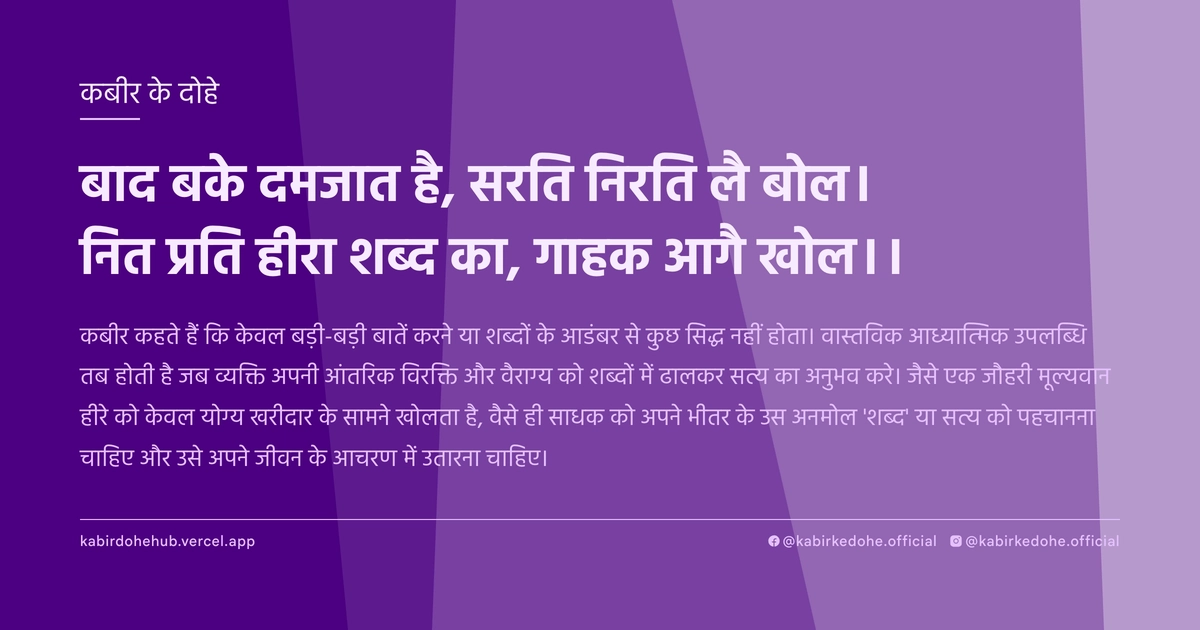
बाद बके दमजात है, सरति निरति लै बोल।
नित प्रति हीरा शब्द का, गाहक आगै खोल।।
Baad bake damjaat hai, sarati nirati lai bol. Nit prati heera shabd ka, gahak aage khol.
इस पृष्ठ पर इस कबीर दोहे का अर्थ (meaning), हिंदी व्याख्या और अंग्रेज़ी अनुवाद, दार्शनिक विश्लेषण और व्यावहारिक जीवन सीख दी गई है। यह दोहा सहज योग (Sahaja Yoga) विषय से जुड़ा है — Kabir doha meaning and explanation in Hindi and English.
अर्थ (Meaning):
कबीर कहते हैं कि केवल बड़ी-बड़ी बातें करने या शब्दों के आडंबर से कुछ सिद्ध नहीं होता। वास्तविक आध्यात्मिक उपलब्धि तब होती है जब व्यक्ति अपनी आंतरिक विरक्ति और वैराग्य को शब्दों में ढालकर सत्य का अनुभव करे। जैसे एक जौहरी मूल्यवान हीरे को केवल योग्य खरीदार के सामने खोलता है, वैसे ही साधक को अपने भीतर के उस अनमोल 'शब्द' या सत्य को पहचानना चाहिए और उसे अपने जीवन के आचरण में उतारना चाहिए।
Kabir asserts that mere grandiloquence or the vanity of scholarly speech achieves nothing. True spiritual attainment occurs when one transforms inner detachment and transcendence into lived truth. Just as a jeweler reveals a priceless diamond only to a discerning buyer, a seeker must discover the invaluable 'Shabda' (Divine Word/Truth) within and manifest it through their conduct and existence.
व्याख्या (Interpretation):
इस दोहे का शाब्दिक अर्थ है कि लोग अक्सर बड़ी बातें करते हैं, लेकिन उनमें गहराई नहीं होती। 'सरति निरति' का अर्थ है संसार से मोह का त्याग और विरक्ति। कबीर यहाँ एक गहरे विरोधाभास को दर्शा रहे हैं: शब्द अक्सर सत्य को छुपाते हैं, लेकिन 'हीरा शब्द' वह सत्य है जो शब्दों के पार है। यह निर्गुण भक्ति का सार है जहाँ ईश्वर किसी मूर्ति में नहीं, बल्कि उस आंतरिक ध्वनि या चेतना में है जिसे 'अनहद नाद' कहा जाता है। माया हमें बाहरी शोर में उलझाए रखती है, जबकि आत्मा का वास्तविक मिलन मौन और शुद्ध अनुभव में होता है। यहाँ 'गाहक' वह जिज्ञासु है जो केवल सुनने के लिए नहीं, बल्कि अनुभव करने के लिए तत्पर है। यह अद्वैत वेदांत के उस सिद्धांत को पुष्ट करता है जहाँ ज्ञाता, ज्ञान और ज्ञेय एक हो जाते हैं।
Literally, the verse critiques those who speak eloquently but lack spiritual substance. 'Sarati Nirati' refers to the state of transcendence and detachment from worldly illusions. Kabir presents a profound paradox: while ordinary words often obscure the truth, the 'Diamond Word' is the truth that transcends language itself. This is the essence of Nirgun Bhakti, where the Divine is not found in idols but in the internal resonance known as 'Anhad Naad'. Maya keeps the soul entangled in external noise, whereas the union of Atman and Brahman occurs in the silence of pure experience. The 'buyer' (gaahak) represents the sincere seeker who desires realization over information. This aligns with Advaita Vedanta, where the distinction between the knower, the known, and the knowledge dissolves into a singular, non-dual reality.
दार्शनिक विश्लेषण (Philosophical Analysis):
कबीर का यह दोहा उस समय के धार्मिक पाखंड और बौद्धिक अहंकार पर कड़ा प्रहार है, जहाँ पंडित और मौलवी केवल शास्त्रों के रटने और कठिन शब्दों के प्रयोग से अपनी श्रेष्ठता सिद्ध करते थे। कबीर का दर्शन 'सहज मार्ग' का है, जो कर्मकांडों के बजाय आंतरिक अनुभव को प्राथमिकता देता है। वे तर्क देते हैं कि यदि आपका ज्ञान आपके व्यवहार में नहीं झलकता, तो वह केवल एक बोझ है।
दार्शनिक स्तर पर, यह सूफी मत के 'हकीकत' (परम सत्य) और 'मरीफत' (दिव्य ज्ञान) के करीब है। सूफीवाद की तरह, कबीर भी मानते हैं कि ईश्वर तक पहुँचने का रास्ता अहंकार के विसर्जन से होकर गुजरता है। जब तक 'मैं' (अहंकार) जीवित है, तब तक 'हीरा शब्द' अदृश्य रहता है। यह विश्लेषण हमें बताता है कि आध्यात्मिक प्रगति का पैमाना बाहरी प्रशंसा नहीं, बल्कि आंतरिक रूपांतरण है।
अद्वैत वेदांत के परिप्रेक्ष्य में, यह दोहा माया के आवरण को हटाने की बात करता है। शब्द जब तक केवल बौद्धिक विलास हैं, वे बंधन हैं; लेकिन जब शब्द 'मंत्र' या 'अनुभव' बन जाते हैं, तो वे मुक्ति के द्वार खोलते हैं। कबीर यहाँ 'शब्द' को केवल ध्वनि नहीं, बल्कि उस ब्रह्मांडीय चेतना के रूप में परिभाषित कर रहे हैं जो हर जीव में व्याप्त है।
सामाजिक रूप से, कबीर जाति और वर्ग के भेदभाव को नकारते हुए यह संदेश देते हैं कि सत्य किसी विशेष वर्ग की बपौती नहीं है। एक अनपढ़ बुनकर भी उस 'हीरे' का स्वामी हो सकता है जिसे एक उच्च शिक्षित विद्वान जीवन भर नहीं खोज पाया। यह ज्ञान के लोकतंत्रीकरण की एक क्रांतिकारी पुकार थी।
अंततः, यह मनोवैज्ञानिक रूपांतरण की प्रक्रिया है। यह 'बोलने' (Speaking) से 'होने' (Being) की यात्रा है। जब साधक अपनी विरक्ति को शब्दों के आडंबर से मुक्त करता है, तब वह उस शून्य में प्रवेश करता है जहाँ केवल शुद्ध अस्तित्व शेष रहता है। यही वह बिंदु है जहाँ व्यक्तिगत पहचान समाप्त होती है और सार्वभौमिक सत्य का उदय होता है।
This couplet is a scathing critique of the religious hypocrisy and intellectual vanity of Kabir's era, where priests and clerics sought superiority through the rote memorization of scriptures and the use of complex terminology. Kabir's philosophy centers on the 'Sahaj Marg' (the Natural Path), prioritizing internal realization over external ritualism. He argues that knowledge which does not manifest in conduct is merely a burden.
Philosophically, this resonates with the Sufi concepts of 'Haqiqat' (Ultimate Truth) and 'Ma'rifat' (Divine Gnosis). Like the Sufis, Kabir believes the path to the Divine requires the annihilation of the ego (Fana). As long as the 'I' persists, the 'Diamond Word' remains hidden. This analysis reveals that the metric of spiritual progress is not external acclaim, but internal transformation.
From the lens of Advaita Vedanta, the verse speaks of piercing the veil of Maya. Words, when used for intellectual vanity, are shackles; however, when words become 'experience' or 'mantra', they become gateways to liberation. Kabir defines 'Shabda' not as mere sound, but as the cosmic consciousness permeating every living being.
Socially, Kabir rejects caste and class hierarchies, asserting that truth is not the monopoly of any elite group. An illiterate weaver can possess the 'diamond' that a highly educated scholar may spend a lifetime seeking. This was a revolutionary call for the democratization of spiritual knowledge.
Ultimately, this is a process of psychological transmutation. It is a journey from 'Speaking' to 'Being'. When the seeker frees their detachment from the vanity of words, they enter the void where only pure existence remains. This is the juncture where individual identity dissolves, and the universal truth emerges.
मूल संदेश (Core Message):
- शब्दों का आडंबर सत्य का सबसे बड़ा अवरोध है।
- वास्तविक ज्ञान बोलने में नहीं, होने में है।
- विरक्ति केवल विचार नहीं, एक जीवंत अनुभव है।
- अहंकार को मिटाकर ही आंतरिक हीरे की खोज संभव है।
- सत्य वह है जो आचरण में उतरे, न कि वह जो केवल सुनाया जाए।
- The vanity of words is the greatest obstacle to Truth.
- True knowledge is not in speaking, but in being.
- Detachment is not a concept, but a lived experience.
- The inner diamond is found only after the ego is annihilated.
- Truth is that which descends into conduct, not that which is merely recited.
व्यावहारिक उदाहरण (Practical Example):
एक समय की बात है, वाराणसी के एक घाट पर माधव नाम का एक वृद्ध नाई रहता था। माधव शहर के सबसे बड़े विद्वानों के बाल काटता था और उनकी लंबी-चौड़ी आध्यात्मिक चर्चाएं सुनता था। वह भी उन शब्दों को दोहराने लगा और खुद को एक ज्ञानी समझने लगा। वह लोगों को उपदेश देता कि वैराग्य क्या है और मोक्ष कैसे मिलता है, लेकिन उसके मन में अभी भी अपने छोटे से घर और धन को लेकर गहरी लालसा थी।
एक दिन उसकी मुलाकात एक मौन साधु से हुई, जो घाट की सीढ़ियों पर चुपचाप बैठे थे। माधव ने उनके सामने अपने ज्ञान का प्रदर्शन करना शुरू किया और कठिन शब्दों में विरक्ति की व्याख्या की। साधु ने केवल मुस्कुराकर माधव के हाथ में मौजूद एक पुराने, गंदे कपड़े के पोटली की ओर इशारा किया, जिसे माधव ने बहुत संभाल कर रखा था।
साधु ने पूछा, "इस पोटली में क्या है?" माधव ने गर्व से कहा, "इसमें मेरे पूर्वजों के कुछ पुराने सिक्के हैं, जो मेरी सुरक्षा हैं।"
साधु ने शांति से कहा, "तुम्हारी वाणी में तो हिमालय जैसी विरक्ति है, लेकिन तुम्हारी मुट्ठी में अभी भी लोभ की पोटली बंधी है। तुम शब्दों के हीरे बेच रहे हो, जबकि तुम्हारा अपना जीवन मिट्टी के ढेलों जैसा है।"
यह बात माधव के हृदय पर बिजली की तरह गिरी। उसे अहसास हुआ कि वह केवल शब्दों का जाल बुन रहा था, जबकि उसका वास्तविक जीवन उन शब्दों के विपरीत था। उसने महसूस किया कि वह 'बोलने' में तो माहिर था, लेकिन 'होने' में शून्य था।
अगले कुछ महीनों तक माधव ने बोलना कम कर दिया। उसने उपदेश देना बंद किया और अपने भीतर झांकना शुरू किया। उसने देखा कि उसकी असली समस्या ज्ञान की कमी नहीं, बल्कि अहंकार था जो उसे शब्दों के पीछे छुपा रहा था।
उसने धीरे-धीरे अपनी संपत्ति का मोह छोड़ा और उन सिक्कों को उन लोगों में बांट दिया जिन्हें वास्तव में जरूरत थी। जैसे-जैसे उसका मोह कम हुआ, उसके चेहरे पर एक वास्तविक शांति आने लगी।
अब जब वह बोलता था, तो उसके शब्दों में कोई दिखावा नहीं था। लोग उसकी बातों से नहीं, बल्कि उसके शांत व्यक्तित्व से प्रभावित होने लगे।
उसने जान लिया था कि असली 'हीरा शब्द' वह नहीं है जो दूसरों को प्रभावित करे, बल्कि वह है जो स्वयं को बदल दे।
माधव अब एक नाई मात्र नहीं था; वह एक जीवित अनुभव बन गया था, जिसने शब्दों के शोर को मौन की गहराई में बदल दिया था।
Once, on the ghats of Varanasi, lived an elderly barber named Madhav. Madhav cut the hair of the city's most renowned scholars and listened to their elaborate spiritual discourses. He began mimicking their language, believing himself to be a learned man. He would preach to others about detachment and salvation, yet internally, he harbored a deep, clinging attachment to his small home and accumulated wealth.
One day, he encountered a silent monk sitting quietly on the stone steps of the ghat. Madhav began showcasing his knowledge, explaining the concept of renunciation using complex, scholarly terms. The monk simply smiled and pointed to a grimy, old cloth bundle that Madhav held tightly in his hand.
The monk asked, "What lies within this bundle?" Madhav replied with pride, "These are old coins from my ancestors, my security for the future."
The monk replied calmly, "Your speech possesses the detachment of the Himalayas, yet your fist still clutches the bundle of greed. You are selling diamonds of words, while your own life remains as coarse as common clay."
These words struck Madhav like a bolt of lightning. He realized he had been weaving a web of words while his actual existence was in direct contradiction to them. He understood that he was an expert at 'speaking' but a novice at 'being'.
For the next few months, Madhav spoke very little. He ceased his preaching and began to peer into his own depths. He discovered that his problem wasn't a lack of knowledge, but an ego that used words as a shield.
Slowly, he let go of his attachment to wealth and distributed those coins among the needy. As his greed diminished, a genuine peace began to radiate from his countenance.
Now, when he spoke, there was no affectation. People were no longer drawn to his words, but to the profound stillness of his presence.
He had learned that the true 'Diamond Word' is not that which impresses others, but that which transforms the self.
Madhav was no longer just a barber; he had become a living experience, having transmuted the noise of words into the depth of silence.
अभ्यास मार्गदर्शन (Practice Guidance):
- मौन का अभ्यास: प्रतिदिन कम से कम एक घंटा पूर्ण मौन रहें। यह देखें कि जब आप बोल नहीं रहे होते, तब आपका अहंकार कैसे छटपटाता है।
- आत्म-निरीक्षण जर्नल: दिन के अंत में लिखें कि आज आपने कितनी बार 'दिखावे' के लिए आध्यात्मिक या नैतिक शब्दों का प्रयोग किया और वास्तव में आपका व्यवहार क्या था।
- शब्द-से-कर्म रूपांतरण: एक ऐसा आध्यात्मिक विचार चुनें जिसे आप अक्सर दोहराते हैं (जैसे 'करुणा') और उसे बिना किसी को बताए एक गुप्त कार्य के माध्यम से लागू करें।
- निदान चेकलिस्ट: क्या मैं दूसरों को सुधारने की कोशिश कर रहा हूँ? क्या मैं अपनी आध्यात्मिक उपलब्धियों के बारे में बात करने में आनंद महसूस करता हूँ? यदि हाँ, तो आप अभी भी 'शब्दों के जाल' में हैं।
- Practice of Silence: Observe complete silence for at least one hour daily. Notice how the ego struggles when it cannot express itself through words.
- Self-Inquiry Journaling: At the end of each day, record instances where you used spiritual or moral language for 'show' versus how your actual behavior manifested.
- Word-to-Action Transmutation: Choose a spiritual concept you often repeat (e.g., 'Compassion') and implement it through a secret act of service without informing anyone.
- Diagnostic Checklist: Am I trying to 'correct' others? Do I feel a surge of pleasure when discussing my spiritual progress? If yes, you are still trapped in the 'web of words'.
चिंतन प्रश्न (Reflection Questions):
- क्या मेरी आध्यात्मिक पहचान मेरे वास्तविक व्यक्तित्व से अधिक बड़ी हो गई है?
- मैं दूसरों के सामने जो 'पवित्र' छवि प्रस्तुत करता हूँ, उसके पीछे कौन से अंधेरे कोने छिपे हैं?
- यदि मुझसे मेरे सभी धार्मिक और आध्यात्मिक शब्द छीन लिए जाएं, तो मेरे व्यक्तित्व में क्या शेष बचेगा?
- क्या मैं सत्य की खोज कर रहा हूँ, या मैं केवल 'सत्य खोजने वाले' की छवि का आनंद ले रहा हूँ?
- मेरे जीवन का कौन सा ऐसा हिस्सा है जहाँ मैं शब्दों से तो विरक्त हूँ, लेकिन वास्तव में बहुत अधिक आसक्त हूँ?
- Has my spiritual identity become larger than my actual personality?
- What dark corners are hidden behind the 'pious' image I project to the world?
- If all my religious and spiritual vocabulary were stripped away, what would remain of my essence?
- Am I seeking the Truth, or am I merely enjoying the image of being a 'seeker of Truth'?
- In which area of my life am I detached in words, but deeply attached in reality?