
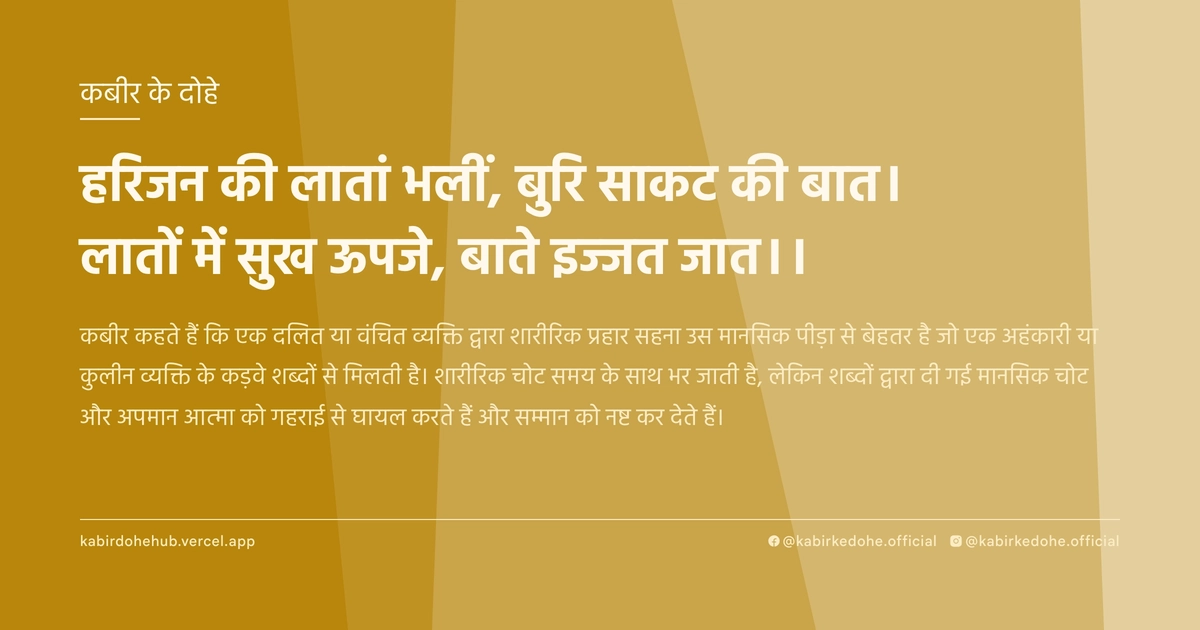
हरिजन की लातां भलीं, बुरि साकट की बात।
लातों में सुख ऊपजे, बाते इज्जत जात।।
Harijan ki laatan bhali, buri sakat ki baat. Laaton mein sukh upaje, baate izzat jaat.
इस पृष्ठ पर इस कबीर दोहे का अर्थ (meaning), हिंदी व्याख्या और अंग्रेज़ी अनुवाद, दार्शनिक विश्लेषण और व्यावहारिक जीवन सीख दी गई है। यह दोहा जाति विरोध (Anti-casteism) विषय से जुड़ा है — Kabir doha meaning and explanation in Hindi and English.
अर्थ (Meaning):
कबीर कहते हैं कि एक दलित या वंचित व्यक्ति द्वारा शारीरिक प्रहार सहना उस मानसिक पीड़ा से बेहतर है जो एक अहंकारी या कुलीन व्यक्ति के कड़वे शब्दों से मिलती है। शारीरिक चोट समय के साथ भर जाती है, लेकिन शब्दों द्वारा दी गई मानसिक चोट और अपमान आत्मा को गहराई से घायल करते हैं और सम्मान को नष्ट कर देते हैं।
Kabir asserts that enduring physical blows from a marginalized person is preferable to enduring the caustic words of a proud, high-status individual. While physical wounds heal over time, the psychological trauma inflicted by arrogant speech pierces the soul, eroding one's dignity and leaving a lasting scar on the spirit.
व्याख्या (Interpretation):
यह दोहा बाहरी हिंसा और आंतरिक मानसिक हिंसा के बीच के विरोधाभास को दर्शाता है। 'लातां' (लातें) यहाँ भौतिक पीड़ा का प्रतीक हैं, जबकि 'साकट की बात' (कुलीन की बातें) सूक्ष्म अहंकार और मानसिक उत्पीड़न का प्रतीक है। कबीर निरगुण भक्ति के माध्यम से यह समझाते हैं कि माया का सबसे खतरनाक रूप 'अहंकार' है। जब एक व्यक्ति अपनी सामाजिक स्थिति के मद में दूसरों को शब्दों से नीचा दिखाता है, तो वह वास्तव में अपनी ही आत्मा के पतन का मार्ग प्रशस्त करता है। यह अद्वैत वेदांत के उस सिद्धांत की ओर इशारा करता है जहाँ आत्मा की कोई जाति नहीं होती; अतः किसी को नीचा दिखाना स्वयं को नीचा दिखाने के समान है।
This couplet highlights the paradox between external physical violence and internal psychological aggression. The 'blows' symbolize tangible pain, whereas the 'words of the elite' represent the subtle violence of ego and systemic oppression. Kabir, through the lens of Nirgun Bhakti, suggests that the most dangerous manifestation of Maya is the ego (Ahankara). When an individual uses their social standing to belittle others, they are not harming the other, but rather accelerating their own spiritual decay. This aligns with Advaita Vedanta, where the Atman is devoid of caste or class; thus, to dehumanize another is to deny the divinity within oneself, creating a spiritual fracture that is harder to heal than a physical bruise.
दार्शनिक विश्लेषण (Philosophical Analysis):
कबीर का यह दोहा उनके युग के कठोर सामाजिक स्तरीकरण और जातिगत भेदभाव पर एक तीखा प्रहार है। उन्होंने देखा कि समाज में 'शुद्धता' और 'उच्चता' के नाम पर शब्दों का उपयोग हथियार के रूप में किया जाता था। कबीर का दर्शन केवल धार्मिक सुधार नहीं, बल्कि एक मनोवैज्ञानिक क्रांति थी। वे सूफीवाद के 'इश्क' (प्रेम) और वेदांत के 'एकत्व' को जोड़ते हैं, जहाँ मनुष्य की पहचान उसके जन्म से नहीं, बल्कि उसके आचरण से होती है।
यहाँ कबीर ritualism (कर्मकांड) और सामाजिक प्रतिष्ठा के खोखलेपन को उजागर करते हैं। वे तर्क देते हैं कि जो व्यक्ति स्वयं को 'उच्च' मानकर दूसरों का अपमान करता है, वह वास्तव में आध्यात्मिक रूप से सबसे निम्न है। यह विश्लेषण हमें बताता है कि अहंकार का विनाश ही वास्तविक मुक्ति है। जब तक व्यक्ति 'मैं' और 'तू' के भेद में फंसा है, वह सत्य से दूर है।
यह दोहा यह भी स्पष्ट करता है कि मानसिक पीड़ा शारीरिक पीड़ा से अधिक घातक क्यों है। शारीरिक चोट शरीर को प्रभावित करती है, लेकिन अपमानित करने वाले शब्द 'चित्त' या चेतना को प्रभावित करते हैं। सूफी परंपरा में, इसे 'नफ्स' (lower self) का प्रभुत्व कहा जाता है। जब नफ्स हावी होता है, तो मनुष्य दूसरों को तुच्छ समझने लगता है, जो कि आध्यात्मिक विकास में सबसे बड़ी बाधा है।
कबीर का दृष्टिकोण यहाँ विद्रोही है क्योंकि वे उस समय के सत्ता ढांचे को चुनौती दे रहे थे। वे यह स्थापित करना चाहते थे कि ईश्वर (निरंजन) किसी मंदिर या जाति में नहीं, बल्कि उस हृदय में बसता है जो करुणा से भरा हो। उनके लिए, एक दलित की लात में भी एक तरह की ईमानदारी हो सकती है, लेकिन एक अहंकारी की मीठी या कड़वी बातों में केवल छल और श्रेष्ठता का भ्रम होता है।
अंततः, यह विश्लेषण हमें इस निष्कर्ष पर ले जाता है कि वास्तविक 'इज्जत' या सम्मान सामाजिक पद से नहीं, बल्कि आंतरिक विनम्रता से आता है। जो व्यक्ति स्वयं को शून्य कर लेता है, वही पूर्णता को प्राप्त करता है। कबीर हमें सिखाते हैं कि शब्दों की हिंसा आत्मा के उस दर्पण को धुंधला कर देती है जिसमें हमें ईश्वर का प्रतिबिंब देखना होता है।
Kabir’s couplet serves as a scathing critique of the rigid social stratification and caste-based discrimination of his era. He observed that in the name of 'purity' and 'superiority,' language was weaponized to maintain power dynamics. Kabir’s philosophy was not merely a religious reform but a psychological revolution, blending the Sufi concept of 'Ishq' (Divine Love) with the Vedantic principle of 'Oneness,' where a human's identity is defined by conduct rather than birth.
Here, Kabir exposes the hollowness of ritualism and social prestige. He argues that the person who considers themselves 'superior' and belittles others is, in spiritual terms, the most degraded. This analysis emphasizes that the annihilation of the ego (Ahankara) is the only path to true liberation. As long as an individual remains trapped in the duality of 'I' and 'Thou,' they remain distanced from the Ultimate Truth.
Furthermore, the verse explains why psychological pain is more lethal than physical suffering. Physical injury affects the body, but insulting words wound the 'Chitta' or the consciousness. In Sufi tradition, this is seen as the dominance of the 'Nafs' (the lower self). When the Nafs prevails, the individual perceives others as inferior, which constitutes the primary obstacle to spiritual ascension.
Kabir’s approach is intentionally subversive, challenging the power structures of his time. He sought to establish that the Formless Divine (Niranjan) resides not in temples or caste hierarchies, but in a heart filled with compassion. To him, there is more honesty in a physical blow from the oppressed than in the calculated, condescending speech of the oppressor, which is rooted in the illusion of superiority.
Ultimately, this analysis leads to the conclusion that true 'honor' or dignity does not stem from social rank, but from internal humility. Only the one who renders themselves 'zero' can attain the 'infinite.' Kabir teaches us that the violence of words clouds the mirror of the soul, preventing us from seeing the reflection of the Divine within all beings.
मूल संदेश (Core Message):
- शारीरिक चोट अस्थायी है, लेकिन शब्दों का घाव गहरा होता है।
- अहंकार मनुष्य को अंधा कर देता है और उसे क्रूर बनाता है।
- सच्ची गरिमा सामाजिक पद में नहीं, बल्कि विनम्रता में है।
- शब्दों की हिंसा आत्मा के दर्पण को धुंधला कर देती है।
- अद्वैत का मार्ग दूसरों में स्वयं को देखने से शुरू होता है।
- Physical wounds are transient; verbal wounds pierce the soul.
- Ego blinds the human spirit and breeds cruelty.
- True dignity resides in humility, not in social hierarchy.
- The violence of words clouds the mirror of the spirit.
- The path of non-duality begins by seeing oneself in others.
व्यावहारिक उदाहरण (Practical Example):
वाराणसी के एक पुराने घाट पर, माधव नाम का एक वृद्ध नाविक रहता था। माधव स्वभाव से अत्यंत सरल था, लेकिन उसकी गरीबी के कारण शहर के कुछ समृद्ध व्यापारी उसे तुच्छ समझते थे।
एक दिन, एक अहंकारी व्यापारी, सेठ धनीराम, माधव की नाव पर सवार हुआ। यात्रा के दौरान, धनीराम ने माधव के फटे कपड़ों और उसकी बोली का मज़ाक उड़ाया। उसने सबके सामने माधव को 'अशिक्षित' और 'नीच' कहा।
माधव चुप रहा, लेकिन धनीराम के शब्द उसके हृदय में गहरे घाव कर गए। उसे लगा कि उसकी पूरी जीवन भर की मेहनत और ईमानदारी का कोई मूल्य नहीं है। वह रात भर सो नहीं सका, उसे वह अपमान एक शारीरिक चोट से अधिक दर्दनाक लगा।
अगले दिन, माधव की नाव एक छोटे से हादसे का शिकार हुई और वह पानी में गिर गया। एक गरीब मल्लाह, जिसे समाज 'अछूत' मानता था, ने अपनी जान जोखिम में डालकर माधव को बचाया।
बचाते समय उस मल्लाह ने गलती से माधव को जोर से धक्का दिया, जिससे माधव की पसली में चोट आई। शारीरिक रूप से माधव दर्द में था, लेकिन उसे एक अजीब सी शांति महसूस हुई।
उसने महसूस किया कि उस मल्लाह का धक्का अनजाने में था और उसमें कोई द्वेष नहीं था। लेकिन सेठ धनीराम के शब्दों में एक गहरा जहर था, जिसका उद्देश्य उसे मानसिक रूप से तोड़ना था।
माधव को कबीर का यह दोहा याद आया। उसने महसूस किया कि शरीर की चोट तो कुछ दिनों में ठीक हो जाएगी, लेकिन शब्दों का वह जहर उसकी आत्मा को कुतर रहा था।
इस बोध ने माधव को बदल दिया। उसने तय किया कि वह अब अपनी कीमत दूसरों की नजरों में नहीं, बल्कि अपनी आत्मा की सच्चाई में खोजेगा।
उसने सेठ धनीराम के प्रति नफरत पालने के बजाय उसके प्रति करुणा महसूस की, क्योंकि वह समझ गया कि धनीराम अपने अहंकार के कारण वास्तव में एक मानसिक जेल में कैद है।
माधव अब घाट का सबसे सम्मानित व्यक्ति बन गया, न इसलिए कि उसके पास धन था, बल्कि इसलिए क्योंकि उसने शब्दों की हिंसा को क्षमा की शक्ति से जीत लिया था।
On an ancient ghat in Varanasi lived an elderly boatman named Madhav. Madhav was simple and kind, but due to his poverty, some of the city's wealthy merchants viewed him with contempt.
One day, an arrogant merchant named Seth Dhaniram boarded Madhav's boat. During the journey, Dhaniram mocked Madhav's tattered clothes and his rustic dialect, calling him 'uneducated' and 'low-born' in front of everyone.
Madhav remained silent, but Dhaniram's words carved deep wounds in his heart. He felt that his lifelong honesty and hard work were worthless. He could not sleep that night, feeling the insult more acutely than any physical injury.
The next day, Madhav's boat encountered a minor accident, and he fell into the river. A poor ferryman, marginalized by society as 'untouchable,' risked his own life to rescue Madhav.
While pulling him out, the ferryman accidentally shoved Madhav hard, causing a bruise on his ribs. Physically, Madhav was in pain, but he felt a strange sense of peace.
He realized that the ferryman's blow was unintentional and devoid of malice. In contrast, Seth Dhaniram's words contained a calculated poison intended to break his spirit.
In that moment, Kabir's couplet resonated within him. He understood that the physical bruise would heal in a few days, but the verbal venom had been eating away at his soul.
This realization transformed Madhav. He decided that he would no longer seek his value in the eyes of others, but in the truth of his own soul.
Instead of harboring hatred for Dhaniram, he felt compassion for him, realizing that the merchant was actually imprisoned in a mental jail of his own ego.
Madhav eventually became the most respected man on the ghat—not because he acquired wealth, but because he conquered the violence of words with the power of forgiveness.
अभ्यास मार्गदर्शन (Practice Guidance):
- दैनिक मौन अभ्यास: दिन में 30 मिनट पूर्ण मौन रहें और यह निरीक्षण करें कि आपके मन में दूसरों के प्रति किस तरह के निर्णय (judgments) उठ रहे हैं।
- शब्द-जागरूकता जर्नल: जब भी आप किसी के प्रति क्रोध या तिरस्कार महसूस करें, उसे लिखें और पूछें—'क्या यह मेरा अहंकार बोल रहा है या मेरी आत्मा?'
- करुणा का अभ्यास: जानबूझकर उन लोगों से बात करें जिन्हें समाज उपेक्षित करता है, और उनके भीतर छिपी दिव्यता को पहचानने का प्रयास करें।
- डायग्नोस्टिक चेकलिस्ट: यदि आप किसी की आलोचना के बाद कई दिनों तक उदास रहते हैं, तो आप अभी भी बाहरी 'इज्जत' (अहंकार) से जुड़े हैं। यदि आप उसे क्षमा कर पाते हैं, तो आप मुक्ति की ओर बढ़ रहे हैं।
- Daily Silence Practice: Spend 30 minutes in complete silence and observe the types of judgments and labels your mind assigns to others.
- Word-Awareness Journal: Whenever you feel anger or contempt toward someone, write it down and ask—'Is this my ego speaking, or my soul?'
- Compassion Exercise: Intentionally engage with those marginalized by society, striving to recognize the inherent divinity within them.
- Diagnostic Checklist: If you remain distressed for days after someone criticizes you, you are still tethered to external 'honor' (ego). If you can forgive and let go, you are moving toward liberation.
चिंतन प्रश्न (Reflection Questions):
- क्या मैंने कभी अपनी शिक्षा या पद का उपयोग किसी को मानसिक रूप से छोटा महसूस कराने के लिए किया है?
- मेरी 'इज्जत' का कितना हिस्सा मेरी वास्तविक योग्यता पर आधारित है और कितना दूसरों की धारणाओं पर?
- जब मैं किसी की आलोचना करता हूँ, तो क्या मैं वास्तव में सुधार चाहता हूँ या अपनी श्रेष्ठता सिद्ध करना चाहता हूँ?
- मेरे भीतर का वह कौन सा 'अहंकार' है जो मुझे कुछ लोगों को खुद से कमतर समझने पर मजबूर करता है?
- क्या मैं शब्दों के बिना अपनी पहचान को परिभाषित कर सकता हूँ?
- Have I ever used my education or position to make someone feel intellectually or socially inferior?
- How much of my 'dignity' is based on actual merit versus the perceptions of others?
- When I criticize someone, am I genuinely seeking their improvement or merely validating my own superiority?
- Which part of my ego compels me to view certain people as 'lesser' than myself?
- Can I define my identity without relying on the labels and words provided by society?