
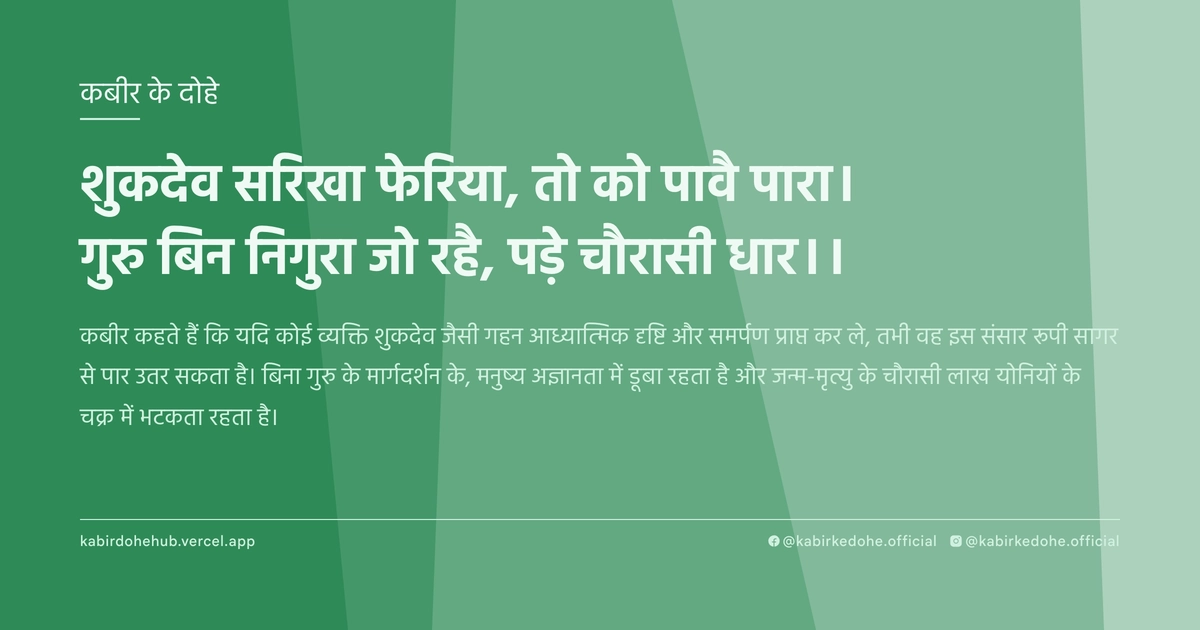
शुकदेव सरिखा फेरिया, तो को पावै पारा।
गुरु बिन निगुरा जो रहै, पड़े चौरासी धार।।
Shukdev sarikha pheriya, to ko paave paara. Guru bin nigura jo rahaye, pade chaurasi dhaar.
इस पृष्ठ पर इस कबीर दोहे का अर्थ (meaning), हिंदी व्याख्या और अंग्रेज़ी अनुवाद, दार्शनिक विश्लेषण और व्यावहारिक जीवन सीख दी गई है। यह दोहा गुरु महत्व (The Guru's Importance) विषय से जुड़ा है — Kabir doha meaning and explanation in Hindi and English.
अर्थ (Meaning):
कबीर कहते हैं कि यदि कोई व्यक्ति शुकदेव जैसी गहन आध्यात्मिक दृष्टि और समर्पण प्राप्त कर ले, तभी वह इस संसार रूपी सागर से पार उतर सकता है। बिना गुरु के मार्गदर्शन के, मनुष्य अज्ञानता में डूबा रहता है और जन्म-मृत्यु के चौरासी लाख योनियों के चक्र में भटकता रहता है।
Kabir asserts that only those who cultivate a spiritual vision and surrender akin to the sage Shukdev can transcend the ocean of worldly existence. Without the guidance of a true Guru, an individual remains trapped in ignorance, condemned to wander through the endless cycle of eighty-four thousand species of birth and death.
व्याख्या (Interpretation):
इस दोहे का शाब्दिक अर्थ है कि शुकदेव जैसी चेतना के बिना मोक्ष असंभव है। यहाँ 'शुकदेव' केवल एक व्यक्ति नहीं, बल्कि उस उच्चतम अवस्था के प्रतीक हैं जहाँ ज्ञान और भक्ति का मिलन होता है। कबीर निरगुण भक्ति का समर्थन करते हुए बताते हैं कि आत्मा (Atman) और परमात्मा (Brahman) का मिलन केवल तब संभव है जब माया का पर्दा हटे। 'चौरासी धार' उस अंतहीन चक्र को दर्शाता है जहाँ अहंकार मनुष्य को बार-बार भौतिक इच्छाओं में बांधता है। यह विरोधाभास है कि ईश्वर सबके भीतर है, फिर भी गुरु के बिना वह अदृश्य रहता है। अंततः, यह दोहा बताता है कि आत्म-साक्षात्कार के लिए एक योग्य मार्गदर्शक अनिवार्य है जो साधक को उसके वास्तविक स्वरूप से परिचित कराए।
Literally, the verse suggests that liberation is unattainable without a consciousness similar to Shukdev. Here, 'Shukdev' is not merely a historical figure but a symbol of the pinnacle where knowledge and devotion converge. Supporting Nirgun Bhakti, Kabir explains that the union of Atman and Brahman occurs only when the veil of Maya is lifted. The 'eighty-four streams' represent the relentless cycle where the ego binds the human soul to material desires. The central paradox lies in the fact that while the Divine resides within all, it remains invisible without the Guru's intervention. Ultimately, the Doha emphasizes that a qualified guide is indispensable to awaken the seeker to their true, non-dual nature.
दार्शनिक विश्लेषण (Philosophical Analysis):
कबीर का यह दोहा मध्यकालीन भारत के उस सामाजिक-धार्मिक परिवेश में रचा गया जहाँ कर्मकांड और जातिगत श्रेष्ठता चरम पर थी। कबीर ने बाहरी आडंबरों को नकारते हुए 'सहज मार्ग' पर बल दिया। उनका दर्शन अद्वैत वेदांत से गहराई से प्रेरित है, जहाँ वे मानते हैं कि जीव और शिव एक ही हैं, बस अज्ञानता की दीवार है।
यहाँ गुरु की महत्ता केवल एक व्यक्ति के रूप में नहीं, बल्कि उस 'तत्व' के रूप में है जो अंधकार को मिटाता है। सूफी मत के 'पीर' और भक्ति मार्ग के 'गुरु' का संगम यहाँ दिखता है, जहाँ गुरु वह दर्पण है जिसमें शिष्य अपना वास्तविक चेहरा देख पाता है। कबीर का तर्क है कि शास्त्र पढ़ना पर्याप्त नहीं है; अनुभवजन्य ज्ञान (Anubhava) ही सत्य है।
चौरासी लाख योनियों का उल्लेख केवल पौराणिक मान्यता नहीं, बल्कि मनोवैज्ञानिक बंधन का प्रतीक है। यह उस मानसिक स्थिति को दर्शाता है जहाँ मनुष्य अपनी पहचान को शरीर, पद या जाति से जोड़ लेता है, जिससे वह बार-बार उन्हीं पुराने पैटर्न्स में फंसता रहता है।
कबीर ritualism (कर्मकांड) का विरोध करते हुए कहते हैं कि मोक्ष किसी तीर्थ या मंदिर में नहीं, बल्कि अंतर्मन की शुद्धि में है। वे यह स्पष्ट करते हैं कि बिना गुरु के, साधक अपनी ही सूक्ष्म वासनाओं को 'ज्ञान' समझकर भ्रमित हो सकता है।
अंतिम विश्लेषण में, यह दोहा अहंकार के विसर्जन (annihilation of ego) की बात करता है। जब तक 'मैं' जीवित है, तब तक 'वह' (परमात्मा) नहीं मिल सकता। गुरु का कार्य इसी 'मैं' को मिटाकर शून्य में विलीन करना है, जिससे साधक उस अनंत चेतना का हिस्सा बन जाता है।
This Doha was composed within the socio-religious milieu of medieval India, a time dominated by rigid ritualism and caste hierarchies. Kabir rejected these external formalities, advocating for the 'Sahaj Marg' (the natural path). His philosophy is deeply rooted in Advaita Vedanta, asserting that the individual soul and the Universal Spirit are one, separated only by the wall of ignorance.
The significance of the Guru here is not merely as a person, but as the 'Principle' that dispels darkness. This reflects a synthesis of the Sufi 'Pir' and the Bhakti 'Guru,' where the teacher acts as a mirror reflecting the disciple's true essence. Kabir argues that scholarly study of texts is insufficient; only experiential knowledge (Anubhava) constitutes truth.
The mention of the 'eighty-four thousand species' is not just a mythological reference but a psychological metaphor for bondage. It represents the mental state where a human identifies with the body, status, or caste, thereby remaining trapped in repetitive patterns of desire and suffering.
Opposing ritualism, Kabir posits that liberation is found not in pilgrimages or temples, but in the purification of the inner self. He warns that without a Guru, a seeker might mistake their own subtle cravings for spiritual enlightenment, leading to deeper delusion.
In final analysis, the verse speaks of the annihilation of the ego. As long as the 'I' exists, the 'Divine' cannot be realized. The Guru's role is to dissolve this 'I' into the void, allowing the seeker to merge into the infinite consciousness.
मूल संदेश (Core Message):
- अहंकार ही वह पर्दा है जो सत्य को ओझल करता है।
- बिना मार्गदर्शन के आध्यात्मिक प्रयास दिशाहीन भटकन हो सकते हैं।
- सच्चा गुरु वह है जो आपको आपसे ही मिलवा दे।
- कर्मकांड केवल शरीर की कसरत है, आत्मा की नहीं।
- मुक्ति का अर्थ स्थान परिवर्तन नहीं, बल्कि दृष्टि परिवर्तन है।
- The ego is the primary veil obscuring the ultimate truth.
- Spiritual efforts without guidance can become aimless wanderings.
- A true Guru is one who introduces you to your own essence.
- Ritualism is merely exercise for the body, not the soul.
- Liberation is not a change of location, but a change of perception.
व्यावहारिक उदाहरण (Practical Example):
वाराणसी के एक पुराने घाट पर रहने वाली एक वृद्ध विधवा, जानकी, का जीवन केवल मंदिर की सीढ़ियों और भिक्षा पर टिका था। वह सालों से मंत्र पढ़ रही थी, लेकिन उसके मन में अपने परिवार के प्रति गहरा क्रोध और समाज के प्रति कड़वाहट थी। वह मानती थी कि केवल जाप करने से वह मोक्ष पा लेगी।
एक दिन उसकी मुलाकात एक फकीर से हुई जो घाट पर चुपचाप बैठा रहता था। फकीर ने जानकी से कहा, 'तुम शब्दों को दोहरा रही हो, लेकिन तुम्हारे भीतर का क्रोध अभी भी जीवित है। क्या तुम उस आग को देख पा रही हो जो तुम्हारे मंत्रों को जला रही है?'
जानकी को पहले तो यह बात चुभी, लेकिन फिर उसने महसूस किया कि वह वास्तव में केवल एक मानसिक ढोंग कर रही थी। उसने फकीर को अपना मार्गदर्शक मान लिया। फकीर ने उसे कोई नया मंत्र नहीं दिया, बल्कि उसे सिखाया कि कैसे अपने क्रोध के मूल को देखा जाए।
जानकी ने अभ्यास शुरू किया कि जब भी वह किसी के प्रति नफरत महसूस करे, वह उस भावना को दबाने के बजाय उसे साक्षी भाव से देखे। उसने पाया कि उसका क्रोध वास्तव में उसकी अपनी अधूरी इच्छाओं का प्रतिबिंब था।
धीरे-धीरे, जानकी का व्यवहार बदलने लगा। वह अब केवल मंत्रों की मशीन नहीं थी, बल्कि उसके हृदय में करुणा जाग उठी। उसने उन लोगों को क्षमा करना शुरू किया जिन्होंने उसे जीवन भर दुख दिए थे।
एक शाम, जब वह गंगा की लहरों को देख रही थी, उसे महसूस हुआ कि वह अब खुद को एक 'परित्यक्त विधवा' के रूप में नहीं देख रही, बल्कि एक अनंत चेतना के हिस्से के रूप में देख रही है।
यह 'कबीर ट्विस्ट' था—बाहरी अनुष्ठान से आंतरिक रूपांतरण की ओर संक्रमण। उसने जाना कि बिना उस फकीर (गुरु) के, वह केवल शब्दों के जाल में फंसी रहती और कभी उस मानसिक शांति तक नहीं पहुँच पाती जिसे वह मोक्ष समझ रही थी।
अंततः, जानकी ने अपनी शेष आयु दूसरों की सेवा में बिताई, यह जानते हुए कि असली मोक्ष किसी अन्य लोक में जाना नहीं, बल्कि इसी जीवन में अहंकार से मुक्त होना है।
Janaki, an elderly widow living on an ancient ghat in Varanasi, spent her days reciting mantras and relying on alms. For years, she believed that the mere repetition of sacred words would grant her moksha, yet her heart remained heavy with resentment toward her family and society.
One day, she encountered a wandering fakir who sat in silence by the river. The fakir observed her and said, 'You are repeating words, but the fire of anger within you is consuming those very mantras. Can you see the flame that burns your prayers?'
Initially, Janaki felt offended, but she soon realized she had been performing a mental charade. She decided to accept the fakir as her guide. He did not give her new mantras; instead, he taught her how to observe the root of her anger.
Janaki began a practice of witnessing her hatred without suppressing it. She discovered that her anger was merely a reflection of her own unfulfilled desires and perceived injustices.
Gradually, Janaki's behavior transformed. She ceased being a machine of recitation and became a vessel of compassion. She began to forgive those who had caused her lifelong suffering.
One evening, while gazing at the ripples of the Ganges, she realized she no longer saw herself as a 'forsaken widow,' but as a fragment of an infinite consciousness.
This was the 'Kabir Twist'—the transition from external ritual to internal transformation. She understood that without the fakir (Guru), she would have remained trapped in a linguistic web, never reaching the peace she mistook for salvation.
Ultimately, Janaki spent her remaining years in selfless service, realizing that true liberation is not traveling to another realm, but dissolving the ego within this very life.
अभ्यास मार्गदर्शन (Practice Guidance):
- प्रतिदिन 20 मिनट मौन अभ्यास करें, जहाँ आप केवल अपने विचारों के साक्षी बनें, बिना किसी निर्णय के।
- एक 'अहंकार डायरी' लिखें: दिन भर में उन क्षणों को नोट करें जब आपने अपनी श्रेष्ठता सिद्ध करने की कोशिश की या जब आपका क्रोध आपकी पहचान बन गया।
- स्व-पूछताछ (Self-Inquiry) का अभ्यास करें: जब भी कोई भावना तीव्र हो, पूछें 'यह कौन महसूस कर रहा है?' और उस 'मैं' की खोज करें।
- निदान चेकलिस्ट: क्या मैं अभी भी बाहरी प्रतीकों (पद, ज्ञान, धर्म) से अपनी पहचान जोड़ रहा हूँ? क्या मैं दूसरों को सुधारने की कोशिश में खुद को श्रेष्ठ मान रहा हूँ? यदि हाँ, तो आप अभी भी 'चौरासी धार' में हैं।
- Practice 20 minutes of daily silence, acting solely as a witness to your thoughts without judgment.
- Maintain an 'Ego Diary': Note moments throughout the day when you attempted to prove your superiority or when anger became your identity.
- Engage in Self-Inquiry: Whenever an intense emotion arises, ask 'Who is experiencing this?' and trace the origin of the 'I'.
- Diagnostic Checklist: Am I still anchoring my identity to external symbols (status, knowledge, religion)? Am I feeling superior while trying to 'correct' others? If yes, you are still caught in the 'eighty-four streams'.
चिंतन प्रश्न (Reflection Questions):
- क्या मेरी आध्यात्मिक साधना वास्तव में मुझे विनम्र बना रही है, या यह मेरे अहंकार को एक 'धार्मिक' रूप दे रही है?
- यदि मुझसे मेरी सभी उपाधियाँ, धर्म और सामाजिक पहचान छीन ली जाएँ, तो मेरा 'वास्तविक स्वरूप' क्या बचेगा?
- मैं किन मानसिक पैटर्न्स (चौरासी धार) को बार-बार दोहरा रहा हूँ, यह जानते हुए भी कि वे मुझे दुख देते हैं?
- क्या मैं किसी बाहरी गुरु की तलाश में हूँ ताकि मैं अपनी जिम्मेदारी से बच सकूँ, या मैं वास्तव में आत्म-विघटन के लिए तैयार हूँ?
- मेरे जीवन का वह कौन सा 'पवित्र' झूठ है जिसे मैं सच मानकर जी रहा हूँ?
- Is my spiritual practice truly making me humble, or is it merely giving my ego a 'religious' mask?
- If all my titles, religion, and social identities were stripped away, what would remain of my 'true self'?
- Which mental patterns (the eighty-four streams) do I repeat relentlessly, even while knowing they cause me suffering?
- Am I seeking an external Guru to avoid personal responsibility, or am I genuinely ready for the dissolution of the self?
- What is the 'sacred lie' in my life that I have accepted as truth?