
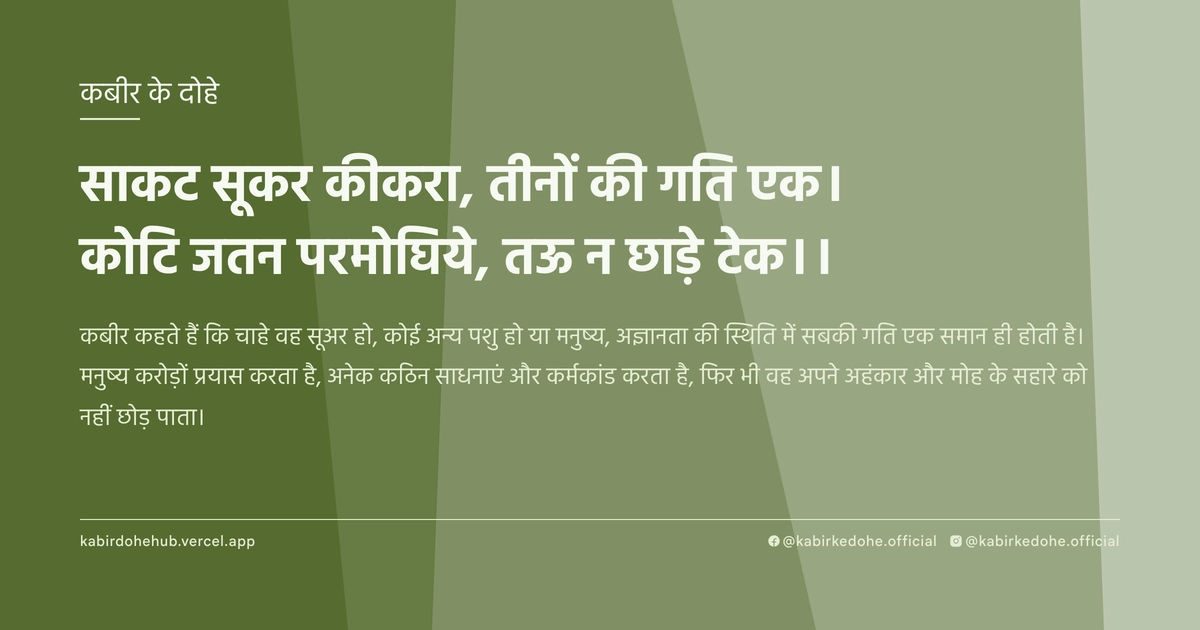
साकट सूकर कीकरा, तीनों की गति एक।
कोटि जतन परमोघिये, तऊ न छाड़े टेक।।
Saakat sukar keekra, teeno ki gati ek. Koti jatan parmoghiye, tau na chhadé tek.
इस पृष्ठ पर इस कबीर दोहे का अर्थ (meaning), हिंदी व्याख्या और अंग्रेज़ी अनुवाद, दार्शनिक विश्लेषण और व्यावहारिक जीवन सीख दी गई है। यह दोहा अहंकार (The Ego) विषय से जुड़ा है — Kabir doha meaning and explanation in Hindi and English.
अर्थ (Meaning):
कबीर कहते हैं कि चाहे वह सूअर हो, कोई अन्य पशु हो या मनुष्य, अज्ञानता की स्थिति में सबकी गति एक समान ही होती है। मनुष्य करोड़ों प्रयास करता है, अनेक कठिन साधनाएं और कर्मकांड करता है, फिर भी वह अपने अहंकार और मोह के सहारे को नहीं छोड़ पाता।
Kabir asserts that whether it is a swine, another animal, or a human, their state remains identical when shrouded in ignorance. Despite millions of efforts and the performance of rigorous rituals, the human being refuses to relinquish their stubborn attachment to the ego and worldly delusions.
व्याख्या (Interpretation):
शाब्दिक अर्थ यह है कि जब तक चेतना जाग्रत नहीं होती, मनुष्य और पशु में कोई अंतर नहीं है। यहाँ 'सूकर' केवल एक पशु नहीं, बल्कि उस जड़ता का प्रतीक है जो केवल इंद्रिय सुखों में लीन रहती है। यह दोहा निर्गुण भक्ति के उस सिद्धांत को दर्शाता है जहाँ माया मनुष्य को अंधा कर देती है। जब तक आत्मा (Atman) स्वयं को शरीर और अहंकार से अलग नहीं देखती, वह उसी चक्र में फंसी रहती है जिसमें पशु फंसे हैं। यह विरोधाभास है कि मनुष्य स्वयं को श्रेष्ठ मानता है, जबकि उसकी मानसिक वृत्तियाँ अभी भी आदिम और वासनापूर्ण हैं।
Literally, it suggests that without awakened consciousness, there is no distinction between a human and a beast. Here, the 'swine' is not merely an animal but a symbol of the spiritual inertia that remains immersed solely in sensory gratifications. This verse reflects the Nirgun Bhakti principle where Maya blinds the seeker. Until the Atman perceives itself as distinct from the body and ego, it remains trapped in the same cycle as the animal kingdom. The central paradox lies in the human claim of superiority while their mental tendencies remain primitive and driven by raw desire.
दार्शनिक विश्लेषण (Philosophical Analysis):
कबीर का यह दोहा मध्यकालीन भारत के उस सामाजिक और धार्मिक परिवेश पर प्रहार है जहाँ बाहरी आडंबरों को मोक्ष का मार्ग माना जाता था। वे स्पष्ट करते हैं कि केवल तीर्थयात्रा, व्रत या माला जपने से (कोटि जतन) परिवर्तन नहीं आता यदि आंतरिक अहंकार (टेक) बना रहे। यह अद्वैत वेदांत के उस विचार से मेल खाता है जहाँ अज्ञान (Avidya) ही बंधन का कारण है। जब तक 'मैं' का भाव है, तब तक जीव माया के वशीभूत है।
सूफीवाद के संदर्भ में, यह 'नफ्स' (Khum/Ego) के विनाश की बात है। कबीर का तर्क है कि धार्मिक पहचान या जातिगत श्रेष्ठता केवल एक भ्रम है। यदि एक पंडित या मौलवी केवल अपनी पहचान पर गर्व करता है और उसके भीतर करुणा और सत्य का अभाव है, तो उसकी आध्यात्मिक स्थिति एक पशु के समान ही है।
यहाँ 'टेक' शब्द अत्यंत महत्वपूर्ण है। यह उस मानसिक सहारे को दर्शाता है जिसे हम अपनी पहचान मानते हैं—हमारा पद, हमारा ज्ञान, या हमारा धर्म। यह वह अंतिम किला है जिसे अहंकार नहीं छोड़ना चाहता। कबीर सिखाते हैं कि वास्तविक मुक्ति बाहरी क्रियाओं में नहीं, बल्कि इस आंतरिक सहारे के पूर्ण विसर्जन में है।
मनोवैज्ञानिक स्तर पर, यह दोहा संज्ञानात्मक विसंगति (Cognitive Dissonance) को दर्शाता है। मनुष्य जानता है कि वह आध्यात्मिक होना चाहता है, लेकिन वह अपनी पुरानी आदतों और पहचानों से इतना चिपका रहता है कि उसका 'प्रयास' केवल एक दिखावा बन जाता है।
अंततः, कबीर का संदेश यह है कि मुक्ति के लिए 'प्रयास' (Effort) से अधिक 'समर्पण' (Surrender) की आवश्यकता है। जब तक आप स्वयं को बचाने की कोशिश कर रहे हैं, आप वास्तव में अपनी कैद को और मजबूत कर रहे हैं। केवल पूर्ण शून्य होने पर ही परमात्मा का अनुभव संभव है।
This couplet strikes at the heart of the medieval Indian social and religious landscape, where external rituals were mistaken for the path to liberation. Kabir clarifies that pilgrimages, fasts, or repetitive chanting (Koti Jatan) yield no transformation if the internal anchor of ego (Tek) remains intact. This aligns with Advaita Vedanta, where ignorance (Avidya) is identified as the primary cause of bondage. As long as the sense of 'I' persists, the soul remains enslaved by Maya.
In the context of Sufism, this refers to the annihilation of the 'Nafs' (the lower self/ego). Kabir argues that religious identity or caste superiority is a mere illusion. If a scholar or a cleric prides himself on his status while lacking compassion and truth, his spiritual state is no different from that of a beast.
The word 'Tek' (support/anchor) is pivotal here. It represents the mental crutch we mistake for our identity—our rank, our knowledge, or our creed. This is the final fortress that the ego refuses to abandon. Kabir teaches that true liberation is found not in external actions, but in the total dissolution of this internal anchor.
Psychologically, the verse highlights a state of cognitive dissonance. The human desires spiritual awakening but clings so fiercely to old habits and identities that their 'effort' becomes a mere performance, a mask for the ego to hide behind.
Ultimately, Kabir suggests that liberation requires 'Surrender' more than 'Effort.' As long as you strive to save your individual self, you are merely reinforcing your prison. Only by becoming a total void can the experience of the Formless Divine be realized.
मूल संदेश (Core Message):
- बाहरी कर्मकांड बिना आंतरिक शुद्धि के व्यर्थ हैं।
- अहंकार ही वह सबसे बड़ी बाधा है जो मनुष्य को पशु बनाता है।
- सच्ची साधना स्वयं को मिटाने में है, स्वयं को बढ़ाने में नहीं।
- श्रेष्ठता का भ्रम ही माया का सबसे सूक्ष्म जाल है।
- जब 'मैं' समाप्त होता है, तभी सत्य का उदय होता है।
- External rituals are futile without internal purification.
- Ego is the primary barrier that reduces a human to an animal state.
- True spiritual practice lies in erasing the self, not enhancing it.
- The illusion of superiority is the most subtle trap of Maya.
- Only when the 'I' vanishes does the Truth emerge.
व्यावहारिक उदाहरण (Practical Example):
वाराणसी के एक पुराने घाट पर माधव नाम का एक वृद्ध बुनकर रहता था। माधव अपनी कला में निपुण था और शहर भर में अपनी श्रेष्ठता के लिए जाना जाता था। वह प्रतिदिन मंदिर जाता, घंटों पूजा करता और दान-पुण्य करता, लेकिन उसके भीतर एक गहरा अहंकार था कि वह इस शहर का सबसे 'शुद्ध' और 'ज्ञानी' व्यक्ति है।
वह अक्सर अपने पड़ोसियों को उनकी छोटी गलतियों के लिए टोकता और उन्हें नीचा दिखाता। उसे लगता था कि उसकी धार्मिक दिनचर्या उसे दूसरों से ऊपर उठाती है। वह खुद को एक आध्यात्मिक शिखर पर मानता था, जबकि वास्तव में वह अपनी श्रेष्ठता के अहंकार में अंधा था।
एक दिन, घाट पर एक फकीर आया जिसने माधव की सारी पूजा-पाठ की बातें सुनीं। फकीर ने माधव से कहा, 'तुम्हारी माला के मनके तो बहुत चमक रहे हैं, लेकिन तुम्हारा हृदय अभी भी उसी कीचड़ में है जहाँ एक सूअर अपनी भूख मिटाता है।'
माधव क्रोधित हो गया। उसने चिल्लाकर कहा, 'मैं एक विद्वान हूँ, मैंने वेदों का अध्ययन किया है, तुम मेरी तुलना एक पशु से कैसे कर सकते हो?'
फकीर ने शांति से उत्तर दिया, 'पशु केवल भोजन और नींद का मोह करता है, और तुम केवल अपनी 'छवि' और 'श्रेष्ठता' का मोह कर रहे हो। दोनों ही अपनी-अपनी वासनाओं के गुलाम हैं। फर्क सिर्फ इतना है कि पशु को पता नहीं है, और तुम इसे धर्म का नाम दे रहे हो।'
यह बात माधव के हृदय में एक तीर की तरह लगी। उसने महसूस किया कि उसकी सारी पूजा केवल उसके अहंकार को पोषण देने का एक साधन थी। वह 'परमोघिये' (कठिन प्रयास) तो कर रहा था, लेकिन अपनी 'टेक' (श्रेष्ठता का सहारा) नहीं छोड़ रहा था।
उस रात माधव सो नहीं सका। उसने अपनी पूरी जिंदगी की समीक्षा की और पाया कि उसने कभी किसी से प्रेम नहीं किया, केवल अपनी श्रेष्ठता सिद्ध की। उसने अपनी सारी उपाधियों और धार्मिक गर्व को त्यागने का निर्णय लिया।
अगले दिन से, माधव ने पूजा करना बंद नहीं किया, लेकिन उसका उद्देश्य बदल गया। अब वह दूसरों को नीचा दिखाने के लिए नहीं, बल्कि स्वयं के भीतर की गंदगी को साफ करने के लिए प्रार्थना करने लगा।
उसने अपनी कला को सेवा का माध्यम बनाया और चुपचाप उन लोगों की मदद करने लगा जिन्हें वह पहले तुच्छ समझता था। उसकी आँखों में अब गर्व नहीं, बल्कि करुणा थी।
माधव ने अंततः समझ लिया कि जब तक वह खुद को 'श्रेष्ठ' मानता रहा, वह वास्तव में एक आध्यात्मिक पशु ही था। जिस क्षण उसने अपनी श्रेष्ठता का सहारा छोड़ा, वह वास्तव में मनुष्य बन गया।
On an ancient ghat in Varanasi lived an elderly weaver named Madhav. Madhav was a master of his craft and renowned throughout the city for his excellence. He visited the temple daily, prayed for hours, and gave generously to charity, yet within him resided a deep-seated ego—the belief that he was the most 'pure' and 'learned' person in the city.
He frequently corrected his neighbors for their minor flaws, subtly belittling them. He believed his rigorous religious routine elevated him above others. He perceived himself to be on a spiritual peak, while in reality, he was blinded by the arrogance of his own superiority.
One day, a wandering fakir arrived at the ghat and overheard Madhav speaking of his spiritual practices. The fakir looked at him and said, 'The beads of your rosary shine brightly, but your heart still lingers in the same mud where a swine seeks its meal.'
Madhav was outraged. He shouted, 'I am a scholar! I have studied the Vedas! How dare you compare me to a beast?'
The fakir replied calmly, 'The animal is merely enslaved by food and sleep, while you are enslaved by the craving for your own image and superiority. Both are slaves to their respective desires. The only difference is that the animal is unaware, while you call your bondage religion.'
These words pierced Madhav's heart like an arrow. He realized that all his rituals were merely tools to nourish his ego. He was engaging in 'Koti Jatan' (strenuous effort), but he refused to let go of his 'Tek' (the anchor of superiority).
That night, Madhav could not sleep. He reviewed his entire life and discovered that he had never truly loved anyone; he had only sought to prove his own greatness.
He decided to renounce all his titles and his religious pride. From the next day, Madhav did not stop praying, but the purpose of his prayer shifted. He no longer prayed to be seen as holy, but to cleanse the internal filth of his soul.
He turned his craft into a medium of service, quietly helping those he had previously deemed insignificant. The pride in his eyes was replaced by genuine compassion.
Madhav finally understood that as long as he viewed himself as 'superior,' he was spiritually no different from an animal. The moment he released the anchor of his ego, he truly became a human being.
अभ्यास मार्गदर्शन (Practice Guidance):
- दैनिक आत्म-निरीक्षण: दिन के अंत में 15 मिनट बैठें और विश्लेषण करें कि आज आपने कितनी बार अपनी श्रेष्ठता सिद्ध करने का प्रयास किया।
- अहंकार का विसर्जन अभ्यास: जानबूझकर ऐसे कार्यों को करें जहाँ आपको कोई श्रेय न मिले और आपकी पहचान गुप्त रहे।
- मौन चिंतन: प्रतिदिन 30 मिनट मौन रहें और यह विचार करें कि यदि आपकी सारी उपाधियाँ और उपलब्धियाँ छीन ली जाएँ, तो आप वास्तव में कौन हैं?
- डायग्नोस्टिक चेकलिस्ट: क्या आप दूसरों की गलती पर तुरंत प्रतिक्रिया देते हैं? क्या आप अपनी धार्मिक/नैतिक श्रेष्ठता महसूस करते हैं? यदि हाँ, तो आप अभी भी 'टेक' से चिपके हैं।
- Daily Self-Audit: Spend 15 minutes at the end of the day analyzing how many times you attempted to prove your superiority over others.
- Ego-Dissolution Practice: Intentionally perform acts of kindness where you receive no credit and your identity remains anonymous.
- Silent Contemplation: Practice 30 minutes of silence daily, reflecting on the question: 'Who am I if all my titles and achievements are stripped away?'
- Diagnostic Checklist: Do you react instantly to others' mistakes? Do you feel a sense of moral or religious superiority? If yes, you are still clinging to the 'Tek'.
चिंतन प्रश्न (Reflection Questions):
- मेरी कौन सी 'धार्मिक' या 'नैतिक' आदतें वास्तव में मेरे अहंकार को संतुष्ट कर रही हैं?
- क्या मैं वास्तव में दूसरों की मदद करता हूँ, या मैं मदद करके अपनी श्रेष्ठता का अनुभव करना चाहता हूँ?
- मेरे जीवन का वह कौन सा 'सहारा' (Tek) है जिसे खोने के डर से मैं सबसे ज्यादा डरता हूँ?
- क्या मेरी डिजिटल पहचान (सोशल मीडिया) मेरे वास्तविक स्वरूप को ढकने वाला एक नया मुखौटा बन गई है?
- यदि मैं अपनी पूरी दुनिया में अकेला रहूँ, तो क्या मेरी 'श्रेष्ठता' का कोई मूल्य बचेगा?
- Which of my 'religious' or 'moral' habits are actually serving to satisfy my ego?
- Do I truly help others, or do I seek the feeling of superiority that comes from helping?
- What is the specific 'anchor' (Tek) in my life that I am most terrified of losing?
- Has my digital identity become a new mask that hides my authentic self?
- If I were the last person on earth, would my sense of 'superiority' hold any value?