
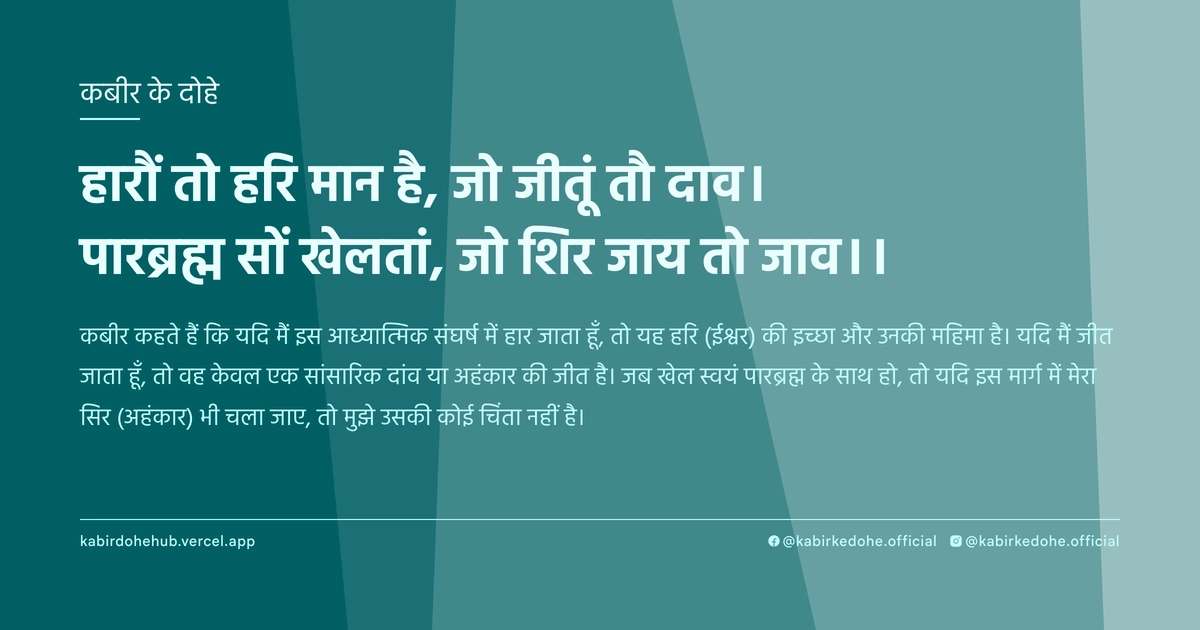
हारौं तो हरि मान है, जो जीतूं तौ दाव।
पारब्रह्म सों खेलतां, जो शिर जाय तो जाव।।
Haarun to hari maan hai, jo jeetun tau daav. Paarbrahm son khelta, jo shir jaaye to jaav.
इस पृष्ठ पर इस कबीर दोहे का अर्थ (meaning), हिंदी व्याख्या और अंग्रेज़ी अनुवाद, दार्शनिक विश्लेषण और व्यावहारिक जीवन सीख दी गई है। यह दोहा प्रपत्ति (Surrender) विषय से जुड़ा है — Kabir doha meaning and explanation in Hindi and English.
अर्थ (Meaning):
कबीर कहते हैं कि यदि मैं इस आध्यात्मिक संघर्ष में हार जाता हूँ, तो यह हरि (ईश्वर) की इच्छा और उनकी महिमा है। यदि मैं जीत जाता हूँ, तो वह केवल एक सांसारिक दांव या अहंकार की जीत है। जब खेल स्वयं पारब्रह्म के साथ हो, तो यदि इस मार्ग में मेरा सिर (अहंकार) भी चला जाए, तो मुझे उसकी कोई चिंता नहीं है।
Kabir asserts that if he loses in this spiritual struggle, it is the will and glory of Hari (the Divine). If he wins, it is merely a worldly gamble or a victory of the ego. When playing a game with the Supreme Brahman, if one's head (symbolizing the ego and identity) is lost in the process, let it be gone without regret.
व्याख्या (Interpretation):
यह दोहा पूर्ण समर्पण और अहंकार के विसर्जन की पराकाष्ठा को दर्शाता है। यहाँ 'हार' का अर्थ आध्यात्मिक विलीनीकरण है, जहाँ जीव अपनी पृथक पहचान खोकर परमात्मा में समा जाता है। 'जीत' को एक 'दांव' कहा गया है क्योंकि जीत में 'मैं' जीवित रहता है, जो वास्तव में एक बंधन है। कबीर निर्गुण भक्ति के उस मार्ग की बात कर रहे हैं जहाँ साधक को अपनी व्यक्तिगत पहचान (शिर) का त्याग करना पड़ता है। यह अद्वैत वेदांत के उस सत्य को उजागर करता है जहाँ आत्मा और ब्रह्म के बीच का द्वैत समाप्त हो जाता है। माया का पर्दा तभी हटता है जब साधक जीतने की इच्छा का त्याग कर देता है। अंततः, यह विरोधाभास है कि ईश्वर के सामने हारना ही वास्तविक जीत है।
This couplet represents the pinnacle of total surrender and the dissolution of the ego. Here, 'losing' signifies spiritual merging, where the individual soul loses its separate identity to dissolve into the Divine. 'Winning' is described as a 'gamble' because victory preserves the 'I', which is essentially a shackle. Kabir speaks of the path of Nirgun Bhakti, where the seeker must sacrifice their personal identity (the head). This highlights the truth of Advaita Vedanta, where the duality between Atman and Brahman vanishes. The veil of Maya only lifts when the seeker abandons the desire to conquer. Ultimately, it presents the paradox that losing before God is the only true victory.
दार्शनिक विश्लेषण (Philosophical Analysis):
कबीर का यह दृष्टिकोण उनके युग के कर्मकांडीय और बाहरी आडंबरों के विरुद्ध एक सशक्त प्रहार है। जहाँ उस समय लोग स्वर्ग की प्राप्ति या मोक्ष के लिए सौदेबाजी कर रहे थे, कबीर 'पूर्ण समर्पण' (Saranagati) की बात करते हैं। यह दर्शन सूफी मत के 'फना' (Fana) के सिद्धांत से गहराई से जुड़ा है, जहाँ प्रेमी अपने अस्तित्व को मिटाकर केवल प्रिय (ईश्वर) को शेष रखता है।
अद्वैत वेदांत के परिप्रेक्ष्य में, 'शिर' का जाना अज्ञान के विनाश का प्रतीक है। जब तक 'मैं' मौजूद है, तब तक ब्रह्म का अनुभव असंभव है। कबीर यहाँ यह स्पष्ट करते हैं कि आध्यात्मिक यात्रा कोई प्रतियोगिता नहीं है, बल्कि एक विसर्जन है। वे जाति और धर्म के संकीर्ण दायरों को तोड़कर एक ऐसी सार्वभौमिक चेतना की बात करते हैं जो केवल प्रेम और समर्पण से प्राप्त होती है।
मनोवैज्ञानिक स्तर पर, यह दोहा 'अहंकार के विलोपन' की प्रक्रिया है। मनुष्य अक्सर अपनी उपलब्धियों को अपनी जीत मानता है, लेकिन कबीर इसे एक 'दांव' कहते हैं, जो अस्थिर और क्षणभंगुर है। वास्तविक शांति तब आती है जब व्यक्ति परिणाम की चिंता छोड़कर स्वयं को उस अनंत सत्ता को सौंप देता है।
यहाँ 'पारब्रह्म' शब्द का प्रयोग यह दर्शाता है कि ईश्वर किसी मंदिर या मस्जिद में सीमित नहीं है, बल्कि वह सर्वव्यापी और निराकार है। यह निर्गुण भक्ति की वह अवस्था है जहाँ भक्त और भगवान के बीच का अंतर समाप्त हो जाता है।
अंततः, कबीर हमें सिखाते हैं कि आध्यात्मिक मार्ग पर सबसे बड़ी बाधा हमारा अपना 'अहं' है। जब हम जीतने की जिद छोड़ देते हैं, तब हम वास्तव में मुक्त होते हैं। यह हारना ही वास्तव में परमात्मा के साथ एकाकार होने की एकमात्र शर्त है।
Kabir's perspective is a powerful strike against the ritualistic and external pomposity of his era. While people of that time were bargaining for heaven or salvation, Kabir speaks of 'Total Surrender' (Saranagati). This philosophy is deeply connected to the Sufi concept of 'Fana', where the lover annihilates their own existence so that only the Beloved (God) remains.
From the lens of Advaita Vedanta, the 'loss of the head' symbolizes the destruction of ignorance. As long as the 'I' exists, the experience of Brahman is impossible. Kabir clarifies that the spiritual journey is not a competition but a dissolution. He breaks the narrow confines of caste and religion to speak of a universal consciousness attainable only through love and surrender.
On a psychological level, this couplet describes the process of 'ego dissolution'. Humans often perceive their achievements as victories, but Kabir calls this a 'gamble', something unstable and ephemeral. True peace arrives when an individual ceases to worry about the outcome and entrusts themselves to the Infinite Being.
The use of the term 'Parabrahman' indicates that God is not confined to a temple or mosque but is omnipresent and formless. This is the state of Nirgun Bhakti where the distinction between the devotee and the Divine vanishes.
Ultimately, Kabir teaches us that the greatest obstacle on the spiritual path is our own 'ego'. When we abandon the stubbornness to win, we are truly liberated. This 'losing' is, in fact, the only condition for becoming one with the Divine.
मूल संदेश (Core Message):
- अहंकार की जीत वास्तव में आत्मा की सबसे बड़ी हार है।
- पूर्ण समर्पण ही वह द्वार है जिससे पारब्रह्म का अनुभव होता है।
- अपनी पहचान को मिटाना ही वास्तविक अस्तित्व की प्राप्ति है।
- जीवन एक खेल है, जहाँ हारना ही परमात्मा में विलीन होना है।
- जब 'मैं' समाप्त होता है, तब केवल 'वह' शेष रहता है।
- The victory of the ego is actually the soul's greatest defeat.
- Total surrender is the only gateway to experiencing the Supreme Brahman.
- Erasing one's identity is the only way to attain true existence.
- Life is a game where losing is the act of merging with the Divine.
- When the 'I' ends, only 'He' remains.
व्यावहारिक उदाहरण (Practical Example):
वाराणसी के घाटों पर रहने वाला एक वृद्ध बुनकर था, जिसका नाम माधव था। माधव अपनी कला में इतना निपुण था कि पूरे शहर में उसके बनाए वस्त्रों की चर्चा थी। उसकी इस कुशलता ने उसके भीतर एक सूक्ष्म अहंकार पैदा कर दिया था; वह मानता था कि उसकी कला उसकी अपनी मेहनत और प्रतिभा का परिणाम है।
एक दिन, एक घुमक्कड़ संत उसके पास आए और उसकी कला की प्रशंसा की, लेकिन साथ ही यह भी कहा कि "तुम्हारी कला सुंदर है, पर तुम इस धागे के मालिक बनने की कोशिश कर रहे हो, जबकि तुम केवल एक माध्यम हो।"
माधव को यह बात चुभी। उसने संत को चुनौती दी कि वह अपनी कला से ऐसा कुछ बनाए जिसे दुनिया ने कभी न देखा हो। उसने महीनों तक दिन-रात मेहनत की, अपनी नींद और स्वास्थ्य को दांव पर लगा दिया। वह इस 'जीत' के नशे में चूर था कि वह सर्वश्रेष्ठ सिद्ध होगा।
तभी एक भीषण बाढ़ आई और उसकी पूरी कार्यशाला, उसके कीमती धागे और वह अधूरी कृति जिसे वह अपनी जीत मान रहा था, सब कुछ गंगा की लहरों में बह गया। माधव टूट गया। वह किनारे बैठकर रोने लगा कि उसने सब कुछ खो दिया।
तभी वही संत वापस आए और मुस्कुराते हुए बोले, "देखो माधव, आज तुम हार गए। तुम्हारी वह 'जीत' का दांव बह गया। अब तुम्हारे पास कुछ नहीं बचा, न वह अहंकार, न वह दावा। अब तुम वास्तव में खाली हो, और इसी खालीपन में ईश्वर का वास है।"
माधव को अचानक कबीर के शब्दों की याद आई। उसे अहसास हुआ कि वह अब तक अपनी कला के माध्यम से खुद को सिद्ध करने की कोशिश कर रहा था, जो कि एक अहंकार का खेल था।
उसने महसूस किया कि जब तक वह 'सर्वश्रेष्ठ' बनने की दौड़ में था, वह तनाव और डर में था। लेकिन अब, जब वह सब कुछ खो चुका था, उसे एक अजीब सी शांति और स्वतंत्रता का अनुभव हुआ।
उसने फिर से बुनना शुरू किया, लेकिन इस बार वह खुद को सिद्ध करने के लिए नहीं, बल्कि एक सेवा के रूप में बुनने लगा। उसकी कला में अब एक नई गहराई और करुणा थी क्योंकि अब वह 'मालिक' नहीं, बल्कि 'माध्यम' बन चुका था।
In the ghats of Varanasi lived an elderly weaver named Madhav. Madhav was so skilled in his craft that his textiles were discussed throughout the city. This mastery had birthed a subtle ego within him; he believed his art was solely the result of his own hard work and genius.
One day, a wandering saint visited him and praised his art, but added, "Your art is beautiful, but you are trying to be the master of the thread, whereas you are merely a medium."
Madhav felt stung by this. He challenged the saint by deciding to create something the world had never seen. For months, he worked day and night, risking his sleep and health. He was intoxicated by the prospect of 'winning' and proving himself the best.
Suddenly, a massive flood struck, and his entire workshop, his precious threads, and the unfinished masterpiece he considered his victory, were all swept away by the currents of the Ganges. Madhav was shattered. He sat on the bank, weeping that he had lost everything.
Just then, the same saint returned and smiled, saying, "Look Madhav, today you have lost. Your gamble for 'victory' has washed away. Now you have nothing left—neither that ego nor that claim. You are finally empty, and it is in this emptiness that the Divine resides."
Madhav suddenly recalled the words of Kabir. He realized that until now, he had been trying to prove himself through his art, which was merely a game of ego.
He felt that as long as he was in the race to be the 'best', he lived in stress and fear. But now, having lost everything, he experienced a strange sense of peace and liberation.
He began weaving again, but this time not to prove himself, but as an act of service. There was now a new depth and compassion in his art because he was no longer the 'master', but the 'medium'.
अभ्यास मार्गदर्शन (Practice Guidance):
- प्रतिदिन 20 मिनट मौन ध्यान करें, जहाँ आप अपने विचारों को 'जीतने' या नियंत्रित करने के बजाय उन्हें केवल साक्षी भाव से देखें।
- एक डायरी लिखें जिसमें आप उन क्षणों को दर्ज करें जब आपने अपनी बात मनवाने की जिद छोड़ी और दूसरे की बात को स्वीकार किया, भले ही वह आपके विपरीत हो।
- जब भी आप किसी उपलब्धि पर गर्व महसूस करें, तो सचेत रूप से यह विचार करें कि यह सफलता किन अनगिनत बाहरी कारकों और दैवीय कृपा का परिणाम है, न कि केवल आपकी अपनी।
- डायग्नोस्टिक चेकलिस्ट: क्या मैं अभी भी अपनी पहचान को अपनी उपलब्धियों से जोड़ रहा हूँ? क्या हारने के विचार से मुझे डर लगता है? क्या मैं दूसरों को नीचा दिखाकर खुद को ऊपर महसूस करता हूँ? यदि हाँ, तो अहंकार अभी जीवित है।
- Practice 20 minutes of silent meditation daily, where instead of trying to 'win' or control your thoughts, you observe them with a witness consciousness.
- Maintain a journal recording moments where you let go of the urge to be right and accepted another's perspective, even if it contradicted your own.
- Whenever you feel pride in an achievement, consciously reflect on the countless external factors and divine grace that contributed to it, rather than attributing it solely to yourself.
- Diagnostic Checklist: Am I still linking my identity to my achievements? Does the thought of losing frighten me? Do I feel superior by belittling others? If yes, the ego is still alive.
चिंतन प्रश्न (Reflection Questions):
- मेरे जीवन में ऐसी कौन सी 'जीत' है जिसे मैं वास्तव में एक बोझ की तरह ढो रहा हूँ?
- यदि मेरी सारी सामाजिक प्रतिष्ठा और उपलब्धियाँ आज छीन ली जाएँ, तो मेरे भीतर क्या बचेगा?
- मैं अपनी डिजिटल पहचान (सोशल मीडिया) के माध्यम से किस तरह के 'जीत के दांव' खेल रहा हूँ?
- क्या मैं वास्तव में ईश्वर की इच्छा को स्वीकार करता हूँ, या मैं केवल अपनी इच्छाओं को ईश्वर की इच्छा मानकर खुद को धोखा दे रहा हूँ?
- मेरे भीतर का वह कौन सा हिस्सा है जो हारने के डर से मुझे पूरी तरह समर्पित होने से रोक रहा है?
- Which 'victory' in my life am I actually carrying as a heavy burden?
- If all my social prestige and achievements were stripped away today, what would remain within me?
- What kind of 'gambles for victory' am I playing through my digital identity (social media)?
- Do I truly accept the Divine will, or am I deceiving myself by labeling my own desires as God's will?
- Which part of me is preventing total surrender due to the fear of losing?