
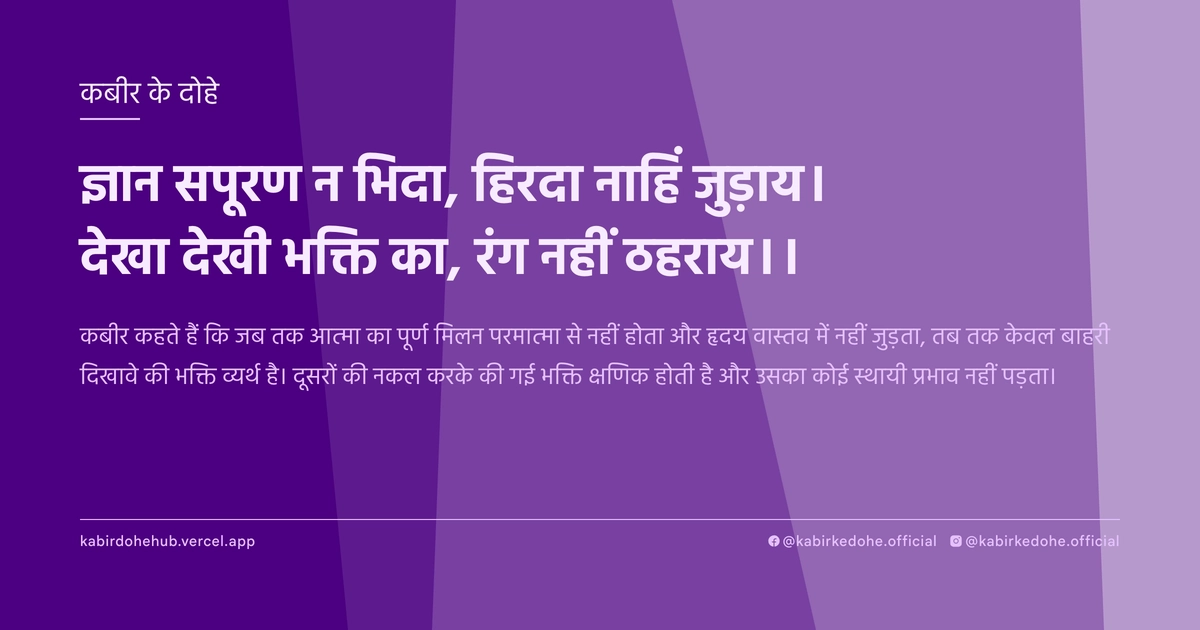
ज्ञान सपूरण न भिदा, हिरदा नाहिं जुड़ाय।
देखा देखी भक्ति का, रंग नहीं ठहराय।।
Gyan sapuran na bhida, hirda nahin judaye. Dekha dekhi bhakti ka, rang nahi thahraye.
इस पृष्ठ पर इस कबीर दोहे का अर्थ (meaning), हिंदी व्याख्या और अंग्रेज़ी अनुवाद, दार्शनिक विश्लेषण और व्यावहारिक जीवन सीख दी गई है। यह दोहा भक्ति (Bhakti) विषय से जुड़ा है — Kabir doha meaning and explanation in Hindi and English.
अर्थ (Meaning):
कबीर कहते हैं कि जब तक आत्मा का पूर्ण मिलन परमात्मा से नहीं होता और हृदय वास्तव में नहीं जुड़ता, तब तक केवल बाहरी दिखावे की भक्ति व्यर्थ है। दूसरों की नकल करके की गई भक्ति क्षणिक होती है और उसका कोई स्थायी प्रभाव नहीं पड़ता।
Kabir asserts that unless there is a complete merging of the soul with the Divine and a genuine union of the heart, superficial devotion is futile. Devotion practiced merely by imitating others is transient and fails to leave a lasting spiritual imprint on the seeker.
व्याख्या (Interpretation):
इस दोहे का शाब्दिक अर्थ है कि बाहरी दिखावे से हृदय नहीं जुड़ता। रूपक के स्तर पर, 'सपूरण' पूर्णता या परमात्मा का प्रतीक है। कबीर यहाँ 'देखा-देखी' यानी अनुकरण की भक्ति की आलोचना कर रहे हैं। यह निर्गुण भक्ति का मूल है, जहाँ ईश्वर मंदिर या मस्जिद में नहीं, बल्कि हृदय की गहराई में है। माया यहाँ उस सामाजिक दबाव का रूप है जो हमें दूसरों की तरह दिखने के लिए प्रेरित करता है। जब तक साधक अपने अहंकार को मिटाकर आत्म-साक्षात्कार नहीं करता, वह केवल एक मुखौटा पहन रहा होता है। यह अद्वैत वेदांत के उस सत्य को दर्शाता है कि सत्य अनुभव का विषय है, प्रदर्शन का नहीं।
Literally, the verse suggests that outward appearances do not unite the heart. Metaphorically, 'Sapuran' symbolizes the Absolute or the Divine. Kabir critiques 'dekha-dekhi'—the devotion of imitation. This is the essence of Nirgun Bhakti, where the Divine resides not in temples or mosques, but in the depths of the heart. Maya manifests here as the social pressure to conform to religious norms. Until the seeker annihilates the ego to achieve self-realization, they are merely wearing a mask. This aligns with Advaita Vedanta, emphasizing that Truth is a matter of direct experience, not performative ritual.
दार्शनिक विश्लेषण (Philosophical Analysis):
कबीर का यह दोहा उस युग की प्रतिक्रिया है जहाँ धर्म केवल कर्मकांड और सामाजिक प्रतिष्ठा का साधन बन गया था। उन्होंने स्पष्ट किया कि भक्ति कोई सामूहिक प्रदर्शन नहीं, बल्कि एक अत्यंत व्यक्तिगत और आंतरिक यात्रा है। यहाँ वे जाति और संप्रदाय के उन बंधनों को तोड़ते हैं जो मनुष्य को केवल बाहरी पहचान देते हैं।
अद्वैत वेदांत के परिप्रेक्ष्य में, 'जुड़ना' का अर्थ है यह पहचानना कि आत्मा और ब्रह्म एक ही हैं। जब तक व्यक्ति स्वयं को शरीर या सामाजिक पद से जोड़कर देखता है, वह 'देखा-देखी' के जाल में फंसा रहता है। यह द्वैत है, जो सत्य को ओझल करता है।
सूफीवाद के 'फना' के सिद्धांत से इसका गहरा संबंध है। जब तक 'मैं' (अहंकार) मौजूद है, तब तक ईश्वर के साथ मिलन संभव नहीं है। नकल की गई भक्ति में 'मैं' और भी प्रबल हो जाता है क्योंकि वह दूसरों से श्रेष्ठ दिखने की इच्छा से प्रेरित होता है।
मनोवैज्ञानिक स्तर पर, कबीर सामाजिक अनुकूलन (social conformity) के खतरे की ओर इशारा कर रहे हैं। जब हम दूसरों की आध्यात्मिक यात्रा की नकल करते हैं, तो हम अपनी अंतरात्मा की आवाज को दबा देते हैं, जिससे आध्यात्मिक शून्यता पैदा होती है।
अंततः, यह दोहा हमें चेतावनी देता है कि सत्य का मार्ग 'भीड़' के पीछे चलने से नहीं, बल्कि एकांत में स्वयं की खोज से मिलता है। वास्तविक भक्ति वह है जो हृदय को रूपांतरित करे, न कि वह जो केवल समाज की नजरों में पवित्रता का भ्रम पैदा करे।
This couplet is a reaction to an era where religion had become a mere tool for ritualism and social prestige. Kabir clarifies that devotion is not a collective performance but a deeply personal and internal journey. He dismantles the barriers of caste and sect that provide only an external identity.
From the perspective of Advaita Vedanta, 'union' means realizing that Atman and Brahman are one. As long as an individual identifies themselves through the body or social status, they remain trapped in the web of imitation. This is duality, which obscures the ultimate Truth.
There is a profound connection here to the Sufi concept of 'Fana' (annihilation). As long as the 'I' (ego) exists, union with the Divine is impossible. Imitative devotion actually strengthens the ego because it is driven by the desire to appear superior or pious in the eyes of others.
Psychologically, Kabir points to the dangers of social conformity. When we mimic the spiritual journey of others, we suppress the voice of our own intuition, leading to a state of spiritual void and alienation from the self.
Ultimately, this verse warns that the path to Truth is not found by following the crowd, but through the solitary quest for the self. True devotion is that which transforms the heart, not that which creates an illusion of purity for social consumption.
मूल संदेश (Core Message):
- दिखावा आत्मा की गहराई को मिटा देता है।
- नकल कभी भी वास्तविक अनुभव का विकल्प नहीं हो सकती।
- सच्ची भक्ति हृदय के मौन समर्पण में बसती है।
- अहंकार का विसर्जन ही परमात्मा से मिलन की पहली शर्त है।
- आंतरिक सत्य बाहरी आडंबरों से कहीं अधिक शक्तिशाली है।
- Performative piety erases the depth of the soul.
- Imitation can never substitute for genuine experience.
- True devotion resides in the silent surrender of the heart.
- The dissolution of ego is the primary condition for union.
- Internal truth is far more potent than external ostentation.
व्यावहारिक उदाहरण (Practical Example):
वाराणसी के एक पुराने घाट पर माधव नाम का एक वृद्ध बुनकर रहता था। वह अपनी पूरी जिंदगी रेशमी वस्त्र बुनने में बिता चुका था, लेकिन उसका मन हमेशा अशांत रहता था।
उसने देखा कि शहर के बड़े पंडित और साधु घंटों माला जपते थे और माथे पर चंदन लगाते थे। माधव ने सोचा कि शायद यही मोक्ष का मार्ग है।
उसने भी वैसा ही करना शुरू किया। वह सुबह जल्दी उठता, भारी वस्त्र पहनता और दूसरों की तरह जोर-जोर से मंत्र पढ़ता। वह चाहता था कि लोग उसे एक 'ज्ञानी' व्यक्ति के रूप में देखें।
बाहर से वह एक आदर्श भक्त दिख रहा था, लेकिन अंदर से वह अभी भी क्रोध और ईर्ष्या से भरा था। उसकी भक्ति केवल एक प्रदर्शन थी, एक 'देखा-देखी' का खेल।
एक दिन उसकी मुलाकात एक फकीर से हुई, जिसने उसकी आँखों में झाँका और कहा, 'माधव, तूने कपड़े तो बदल लिए, पर क्या तूने अपना हृदय बदला?'
माधव ठिठक गया। उसे अहसास हुआ कि वह केवल एक भूमिका निभा रहा था। उसने महसूस किया कि उसकी माला और चंदन केवल उसके अहंकार को पोषण दे रहे थे।
उसने दिखावे की सारी रस्में छोड़ दीं और मौन रहकर अपने भीतर के शोर को सुनना शुरू किया। उसने पाया कि असली प्रार्थना उसके काम की ईमानदारी और दूसरों के प्रति करुणा में थी।
अब वह बिना किसी बाहरी आडंबर के, केवल प्रेम और समर्पण के साथ जीता था। उसका हृदय अब वास्तव में जुड़ चुका था, और उसका रंग अब स्थायी था।
On an old ghat in Varanasi lived an elderly weaver named Madhav. He had spent his entire life weaving silk fabrics, yet his mind remained perpetually restless.
He observed the city's prominent priests and saints chanting beads for hours and applying sandalwood paste to their foreheads. Madhav thought this must be the path to liberation.
He began to do the same. He woke up early, wore heavy traditional robes, and chanted mantras loudly, imitating others. He wanted people to perceive him as a 'learned' man.
Externally, he appeared to be an ideal devotee, but internally, he was still consumed by anger and jealousy. His devotion was merely a performance, a game of imitation.
One day, he met a wandering dervish who looked into his eyes and asked, 'Madhav, you have changed your clothes, but have you changed your heart?'
Madhav froze. He realized he was merely playing a role. He understood that his beads and sandalwood were only feeding his ego.
He abandoned all the performative rituals and began to sit in silence, listening to the noise within. He discovered that true prayer lay in the honesty of his work and compassion for others.
Now, without any external pomp, he lived with simple love and surrender. His heart was finally united, and his spiritual color was now permanent.
अभ्यास मार्गदर्शन (Practice Guidance):
- दैनिक मौन अभ्यास: प्रतिदिन 20 मिनट पूर्ण मौन में बैठें। यह देखें कि क्या आपकी आध्यात्मिक इच्छाएं आपकी अपनी हैं या समाज द्वारा थोपी गई हैं।
- आत्म-पूछताछ जर्नल: हर रात लिखें—'आज मैंने कौन सा कार्य केवल दूसरों को दिखाने के लिए किया?' और 'किस कार्य में मुझे वास्तव में आंतरिक शांति मिली?'
- व्यवहार परिवर्तन: किसी भी धार्मिक अनुष्ठान को करने से पहले खुद से पूछें, 'यदि कोई मुझे नहीं देख रहा होता, तो क्या मैं फिर भी यह करता?'
- निदान चेकलिस्ट: यदि आप दूसरों की प्रशंसा पर निर्भर हैं, तो आप 'देखा-देखी' में हैं। यदि आपकी शांति आंतरिक स्थिति पर निर्भर है, तो आप 'जुड़' चुके हैं।
- Daily Silence Practice: Sit in absolute silence for 20 minutes daily. Observe whether your spiritual desires are genuinely yours or imposed by society.
- Self-Inquiry Journaling: Every night, write—'Which action did I perform today solely for external validation?' and 'Which action brought me genuine inner peace?'
- Behavioral Shift: Before performing any religious ritual, ask yourself, 'If no one were watching me, would I still do this?'
- Diagnostic Checklist: If your peace depends on external praise, you are in the state of 'imitation'. If your peace depends on your internal state, you have achieved 'union'.
चिंतन प्रश्न (Reflection Questions):
- मेरे जीवन के कौन से 'पवित्र' कार्य वास्तव में मेरी सामाजिक छवि को बनाए रखने के साधन हैं?
- यदि समाज से सभी धार्मिक पहचानें हटा दी जाएं, तो मेरे भीतर क्या बचेगा?
- मैं अपनी आध्यात्मिक प्रगति को मापने के लिए किन बाहरी पैमानों का उपयोग कर रहा हूँ?
- क्या मेरी प्रार्थनाएं ईश्वर से जुड़ने के लिए हैं या स्वयं को श्रेष्ठ सिद्ध करने के लिए?
- मेरे भीतर का वह कौन सा हिस्सा है जो अभी भी दूसरों की स्वीकृति के लिए तड़प रहा है?
- Which of my 'sacred' actions are actually tools to maintain my social image?
- If all religious identities were stripped away from society, what would remain within me?
- What external metrics am I using to measure my spiritual progress?
- Are my prayers intended for union with the Divine or to prove my own superiority?
- Which part of me is still craving validation from others?