
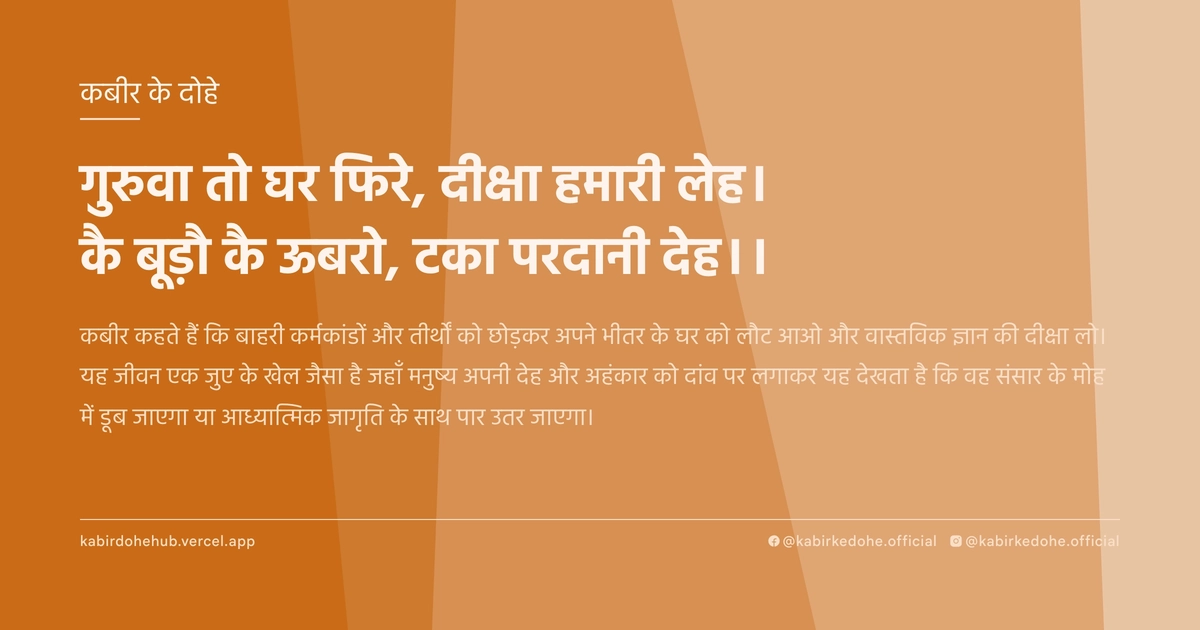
गुरुवा तो घर फिरे, दीक्षा हमारी लेह।
कै बूड़ौ कै ऊबरो, टका परदानी देह।।
Guruva to ghar phire, deeksha hamari leh. Kai boodau kai oobaro, taka pardani deh.
इस पृष्ठ पर इस कबीर दोहे का अर्थ (meaning), हिंदी व्याख्या और अंग्रेज़ी अनुवाद, दार्शनिक विश्लेषण और व्यावहारिक जीवन सीख दी गई है। यह दोहा वैराग्य (Detachment) विषय से जुड़ा है — Kabir doha meaning and explanation in Hindi and English.
अर्थ (Meaning):
कबीर कहते हैं कि बाहरी कर्मकांडों और तीर्थों को छोड़कर अपने भीतर के घर को लौट आओ और वास्तविक ज्ञान की दीक्षा लो। यह जीवन एक जुए के खेल जैसा है जहाँ मनुष्य अपनी देह और अहंकार को दांव पर लगाकर यह देखता है कि वह संसार के मोह में डूब जाएगा या आध्यात्मिक जागृति के साथ पार उतर जाएगा।
Kabir urges the seeker to cease wandering in external rituals and pilgrimages, returning instead to the 'home' of the inner self to receive true initiation. He describes human existence as a high-stakes gamble where the physical body and ego are the stakes; the ultimate question is whether one will drown in the illusions of the world or emerge liberated through spiritual awakening.
व्याख्या (Interpretation):
इस दोहे का शाब्दिक अर्थ है कि बाहरी खोज को त्यागकर आंतरिक सत्य की शरण में आना। यहाँ 'घर' का अर्थ भौतिक निवास नहीं, बल्कि आत्मा का मूल स्वरूप है। 'दीक्षा' यहाँ किसी गुरु द्वारा दिया गया मंत्र नहीं, बल्कि आत्म-साक्षात्कार का अनुभव है। कबीर 'बूड़ौ' (डूबने) और 'ऊबरो' (उबरने) के माध्यम से माया के प्रभाव और मोक्ष के बीच के द्वंद्व को दर्शाते हैं। यह निर्गुण भक्ति का सार है, जहाँ ईश्वर किसी मंदिर में नहीं बल्कि श्वासों के बीच स्थित है। यह अद्वैत वेदांत के उस सत्य को उजागर करता है जहाँ जीव और ब्रह्म का भेद केवल अज्ञानता के कारण है। अंततः, यह देह एक माध्यम है, जिसे यदि अहंकार के साथ जोड़ा जाए तो वह बंधन बन जाती है, और यदि विरक्ति के साथ देखा जाए तो वह मुक्ति का द्वार बनती है।
Literally, the verse calls for abandoning external quests to seek refuge in internal truth. Here, 'home' does not signify a physical dwelling but the primordial essence of the Soul. 'Initiation' refers not to a ritualistic mantra bestowed by a priest, but to the direct experience of self-realization. Through the contrast of 'drowning' and 'emerging,' Kabir illustrates the tension between the grip of Maya (illusion) and the attainment of Moksha (liberation). This is the core of Nirgun Bhakti, asserting that the Divine resides not in temples, but within the very rhythm of one's breath. It echoes Advaita Vedanta, suggesting that the perceived separation between the Atman and Brahman is merely a veil of ignorance. Ultimately, the body is presented as a vehicle; when tethered to ego, it becomes a prison, but when viewed through detachment, it becomes the gateway to transcendence.
दार्शनिक विश्लेषण (Philosophical Analysis):
कबीर का यह दोहा उस समय के सामाजिक और धार्मिक परिवेश पर एक कड़ा प्रहार है जहाँ धर्म केवल बाहरी दिखावे, तीर्थयात्राओं और कठिन व्रत-उपवास तक सीमित था। वे स्पष्ट करते हैं कि सत्य किसी भौगोलिक स्थान या बाहरी अनुष्ठान में नहीं मिलता। यह दृष्टिकोण सूफीवाद के 'अनल हक़' (मैं सत्य हूँ) और अद्वैत वेदांत के 'अहं ब्रह्मास्मि' के समानांतर है, जहाँ साधक को अपने भीतर ही परमात्मा का साक्षात्कार करना होता है।
कबीर का 'दीक्षा' शब्द यहाँ पारंपरिक धार्मिक दीक्षा का उपहास है। उनके लिए वास्तविक दीक्षा वह है जो अहंकार का विनाश करे। वे तर्क देते हैं कि जब तक मनुष्य खुद को शरीर मानता है, वह जन्म और मृत्यु के चक्र में फँसा रहता है। यह 'देह' को दांव पर लगाने की बात एक मनोवैज्ञानिक रूपांतरण की मांग है—अपनी पहचान को भौतिकता से हटाकर चेतना पर केंद्रित करना।
यहाँ 'टका' या दांव का उल्लेख जीवन की अनिश्चितता और माया के खेल को दर्शाता है। कबीर यह समझाते हैं कि मनुष्य अपना पूरा जीवन बाहरी दुनिया को संवारने में लगा देता है, जबकि उसकी आत्मा प्यासी रहती है। यह एक आध्यात्मिक चेतावनी है कि समय सीमित है और यदि जागृति नहीं हुई, तो मनुष्य माया के सागर में डूब जाएगा।
जाति और वर्ण व्यवस्था के प्रति कबीर का विद्रोह यहाँ भी झलकता है। वे कहते हैं कि ज्ञान किसी विशेष जाति या वर्ग की बपौती नहीं है; यह केवल उनके लिए उपलब्ध है जो अपने 'घर' (अंतर्मन) लौटने का साहस रखते हैं। यह लोक-परंपराओं के ऊपर व्यक्तिगत अनुभव की प्रधानता को स्थापित करता है।
अंततः, यह विश्लेषण हमें इस निष्कर्ष पर ले जाता है कि कबीर के लिए मुक्ति का मार्ग 'शून्य' की ओर जाना है। यह शून्य रिक्तता नहीं, बल्कि वह पूर्णता है जहाँ द्वैत समाप्त हो जाता है। जब 'मैं' और 'तू' का भेद मिट जाता है, तभी मनुष्य वास्तव में 'उबरता' है और उस परम सत्य में विलीन हो जाता है जिसे शब्दों में बांधना असंभव है।
This couplet serves as a searing critique of the socio-religious climate of Kabir's era, where spirituality had devolved into external displays, pilgrimages, and rigid asceticism. Kabir asserts that Truth is not found in a geographical location or a ritualistic act. This perspective aligns with the Sufi concept of 'Anal Haq' (I am the Truth) and the Advaita Vedanta realization of 'Aham Brahmasmi,' where the seeker must encounter the Divine within the depths of their own being.
Kabir's use of the word 'initiation' (diksha) is a subversive irony. For him, true initiation is not a ceremony but the annihilation of the ego. He argues that as long as a human identifies solely with the physical body, they remain trapped in the cycle of Samsara. The metaphor of 'staking the body' demands a psychological shift—moving one's identity from the material form to pure consciousness.
The reference to a 'gamble' or 'stake' highlights the precariousness of human existence and the deceptive nature of Maya. Kabir suggests that humans spend their entire lives decorating the external world while their soul remains parched. It is a spiritual alarm: time is finite, and without awakening, the individual is destined to drown in the ocean of illusion.
Kabir's rebellion against caste and social hierarchy is implicit here. He posits that spiritual knowledge is not the monopoly of any specific caste or elite class; it is accessible only to those who possess the courage to return to their 'home' (the inner self). This elevates personal experiential truth over inherited tradition.
Ultimately, this analysis reveals that for Kabir, the path to liberation is a journey toward the 'Shunya' (the Void). This Void is not emptiness, but a plenum where all dualities cease to exist. When the distinction between 'I' and 'Thou' dissolves, the seeker truly 'emerges' and merges into the Absolute Truth, which transcends all linguistic description.
मूल संदेश (Core Message):
- बाहरी खोज एक भ्रम है; सत्य केवल भीतर है।
- अहंकार का त्याग ही वास्तविक आध्यात्मिक दीक्षा है।
- देह को साधन मानें, साध्य नहीं।
- माया के खेल में डूबने के बजाय जागरूकता चुनें।
- आंतरिक शांति ही एकमात्र वास्तविक घर है।
- External searching is an illusion; Truth resides only within.
- The surrender of ego is the only true spiritual initiation.
- Treat the body as a vehicle, not the destination.
- Choose awareness over drowning in the game of Maya.
- Inner stillness is the only authentic home.
व्यावहारिक उदाहरण (Practical Example):
वाराणसी के घाटों पर रहने वाले एक वृद्ध बुनकर थे, जिनका नाम माधव था। माधव ने अपना पूरा जीवन बेहतरीन रेशमी वस्त्र बनाने में बिताया, लेकिन उनका मन हमेशा अशांत रहता था। वे मानते थे कि यदि वे गंगा में अधिक डुबकी लगाएंगे और बड़े-बड़े पंडितों को दान देंगे, तो उन्हें मोक्ष मिल जाएगा। वे हर साल कठिन तीर्थयात्राएं करते, लेकिन घर लौटकर फिर वही क्रोध और ईर्ष्या उन्हें घेर लेती।
एक दिन माधव की मुलाकात एक फकीर से हुई, जिसने उन्हें कबीर का यह दोहा सुनाया। फकीर ने पूछा, 'माधव, तुम जिस घर की तलाश में काशी और कांची दौड़ रहे हो, क्या तुमने कभी अपने भीतर झाँका है?' माधव को पहले तो यह बात अजीब लगी, लेकिन फकीर के शब्दों ने उन्हें सोचने पर मजबूर कर दिया।
माधव ने महसूस किया कि वे बाहरी आडंबरों में इतने व्यस्त थे कि उन्होंने कभी अपनी सांसों के संगीत को नहीं सुना। उन्होंने तय किया कि अब वे केवल बाहरी स्नान नहीं, बल्कि आंतरिक शुद्धि करेंगे। उन्होंने दान देना बंद नहीं किया, लेकिन अब वे दान अहंकार से नहीं, बल्कि करुणा से देने लगे।
उन्होंने अपने काम को ही पूजा बना लिया। जब वे धागों को बुनते, तो वे यह नहीं सोचते कि यह कपड़ा कितने में बिकेगा, बल्कि वे उस धागे में ईश्वर की उपस्थिति को महसूस करने लगे। उनके मन का शोर धीरे-धीरे शांत होने लगा।
एक समय ऐसा आया जब माधव को अब किसी तीर्थ की आवश्यकता नहीं रही। उन्हें समझ आया कि जिस शांति की तलाश में वे मीलों चले थे, वह उनके अपने हृदय के भीतर एक छोटे से कोने में छिपी थी।
उनके व्यवहार में एक अद्भुत बदलाव आया। वे अब छोटे विवादों पर क्रोध नहीं करते थे। गाँव के लोग उनके पास शांति और मार्गदर्शन के लिए आने लगे।
माधव ने अपनी देह और संपत्ति को दांव पर नहीं लगाया, बल्कि अपने 'अहंकार' को दांव पर लगा दिया। उन्होंने यह स्वीकार किया कि वे कुछ भी नहीं हैं, और इसी 'कुछ नहीं' होने के अहसास ने उन्हें पूर्ण बना दिया।
अंत में, माधव ने पाया कि वास्तविक दीक्षा किसी गुरु के हाथ से मिला हुआ धागा नहीं, बल्कि स्वयं के भीतर की वह रोशनी है जो अंधकार को मिटा देती है। वे अब वास्तव में 'उबर' चुके थे।
In the ghats of Varanasi lived an elderly weaver named Madhav. Madhav had spent his entire life crafting the finest silk garments, yet his mind remained a storm of unrest. He believed that by taking countless dips in the Ganges and offering lavish donations to high priests, he would secure salvation. Every year, he embarked on grueling pilgrimages, only to return home to the same old patterns of anger and envy.
One day, Madhav encountered a wandering dervish who recited this specific Doha by Kabir. The dervish asked, 'Madhav, you run to Kashi and Kanchi searching for a home, but have you ever dared to look inside yourself?' Initially, Madhav found the question absurd, but the dervish's piercing gaze forced him into a state of introspection.
Madhav realized he had been so consumed by external rituals that he had never listened to the music of his own breath. He decided that henceforth, he would pursue internal purification rather than mere external bathing. He did not stop being charitable, but his giving shifted from a desire for merit to a gesture of pure compassion.
He transformed his craft into a meditation. As he wove the threads, he stopped calculating the market price of the cloth and instead began to feel the presence of the Divine in every intersection of the warp and weft. The noise in his mind began to subside.
Eventually, Madhav found that he no longer needed pilgrimages. He discovered that the peace he had sought across thousands of miles was hidden in a small, neglected corner of his own heart.
A profound change manifested in his behavior. He ceased reacting with anger to petty disputes. Villagers began visiting him not for cloth, but for the stillness and guidance he radiated.
Madhav did not gamble with his physical body or wealth; instead, he staked his 'ego.' He accepted that he was nothing, and in this realization of 'nothingness,' he became everything.
In the end, Madhav understood that true initiation was not a sacred thread tied by a priest, but the inner light that dissolves all darkness. He had finally 'emerged' from the depths of illusion.
अभ्यास मार्गदर्शन (Practice Guidance):
- प्रतिदिन 20 मिनट 'साक्षी भाव' का अभ्यास करें: अपने विचारों को बिना किसी निर्णय के केवल देखें, जैसे आप किसी और के जीवन की फिल्म देख रहे हों।
- आत्म-पूछताछ जर्नल: हर रात लिखें कि आज आपने कितनी बार अपनी पहचान को बाहरी उपलब्धियों या शरीर से जोड़ा और कितनी बार आप अपने आंतरिक केंद्र में लौटे।
- मौन व्रत: सप्ताह में एक दिन या दिन में कुछ घंटे पूर्ण मौन रहें, ताकि बाहरी शोर कम हो और आंतरिक 'घर' की आवाज सुनाई दे।
- निदान चेकलिस्ट: क्या आप अभी भी अपनी शांति के लिए बाहरी परिस्थितियों पर निर्भर हैं? क्या आप अभी भी दूसरों को अपनी मान्यताओं से छोटा समझते हैं? यदि हाँ, तो आप अभी भी 'डूब' रहे हैं।
- Practice 'Witness Consciousness' for 20 minutes daily: Observe your thoughts without judgment, as if watching a movie of someone else's life.
- Self-Inquiry Journaling: Every night, record instances where you identified yourself with external achievements or the physical body, and moments you returned to your inner center.
- Vow of Silence: Dedicate one day a week or a few hours daily to absolute silence to diminish external noise and hear the voice of the inner 'home.'
- Diagnostic Checklist: Are you still dependent on external circumstances for your peace? Do you still perceive others as inferior based on your beliefs? If yes, you are still 'drowning' in Maya.
चिंतन प्रश्न (Reflection Questions):
- यदि आपकी सारी सामाजिक पहचान (नाम, पद, रिश्ता) छीन ली जाए, तो आपके भीतर क्या बचेगा?
- आप अपनी शांति के लिए किन बाहरी 'तीर्थों' या लोगों पर निर्भर हैं, और वह निर्भरता आपको कैसे सीमित करती है?
- आपका 'डिजिटल अहंकार' (सोशल मीडिया इमेज) आपके वास्तविक स्वरूप को कितना ढक रहा है?
- क्या आप वास्तव में सत्य की खोज कर रहे हैं, या केवल अपनी मान्यताओं की पुष्टि करने वाले प्रमाण ढूंढ रहे हैं?
- वह कौन सा डर है जो आपको अपने आंतरिक घर में प्रवेश करने से रोकता है?
- If all your social identities (name, title, relationships) were stripped away, what would remain within you?
- Which external 'pilgrimages' or people do you depend on for peace, and how does this dependency limit you?
- To what extent does your 'digital ego' (social media image) obscure your authentic self?
- Are you truly seeking Truth, or are you merely searching for evidence that confirms your existing biases?
- What is the specific fear that prevents you from entering your inner home?