
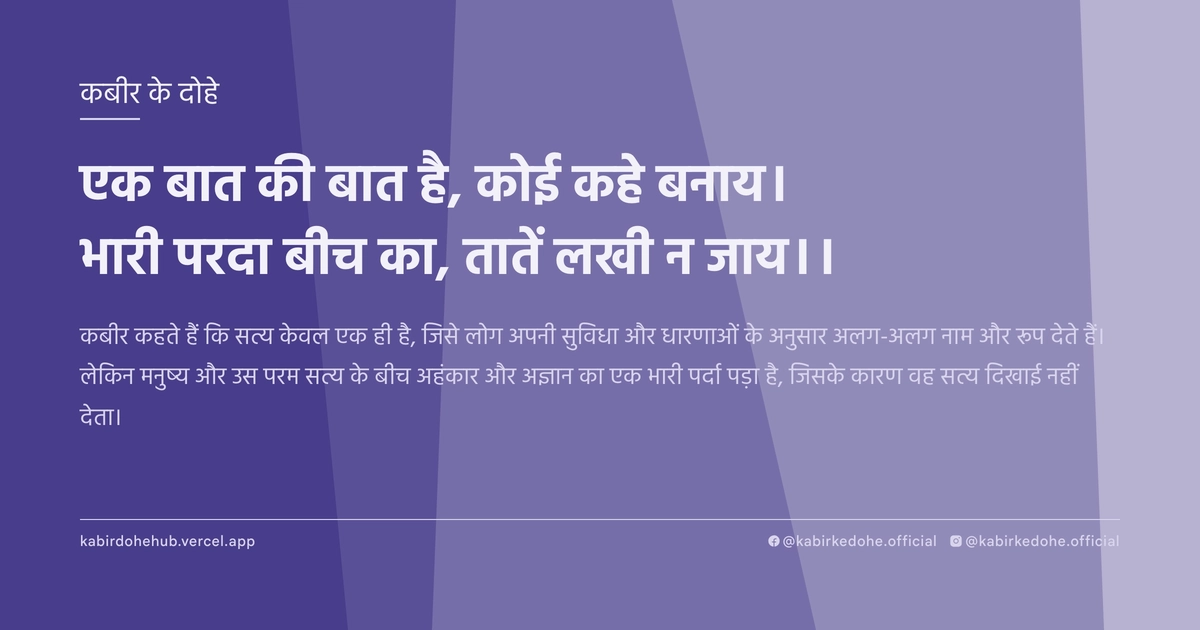
एक बात की बात है, कोई कहे बनाय।
भारी परदा बीच का, तातें लखी न जाय।।
Ek baat ki baat hai, koi kahe banay. Bhaari parda beech ka, taaten lakhi na jaaye.
इस पृष्ठ पर इस कबीर दोहे का अर्थ (meaning), हिंदी व्याख्या और अंग्रेज़ी अनुवाद, दार्शनिक विश्लेषण और व्यावहारिक जीवन सीख दी गई है। यह दोहा अंतर ज्योति (The Inner Light) विषय से जुड़ा है — Kabir doha meaning and explanation in Hindi and English.
अर्थ (Meaning):
कबीर कहते हैं कि सत्य केवल एक ही है, जिसे लोग अपनी सुविधा और धारणाओं के अनुसार अलग-अलग नाम और रूप देते हैं। लेकिन मनुष्य और उस परम सत्य के बीच अहंकार और अज्ञान का एक भारी पर्दा पड़ा है, जिसके कारण वह सत्य दिखाई नहीं देता।
Kabir asserts that Truth is singular and absolute, though people describe it in various fragmented ways. However, a dense veil of ego and ignorance hangs between the seeker and the Divine, rendering the ultimate reality invisible to the clouded eye.
व्याख्या (Interpretation):
इस दोहे का शाब्दिक अर्थ है कि सत्य एक है, पर वह ओझल है। रूपकात्मक रूप से, 'परदा' माया और अहंकार का प्रतीक है। निर्गुण भक्ति के अनुसार, ईश्वर किसी मूर्ति या मंदिर में नहीं, बल्कि स्वयं के भीतर है। अद्वैत वेदांत के परिप्रेक्ष्य में, यह पर्दा 'अविद्या' है जो आत्मा और ब्रह्म की एकता को छुपाता है। जब तक यह पर्दा नहीं हटता, मनुष्य द्वैत (दो होने का भ्रम) में जीता रहता है। यह विरोधाभास है कि जिसे हम बाहर खोज रहे हैं, वह हमारे भीतर ही है, बस एक पर्दे की दूरी पर।
Literally, the verse speaks of a hidden truth. Metaphorically, the 'veil' represents Maya (illusion) and the Ahamkara (ego). In the tradition of Nirgun Bhakti, the Divine is formless and omnipresent, not confined to idols. From the lens of Advaita Vedanta, this veil is 'Avidya' (primordial ignorance) that obscures the non-duality of Atman and Brahman. The central paradox is that the seeker is searching for the very entity that is searching through them. Until this veil is rent asunder, the human condition remains trapped in the illusion of separation.
दार्शनिक विश्लेषण (Philosophical Analysis):
कबीर का यह दोहा उनके युग के धार्मिक कट्टरवाद और कर्मकांडों पर एक तीखा प्रहार है। उन्होंने देखा कि लोग धर्म को बाहरी प्रतीकों, जैसे माला, तिलक या विशेष वस्त्रों में खोज रहे थे, जबकि सत्य आंतरिक था। कबीर का दर्शन सूफीवाद के 'फना' (अहंकार का विनाश) और वेदांत के 'ज्ञान' का संगम है। वे तर्क देते हैं कि सत्य को शब्दों या शास्त्रों से नहीं, बल्कि अनुभव से जाना जा सकता है।
यहाँ 'परदा' केवल अज्ञान नहीं, बल्कि वह सामाजिक और मानसिक संरचना है जो हमें दूसरों से अलग करती है। जाति, धर्म और वर्ग के भेद इसी पर्दे के धागे हैं। कबीर का मानना था कि जब तक व्यक्ति अपनी पहचान को 'मैं' और 'मेरा' से मुक्त नहीं करता, वह सत्य को नहीं देख सकता। यह मनोवैज्ञानिक रूपांतरण की प्रक्रिया है जहाँ व्यक्ति अपनी सीमित पहचान को त्यागकर सार्वभौमिक चेतना में विलीन होता है।
ऐतिहासिक रूप से, कबीर ने उस समय के पंडितों और मुल्लाओं को चुनौती दी जो सत्य का दावा तो करते थे, लेकिन उनके व्यवहार में करुणा और प्रेम का अभाव था। उनके लिए, सत्य का अर्थ केवल बौद्धिक ज्ञान नहीं, बल्कि आचरण की पवित्रता था। वे कहते हैं कि सत्य 'एक' है, जिसका अर्थ है कि सभी धर्म अंततः एक ही गंतव्य की ओर ले जाते हैं, यदि पर्दे हटा दिए जाएं।
यह विश्लेषण स्पष्ट करता है कि कबीर का मार्ग 'सहज' मार्ग है। वे कठिन तपस्या के बजाय जागरूकता और ईमानदारी पर जोर देते हैं। उनके अनुसार, सत्य को 'बनाया' नहीं जाता, बल्कि उसे 'पहचाना' जाता है। जो लोग सत्य को शब्दों में बांधने की कोशिश करते हैं, वे वास्तव में पर्दे को और मोटा कर रहे होते हैं।
अंततः, यह दोहा हमें सिखाता है कि आध्यात्मिक यात्रा बाहर की यात्रा नहीं, बल्कि भीतर की यात्रा है। यह अहंकार के विसर्जन की प्रक्रिया है। जब 'मैं' मिटता है, तब केवल 'वह' बचता है, और यही वह क्षण है जब पर्दा गिरता है और सत्य का साक्षात्कार होता है।
This couplet is a profound critique of the religious dogmatism and ritualism prevalent during Kabir's era. He observed that seekers were obsessing over external symbols—beads, tilaks, or specific attire—while the essence remained untouched. Kabir’s philosophy is a synthesis of the Sufi concept of 'Fana' (annihilation of the self) and the Vedantic pursuit of 'Jnana' (knowledge). He argues that Truth cannot be captured by scriptures but must be lived through direct experience.
The 'veil' is not merely ignorance but the entire socio-psychological construct that creates separation. Caste, creed, and class are the threads that weave this veil. Kabir posits that as long as an individual clings to the identity of 'I' and 'Mine,' the Truth remains obscured. This is a process of psychological alchemy where the limited ego is transmuted into universal consciousness.
Historically, Kabir challenged the clergy of his time—the Pandits and Mullahs—who claimed monopoly over Truth yet lacked compassion. For him, Truth was not an intellectual trophy but a quality of character. By stating that Truth is 'One,' he suggests that all spiritual paths converge at a single point once the artificial barriers of identity are removed.
His approach is the 'Sahaj' path—the path of spontaneity. He emphasizes awareness over austerity. He suggests that Truth is not something to be 'constructed' or 'manufactured' (banay), but something to be 'recognized.' Those who try to define Truth in rigid words are often thickening the veil rather than thinning it.
Ultimately, this verse teaches that the spiritual journey is an inward descent. It is the systematic dismantling of the ego. When the 'I' vanishes, only the 'Absolute' remains. This is the precise moment the veil falls, and the seeker realizes they were the destination all along.
मूल संदेश (Core Message):
- सत्य एक है, हमारी धारणाएं अनेक हैं।
- अहंकार ही वह पर्दा है जो ईश्वर को छुपाता है।
- बाहरी खोज व्यर्थ है, आंतरिक दृष्टि अनिवार्य है।
- जब 'मैं' मिटता है, तब 'वह' प्रकट होता है।
- प्रेम और सेवा ही पर्दे को हटाने के सबसे तेज साधन हैं।
- Truth is singular; our perceptions are fragmented.
- The ego is the only veil obscuring the Divine.
- External searches are futile; inner vision is essential.
- When the 'I' dissolves, the 'Absolute' emerges.
- Love and service are the fastest ways to rend the veil.
व्यावहारिक उदाहरण (Practical Example):
वाराणसी के एक पुराने घाट पर माधव नाम का एक वृद्ध बुनकर रहता था। माधव अपनी पूरी जिंदगी सबसे बेहतरीन रेशमी कपड़े बुनने में बिता चुका था। वह अपने काम में इतना निपुण था कि लोग दूर-दूर से उसके पास आते थे। लेकिन माधव के मन में एक गहरी अशांति थी। वह मानता था कि उसकी श्रेष्ठता का कारण उसकी कला है, और वह खुद को अन्य बुनकरों से ऊपर समझने लगा था।
एक दिन, एक फकीर उसके पास आया और उसके द्वारा बुने गए एक अत्यंत सुंदर और महंगे पर्दे को देखा। फकीर ने मुस्कुराते हुए कहा, 'माधव, तुमने यह पर्दा इतना सुंदर बनाया है कि अब तुम इसके पीछे की दुनिया को भूल गए हो।'
माधव को पहले तो यह बात समझ नहीं आई। उसने गर्व से कहा, 'यह मेरी कला की पराकाष्ठा है, इसे देखो!' फकीर ने शांति से जवाब दिया, 'मैं कपड़े की सुंदरता नहीं, बल्कि उस पर्दे की बात कर रहा हूँ जिसे तुमने अपने मन के चारों ओर लपेट लिया है। तुम्हारी यह कला अब तुम्हारा अहंकार बन गई है, और यही वह पर्दा है जो तुम्हें तुम्हारी अपनी आत्मा से अलग कर रहा है।'
माधव उस रात सो नहीं सका। उसने महसूस किया कि वह अपनी कला का स्वामी नहीं, बल्कि उसका गुलाम बन गया था। उसने अपनी श्रेष्ठता के भ्रम को एक भारी पर्दे की तरह महसूस किया, जिसने उसे उसके पड़ोसियों, उसके परिवार और यहाँ तक कि उसकी अपनी शांति से दूर कर दिया था।
अगले दिन, माधव ने एक अलग काम शुरू किया। उसने अपनी कला का उपयोग केवल धन कमाने के लिए नहीं, बल्कि दूसरों की मदद के लिए करना शुरू किया। उसने गरीब बच्चों को मुफ्त में बुनाई सिखानी शुरू की।
जैसे-जैसे उसका अहंकार कम हुआ, उसे महसूस हुआ कि वह अब पहले से कहीं अधिक 'देख' पा रहा है। उसे अपने सहकर्मियों में वही दिव्यता दिखने लगी जो वह ईश्वर में खोज रहा था।
उसने पाया कि जब उसने 'सर्वश्रेष्ठ बुनकर' होने का मुखौटा उतारा, तो उसके जीवन का बोझ हल्का हो गया। वह अब केवल कपड़े नहीं बुन रहा था, बल्कि रिश्तों और प्रेम के धागे जोड़ रहा था।
माधव की कहानी हमें सिखाती है कि हमारी उपलब्धियां और हमारी पहचान अक्सर हमारे और सत्य के बीच पर्दे बन जाती हैं। जब हम अपनी पहचान को सेवा में बदलते हैं, तो वह पर्दा अपने आप हट जाता है।
On an ancient ghat in Varanasi lived an elderly weaver named Madhav. Madhav had spent his entire life weaving the finest silk fabrics. He was so skilled that people traveled from afar to seek his work. However, a deep restlessness plagued his heart. He believed his superiority stemmed from his art, and he began to view himself as far above other weavers.
One day, a wandering dervish visited him and looked at an exquisitely beautiful and expensive curtain Madhav had just finished. The dervish smiled and said, 'Madhav, you have crafted this curtain so beautifully that you have forgotten the world behind it.'
Madhav was initially confused. He replied with pride, 'Look at the precision! This is the pinnacle of my craft!' The dervish replied calmly, 'I am not speaking of the fabric's beauty, but of the veil you have wrapped around your own mind. Your art has now become your ego, and this is the heavy curtain separating you from your own soul.'
Madhav could not sleep that night. He realized he was no longer the master of his art, but its slave. He felt his illusion of superiority as a heavy shroud that had distanced him from his neighbors, his family, and his own inner peace.
The next day, Madhav began a different practice. He stopped using his skill solely for profit and started using it to serve others. He began teaching weaving to underprivileged children in the neighborhood for free.
As his ego diminished, he found that he could 'see' more clearly than ever before. He began to perceive the same divinity in his fellow craftsmen that he had been searching for in the temples.
He discovered that once he shed the mask of being the 'greatest weaver,' the burden of his life lifted. He was no longer just weaving cloth; he was weaving threads of compassion and love.
Madhav's story teaches us that our achievements and identities often become the very veils that hide the Truth. When we transform our identity into service, the veil naturally dissolves.
अभ्यास मार्गदर्शन (Practice Guidance):
- प्रतिदिन 20 मिनट मौन अभ्यास करें, जहाँ आप अपने विचारों को केवल एक दर्शक की तरह देखें, बिना किसी निर्णय के।
- एक 'अहंकार डायरी' लिखें: दिन भर में उन क्षणों को नोट करें जब आपने महसूस किया कि आप दूसरों से बेहतर या अलग हैं। विश्लेषण करें कि वह कौन सा 'पर्दा' था।
- सेवा का अभ्यास: सप्ताह में एक बार ऐसा कार्य करें जिसमें आपकी पहचान पूरी तरह गुप्त रहे और आप केवल एक माध्यम के रूप में कार्य करें।
- निदान चेकलिस्ट: क्या आप अभी भी दूसरों को उनकी जाति, धर्म या पद से पहचानते हैं? क्या आप अपनी उपलब्धियों पर गर्व महसूस करते हैं? यदि हाँ, तो पर्दा अभी भी मौजूद है।
- Practice 20 minutes of daily silence, observing your thoughts as a detached witness without judgment.
- Maintain an 'Ego Journal': Note moments during the day when you felt superior or separate from others. Analyze which specific 'veil' was active.
- Anonymous Service: Once a week, perform an act of kindness where your identity remains completely hidden, acting only as a channel for goodness.
- Diagnostic Checklist: Do you still categorize people by caste, religion, or status? Do you derive your worth from achievements? If yes, the veil is still present.
चिंतन प्रश्न (Reflection Questions):
- मेरे जीवन में वह कौन सा 'पर्दा' है जिसे मैं सबसे अधिक सहेज कर रखता हूँ—मेरा पद, मेरी शिक्षा, या मेरा धर्म?
- यदि मेरी सारी सामाजिक पहचान छीन ली जाए, तो मेरे भीतर क्या बचेगा?
- क्या मैं वास्तव में सत्य की खोज कर रहा हूँ, या मैं केवल अपनी मान्यताओं की पुष्टि चाहता हूँ?
- मेरे डिजिटल व्यक्तित्व (Social Media Ego) और मेरे वास्तविक स्वरूप के बीच कितना बड़ा पर्दा है?
- मैं किन लोगों को 'अछूत' या 'निम्न' मानता हूँ, और यह धारणा मेरे अपने सत्य को कैसे छुपा रही है?
- What is the 'veil' I cherish most in my life—my status, my education, or my religious identity?
- If all my social identifiers were stripped away, what would remain within me?
- Am I truly seeking the Truth, or am I merely seeking confirmation of my existing beliefs?
- How thick is the veil between my digital persona (social media ego) and my authentic self?
- Whom do I subconsciously perceive as 'inferior,' and how does this bias obscure my own realization?