
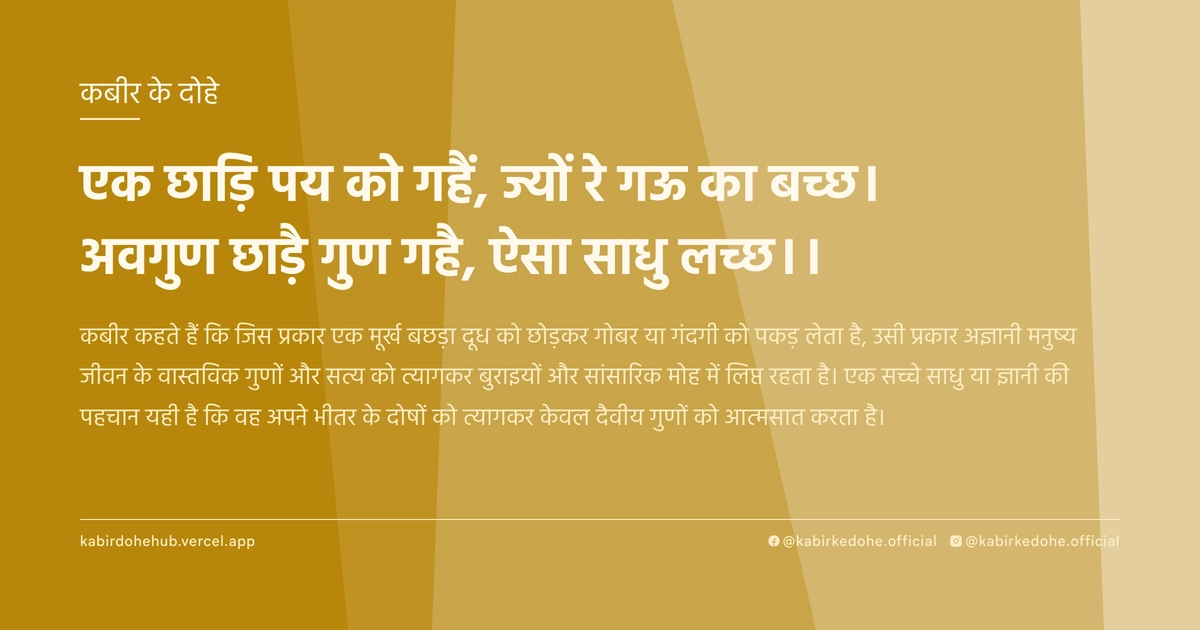
एक छाड़ि पय को गहैं, ज्यों रे गऊ का बच्छ।
अवगुण छाड़ै गुण गहै, ऐसा साधु लच्छ।।
Ek chhad i pay ko gahain, jyon re gau ka bachchh. Avgun chhadai gun gahai, aisa sadhu lachchh.
इस पृष्ठ पर इस कबीर दोहे का अर्थ (meaning), हिंदी व्याख्या और अंग्रेज़ी अनुवाद, दार्शनिक विश्लेषण और व्यावहारिक जीवन सीख दी गई है। यह दोहा आत्मनिरीक्षण (Self-introspection) विषय से जुड़ा है — Kabir doha meaning and explanation in Hindi and English.
अर्थ (Meaning):
कबीर कहते हैं कि जिस प्रकार एक मूर्ख बछड़ा दूध को छोड़कर गोबर या गंदगी को पकड़ लेता है, उसी प्रकार अज्ञानी मनुष्य जीवन के वास्तविक गुणों और सत्य को त्यागकर बुराइयों और सांसारिक मोह में लिप्त रहता है। एक सच्चे साधु या ज्ञानी की पहचान यही है कि वह अपने भीतर के दोषों को त्यागकर केवल दैवीय गुणों को आत्मसात करता है।
Kabir observes that just as a foolish calf might ignore the nourishing milk to cling to waste or dirt, an ignorant person discards spiritual virtues to embrace vices and worldly delusions. A true seeker or 'Sadhu' is defined by the conscious act of shedding internal flaws and clinging firmly to the divine attributes of truth and purity.
व्याख्या (Interpretation):
इस दोहे में 'पय' (दूध) शुद्ध चेतना और ईश्वरीय ज्ञान का प्रतीक है, जबकि 'बछड़ा' मानव आत्मा का प्रतिनिधित्व करता है जो माया के प्रभाव में भ्रमित है। शाब्दिक अर्थ से परे, यह दोहा हमारी चयन प्रक्रिया की विडंबना को दर्शाता है जहाँ हम अक्सर उस चीज़ को चुनते हैं जो हमें नष्ट करती है, न कि उसे जो हमें पोषण देती है। निर्गुण भक्ति के संदर्भ में, यह 'माया' के आवरण को हटाने की प्रक्रिया है। जब साधक अपनी 'अविद्या' (अज्ञान) को पहचान लेता है, तब वह द्वैत से मुक्त होकर अद्वैत की ओर बढ़ता है। यहाँ 'गुण' का अर्थ केवल नैतिक अच्छाई नहीं, बल्कि वह सार्वभौमिक सत्य है जो आत्मा और ब्रह्म की एकता को दर्शाता है। यह विरोधाभास है कि सत्य हमारे भीतर ही है, फिर भी हम बाहरी गंदगी में उसे खोजते हैं। अंततः, यह आत्म-रूपांतरण की वह अवस्था है जहाँ अहंकार का विसर्जन होता है और केवल शुद्ध चैतन्य शेष रहता है।
In this couplet, 'Pay' (milk) symbolizes pure consciousness and divine knowledge, while the 'calf' represents the human soul bewildered by the influence of Maya. Beyond the literal meaning, the verse highlights the irony of human choice, where we often cling to that which degrades us rather than that which nourishes us. Within the framework of Nirgun Bhakti, this is the process of piercing the veil of illusion. When the seeker recognizes their 'Avidya' (ignorance), they move from the duality of the ego toward the non-duality of Advaita. Here, 'Gun' (virtue) does not merely refer to moral goodness, but to the universal truth that reveals the oneness of Atman and Brahman. The central paradox lies in the fact that while the truth resides within, we obsessively seek it in the external filth of material desire. Ultimately, it describes a state of transmutation where the ego is annihilated, leaving only pure, luminous consciousness.
दार्शनिक विश्लेषण (Philosophical Analysis):
कबीर का यह दोहा उस सामाजिक और धार्मिक जड़ता पर प्रहार करता है जो उनके समय में व्याप्त थी। उन्होंने देखा कि लोग बाहरी कर्मकांडों, तीर्थयात्राओं और जातिगत श्रेष्ठता (जो 'अवगुण' हैं) में फंसे हुए थे, जबकि आंतरिक पवित्रता और प्रेम (जो 'पय' या दूध है) को पूरी तरह अनदेखा कर रहे थे। यह दृष्टिकोण सीधे तौर पर ब्राह्मणवादी कर्मकांडवाद और सूफी मत के कुछ बाहरी रूपों की आलोचना करता है, जहाँ धर्म केवल एक सामाजिक पहचान बन गया था।
दार्शनिक स्तर पर, यह अद्वैत वेदांत के 'विवेक' (discrimination) के सिद्धांत से मेल खाता है। विवेक वह क्षमता है जिससे साधक 'नित्य' (शाश्वत) और 'अनित्य' (क्षणभंगुर) के बीच अंतर कर सके। कबीर तर्क देते हैं कि जब तक हम अपनी कमियों और अहंकार को 'गुण' मानकर पकड़े रहते हैं, तब तक हम आध्यात्मिक रूप से अंधे हैं। यह मानसिक गुलामी की एक स्थिति है जहाँ हम अपनी ही अज्ञानता के प्रेम में पड़ जाते हैं।
सूफीवाद के 'नफ़्स' (अहंकार) के सिद्धांत के साथ इसका गहरा संबंध है। जिस प्रकार सूफी मत में नफ़्स को मारने या नियंत्रित करने की बात कही गई है, कबीर 'अवगुण' को छोड़ने की बात करते हैं। यह केवल नैतिक सुधार नहीं है, बल्कि एक मनोवैज्ञानिक मृत्यु और पुनर्जन्म है। जब तक पुराना 'मैं' (अहंकार) नहीं मरता, तब तक नया 'मैं' (दिव्य स्वरूप) प्रकट नहीं हो सकता।
कबीर की निर्गुण भक्ति यह सिखाती है कि ईश्वर किसी मंदिर या मस्जिद में नहीं, बल्कि उस शुद्धता में है जो अवगुणों के त्याग के बाद बचती है। वे कहते हैं कि सत्य को पाने के लिए कुछ 'जोड़ना' नहीं पड़ता, बल्कि बहुत कुछ 'छोड़ना' पड़ता है। यह 'नेति-नेति' (यह नहीं, वह नहीं) की प्रक्रिया है, जहाँ हम उन सभी परतों को हटाते हैं जो हमारी वास्तविक प्रकृति को ढक रही हैं।
अंततः, यह विश्लेषण हमें बताता है कि आध्यात्मिक प्रगति का पैमाना यह नहीं है कि हमने कितनी पुस्तकें पढ़ीं या कितने मंत्र जपे, बल्कि यह है कि हमने अपने भीतर के कितने विकारों को वास्तव में त्याग दिया है। यह एक कठोर आत्म-परीक्षण की मांग करता है, जहाँ साधक स्वयं को एक दर्पण में देखे और अपनी कुरूपता को स्वीकार कर उसे शुद्ध करने का साहस करे।
Kabir's couplet strikes at the heart of the social and religious inertia prevalent during his era. He observed that people were entrenched in external rituals, pilgrimages, and caste superiority—which he identifies as 'Avgun' (vices)—while completely ignoring internal purity and love, the 'Pay' or nourishing milk of the soul. This perspective is a direct critique of Brahmanical ritualism and certain external forms of Sufism where religion had devolved into a mere social identity.
On a philosophical level, this aligns with the Advaita Vedanta principle of 'Viveka' (discrimination). Viveka is the intellectual faculty that allows a seeker to distinguish between the 'Nitya' (eternal) and the 'Anitya' (ephemeral). Kabir argues that as long as we mistake our flaws and ego for virtues, we remain spiritually blind. This is a state of psychological bondage where we fall in love with our own ignorance.
There is a profound connection here to the Sufi concept of 'Nafs' (the lower self/ego). Just as Sufism emphasizes the annihilation or discipline of the Nafs, Kabir advocates for the abandonment of 'Avgun'. This is not merely a moral improvement but a psychological death and rebirth. Until the old 'I' (the ego) dies, the new 'I' (the divine essence) cannot manifest.
Kabir's Nirgun Bhakti teaches that the Divine is not found in temples or mosques, but in the purity that remains after the vices are stripped away. He suggests that attaining truth is not about 'adding' something to oneself, but about 'subtracting' the unnecessary. This is the process of 'Neti-Neti' (not this, not that), where we peel away the layers that obscure our true nature.
Ultimately, this analysis reveals that the metric of spiritual progress is not the number of scriptures read or mantras chanted, but the extent to which one has actually relinquished internal distortions. It demands a rigorous self-examination, where the seeker looks into the mirror of consciousness, acknowledges their ugliness, and finds the courage to purify it.
मूल संदेश (Core Message):
- अहंकार की पहचान ही मुक्ति का पहला चरण है।
- बाहरी पवित्रता एक भ्रम है; आंतरिक शुद्धि ही सत्य है।
- सत्य को पाने के लिए पहले असत्य का त्याग करना अनिवार्य है।
- प्रेम और करुणा ही आत्मा का वास्तविक पोषण (पय) हैं।
- साधु वह नहीं जो पूजा करे, बल्कि वह है जो विकारों को त्यागे।
- Recognizing the ego is the first step toward liberation.
- External purity is an illusion; internal purification is the only truth.
- To attain the Truth, one must first relinquish the falsehood.
- Love and compassion are the true nourishment (milk) of the soul.
- A saint is not one who performs rituals, but one who sheds distortions.
व्यावहारिक उदाहरण (Practical Example):
वाराणसी के घाटों पर रहने वाले एक वृद्ध विधवा, जानकी, की कहानी है। जानकी ने अपना पूरा जीवन कठोर नियमों, उपवासों और दूसरों की नजरों में 'पवित्र' दिखने की कोशिश में बिता दिया था। वह हर दिन घंटों पूजा करती थी, लेकिन उसके मन में अपने परिवार के प्रति गहरी कड़वाहट और समाज के प्रति निर्णय लेने की प्रवृत्ति (judgmental nature) थी। वह मानती थी कि उसकी कठोरता ही उसकी धार्मिकता है।
एक दिन, वह कबीर के एक अनुयायी को एक साधारण व्यक्ति को प्रेम से समझाते हुए देखती है। वह अनुयायी उसे बताता है कि 'पवित्रता माथे की भस्म में नहीं, बल्कि हृदय की करुणा में है।' जानकी को अचानक एहसास हुआ कि वह जिस 'पवित्रता' को पकड़े हुए थी, वह वास्तव में उसका अहंकार था—एक ऐसा 'अवगुण' जिसे वह 'गुण' समझकर पूज रही थी।
उसने महसूस किया कि वह दूध (प्रेम और क्षमा) को छोड़कर गोबर (अहंकार और कठोरता) को पकड़कर बैठी थी। यह उसके लिए एक गहरा झटका था। उसने अपनी पूरी जीवनशैली को बदलने का निर्णय लिया। उसने उपवासों की संख्या कम की और उन घंटों का उपयोग उन लोगों की मदद करने में किया जिन्हें उसने वर्षों से अनदेखा किया था।
शुरुआत में, उसे बहुत बेचैनी हुई। उसका मन उसे बार-बार पुराने ढर्रे पर ले जाना चाहता था। उसे लगा कि वह अपनी धार्मिकता खो रही है। लेकिन जैसे-जैसे उसने अपने भीतर के क्रोध और श्रेष्ठता के भाव को छोड़ा, उसे एक ऐसी शांति का अनुभव हुआ जो उसने कभी किसी मंदिर में नहीं पाई थी।
उसने अपने उस बेटे को माफ कर दिया जिससे वह सालों से बात नहीं कर रही थी। उसने पाया कि जब उसने 'सही होने' की जिद छोड़ी, तो वह वास्तव में 'सही' होने लगी। उसकी आँखों में अब दूसरों के लिए निर्णय नहीं, बल्कि सहानुभूति थी।
गाँव के लोग हैरान थे कि जो महिला कभी केवल नियमों की बात करती थी, अब वह प्रेम की मूरत बन गई थी। वह अब केवल पूजा नहीं करती थी, बल्कि वह स्वयं एक प्रार्थना बन गई थी।
उसने सीखा कि असली साधना बाहरी दिखावे को त्यागकर आंतरिक विकारों को मिटाना है। उसका जीवन अब एक बोझ नहीं, बल्कि एक उत्सव बन गया था क्योंकि उसने 'अवगुण' को छोड़कर 'गुण' को पकड़ लिया था।
जानकी की यह यात्रा दर्शाती है कि कैसे एक छोटा सा बोध पूरे व्यक्तित्व को बदल सकता है। उसने यह जान लिया कि ईश्वर को पाने का रास्ता खुद को खोने से होकर गुजरता है, और वह 'खोना' वास्तव में अपने अहंकार का त्याग करना है।
Consider the story of Janki, an elderly widow living on the ghats of Varanasi. Janki had spent her entire life adhering to rigid rules, fasting, and striving to appear 'pure' in the eyes of others. She spent hours in prayer daily, yet her heart harbored deep bitterness toward her family and a judgmental attitude toward society. She believed her austerity was the hallmark of her righteousness.
One day, she witnessed a follower of Kabir speaking with immense tenderness to a common man. That follower told her, 'Purity does not lie in the ash on the forehead, but in the compassion of the heart.' Janki suddenly realized that the 'purity' she had been clinging to was actually her ego—a 'vice' she had been worshipping as a 'virtue.'
She felt that she had been ignoring the milk (love and forgiveness) to cling to the waste (ego and rigidity). This was a profound shock to her system. She decided to transform her entire way of living. She reduced her obsessive fasting and used those hours to help people she had ignored for years.
Initially, she felt immense restlessness. Her mind tried to pull her back to her old patterns. She feared she was losing her religiosity. However, as she let go of her anger and sense of superiority, she experienced a peace she had never found in any temple.
She forgave her son, with whom she hadn't spoken for years. She discovered that when she stopped insisting on being 'right,' she actually began to be 'right.' The judgment in her eyes was replaced by empathy.
The villagers were astonished that the woman who once spoke only of rules had become an embodiment of love. She no longer just performed prayers; she became a living prayer.
She learned that true spiritual practice is not about external displays but about eradicating internal distortions. Her life ceased to be a burden and became a celebration because she had traded her vices for virtues.
Janki's journey illustrates how a single moment of awareness can reshape a personality. She realized that the path to the Divine requires losing oneself, and that 'loss' is actually the shedding of the ego.
अभ्यास मार्गदर्शन (Practice Guidance):
- दैनिक आत्म-निरीक्षण: प्रतिदिन 15 मिनट मौन बैठें और उन व्यवहारों की सूची बनाएं जिन्हें आप 'गुण' मानते हैं लेकिन वे वास्तव में आपका अहंकार (जैसे- दूसरों को सही साबित करना) हैं।
- विपरीत प्रतिक्रिया अभ्यास: जब भी आपके मन में किसी के प्रति निर्णय या क्रोध आए, तो रुकें और पूछें, 'क्या मैं अभी दूध को छोड़कर गोबर पकड़ रहा हूँ?'
- सेवा का संकल्प: सप्ताह में एक बार ऐसे व्यक्ति की निस्वार्थ मदद करें जिससे आपका वैचारिक मतभेद हो, ताकि आपके भीतर की श्रेष्ठता का भाव मिट सके।
- डायग्नोस्टिक चेकलिस्ट: क्या मैं अपनी गलतियों को सही ठहराने के लिए तर्क ढूंढ रहा हूँ? क्या मेरी धार्मिकता दूसरों को छोटा महसूस कराती है? यदि हाँ, तो आप अभी भी 'अवगुण' को पकड़े हुए हैं।
- Daily Self-Inquiry: Spend 15 minutes in silence daily, listing behaviors you perceive as 'virtues' but are actually ego-driven (e.g., the need to be proven right).
- Opposite Reaction Practice: Whenever judgment or anger arises, pause and ask, 'Am I currently ignoring the milk to cling to the waste?'
- Sankalpa of Service: Once a week, selflessly help someone with whom you have a deep ideological conflict to dissolve your sense of superiority.
- Diagnostic Checklist: Am I searching for justifications to excuse my flaws? Does my spirituality make others feel inferior? If yes, you are still clinging to the 'Avgun'.
चिंतन प्रश्न (Reflection Questions):
- मेरे जीवन का वह कौन सा 'गुण' है जो वास्तव में मेरा छिपा हुआ अहंकार है?
- मैं अपनी छवि को 'पवित्र' बनाए रखने के लिए किन आंतरिक अंधेरों को अनदेखा कर रहा हूँ?
- क्या मेरी नैतिकता दूसरों की मदद के लिए है या खुद को श्रेष्ठ महसूस कराने के लिए?
- यदि मेरी सारी सामाजिक पहचान (पद, जाति, धर्म) छीन ली जाए, तो मेरे भीतर क्या बचेगा?
- मैं किन ऐसी आदतों से चिपका हुआ हूँ जो मुझे मानसिक रूप से पोषण नहीं दे रहीं, फिर भी मैं उन्हें नहीं छोड़ पा रहा?
- Which 'virtue' in my life is actually a hidden form of ego?
- What internal shadows am I ignoring to maintain a 'pure' public image?
- Is my morality intended to help others or to make me feel superior?
- If all my social identities (status, caste, religion) were stripped away, what would remain within me?
- What habits am I clinging to that provide no spiritual nourishment, yet I refuse to let go?