
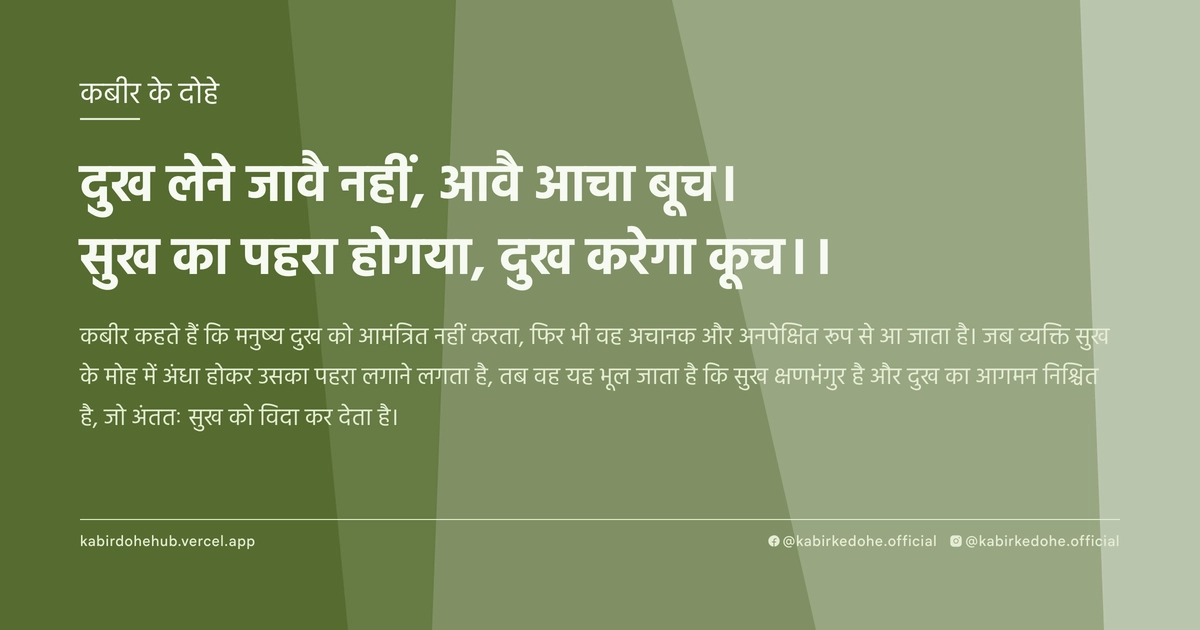
दुख लेने जावै नहीं, आवै आचा बूच।
सुख का पहरा होगया, दुख करेगा कूच।।
Dukh lene jaave nahi, aave aacha booch. Sukh ka pahra hogaya, dukh karega kooch.
इस पृष्ठ पर इस कबीर दोहे का अर्थ (meaning), हिंदी व्याख्या और अंग्रेज़ी अनुवाद, दार्शनिक विश्लेषण और व्यावहारिक जीवन सीख दी गई है। यह दोहा दुख और सुख (Sorrow and Joy) विषय से जुड़ा है — Kabir doha meaning and explanation in Hindi and English.
अर्थ (Meaning):
कबीर कहते हैं कि मनुष्य दुख को आमंत्रित नहीं करता, फिर भी वह अचानक और अनपेक्षित रूप से आ जाता है। जब व्यक्ति सुख के मोह में अंधा होकर उसका पहरा लगाने लगता है, तब वह यह भूल जाता है कि सुख क्षणभंगुर है और दुख का आगमन निश्चित है, जो अंततः सुख को विदा कर देता है।
Kabir observes that while a human never consciously seeks out suffering, it arrives unbidden and unexpectedly. When one becomes obsessed with guarding and clinging to fleeting pleasure, they fail to realize that such attachment is an illusion, and sorrow will inevitably march in to displace the temporary joy.
व्याख्या (Interpretation):
शाब्दिक अर्थ यह है कि दुख बिना बुलाए आता है। आध्यात्मिक स्तर पर, यह 'माया' के प्रभाव को दर्शाता है। जब हम सुख को स्थायी मानकर उसे पकड़ने की कोशिश करते हैं, तो हम वास्तव में दुख के बीज बो रहे होते हैं। यह निर्गुण भक्ति का संकेत है कि संसार में कोई भी स्थिति स्थायी नहीं है। आत्मा और परमात्मा के बीच का द्वंद्व तब समाप्त होता है जब हम सुख-दुख के द्वैत से ऊपर उठकर साक्षी भाव में स्थित हो जाते हैं।
Literally, it suggests that sorrow arrives uninvited. Metaphorically, this illustrates the grip of Maya (illusion). When we attempt to guard pleasure as a permanent possession, we inadvertently invite suffering. This aligns with Nirgun Bhakti, emphasizing that no worldly state is permanent. The duality of the human condition is resolved only when the seeker transcends the oscillation between joy and grief, attaining the state of the 'Sakshi' or the detached witness, realizing the non-duality of Atman and Brahman.
दार्शनिक विश्लेषण (Philosophical Analysis):
कबीर का यह दोहा उस समय के सामाजिक और धार्मिक पाखंड पर प्रहार करता है जहाँ लोग केवल बाहरी कर्मकांडों से मोक्ष की आशा करते थे। वे समझाते हैं कि सुख और दुख सिक्के के दो पहलू हैं। अद्वैत वेदांत के अनुसार, जब तक 'अहंकार' है, तब तक द्वैत (सुख-दुख) रहेगा। कबीर यहाँ सूफी मत के 'फना' होने की बात करते हैं, जहाँ व्यक्ति अपनी इच्छाओं को मिटाकर ईश्वर में लीन हो जाता है।
वे बताते हैं कि सुख का 'पहरा' लगाना वास्तव में एक मनोवैज्ञानिक बंधन है। हम सुख को बचाने की कोशिश में इतने व्यस्त हो जाते हैं कि हम वर्तमान क्षण की वास्तविकता को खो देते हैं। यह आसक्ति ही दुख का मूल कारण है।
कबीर का दर्शन यह है कि दुख वास्तव में एक शिक्षक है। जब सुख का पहरा टूटता है, तब मनुष्य अंतर्मुखी होता है। यह विखंडन ही आध्यात्मिक जागृति का द्वार खोलता है।
वे जाति और धर्म के भेदों को नकारते हुए यह संदेश देते हैं कि पीड़ा सार्वभौमिक है। चाहे कोई राजा हो या रंक, सुख की क्षणभंगुरता सबको समान रूप से प्रभावित करती है।
अंततः, यह दोहा हमें सिखाता है कि मुक्ति सुख की प्राप्ति में नहीं, बल्कि सुख और दुख के प्रति तटस्थता (Equanimity) विकसित करने में है। जब हम 'मैं' और 'मेरा' का त्याग करते हैं, तब दुख का कूच (प्रस्थान) स्वतः हो जाता है।
Kabir's couplet strikes at the heart of the ritualistic hypocrisy of his era, where people sought salvation through external ceremonies. He posits that joy and sorrow are two sides of the same coin. According to Advaita Vedanta, as long as the 'Ego' exists, duality—the perception of opposites like pleasure and pain—will persist. Kabir echoes the Sufi concept of 'Fana', the annihilation of the self into the Divine.
He explains that 'guarding' pleasure is a psychological trap. In our desperate attempt to preserve a fleeting moment of happiness, we lose touch with the eternal present. This attachment is the primary catalyst for suffering.
Kabir suggests that sorrow is actually a catalyst for growth. When the fortress of pleasure collapses, the human is forced to turn inward. This breakdown is often the only gateway to genuine spiritual awakening.
By rejecting caste and religious hierarchies, he asserts that suffering is the great equalizer. Whether a king or a pauper, the transience of joy affects all sentient beings with equal intensity.
Ultimately, the philosophy here is that liberation is not found in the pursuit of pleasure, but in the cultivation of equanimity. When the 'I' and 'Mine' are dissolved, the march of sorrow ceases to be a threat and becomes a path to liberation.
मूल संदेश (Core Message):
- सुख की आसक्ति ही दुख का निमंत्रण है।
- स्थायित्व की खोज एक भ्रम है, प्रवाह को स्वीकार करें।
- अहंकार का अंत ही वास्तविक शांति का प्रारंभ है।
- दुख शत्रु नहीं, बल्कि जागृति का एक साधन है।
- साक्षी भाव ही जीवन के द्वंद्वों से मुक्ति का मार्ग है।
- Attachment to pleasure is the invitation for pain.
- The search for permanence is an illusion; embrace the flow.
- The end of the ego is the beginning of true peace.
- Sorrow is not an enemy, but a tool for awakening.
- Witness consciousness is the only path beyond duality.
व्यावहारिक उदाहरण (Practical Example):
वाराणसी के घाटों पर रहने वाली एक वृद्ध विधवा, जानकी, का जीवन केवल अपनी छोटी सी दुकान और कुछ बचे हुए गहनों के इर्द-गिर्द घूमता था। वह अपने गहनों को अपनी सुरक्षा और सुख का आधार मानती थी और उन्हें हर समय संजोकर रखती थी।
वह मानती थी कि जब तक उसके पास ये गहने हैं, वह समाज में सम्मानित है और उसका बुढ़ापा सुरक्षित है। वह अपने गहनों की सुरक्षा में इतनी मग्न थी कि उसने अपने आसपास के दुखी लोगों की मदद करना छोड़ दिया था।
एक रात, एक भीषण चोरी हुई और उसके सारे गहने चोरी हो गए। जानकी टूट गई। उसे लगा कि उसका सारा सुख छिन गया है और अब केवल अंतहीन दुख बचा है।
वह हफ्तों तक शोक में डूबी रही, यह सोचते हुए कि उसने सुख का पहरा लगाया था, फिर भी दुख ने उसे घेर लिया।
एक दिन वह एक साधु के पास गई और रोते हुए अपनी व्यथा सुनाई। साधु ने मुस्कुराकर कहा, 'तुम गहनों का पहरा नहीं दे रही थी, बल्कि अपनी आसक्ति का पहरा दे रही थी।'
साधु ने समझाया कि गहने सुख नहीं थे, बल्कि गहनों के खोने का डर ही असली दुख था। जब तक वह उन्हें पकड़ कर बैठी थी, वह डर में थी।
जानकी को अचानक बोध हुआ कि जिस सुख को वह बचा रही थी, वह वास्तव में एक मानसिक जेल थी। उसने महसूस किया कि असली शांति गहनों के होने या न होने में नहीं, बल्कि इस सत्य को स्वीकार करने में है कि सब कुछ नश्वर है।
उसने अपने जीवन के शेष वर्ष अन्य बेसहारा महिलाओं की मदद करने में बिताए। अब वह सुख और दुख के उतार-चढ़ाव से विचलित नहीं होती थी।
उसका व्यवहार बदल गया; वह अब गहनों की नहीं, बल्कि करुणा की पहरेदार बन गई थी।
उसने पाया कि जब उसने सुख को पकड़ना छोड़ दिया, तो दुख ने उसे डराना बंद कर दिया।
Janaki, an elderly widow living on the ghats of Varanasi, centered her entire existence around a small shop and a few remaining pieces of jewelry. She viewed these ornaments as the foundation of her security and happiness, guarding them obsessively.
She believed that as long as she possessed these jewels, she maintained her social status and a secure old age. In her preoccupation with guarding this perceived happiness, she became indifferent to the suffering of others around her.
One night, a devastating theft occurred, and all her jewelry was stolen. Janaki was shattered. She felt her entire happiness had been ripped away, leaving only an endless void of sorrow.
For weeks, she wallowed in grief, lamenting that despite her efforts to guard her joy, sorrow had marched in and conquered her life.
Driven by despair, she visited a wandering monk and shared her agony. The monk smiled and said, 'You were not guarding jewelry; you were guarding your own attachment.'
He explained that the jewelry was not the source of happiness, but the fear of losing it was the source of her misery. As long as she clung to them, she lived in a state of latent anxiety.
Janaki suddenly realized that the happiness she tried to preserve was actually a psychological prison. She understood that true peace does not lie in possession, but in accepting the transience of all material things.
She spent the remainder of her years serving other destitute women in the city. She no longer trembled at the fluctuations of fortune.
Her behavior underwent a radical shift; she ceased being a guardian of gold and became a guardian of compassion.
She discovered that once she stopped trying to capture happiness, sorrow lost its power to terrify her.
अभ्यास मार्गदर्शन (Practice Guidance):
- प्रतिदिन 20 मिनट 'साक्षी भाव' का अभ्यास करें: अपने विचारों और भावनाओं को बिना किसी निर्णय के केवल देखें, जैसे आप किसी फिल्म को देख रहे हों।
- आत्म-पूछताछ जर्नल: लिखें कि आप वर्तमान में किन चीजों को 'पकड़ने' या 'बचाने' की कोशिश कर रहे हैं और यह डर आपको कैसे प्रभावित कर रहा है।
- व्यवहारिक परिवर्तन: सप्ताह में एक बार जानबूझकर किसी ऐसी स्थिति में जाएं जो आपको असहज करती हो, ताकि आप सुख-दुख के प्रति अपनी प्रतिक्रिया को संतुलित कर सकें।
- नैदानिक चेकलिस्ट: क्या मैं किसी छोटी सी हानि पर अत्यधिक विचलित होता हूँ? क्या मैं सुख के समय भविष्य के खोने के डर में जीता हूँ? यदि हाँ, तो आप अभी भी 'पहरा' लगा रहे हैं।
- Practice 'Witness Consciousness' for 20 minutes daily: Observe your thoughts and emotions without judgment, as if watching a movie of your own life.
- Self-Inquiry Journaling: List the things you are currently trying to 'hold onto' or 'protect' and analyze how this fear of loss dictates your behavior.
- Behavioral Shift: Once a week, intentionally place yourself in a mildly uncomfortable situation to train your mind to remain equanimous amidst shifting states.
- Diagnostic Checklist: Do I react disproportionately to small losses? Do I spend my moments of joy fearing their end? If yes, you are still 'guarding' the illusion.
चिंतन प्रश्न (Reflection Questions):
- वह कौन सी 'डिजिटल पहचान' या छवि है जिसे आप दुनिया के सामने बचाने के लिए संघर्ष कर रहे हैं?
- क्या आपका सुख वास्तव में आंतरिक है, या यह दूसरों की प्रशंसा पर निर्भर है?
- जब आप कहते हैं कि आप 'सुखी' हैं, तो क्या उस सुख के पीछे खोने का एक सूक्ष्म डर छिपा होता है?
- आपके जीवन का वह कौन सा दुख है जिसे आप स्वीकार करने के बजाय उससे लड़ रहे हैं?
- यदि आज आपकी सारी उपलब्धियां छीन ली जाएं, तो आपके भीतर क्या शेष बचेगा?
- What 'digital identity' or curated image are you struggling to maintain for the world?
- Is your happiness truly internal, or is it contingent upon the validation of others?
- When you claim to be 'happy,' is there a subtle, underlying fear of that happiness ending?
- Which specific sorrow in your life are you fighting against instead of accepting?
- If all your achievements were stripped away today, what would remain of your core essence?