
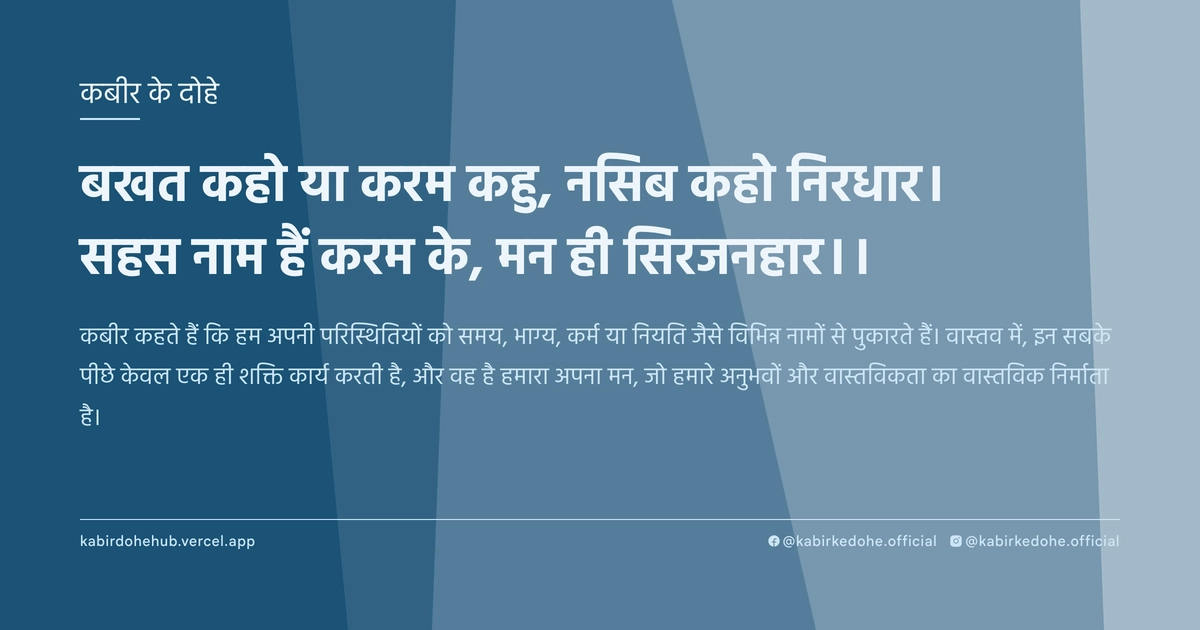
बखत कहो या करम कहु, नसिब कहो निरधार।
सहस नाम हैं करम के, मन ही सिरजनहार।।
Bakhat kaho ya karam kahu, nasib kaho nirdhaar. Sahas naam hain karam ke, man hi sirjanhaar.
इस पृष्ठ पर इस कबीर दोहे का अर्थ (meaning), हिंदी व्याख्या और अंग्रेज़ी अनुवाद, दार्शनिक विश्लेषण और व्यावहारिक जीवन सीख दी गई है। यह दोहा कर्म (Karma) विषय से जुड़ा है — Kabir doha meaning and explanation in Hindi and English.
अर्थ (Meaning):
कबीर कहते हैं कि हम अपनी परिस्थितियों को समय, भाग्य, कर्म या नियति जैसे विभिन्न नामों से पुकारते हैं। वास्तव में, इन सबके पीछे केवल एक ही शक्ति कार्य करती है, और वह है हमारा अपना मन, जो हमारे अनुभवों और वास्तविकता का वास्तविक निर्माता है।
Kabir asserts that whether we attribute our life circumstances to time, destiny, fate, or predestination, these are merely different labels for the same phenomenon. The ultimate architect of our perceived reality and the source of our suffering or joy is the human mind itself.
व्याख्या (Interpretation):
इस दोहे का शाब्दिक अर्थ है कि हम अपनी विफलताओं या सफलताओं के लिए बाहरी कारणों को जिम्मेदार ठहराते हैं। रूपकात्मक रूप से, कबीर 'माया' के उस जाल की ओर इशारा कर रहे हैं जहाँ मनुष्य स्वयं को एक असहाय कठपुतली मानता है। निर्गुण भक्ति के परिप्रेक्ष्य में, यह मन ही है जो द्वैत (duality) पैदा करता है और आत्मा को ब्रह्म से अलग महसूस कराता है। जब हम कहते हैं कि 'मेरा भाग्य खराब है', तो हम वास्तव में अपने मन द्वारा निर्मित एक मानसिक प्रक्षेपण (projection) को सत्य मान रहे होते हैं। यह विरोधाभास है कि जिस मन को हम बंधन मानते हैं, वही मन यदि जागृत हो जाए, तो वह मुक्ति का द्वार भी बन सकता है। अंततः, यह दोहा अद्वैत वेदांत के इस सिद्धांत की पुष्टि करता है कि दृष्टा और दृश्य एक ही हैं, और मन ही वह पर्दा है जो सत्य को ढकता है।
Literally, the verse addresses the tendency to blame external forces for one's lot in life. Metaphorically, Kabir points toward the veil of Maya, where the individual perceives themselves as a helpless puppet of destiny. In the context of Nirgun Bhakti, it is the mind that creates the illusion of duality, separating the Atman from the universal Brahman. When we claim 'fate is cruel,' we are validating a mental projection rather than an objective truth. The central paradox lies in the fact that the mind, which acts as the primary shackle, is also the only instrument capable of achieving liberation through self-realization. This aligns with Advaita Vedanta, suggesting that the perceived separation between the observer and the observed is a construct of the mind, which, once dissolved, reveals the singular, non-dual reality.
दार्शनिक विश्लेषण (Philosophical Analysis):
कबीर का यह विचार उनके समय के सामाजिक और धार्मिक परिवेश के विरुद्ध एक क्रांतिकारी प्रहार था। मध्यकालीन भारत में, 'प्रारब्ध' और 'भाग्य' का उपयोग अक्सर यथास्थिति बनाए रखने और जातिगत भेदभाव को उचित ठहराने के लिए किया जाता था। कबीर ने इस नियतिवाद (Fatalism) को चुनौती दी और व्यक्ति को उसकी अपनी चेतना की जिम्मेदारी सौंपी।
दार्शनिक स्तर पर, यह दोहा सूफी मत के 'इंसान-ए-कामिल' और वेदांत के 'साक्षी भाव' का संगम है। सूफीवाद में, मन की शुद्धि (Tazkiyah) के बिना ईश्वर का साक्षात्कार असंभव है, क्योंकि मन ही वह दर्पण है जिसमें खुदा की छवि दिखती है। कबीर यहाँ स्पष्ट कर रहे हैं कि बाहरी कर्मकांड या ग्रहों की स्थिति मनुष्य का भाग्य नहीं बदलती, बल्कि आंतरिक रूपांतरण ही वास्तविक परिवर्तन है।
अद्वैत वेदांत के अनुसार, यह जगत एक 'विवर्त' या आभास है। यदि मन यह मान ले कि वह शरीर और अहंकार है, तो वह कर्मों के बंधन में बंध जाता है। लेकिन यदि मन यह जान ले कि वह शुद्ध चैतन्य है, तो 'नसिब' और 'बखत' जैसे शब्द अर्थहीन हो जाते हैं। कबीर का प्रहार उस अज्ञान (Avidya) पर है जो मनुष्य को बाहरी दुनिया का दास बनाता है।
मनोवैज्ञानिक रूप से, कबीर 'लocus of Control' की बात कर रहे हैं। जब व्यक्ति बाहरी कारकों (External Locus) को दोष देता है, तो वह अपनी शक्ति खो देता है। जैसे ही वह स्वीकार करता है कि 'मन ही सिरजनहार' है, वह अपनी मानसिक अवस्था को बदलने की क्षमता प्राप्त कर लेता है, जिससे उसके जीवन की दिशा बदल जाती है।
अंततः, यह दोहा कर्मकांडीय धर्म की अस्वीकृति है। कबीर कहते हैं कि मंदिर, मस्जिद या ग्रहों की पूजा से अधिक महत्वपूर्ण मन का अनुशासन है। जब अहंकार का विसर्जन होता है, तब यह समझ आता है कि जिसे हम 'ईश्वर की इच्छा' कह रहे थे, वह वास्तव में हमारे अपने अवचेतन संस्कारों का परिणाम था।
Kabir's insight was a revolutionary strike against the socio-religious fabric of his era. In medieval India, concepts of 'Prarabdha' (destiny) and 'fate' were often weaponized to maintain the status quo and justify caste-based oppression. By shifting the agency from fate to the mind, Kabir challenged fatalism and returned the responsibility of spiritual evolution to the individual.
Philosophically, this verse represents a confluence of the Sufi concept of 'Insan-e-Kamil' (the perfected human) and the Vedantic 'Sakshi' (witness consciousness). In Sufism, the purification of the heart (Tazkiyah) is essential because the mind is the mirror reflecting the Divine. Kabir clarifies that ritualistic adherence or astrological alignments do not alter one's destiny; only internal transmutation can bring about a genuine shift in existence.
According to Advaita Vedanta, the world is a 'Vivarta' or an illusory appearance. If the mind identifies with the body and ego, it becomes entangled in the web of karma. However, once the mind realizes its essence as pure consciousness, terms like 'fate' and 'luck' lose their potency. Kabir attacks the 'Avidya' (ignorance) that renders a human a slave to external circumstances.
Psychologically, Kabir is discussing the 'Locus of Control.' When an individual attributes their life to external factors, they surrender their agency. The moment they acknowledge that the mind is the 'creator' (Sirjanhaar), they regain the power to alter their mental state, which subsequently reshapes their lived experience.
Ultimately, this is a rejection of ritualistic religion. Kabir posits that discipline of the mind is far more potent than temple or mosque rituals. When the ego is annihilated, one realizes that what was perceived as 'divine will' was often the manifestation of one's own subconscious impressions and mental conditioning.
मूल संदेश (Core Message):
- भाग्य एक मानसिक भ्रम है जिसे हम अपनी जिम्मेदारी से बचने के लिए रचते हैं।
- मन ही वह लेंस है जो वास्तविकता को सुखद या दुखद बनाता है।
- बाहरी परिस्थितियों का नियंत्रण नहीं, बल्कि आंतरिक प्रतिक्रिया का नियंत्रण ही वास्तविक शक्ति है।
- जब अहंकार मिटता है, तब नियति का डर समाप्त हो जाता है।
- आप अपने जीवन के शिकार नहीं, बल्कि अपने मानसिक संस्कारों के निर्माता हैं।
- Fate is a mental construct created to evade personal responsibility.
- The mind is the lens that renders reality either blissful or miserable.
- True power lies not in controlling external events, but in mastering the internal response.
- When the ego dissolves, the fear of destiny vanishes.
- You are not a victim of circumstances, but the architect of your mental impressions.
व्यावहारिक उदाहरण (Practical Example):
वाराणसी के घाटों पर रहने वाला एक वृद्ध विधवा, जिसे समाज ने 'अशुभ' मानकर हाशिए पर धकेल दिया था, अपनी पूरी जिंदगी को 'बुरे भाग्य' का परिणाम मानती रही। वह मानती थी कि उसका जीवन दुखद है क्योंकि उसके सितारे खराब थे और उसकी नियति ही कष्ट सहना था।
वह हर दिन गंगा किनारे बैठकर अपनी किस्मत को कोसती और यह सोचती कि यदि वह किसी दूसरे परिवार में जन्म लेती, तो शायद उसका जीवन सुखमय होता। उसके लिए 'नसिब' एक ऐसी दीवार थी जिसे वह कभी पार नहीं कर सकती थी।
एक दिन उसकी मुलाकात एक घुमक्कड़ फकीर से हुई, जिसने उसे कबीर का यह दोहा सुनाया। फकीर ने उससे पूछा, 'यदि तुम्हारा भाग्य बुरा है, तो वह भाग्य लिख किसने रहा है? क्या वह भाग्य तुम्हारे मन के बाहर है या भीतर?'
वृद्ध महिला ने उत्तर दिया कि भाग्य तो ईश्वर लिखता है। फकीर ने मुस्कुराते हुए कहा, 'ईश्वर ने तो तुम्हें केवल एक जीवन दिया, लेकिन उस जीवन को 'दुखद' कहने वाला तुम्हारा मन है। तुम्हारा मन ही इस दुख को पाल रहा है और इसे भाग्य का नाम दे रहा है।'
इस बात ने महिला के भीतर एक हलचल पैदा कर दी। उसने महसूस किया कि वह वास्तव में अपनी परिस्थितियों से ज्यादा, उन परिस्थितियों के प्रति अपनी 'नफरत' और 'बेचारगी' से पीड़ित थी।
उसने धीरे-धीरे अपनी सोच बदली। उसने यह मानना बंद कर दिया कि वह एक 'पीड़ित' है। उसने घाट पर आने वाले अन्य असहाय लोगों की मदद करना शुरू किया, जिससे उसे एक नया उद्देश्य मिला।
जैसे-जैसे उसका मन 'बेचारगी' से 'सेवा' की ओर बढ़ा, उसकी बाहरी दुनिया बदलने लगी। लोग जो उसे अशुभ मानते थे, अब उसकी करुणा और शांति की ओर आकर्षित होने लगे।
उसने पाया कि जब उसने 'नसिब' के पर्दे को हटाया, तो उसे पता चला कि वह खुद ही अपने जीवन की निर्माता थी। उसकी आंतरिक शांति अब बाहरी परिस्थितियों पर निर्भर नहीं थी।
उसका रूपांतरण यह था कि उसने बाहरी 'बखत' को दोष देना बंद किया और अपने भीतर के 'सिरजनहार' (मन) को जागृत किया।
अंततः, वह महिला जिसे समाज ने मृत मान लिया था, अपने जीवन के अंतिम वर्षों में सबसे जीवंत और सम्मानित व्यक्ति बनी, क्योंकि उसने मन के खेल को समझ लिया था।
In the ancient alleys of Varanasi lived an elderly widow, marginalized by society and labeled as 'inauspicious.' For decades, she viewed her life as a series of misfortunes, attributing her suffering to 'bad luck' and a cruel destiny.
She spent her days by the Ganges, lamenting her fate and believing that had she been born into a different family or under a different star, her life would have been blissful. To her, 'Nasib' was an impenetrable wall that defined her existence.
One afternoon, she encountered a wandering fakir who recited this specific Doha to her. The fakir asked, 'If your fate is so cruel, who is writing it? Is this fate outside of you, or is it residing within your mind?'
The woman replied that God writes the destiny. The fakir smiled and said, 'God gave you life, but it is your mind that labels that life as "miserable." Your mind is nurturing this grief and calling it fate.'
This realization sparked a profound inner turmoil. She began to notice that she was suffering less from her actual circumstances and more from her internal narrative of being a 'victim.'
Slowly, she shifted her perspective. She stopped identifying as a casualty of destiny. She began offering small acts of kindness to other displaced souls on the ghats, finding a new sense of purpose.
As her mind shifted from 'helplessness' to 'service,' her external reality began to transform. People who once shunned her were now drawn to her radiating peace and compassion.
She discovered that once she tore down the veil of 'fate,' she found the power to recreate her own internal world. Her happiness was no longer hostage to her social status.
Her transformation was rooted in the cessation of blaming 'Bakhat' (time) and the awakening of the 'Sirjanhaar' (the creating mind).
In the end, the woman whom society had written off became the most revered figure in her colony, proving that the mind's perception is the ultimate architect of reality.
अभ्यास मार्गदर्शन (Practice Guidance):
- प्रतिदिन 20 मिनट 'साक्षी भाव' का अभ्यास करें: अपने विचारों को बिना किसी निर्णय के देखें और पहचानें कि कैसे आपका मन किसी घटना को 'अच्छा' या 'बुरा' लेबल करता है।
- स्व-पूछताछ जर्नल: जब भी आप कहें 'मेरी किस्मत खराब है', तो लिखें कि इस विचार के पीछे कौन सा डर या पूर्वाग्रह है और यह विचार आपकी वर्तमान स्थिति को कैसे प्रभावित कर रहा है।
- व्यवहारिक परिवर्तन: किसी भी समस्या के लिए बाहरी कारणों (लोग, समय, भाग्य) को दोष देना पूरी तरह बंद करें और पूछें, 'मेरा मन इस स्थिति को कैसे देख रहा है और मैं इसे कैसे बदल सकता हूँ?'
- निदान चेकलिस्ट: यदि आप अभी भी बार-बार 'काश ऐसा होता' या 'मेरी किस्मत ही ऐसी है' कह रहे हैं, तो आप अभी भी मन के भ्रम में हैं। यदि आप वर्तमान क्षण में शांति महसूस करते हैं चाहे परिस्थिति कैसी भी हो, तो आप इस ज्ञान को जी रहे हैं।
- Practice 'Witness Consciousness' for 20 minutes daily: Observe your thoughts without judgment and notice how your mind labels events as 'good' or 'bad.'
- Self-Inquiry Journaling: Whenever you find yourself saying 'I am unlucky,' write down the underlying fear or bias and analyze how this narrative is shaping your current emotional state.
- Behavioral Shift: Completely cease blaming external factors (people, time, fate) for your problems. Instead, ask, 'How is my mind perceiving this situation, and how can I shift that perception?'
- Diagnostic Checklist: If you frequently use phrases like 'I wish things were different' or 'This is just my luck,' you are still operating under the illusion. If you maintain inner equanimity regardless of external chaos, you are embodying this wisdom.
चिंतन प्रश्न (Reflection Questions):
- मेरे जीवन की कौन सी 'नाकामी' वास्तव में मेरी नियति थी, और कौन सी मेरे मन द्वारा निर्मित एक कहानी थी?
- क्या मैं अपनी असफलताओं के लिए 'भाग्य' का सहारा इसलिए लेता हूँ ताकि मुझे खुद को बदलने की कठिन मेहनत न करनी पड़े?
- मेरा 'डिजिटल अहंकार' (सोशल मीडिया इमेज) मुझे यह विश्वास दिलाने के लिए कैसे मजबूर करता है कि मेरी खुशी बाहरी प्रशंसा पर निर्भर है?
- यदि मैं आज अपनी सभी बाहरी पहचान (नाम, पद, संबंध) खो दूँ, तो क्या मेरा मन अभी भी खुद को 'दुखी' महसूस कराएगा?
- मेरे भीतर का वह कौन सा डर है जो मुझे यह मानने से रोकता है कि मैं अपनी वास्तविकता का निर्माता हूँ?
- क्या मेरी नैतिकता केवल सामाजिक दबाव है, या यह मेरे मन की वास्तविक जागृति से उपजी है?
- Which 'failure' in my life was truly an inevitability, and which was merely a narrative constructed by my mind?
- Do I use 'fate' as a psychological shield to avoid the grueling work of self-transformation?
- How does my 'digital ego' (social media persona) trick me into believing that my happiness depends on external validation?
- If I were stripped of all external identities (name, status, relationships), would my mind still project a sense of suffering?
- What is the specific fear within me that resists the idea of being the sole architect of my reality?
- Is my sense of morality a result of social conditioning, or does it stem from a genuine awakening of the mind?