
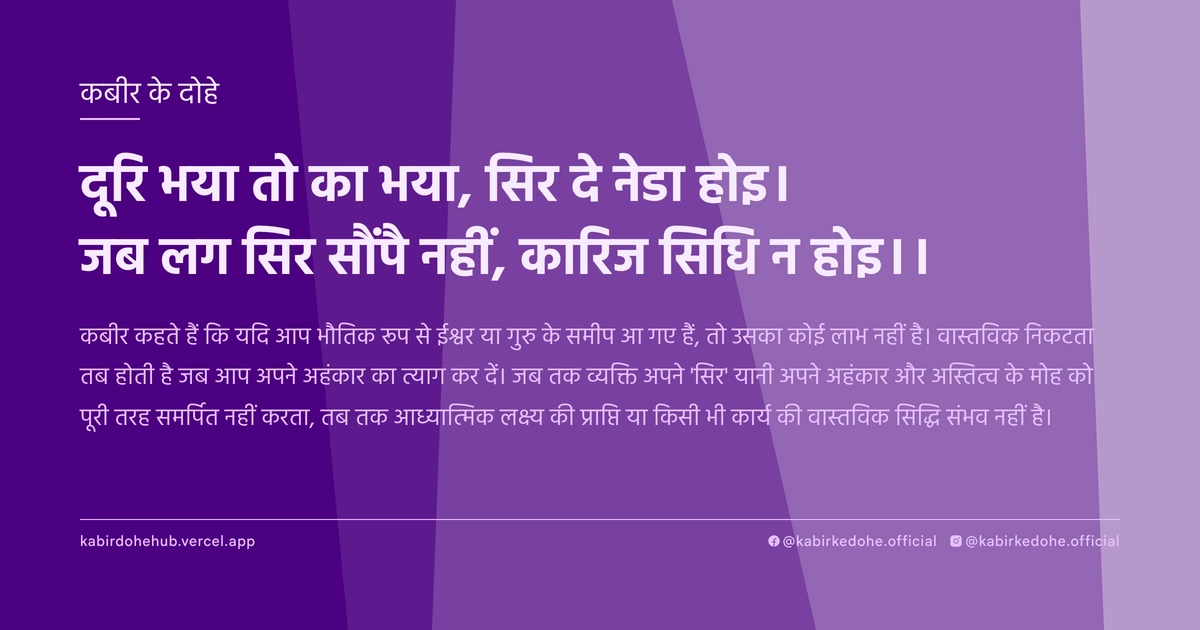
दूरि भया तो का भया, सिर दे नेडा होइ।
जब लग सिर सौंपै नहीं, कारिज सिधि न होइ।।
Doori bhaya to ka bhaya, sir de neda hoi. Jab lag sir saupai nahi, kaarij sidhi na hoi.
इस पृष्ठ पर इस कबीर दोहे का अर्थ (meaning), हिंदी व्याख्या और अंग्रेज़ी अनुवाद, दार्शनिक विश्लेषण और व्यावहारिक जीवन सीख दी गई है। यह दोहा प्रपत्ति (Surrender) विषय से जुड़ा है — Kabir doha meaning and explanation in Hindi and English.
अर्थ (Meaning):
कबीर कहते हैं कि यदि आप भौतिक रूप से ईश्वर या गुरु के समीप आ गए हैं, तो उसका कोई लाभ नहीं है। वास्तविक निकटता तब होती है जब आप अपने अहंकार का त्याग कर दें। जब तक व्यक्ति अपने 'सिर' यानी अपने अहंकार और अस्तित्व के मोह को पूरी तरह समर्पित नहीं करता, तब तक आध्यात्मिक लक्ष्य की प्राप्ति या किसी भी कार्य की वास्तविक सिद्धि संभव नहीं है।
Kabir asserts that mere physical proximity to the Divine or a spiritual guide is meaningless. True closeness is not measured by distance but by the surrender of the ego. Until one is willing to 'offer their head'—symbolizing the complete annihilation of the prideful self and the attachment to individual identity—no spiritual endeavor can reach its ultimate fruition or success.
व्याख्या (Interpretation):
इस दोहे में 'सिर' शब्द अहंकार और व्यक्तिगत पहचान का प्रतीक है। कबीर यहाँ एक गहरे विरोधाभास को प्रस्तुत करते हैं: निकटता भौतिक नहीं, बल्कि मानसिक और आध्यात्मिक होती है। निरगुण भक्ति के संदर्भ में, ईश्वर किसी विशेष स्थान पर नहीं रहता, बल्कि वह आत्मा के भीतर है। माया हमें यह विश्वास दिलाती है कि तीर्थयात्रा या बाहरी अनुष्ठानों से हम परमात्मा के करीब पहुँच सकते हैं, लेकिन यह एक भ्रम है। जब तक 'मैं' (अहंकार) जीवित है, तब तक आत्मा और ब्रह्म के बीच एक पर्दा बना रहता है। अद्वैत वेदांत के अनुसार, जब तक द्वैत (दो होने का भाव) समाप्त नहीं होता, तब तक मोक्ष संभव नहीं है। अतः, 'सिर सौंपने' का अर्थ है अपनी पूरी इच्छाशक्ति और पहचान को उस अनंत शून्य में विलीन कर देना, जहाँ केवल सत्य शेष रह जाता है।
In this couplet, the 'head' serves as a potent metaphor for the ego and the construct of individual identity. Kabir presents a profound paradox: proximity is not spatial but existential. Within the framework of Nirgun Bhakti, the Divine does not reside in a specific location but is immanent within the soul. Maya creates the illusion that physical pilgrimages or external rituals bring one closer to God, but this is a deception. As long as the 'I' (the ego) persists, a veil remains between the Atman and Brahman. According to Advaita Vedanta, liberation is impossible as long as duality—the sense of being separate from the Whole—exists. Therefore, 'offering the head' signifies the total surrender of one's will and identity into the infinite void, where only the Absolute Truth remains.
दार्शनिक विश्लेषण (Philosophical Analysis):
कबीर का यह दर्शन उस समय के कट्टरपंथी धार्मिक वातावरण के विरुद्ध एक सशक्त प्रहार था, जहाँ लोग केवल बाहरी प्रतीकों और कर्मकांडों को ही धर्म मानते थे। उन्होंने स्पष्ट किया कि ईश्वर की प्राप्ति के लिए किसी मंदिर, मस्जिद या विशेष भौगोलिक स्थान की आवश्यकता नहीं है। यह विचार सूफी मत के 'फना' (अहंकार का विनाश) के सिद्धांत से गहराई से मेल खाता है, जहाँ साधक अपनी व्यक्तिगत इच्छाओं को ईश्वर की इच्छा में विलीन कर देता है।
ऐतिहासिक रूप से, कबीर ने जाति व्यवस्था और सामाजिक ऊंच-नीच को चुनौती दी, क्योंकि ये सभी 'अहंकार' के विभिन्न रूप हैं। जब एक व्यक्ति स्वयं को किसी विशेष जाति या धर्म का श्रेष्ठ मानता है, तो वह वास्तव में अपने 'सिर' को पकड़ कर बैठा है, उसे समर्पित नहीं कर रहा। यह मानसिक जड़ता ही आध्यात्मिक प्रगति में सबसे बड़ी बाधा है।
अद्वैत वेदांत के परिप्रेक्ष्य में, यह दोहा 'अहं ब्रह्मास्मि' की प्राप्ति का मार्ग बताता है। जब तक व्यक्ति स्वयं को शरीर और मन की सीमाओं में देखता है, वह अलग रहता है। जैसे ही वह इस सीमित पहचान (सिर) का त्याग करता है, वह अनुभव करता है कि वह स्वयं वह अनंत चेतना है।
मनोवैज्ञानिक स्तर पर, यह 'अहं' के विसर्जन की प्रक्रिया है। कबीर यह समझाते हैं कि जिसे हम अपना 'व्यक्तित्व' या 'सम्मान' कहते हैं, वह वास्तव में एक मानसिक बंधन है। इस बंधन को तोड़ना ही वास्तविक स्वतंत्रता है।
अतः, 'कारिज सिधि' या कार्य की सिद्धि का अर्थ सांसारिक सफलता नहीं, बल्कि आत्म-साक्षात्कार है। यह वह बिंदु है जहाँ साधक और साध्य एक हो जाते हैं, और खोज समाप्त हो जाती क्योंकि खोजकर्ता स्वयं ही खोज का विषय बन जाता है।
Kabir's philosophy serves as a powerful critique of the dogmatic religious environment of his era, where spirituality was reduced to external symbols and rigid rituals. He clarifies that realizing the Divine requires no temple, mosque, or specific geographical location. This insight aligns deeply with the Sufi concept of 'Fana' (annihilation of the self), where the seeker dissolves their individual will into the Divine Will.
Historically, Kabir challenged the caste system and social hierarchies, recognizing them as manifestations of the ego. When an individual claims superiority based on birth or creed, they are clinging to their 'head' rather than surrendering it. This mental rigidity is the primary obstacle to spiritual evolution.
From the perspective of Advaita Vedanta, this doha outlines the path toward 'Aham Brahmasmi' (I am Brahman). As long as a person perceives themselves within the limitations of the body and mind, they remain in a state of separation. The moment they relinquish this limited identity, they realize they are the infinite consciousness itself.
On a psychological level, this is the process of ego-dissolution. Kabir explains that what we perceive as our 'personality' or 'honor' is, in reality, a mental shackle. Breaking this shackle is the only true liberation.
Thus, 'Kaarij Sidhi' or the 'success of the task' does not refer to worldly achievement, but to self-realization. It is the point where the seeker and the sought become one, and the search ends because the searcher has discovered that they were the destination all along.
मूल संदेश (Core Message):
- बाहरी निकटता केवल एक भ्रम है; वास्तविक मिलन आंतरिक समर्पण में है।
- अहंकार का त्याग ही आध्यात्मिक यात्रा का एकमात्र प्रवेश द्वार है।
- जब तक 'मैं' मौजूद है, तब तक 'वह' (परमात्मा) ओझल रहेगा।
- पूर्ण समर्पण का अर्थ है अपनी पहचान को अनंत में विलीन करना।
- सच्ची सिद्धि कर्मकांडों में नहीं, बल्कि अहंकार के विसर्जन में निहित है।
- External proximity is a mere illusion; true union lies in internal surrender.
- The relinquishing of the ego is the only gateway to the spiritual journey.
- As long as the 'I' persists, the 'Divine' remains hidden.
- Total surrender means dissolving the individual identity into the Infinite.
- True attainment lies not in rituals, but in the annihilation of the self.
व्यावहारिक उदाहरण (Practical Example):
वाराणसी के घाटों पर रहने वाले एक वृद्ध विधवा, जानकी, का जीवन अत्यंत कठिन था। वह दूसरों के घरों में छोटे-मोटे काम करती और शाम को गंगा किनारे बैठकर घंटों प्रार्थना करती। वह मानती थी कि वह बहुत धार्मिक है क्योंकि वह रोज व्रत रखती है और घंटों मंत्र जाप करती है। वह अक्सर अपने आस-पास के लोगों को उनकी 'अधार्मिकता' के लिए टोकती थी, जिससे उसके मन में एक सूक्ष्म श्रेष्ठता का भाव पैदा हो गया था।
एक दिन उसकी मुलाकात एक फकीर से हुई, जिसने उसे देखा और मुस्कुराकर कहा, "तुम गंगा के इतने करीब हो, फिर भी किनारे पर खड़ी हो।" जानकी ने गर्व से कहा कि वह दिन-भर तपस्या करती है। फकीर ने उत्तर दिया, "तपस्या तो शरीर की है, लेकिन तुम्हारा 'मैं' अभी भी जीवित है। तुम ईश्वर के पास नहीं, बल्कि अपनी पवित्रता के अहंकार के पास बैठी हो।"
यह बात जानकी के हृदय में चुभ गई। उसने महसूस किया कि उसकी प्रार्थनाएं ईश्वर के लिए नहीं, बल्कि अपनी स्वयं की छवि को 'पवित्र' सिद्ध करने के लिए थीं। वह जिसे भक्ति समझ रही थी, वह वास्तव में उसके अहंकार का पोषण था।
अगले कुछ महीनों में, जानकी का व्यवहार बदलने लगा। उसने दूसरों को सुधारने की कोशिश छोड़ दी। उसने महसूस किया कि जब वह किसी भूखे को चुपचाप रोटी खिलाती है, तो उसे उस 'श्रेष्ठता' का अनुभव नहीं होता जो उसे मंत्र जाप से मिलता था।
एक दिन, उसने अपनी जीवन भर की छोटी सी जमापूंजी एक अनाथ बच्चे की शिक्षा के लिए दान कर दी, बिना किसी को बताए और बिना किसी प्रशंसा की इच्छा के। उस क्षण, उसने महसूस किया कि उसका 'सिर' (उसका अहंकार और उसकी पहचान एक 'पवित्र विधवा' के रूप में) वास्तव में गिर गया था।
अब वह केवल प्रार्थना नहीं करती थी, बल्कि वह प्रार्थना बन गई थी। उसके चेहरे पर एक ऐसी शांति थी जो पहले कभी नहीं देखी गई थी।
उसने पाया कि जब उसने अपनी 'धार्मिक पहचान' का मोह छोड़ दिया, तब वह वास्तव में उस परमात्मा के करीब पहुँच गई, जिसे वह वर्षों से खोज रही थी।
यह जानकी का 'कबीर ट्विस्ट' था—जहाँ बाहरी अनुष्ठानों की निकटता ने काम नहीं किया, बल्कि आंतरिक समर्पण ने उसे मुक्ति का मार्ग दिखाया।
Janaki, an elderly widow living on the ghats of Varanasi, led a life of extreme hardship. She performed menial tasks in various households and spent hours in prayer by the Ganges every evening. She believed herself to be deeply religious because of her strict fasts and constant chanting of mantras. This led her to frequently correct others for their 'lack of piety,' fostering a subtle sense of spiritual superiority within her.
One day, she encountered a wandering fakir who looked at her and smiled, saying, "You are so close to the Ganges, yet you remain standing on the shore." Janaki proudly listed her austerities. The fakir replied, "Your penance is merely physical, but your 'I' is still very much alive. You are not sitting with God; you are sitting with the ego of your own purity."
These words pierced Janaki's heart. She realized that her prayers were not for the Divine, but to validate her own image as a 'holy woman.' What she had mistaken for devotion was, in fact, the nourishment of her ego.
Over the following months, Janaki's behavior began to shift. She stopped trying to reform others. She discovered that when she quietly fed a hungry stranger, she felt a peace that the pride of chanting mantras never provided.
One day, she donated her meager life savings toward the education of an orphaned child, doing so in total secrecy and without any desire for recognition. In that moment, she felt her 'head'—her ego and her identity as a 'pious widow'—finally fall away.
She no longer just performed prayer; she became the prayer itself. A serenity settled upon her face that had never been seen before.
She found that once she relinquished the attachment to her 'religious identity,' she finally attained the proximity to the Divine that she had sought for decades.
This was Janaki's 'Kabir Twist'—where physical and ritualistic proximity failed, but internal surrender opened the gates to true liberation.
अभ्यास मार्गदर्शन (Practice Guidance):
- प्रतिदिन 20 मिनट मौन अभ्यास करें, जहाँ आप केवल अपने विचारों को देखें बिना उन्हें सही या गलत ठहराए, यह पहचानते हुए कि 'विचार' आप नहीं हैं।
- एक 'अहंकार डायरी' लिखें: दिन भर में उन क्षणों को दर्ज करें जब आपने महसूस किया कि आप दूसरों से श्रेष्ठ हैं या जब आपको अपनी प्रशंसा की इच्छा हुई।
- सचेत सेवा (Conscious Service): सप्ताह में एक बार ऐसा कार्य करें जिससे किसी की मदद हो, लेकिन इस शर्त पर कि उस कार्य की जानकारी किसी को न हो और आप स्वयं भी उसे भूल जाएँ।
- निदान चेकलिस्ट: क्या मैं अभी भी अपनी उपलब्धियों का श्रेय स्वयं ले रहा हूँ? क्या मैं दूसरों के विचारों से विचलित होता हूँ? क्या मेरी शांति बाहरी प्रशंसा पर निर्भर है? यदि हाँ, तो 'सिर' अभी भी समर्पित नहीं हुआ है।
- Practice 20 minutes of daily silence, observing your thoughts without judgment, consciously recognizing that 'you' are not your thoughts.
- Maintain an 'Ego Journal': Record moments throughout the day when you felt superior to others or experienced a craving for validation and praise.
- Conscious Service: Perform one act of kindness per week with the strict condition that it remains completely anonymous and you consciously let go of the memory of the act.
- Diagnostic Checklist: Am I still claiming credit for my achievements? Do I feel disturbed by others' opinions of me? Is my peace dependent on external validation? If yes, the 'head' has not yet been surrendered.
चिंतन प्रश्न (Reflection Questions):
- मेरी वह कौन सी 'पवित्र' या 'नैतिक' पहचान है जिसका मैं सबसे अधिक गर्व करता हूँ और जो वास्तव में मेरे अहंकार को छिपा रही है?
- यदि आज मेरी सारी सामाजिक प्रतिष्ठा और उपलब्धियाँ छीन ली जाएँ, तो क्या मेरे भीतर कुछ बचेगा जिसे मैं 'मैं' कह सकूँ?
- मैं अपनी आध्यात्मिक यात्रा में 'प्रयास' कर रहा हूँ या 'समर्पण'? क्या मेरा प्रयास वास्तव में मुझे और अधिक अहंकारी बना रहा है?
- डिजिटल युग में, मेरी सोशल मीडिया प्रोफाइल मेरे 'सिर' (अहंकार) का कितना बड़ा विस्तार बन चुकी है?
- क्या मैं वास्तव में सत्य की खोज में हूँ, या मैं केवल उस सत्य की खोज करने वाले की छवि से प्रेम करता हूँ?
- Which 'holy' or 'moral' identity do I take the most pride in, and how is it actually masking my ego?
- If all my social status and achievements were stripped away today, would there be anything left that I could call 'I'?
- Am I 'striving' in my spiritual journey or 'surrendering'? Is my striving actually making me more egoistic?
- In the digital age, to what extent has my social media profile become an extension of my 'head' (ego)?
- Am I truly seeking the Truth, or am I merely in love with the image of being a 'seeker of Truth'?